
All posts by mirriamcooper

Parenting Coordination: Your Lifeline in High-Conflict Custody Situations in Illinois Explained

High-conflict custody battles can make it challenging for parents to agree on what is best for their children. Emotions run high, communication breaks down, and court orders often don’t solve day-to-day struggles.

Parenting coordination provides separated parents in Illinois with a lifeline to reduce conflicts, enhance communication, and maintain a focus on the children’s needs.

A parenting coordinator serves as a neutral guide, assisting families in resolving conflicts, making informed decisions, and adhering to parenting plans.

In Illinois, this service is often utilized when co-parents are unable to work together or shield their children from ongoing conflict, making it a crucial tool for many families facing these challenges.

Key Takeaways

  • Parenting coordination helps manage high-conflict custody cases.
  • Coordinators support better communication and decision-making.
  • This process prioritizes the best interests of the children.

Understanding Parenting Coordination In Illinois Family Law

Parenting coordination in Illinois helps parents resolve lingering conflicts about decisions for their children after separation or divorce.

Illinois family courts often utilize this tool in high-conflict cases to mitigate ongoing disputes and promote more stable parenting arrangements.

What Is Parenting Coordination?

Parenting coordination is a process that involves a neutral professional who assists separated parents in managing disputes regarding their children.

The court appoints a parenting coordinator to assist parents in communicating, resolving disagreements, and maintaining a focus on the child’s best interests.

Unlike traditional mediation, parenting coordination can continue after a court enters a parenting plan.

Tasks may include clarifying schedules, handling changes, and resolving issues without requiring a return to court.

This approach seeks to minimize conflict and protect children from ongoing arguments.

The coordinator cannot make major decisions on behalf of the parents, but they can assist with issues such as pick-up times, holidays, and adhering to the current court order.

Some benefits in high-conflict cases include reduced court time, lower parental stress, and more consistent routines for children.

This service is especially effective when parents struggle to cooperate or communicate on their own.

Who Can Serve As A Parenting Coordinator?

Illinois law sets clear requirements for individuals to serve as parenting coordinators in family court.

To qualify, a person must have a background in mental health, family law, or a related field.

Many parenting coordinators are experienced attorneys, psychologists, or social workers who have special training in conflict resolution, child development, and mediation.

The Illinois Supreme Court created Rule 909, which sets minimum standards for qualifications and training.

For example, coordinators are required to complete specific training programs and maintain their education regularly.

Cook County and other local courts may impose additional requirements; therefore, parents should check with their local court or consult their attorney.

A qualified parenting coordinator is always appointed as a neutral party.

This means the coordinator does not represent either parent and must avoid situations that create conflicts of interest.

Their primary duty is to support the children and help parents stick to the family court’s orders.

When Do Illinois Courts Appoint A Parenting Coordinator?

Illinois family courts order a parenting coordinator mainly in high-conflict or complex custody cases.

Judges may assign a coordinator after the court approves a parenting plan or, in special cases, even before the plan is final if both parents or the court agree.

The court will consider factors such as repeated disputes, frequent violations of court orders, or when direct communication between parents is harmful or ineffective.

In Cook County and many other areas, the court often uses a coordinator as a last resort before holding multiple court hearings over similar issues.

Examples of when a coordinator may be appointed include:

  • Frequent disagreements over exchanges or scheduling
  • Refusal to follow the parenting plan
  • Ongoing communication problems that affect the child

Parents can also request that the court appoint a coordinator, but the judge makes the final decision based on what will help reduce conflict.

Signs You May Need A Parenting Coordinator

Signs You May Need A Parenting Coordinator

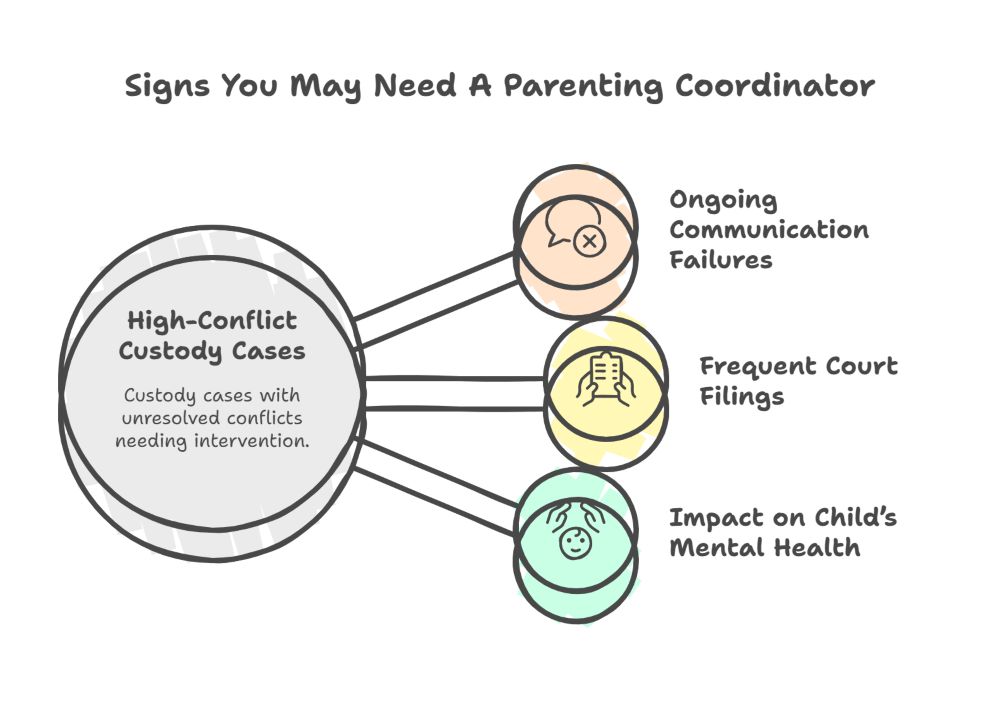
High-conflict custody cases often involve problems that courts alone cannot solve.

These issues can disrupt communication, waste time on legal battles, and have a serious effect on a child’s mental health.

Ongoing Communication Failures Between Co-Parents

When parents struggle to talk and cooperate, the effect can be harmful for both the adults and the child.

In Illinois, parenting plans rely on strong communication, but some parents find themselves stuck in arguments over drop-off times, school events, or schedule changes.

Emails and texts are often misunderstood or ignored. Meetings usually end in disputes or without a clear resolution.

This makes joint custody almost impossible to carry out smoothly. A parenting coordinator steps in as a neutral third party to help parents talk through disagreements about their child.

Coordinators guide conversations and keep things focused on what is best for the child, helping families manage and resolve ongoing parenting plans and communication breakdowns.

This approach offers genuine high-conflict parenting assistance in Illinois without necessitating a return to court for every disagreement.

Frequent Court Filings Over Minor Parenting Issues

Sometimes, parents file motions in court regarding minor issues, such as bedtime, activity choices, or vacation plans.

These filings can cause stress, increase legal costs, and delay solutions for families in high-conflict custody cases.

Judges may not have time to handle each minor dispute. Instead, repeated court cases can further harm trust and communication.

A parenting coordinator can help resolve these minor issues outside of court with less expense and delay.

By making decisions or guiding parents through solutions, coordinators lower the number of court filings and help enforce child custody dispute agreements.

This keeps focus on the child and avoids the negative cycle of court battles over parenting plans.

Impact On The Child’s Mental Health And Stability

Constant conflict between parents is one of the main risks to a child’s well-being during custody battles.

Children who witness arguments or feel caught in the middle may suffer stress, anxiety, and problems at school or home.

They might become worried about exchanges between parents or feel pressure to pick sides.

When fighting drags on, a child can lose their sense of security and find it hard to build a healthy relationship with both parents.

Working with a parenting coordinator can shield children from exposure to adult disagreements and encourage more stable routines.

By supporting healthy and meaningful parent-child relationships, parenting coordinators put the focus back on the child’s needs, offering a practical solution for high-conflict parenting help in Illinois.

If custody battles persist, Cooper Trachtenberg Law Group can help you explore parenting coordination to mitigate the conflict. Contact us for a confidential review of your situation.

If you’re ready to get started, call us now!

How Parenting Coordinators Work With Families

Parenting coordinators play a crucial role in helping families navigate and manage custody conflicts.

They help parents work through disagreements, keep children’s needs as the main focus, and often resolve issues that might otherwise end up back in court.

Scope Of Authority In Illinois Parenting Coordination

In Illinois, parenting coordinators have clearly defined authority, as established by the court order or agreement between the parties.

They do not replace the judge, but can assist with day-to-day decisions regarding the parenting plan, exchanges, and schedules.

Parenting coordinators work to resolve disputes over simple matters, such as pickup times or school events.

They also help when parents disagree about school choices, health care needs, and extracurricular activities.

Their role can include monitoring compliance with court orders or making recommendations.

Sometimes, they may have limited power to decide certain issues, but the court remains in control of major decisions and legal custody.

In the Chicago area, parenting coordination services often focus on supporting the parents in working together without needing repeated court intervention.

Neutrality And Accountability

A parenting coordinator must remain neutral, meaning they do not take sides, favor one parent, or act as an advocate for either party.

Their main goal is to support the best interests of the children while holding both parents accountable to the parenting plan and court orders.

Parenting coordinators document each step of the process, keeping records of all interactions, recommendations, and agreements.

They can also report concerns to the court, especially if one parent consistently fails to follow recommendations or court orders.

This ensures that both parents meet their responsibilities.

In some cases, the coordinator may be involved in supervised visitation or suggest safeguards if there are safety concerns.

Their role is to create a fair process and help prevent new or ongoing conflicts from affecting the children.

Communication Protocols And Decision-Making

Parenting coordinators create clear systems for communication between parents.

This can include setting up regular meetings, using email or online tools, and defining how parents must notify each other about schedule changes.

They may draft rules for how parents communicate, especially if there is a history of high-conflict exchanges.

This support helps parents stay focused on the children rather than reliving past disputes.

When parents cannot agree, the coordinator steps in to make recommendations or facilitate compromise.

In some instances, and if permitted by court order, the parenting coordinator might decide on issues such as minor schedule changes, which helps avoid another court appearance.

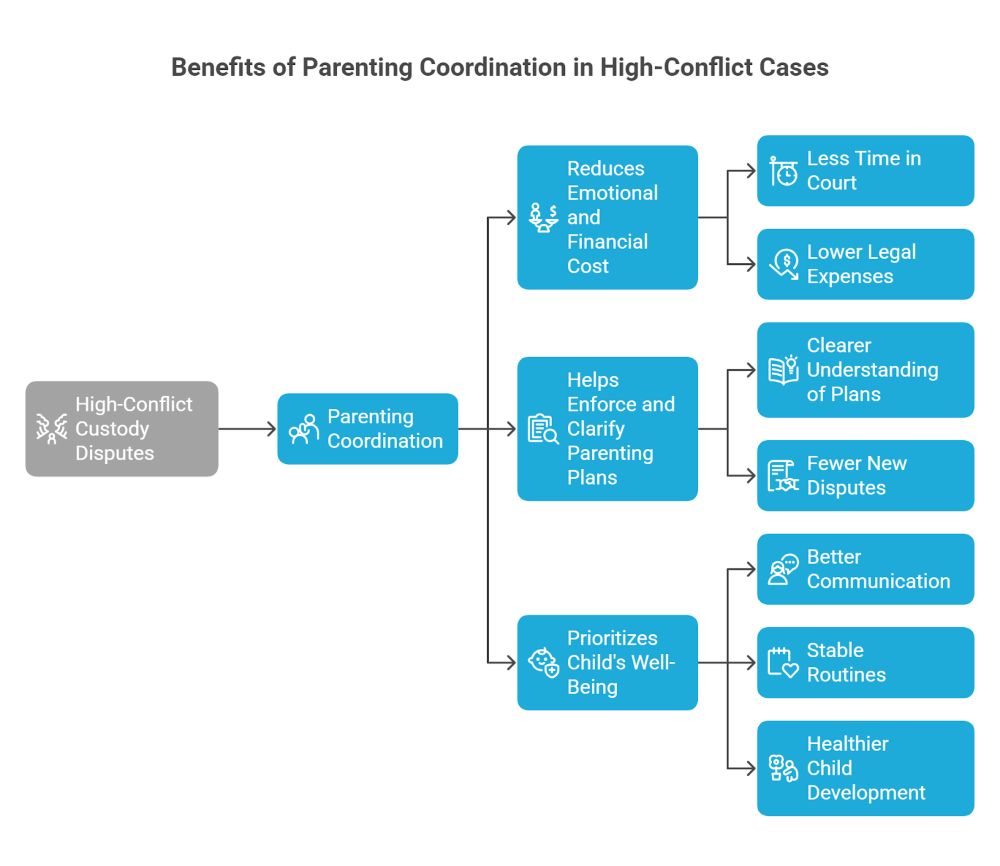
Benefits Of Parenting Coordination In High-Conflict Cases

Parenting coordination provides tangible, measurable benefits to families navigating ongoing conflict during custody disputes in Illinois.

It addresses emotional stress, repeated arguments, and confusion over court orders that often impact both parents and children.

Reduces The Emotional And Financial Cost Of Litigation

High-conflict custody disputes often result in repeated courtroom appearances and substantial legal fees. Attorneys’ fees, court costs, and time away from work can quickly add up, creating a significant financial burden.

Parenting coordinators step in as a neutral third party to help parents resolve disputes outside of court. With their help, parents spend less time in front of a judge and more time reaching solutions in real life.

This approach can save families thousands of dollars in legal expenses.

Emotionally, families also see relief. The stress and anxiety of ongoing court battles decrease when parents have a professional guiding their communication and helping to settle disagreements.

According to the High Conflict Institute, this process helps lower overall tension for everyone involved.

Helps Enforce And Clarify Parenting Plans

Parenting plans are often detailed, but disagreements still arise regarding schedules, holidays, or decision-making. Parenting coordinators help interpret and enforce these plans when parents are unable to agree.

They can answer questions about the meaning of specific terms or help modify arrangements when needed. If one parent does not follow the plan, the coordinator helps address the problem quickly without a return to court.

Families find it much easier to adhere to the agreement, thereby reducing the likelihood of new disputes. 

Prioritizes The Child’s Well-Being

High-conflict environments can be damaging for children, leading to stress, anxiety, and behavioral issues. Parenting coordinators always keep the child’s best interests as their main concern.

They work with both parents to encourage better communication, reduce arguments in front of the children, and maintain stable routines. By acting as a buffer during heated moments, coordinators help create a more peaceful environment for the kids.

Children benefit from consistent schedules and calmer parents, which supports healthier emotional and social development. 

The Association of Family and Conciliation Courts further helps explain how this focus protects children from ongoing conflict.

Tired of court dates over simple parenting issues? Cooper Trachtenberg Law Group offers parenting coordination services that help restore structure to high-conflict custody cases. Schedule a strategy session today.

If you’re ready to get started, call us now!

Parenting Coordination Vs. Other Family Law Roles

In high-conflict custody cases, various professionals have distinct responsibilities. Understanding what each role does helps parents know who can best support their family’s needs.

Parenting Coordinator Vs. Mediator

A parenting coordinator works with parents who have ongoing, heated disputes about their children. Their job is usually long-term and continues after a court order or agreement is in place.

They focus on reducing conflict, helping parents stick to parenting plans, and making recommendations if parents cannot agree.

A mediator, on the other hand, is a neutral third party who helps parents reach an agreement before any order is made. Mediation is usually voluntary and short-term.

The mediator does not have the power to monitor families or make recommendations to the court. 

In short, a parenting coordinator is often appointed by the court to manage and follow up on families with high conflict, while a mediator helps parents reach an original agreement.

Parenting Coordinator Vs. Guardian ad Litem (GAL)

A guardian ad litem (GAL) is a court-appointed person, often an attorney, who represents the best interests of the child in custody cases. The GAL investigates and makes recommendations to the judge about what custody situation will work best for the child.

They may interview the parents, children, and others, then submit a detailed report to the court. A parenting coordinator does not act as the child’s legal representative.

Instead, their primary role is to work with parents on day-to-day parenting disputes, assist with communication, and support the implementation of the parenting plan. 

While both roles aim to protect children, the GAL serves as the child’s voice in court, and the parenting coordinator helps manage ongoing conflict outside the courtroom.

When Both Roles May Be Necessary

There are some high-conflict cases where a judge may assign both a guardian ad litem (GAL) and a parenting coordinator. This usually occurs when there are serious concerns about the child’s well-being or if past recommendations haven’t resolved the conflict.

The GAL focuses on investigating and voicing the child’s best interests in court. The parenting coordinator steps in to help the parents manage day-to-day issues after a custody order is in place.

These professionals work separately but can both be important when parents can’t resolve disputes, and the child’s safety or mental health is at risk.

How To Request A Parenting Coordinator In Illinois

Courts in Illinois may appoint a parenting coordinator when parents are unable to communicate effectively or implement a parenting schedule

Knowing how to request one, what information to provide, and how costs work makes the process easier.

Filing A Motion For Appointment

Anyone involved in a custody or parenting dispute can request a parenting coordinator by filing a motion with the court. 

Typically, a parent’s attorney files this paperwork with the court; however, parents can also file it themselves if they don’t have a lawyer.

The form must be submitted in the county circuit court where the parenting case is ongoing. If both parents agree, they can file a joint motion.

If one party disagrees, the judge will determine whether a coordinator is necessary. Situations where parents are not able to work together or follow parenting plans are common reasons judges consider appointing a coordinator.

The judge may set a court date to review the request. It is important to act quickly if communication between parents is not working.

What To Include In Your Request

The motion should include the reason for requesting a parenting coordinator and describe past efforts to resolve issues, such as mediation or counseling. 

Parents should explain the issues they are having, such as disagreements over schedules, exchanges, or decisions regarding the child.

Include details about how often disagreements happen and show why other options have failed. List any court orders or parenting plans already in place.

It helps to mention if a specific parenting coordinator is preferred; however, the judge ultimately decides who is appointed. Clarity and detail are important.

Proof of high-conflict behavior or failed attempts to co-parent will help the court make its decision. Requests should also state what the parents hope to achieve by working with the coordinator.

Choosing The Right Parenting Coordinator For Your Case

It is essential to select a skilled parenting coordinator who can help mitigate conflict and make co-parenting more seamless. 

Factors such as professional experience, proper training, and the coordinator’s approach should guide this choice.

Questions To Ask Before an Appointment

Before choosing a parenting coordinator, parents should inquire about the professional’s background, education, and specific training in parenting coordination in Illinois. 

Many qualified coordinators have a background in law or mental health, along with experience in high-conflict family law cases.

Asking how the coordinator handles disagreements or difficult situations will reveal their conflict resolution skills and decision-making process. It’s helpful to know whether the coordinator has been court-appointed or chosen by private agreement in past cases.

Parents should also ask about availability, methods of communication, and any fees or payment schedules. 

Understanding how the coordinator helps parents follow, change, or enforce parenting plans can indicate whether their process aligns with the family’s needs.

Key questions to consider:

  • What experience do you have with high-conflict families?
  • Are you certified or trained in parenting coordination specifically?
  • How do you communicate with both parents?
  • What are your fees and billing practices?

Cooper Trachtenberg Law Group’s Approach To Parenting Coordination

Cooper Trachtenberg Law Group uses a structured, hands-on method to parenting coordination. Their team combines family law experience and ongoing education in conflict resolution.

They help parents address disputes quickly outside of court. The child’s best interests are kept at the center of every discussion.

The group works with parents to develop clear communication and practical problem-solving skills. They’re skilled at helping families adapt to changing needs or shift parenting plans as children grow.

Regular meetings and goal-setting are part of their process. This helps ensure that issues are addressed before they escalate.

They stay updated on standards and parenting coordination training in Illinois to maintain a professional and current practice.

Cooper Trachtenberg Law Group supports families in crisis with child-first parenting coordination solutions. Start building a healthier path forward—call now to request a private consultation.

Contact Us Today For An Appointment

    I have read the

    Frequently Asked Questions

    What is parenting coordination in Illinois?

    Parenting coordination is a court-approved process where a trained neutral helps high-conflict parents follow custody orders and resolve parenting disputes outside of court.

    Who pays for a parenting coordinator in Illinois?

    Fees are typically split between parents unless the court assigns one party to cover more, based on income and case factors.

    Can a parenting coordinator make legal decisions on behalf of a child?

    No. Parenting coordinators can suggest solutions and help enforce orders, but cannot change custody arrangements or create new legal orders.

    How is a parenting coordinator appointed?

    A judge may appoint one by court order after either parent files a motion demonstrating ongoing high-conflict issues.

    What’s the difference between a mediator and a parenting coordinator?

    Mediators help parties reach agreements. Parenting coordinators stay involved to monitor compliance and resolve disputes after orders are in place.

    Is parenting coordination confidential?

    Communications may be reported to the court depending on jurisdiction and the terms of the court order. Coordinators often file status updates or recommendations.

    Can I request a specific parenting coordinator?

    Yes. If both parties agree, you may request a coordinator of your choice. Otherwise, the court selects a qualified neutral from an approved list.

    College Funding After Divorce: Protecting Your Child’s Educational Future in Illinois

    College tuition is rising every year, making the prospect of paying for school a significant concern for divorced parents in Illinois.

    Illinois law allows courts to order one or both divorced parents to contribute to their child’s college expenses, so protecting your child’s future starts with having a clear plan.

    Handling college costs after a divorce can be confusing. Taking the right steps now can help avoid problems later.

    Many parents are surprised to learn that, unlike most states, Illinois courts may require parents to share the financial responsibility for college even after divorce.

    This makes it crucial to address college funding during divorce proceedings so that all parties understand their roles and obligations.

    Understanding these rules helps both parents and children avoid costly surprises when it comes time to apply to college.

    Key Takeaways

    • Illinois courts can require divorced parents to contribute to their children’s college expenses.
    • Planning for college costs during divorce helps avoid future conflict.
    • Understanding state law is key to making smart college funding decisions.

    The Cost Of College Today — And Why Planning Matters

    The Cost Of College Today — And Why Planning Matters

    College costs in Illinois have risen faster than the incomes of many families.

    Divorced parents must navigate changing financial responsibilities, making early planning essential to avoid confusion and conflict.

    Illinois Families Face Rising College Expenses

    The average yearly cost for tuition, fees, and living expenses at public universities in Illinois is now more than $30,000. Private colleges can cost more than $60,000 per year.

    These figures do not include additional expenses such as textbooks, transportation, and health insurance.

    According to recent analysis, the average annual college tuition in the U.S. is approaching $40,000.

    This trend puts growing pressure on Illinois families who may already be coping with higher living costs or stagnant wages.

    Planning how to pay for college is important because scholarships, grants, and financial aid are not guaranteed to be available.

    Families who save early or set clear expectations are often able to provide more support for their children’s education.

    Divorce Often Disrupts Education Funding Plans

    Divorce can leave parents uncertain about who will pay for college, which can impact their savings plans and their eligibility for financial aid.

    When parents separate, agreements regarding the payment of higher education expenses may not be in place or may be unclear.

    A separation often means assets are split and incomes change.

    This shift can reduce the funds saved for college and may leave children uncertain about their future.

    Without a clear divorce agreement, conflicts can arise over who pays which expenses or how much each parent is expected to contribute.

    Legal professionals suggest that good divorce agreements should set guidelines for college funding, including details on how costs are divided and whether both parents must approve college choices.

    This can help minimize stress and protect the child’s educational future.

    What Illinois Law Says About Paying For College After Divorce

    Illinois law outlines how college costs are divided when parents divorce.

    Courts can order parents to contribute to a child’s higher education, and the rules governing these contributions are established by state law.

    750 ILCS 5/513: Post-Secondary Education Expenses

    Under 750 ILCS 5/513, both parents may be required to contribute to post-secondary education support in Illinois.

    This means the court can order either or both parents to pay part or all of college expenses, even if the child is over 18.

    Covered expenses often include tuition, fees, housing, books, and sometimes transportation and healthcare.

    The law also sets a limit, so parents usually do not have to pay more than the cost of in-state tuition at the University of Illinois.

    Payments can be made directly to the school, to either parent, or the child for reasonable expenses.

    Courts decide the division based on each family’s unique situation.

    Factors Illinois Judges Consider

    Judges consider several factors when determining who pays for college after divorce in Illinois.

    Important things they consider include:

    • Both parents’ incomes and financial resources
    • The child’s financial resources, including savings and scholarships
    • The standard of living the child would have had if the parents were together
    • The academic performance and goals of the child

    A parent’s ability to pay is a major focus. The court ensures that the obligation does not create an unfair hardship for either parent.

    Judges may adjust the order if either parent’s financial situation changes or if the child’s educational plans change.

    Who Qualifies Under The Law

    The law covers children who are seeking post-secondary education support in Illinois.

    Eligibility depends on:

    • The child’s age (usually younger than 23, but up to 25 if there are good reasons)
    • Continuous academic enrollment and progress
    • Genuine educational need, such as pursuing an undergraduate degree or vocational training

    A child must generally remain a full-time student in good academic standing to keep receiving support.

    Courts rarely order support for graduate studies, focusing instead on undergraduate or professional programs.

    Both biological and adopted children may qualify under 750 ILCS 5/513, provided the court finds the request to be fair and necessary.

    College doesn’t pay for itself, especially after divorce. Cooper Trachtenberg Law Group helps Illinois parents lock in funding plans during settlement. Contact us today to secure your child’s future.

    If you’re ready to get started, call us now!

    Why Including College Costs In Your Divorce Decree Is Critical

    Why Including College Costs In Your Divorce Decree Is Critical

    In Illinois, divorced parents are not always legally required to pay for their child’s college expenses.

    Making college funding terms clear in the divorce decree helps families avoid confusion about who pays, how much, and what qualifies as an expense.

    Preventing Future Legal Battles

    Spelling out college cost responsibilities in the divorce settlement can help both parents prevent arguments years later.

    If details about tuition, books, housing, or other fees are not included in the Illinois divorce decree, one parent may refuse to help pay.

    This leaves the other parent—or the child—taking on all the expenses.

    Without clear terms, parents may need to return to court if a dispute arises.

    This can cause stress for the entire family and may force the child to delay or change their college plans.

    Including a college funding clause helps set clear expectations, so both sides know what to plan for financially.

    What To Include In A College Funding Clause

    A strong college cost clause in an Illinois divorce decree should be clear and specific.

    It usually covers:

    • How much each parent will pay (percent or dollar amount)
    • What expenses count (tuition, books, room, board, application fees, transportation)
    • When and how payments are made
    • Limits on types of schools (public vs. private, in-state vs. out-of-state)
    • Academic expectations, such as minimum grades required

    Itemizing these details helps avoid confusion later.

    Parents can also agree to review costs each year or set a cap based on current state university tuition rates.

    This makes it easier to adjust as college prices go up.

    The law gives Illinois courts the power to order parents to help with these expenses if it was agreed upon in the original Illinois divorce decree, including college tuition.

    Use Of 529 Plans Or Trusts

    Parents often use a Bright Start 529 account after their divorce in Illinois to save for college with tax benefits.

    Including a 529 plan in the divorce tuition clause can help ensure money is set aside and used only for the child’s education.

    A divorce settlement college cost agreement may name who will manage and contribute to the account.

    It can restrict withdrawals to only pay for approved college costs.

    Alternatively, some parents choose to set up an educational trust for similar protection.

    Clearly outlining the use of 529 plans or trusts in the divorce decree can create security and avoid conflicts over how the funds are handled.

    Setting up and agreeing on these plans early can make paying for college smoother for divorced families.

    It can also help streamline the college cost parenting plan in Illinois.

    Understanding FAFSA Rules For Divorced Parents

    When parents in Illinois divorce, applying for college financial aid, such as the FAFSA, can raise unique concerns.

    Changing rules may affect which parents’ finances are considered, how much aid a student receives, and how this process compares to other forms, such as the CSS Profile.

    FAFSA Custodial Parent Definition

    As of the 2024-2025 school year, the FAFSA now considers the parent who provided the most financial support in the past year, rather than just the parent with whom the student lived.

    This change is particularly important for Illinois families navigating divorce and the FAFSA rules for divorced parents.

    Legal custody is not the deciding factor in determining custody. Instead, what counts is the support provided.

    If support is equal, then the parent with the higher income must complete the form.

    This updated rule applies even if the legal custody arrangement is 50/50 split of expenses.

    Here’s a quick look:

    Old RuleNew Rule
    Lived with most in the last 12 monthsProvided most financial support in the previous 12 months

    For parents sharing expenses or switching custody, keeping careful records is important.

    How Divorce Can Improve Or Complicate Aid

    Divorce can sometimes improve financial aid chances if only one parent’s income and assets are counted. 

    If the parent providing the most support has a lower income than the other parent, the expected family contribution may be lower, resulting in a higher level of financial aid.

    However, divorce can complicate applications when support, custody, or income changes after separation. 

    For example, if parents split after taxes are filed, families must still use tax information from the previous year. They may need to notify colleges about any recent changes to their financial situation.

    Colleges may require additional paperwork and offer assistance in documenting changes. 

    Families should keep track of who pays for what during the year and communicate with financial aid offices if the household’s financial picture changes.

    FAFSA vs. CSS Profile Differences

    The FAFSA and CSS Profile treat divorced parents differently. The FAFSA only requests information from the parent who provides the most financial support.

    The other parent’s income is not reported unless the parent has remarried, in which case a stepparent’s information may be required. The CSS Profile, used by some private schools, often requires information from both biological parents.

    Even if a parent does not have legal custody or is not involved, their financial details may still be needed.

    Here’s a comparison:

    FormParent Info Needed
    FAFSAParent giving most support (plus spouse, if remarried)
    CSS ProfileUsually, both biological/legal parents (sometimes stepparents too)

    Families applying to colleges that use both forms should plan for these differences. Be prepared to provide more detailed financial information for the CSS Profile. 

    What Happens When A Parent Refuses To Contribute

    In Illinois, divorced parents may be required by court order to contribute to their child’s college expenses. 

    When one parent refuses to pay, legal steps can be taken to enforce these obligations and ensure the child’s educational needs are supported.

    Enforcing College Support Through The Courts

    In Illinois, a parent can request that the court order the other parent to make college expense contributions if they refuse to pay voluntarily. 

    This often occurs when a disagreement arises after the child turns 18, as child support for college is separate from standard child support.

    The law allows the court to order parents to share the costs of college, including tuition, housing, books, and other related expenses. 

    These costs typically have a cap at the amount charged by the University of Illinois at Urbana-Champaign, unless the court determines there is a compelling reason to exceed this amount.

    If a parent does not follow the court order, the other parent or the child may request enforcement by filing a motion in court. The judge may then issue consequences for non-payment and set up a payment schedule.

    Common Enforcement Challenges

    Enforcing college contributions can be difficult for several reasons. Sometimes, the parent refuses to pay claims because they cannot afford it or disputes what costs are “reasonable.”

    In some situations, communication breaks down, making it hard to agree, or the parent simply ignores the court order. 

    Another challenge is determining which expenses qualify under Illinois law, particularly for items such as travel or personal expenses.

    If the child’s grades fall below a “C” average, or if they get married, get a full-time job, or turn a certain age (often 23), the obligation to pay may end, complicating enforcement. Parents may also struggle to gather documentation or find legal help.

    Legal Remedies In Illinois

    Illinois courts offer several options for addressing non-payment. Judges may garnish wages, intercept tax refunds, or place liens on property to collect overdue support for college costs.

    In certain situations, the court may add interest to unpaid amounts to encourage payment. If the refusal continues, a judge can hold the parent in contempt of court.

    This means they could face fines or even jail time for failing to comply with the court’s order. The court may also require the parent to provide regular financial updates to track their ability to pay.

    Unsure how to divide tuition costs after divorce? Cooper Trachtenberg Law Group crafts enforceable education clauses that protect your child and prevent future courtroom battles. Schedule your private consultation today.

    If you’re ready to get started, call us now!

    Common Mistakes Illinois Parents Make When Planning For College Post-Divorce

    Common Mistakes Illinois Parents Make When Planning For College Post-Divorce

    Many Illinois parents face unique challenges when planning for their child’s college expenses after a divorce. Careful planning and informed decisions are important to avoid financial stress and future disputes.

    Leaving College Costs Out Of The Agreement

    One major mistake is not including college funding in the divorce agreement or parenting plan. If details about tuition, housing, and other college expenses are left out, this can lead to misunderstandings between parents.

    Without a clear agreement, it is not always obvious who will pay what part of the costs or which expenses are even covered. This can delay payments and impact the child’s ability to register for classes or secure suitable housing.

    Illinois law allows courts to order parents to pay for college expenses, but leaving these issues out of the settlement can force families back to court. 

    Failing To Plan For Inflation Or Out-of-State Costs

    Some parents do not account for the fact that tuition and living expenses often rise every year. If a divorce settlement only considers the current costs, parents may be caught off guard when prices increase.

    Another frequent problem is overlooking out-of-state or private college tuition. These schools can charge much higher rates than public in-state schools, and the difference can be thousands of dollars each year.

    To avoid surprises, it is smart to include language about how to handle increased costs and to set limits or guidelines for the types of schools a child can attend. 

    Consider using a divorce college savings plan, such as a 529 account, which grows over time and helps manage rising educational expenses.

    Not Coordinating With A Family Law Attorney

    Attempting to resolve college funding issues without professional assistance can lead to mistakes. Family law attorneys are familiar with the specific rules in Illinois, including 750 ILCS 5/513.

    An experienced lawyer can help parents understand their rights and what a court might order for college costs. Attorneys can also draft clear legal agreements that cover future changes, such as tuition increases or modifications to custody or income arrangements. Working with a family law attorney can prevent heated arguments, court hearings, and missed deadlines.

    Legal guidance helps both parents and children maximize the benefits of available college resources, ensuring that each party understands their respective obligations. 

    How Cooper Trachtenberg Law Group Helps Protect College Plans

    Families facing divorce in Illinois often worry about how to protect their children’s college savings. 

    Cooper Trachtenberg Law Group leverages its legal experience to assist parents in establishing clear college funding arrangements while addressing education costs during the divorce process.

    Structuring Legally Enforceable Education Provisions

    Cooper Trachtenberg Law Group assists parents in incorporating college expense agreements into their divorce settlements. They use Section 513 of the Illinois Marriage and Dissolution of Marriage Act.

    This law allows courts to order payments for a child’s college tuition, housing, books, and other expenses until the child completes their undergraduate degree. The attorneys at Cooper Trachtenberg Law Group use plain language to ensure that families understand their rights and responsibilities.

    Provisions often outline who pays for tuition, what type of school qualifies, and how expenses are divided. By clearly outlining costs, deadlines, and payment methods, families avoid future disputes.

    Documents are drafted to be enforceable by Illinois courts. This means both parents are held responsible if one fails to pay for their share of educational expenses.

    Such planning can ensure steady funding for a child’s college education without confusion after divorce.

    Addressing Education Planning In Mediation Or Litigation

    Cooper Trachtenberg Law Group assists parents in discussing college funding during mediation, where reaching an agreement is often less stressful and less expensive.

    Mediation enables both parents to express their concerns and make decisions together, resulting in customized solutions for their child’s future.

    If mediation is not possible, they represent clients in court. Judges can determine specific details about dividing costs, using state guidelines and the child’s needs.

    The goal is to protect education funds and ensure that parents adhere to the agreed-upon terms, even in the event of future disagreements. These lawyers also work to safeguard unique assets, such as 529 college savings plans.

    With careful legal guidance, they can protect your child’s college fund during a divorce case and ensure funds are not used for other purposes.

    Long-Term Focus On Your Child’s Academic Future

    Cooper Trachtenberg Law Group takes a long-term view when helping clients. They plan for future education expenses, not just immediate costs.

    Agreements can be tailored to cover four or more years of schooling, including tuition, books, and housing. This flexibility applies even if a child’s plans change.

    If circumstances change, such as a parent’s job loss or a significant increase in college costs, the firm can help update the court orders or settlement terms.

    The firm pays close attention to the details that matter for children’s academic success. 

    From specifying payment methods to ensuring continued access to college funds, their support is vital for protecting education funds after divorce in Illinois.

    Don’t leave college funding to chance. Cooper Trachtenberg Law Group builds divorce agreements that safeguard your child’s academic goals. Contact us now to schedule your personalized education strategy session.

    Contact Us Today For An Appointment

      I have read the

      Frequently Asked Questions 

      Can Illinois courts require divorced parents to pay for college?

      Yes. Under 750 ILCS 5/513, Illinois courts may require one or both divorced parents to contribute to their child’s post-secondary education expenses, including tuition, housing, books, and medical insurance.

      What are considered “reasonable college expenses” under Illinois law?

      Reasonable expenses typically include tuition, room and board, textbooks, and fees, up to the cost of attending the University of Illinois as an in-state student.

      Does child support cover college tuition in Illinois?

      No. Standard child support usually ends at age 18 or high school graduation. College costs must be addressed separately in the divorce decree or through 750 ILCS 5/513.

      Who fills out the FAFSA if the parents are divorced?

      The FAFSA must be completed by the custodial parent—the one with whom the student lived the most in the past 12 months, not necessarily the parent who claims the child on taxes.

      What happens if one parent refuses to pay for college?

      If college costs were included in a court order or divorce decree, you can file a motion to enforce the agreement. Courts may order wage garnishment or contempt penalties for nonpayment.

      Can parents negotiate college contributions privately in a divorce?

      Yes, and it’s highly recommended. A written agreement outlining each parent’s obligations is legally enforceable and prevents future disputes.

      Can 529 college savings plans be divided in a divorce?

      Yes. The divorce decree should specify ownership, control of withdrawals, and how future contributions will be handled to prevent misuse or loss of funds.

      Protecting Your Children: Establishing Safe Parenting Time with a Substance-Abusing Co-Parent

      Watching your child interact with a co-parent who struggles with substance abuse can be stressful and scary. 

      You do have steps you can take to keep your child safe and make sure they’re okay during parenting time, even if the other parent has substance issues.

      Knowing your rights and options helps you make the best choices for your family. It’s not always easy, but there are ways forward.

      If you understand how addiction impacts children and what legal protections exist, you’re better equipped to build a safer environment. 

      This article walks you through planning safe parenting time, documenting concerns, and working with the court if changes are needed.

      Key Takeaways

      • Substance abuse can affect parenting and your child’s safety.
      • Legal steps and careful planning help protect your child.
      • Courts can modify custody when a child’s safety is at risk.

      Understanding the Impact of Parental Substance Abuse on Children

      When a parent struggles with substance abuse, their children’s health, safety, and development often suffer. The situation affects emotions, daily life, custody rights, and legal decisions.

      More than 7.5 million children in the U.S. live with a parent who has an alcohol use disorder.” – National Institute on Alcohol Abuse and Alcoholism (NIAAA)

      Emotional and Developmental Risks

      Kids exposed to parental substance abuse face higher risks for emotional and behavioral problems. 

      They might feel anxious, scared, or insecure because of inconsistent parenting or unpredictable routines.

      Some children withdraw, while others overachieve or try hard to please adults as a way to cope. Academic performance can drop, and attention or cognitive problems may increase.

      Sometimes, neglect or even abuse happens when substance use leads to chaos at home. Healthy attachments become tough to form, and trust or self-esteem issues can crop up.

      Kids living with a parent who uses drugs or alcohol often have unmet needs. Even when parents mean well, proper care can slip through the cracks.

      It’s important to recognize risk factors and watch for warning signs. 

      Legal Definitions and Standards

      Family law focuses on protecting children’s best interests in substance abuse cases. Courts treat substance abuse as a serious concern during child custody hearings.

      If there’s evidence of drug or alcohol abuse, judges may set limits on parenting time or require supervised visits. Legal definitions depend on documented patterns, like failed drug tests, criminal charges, or reports from teachers and family members.

      Judges can order treatment, request regular drug screens, or appoint a guardian ad litem to advocate for your child. Custody arrangements usually prioritize safety, stability, and proper care.

      Both parents have legal rights, but the child’s well-being comes first. For more details, see parental substance misuse guidelines and family law custody substance abuse standards.

      Worried your co-parent’s substance use is putting your child at risk? Start a legal safety plan today with Cooper Trachtenberg Law Group’s emergency custody services.

      If you’re ready to get started, call us now!

      Legal Protections Available for the Sober Parent

      Legal Protections Available for the Sober Parent

      If your child’s safety is at risk because of a co-parent’s substance abuse, you have legal steps you can take. 

      These include asking the court for immediate custody changes and requesting regular checks for your child’s protection.

      Emergency Orders and Temporary Custody

      If your ex is using drugs and you think your child is in danger, you can ask the court for an emergency custody order due to drug use. This order temporarily changes custody in urgent situations.

      Courts move quickly in these cases, especially if there’s proof of substance abuse or danger. You might need police reports, text messages, or witness statements that show the risk.

      Judges review this evidence before granting an emergency order. Often, you’ll get temporary sole custody until a hearing happens, and the other parent’s visitation may be supervised or stopped for now.

      Getting sole custody because of a co-parent’s drug use can also involve longer court processes. The court needs proof that the other parent’s substance abuse harms your child’s safety, health, or well-being.

      Drug Testing and Monitoring Requests

      You can ask the court to require your co-parent to take a court-ordered drug test as part of your custody case. This is common if there’s a pattern of substance abuse or strong reasons to believe your ex is using drugs.

      Courts may order random or regular drug tests. If the parent fails or refuses, their parenting time can be limited or supervised.

      Keeping detailed records of missed visits, unsafe behavior, or suspected drug use helps your case. Sometimes, monitoring includes supervised visits or requiring your co-parent to attend treatment programs.

      The main goal is a plan that keeps your child safe and, if possible, supports both parents’ roles. 

      Creating a Safe Parenting Time Plan

      If you’re parenting with a substance-abusing ex, you have tools to help protect your child and build a safer schedule. Understanding your options and using legal support really can make a difference.

      Supervised Visitation Options

      Supervised visitation means a responsible adult or professional stays present during your ex’s parenting time with your child. Courts often order this when there are concerns about drug or alcohol use.

      Supervised visits might happen at special visitation centers, or a family member or neutral third party might supervise. The main goal is to keep your child safe while allowing contact with the parent.

      Parents usually follow strict rules about time, location, and who’s allowed to be there. Here are some common rules for supervised visitation:

      • Visits only at specific times and places
      • No use of drugs or alcohol before or during visits
      • Supervision by a trained monitor or trusted family member
      • Immediate reporting of any dangerous behavior

      These restrictions help keep your child safe. Courts may update the plan if things change based on your ex’s progress or ongoing concerns.

      Using Parenting Coordinators or Guardian Ad Litems

      A parenting coordinator is a trained professional who helps you and your ex stick to the parenting plan. They can step in if parents argue or can’t agree, focusing on what’s best for your child.

      Parenting coordinators keep records and can report to the court, making sure both parents follow the rules. 

      A guardian ad litem (GAL) is a special advocate appointed by the court for your child, especially in substance abuse cases.

      The GAL talks to your child, each parent, and sometimes teachers or doctors to determine what’s happening. Then, the GAL gives the court a report with recommendations for safe parenting time.

      Key tasks a GAL may handle in drug or alcohol cases:

      • Investigate the home situation
      • Interview your child about their feelings and fears
      • Check if the parent is following the substance use orders

      Having a GAL or parenting coordinator means someone neutral is watching out for your child’s well-being. Honestly, that can give you more peace of mind during the process.

      Don’t wait for things to escalate. Request supervised visitation or parenting restrictions now—Cooper Trachtenberg Law Group is here to help you act quickly and legally.

      If you’re ready to get started, call us now!

      Documenting Substance Abuse and Unsafe Behavior

      Recording incidents and using the right tools can help you protect your children and provide clear evidence if courts get involved. Detailed records give judges a better picture of your child’s situation.

      What Types of Evidence Are Most Useful

      If you’re dealing with a substance-abusing co-parent, keeping thorough and factual records matters. Some of the most useful evidence includes:

      • Text messages or emails where your co-parent admits to drug or alcohol use.
      • Photos or videos showing unsafe conditions during visits.
      • Witness statements from friends, family, or neighbors who have seen the behavior.
      • Police reports that document any substance-related calls or visits to the home.
      • Failed drug tests or positive screening results, especially if court-ordered.

      This evidence can show risky patterns and support your claims during a child custody battle involving drug testing. Presenting organized, clear proof helps more in the family court than vague concerns.

      Always keep records dated and detailed. Avoid exaggerating or guessing—share only the facts.

      Tools for Ongoing Documentation

      Simple tools can make tracking substance abuse and unsafe behavior easier. Many parents keep a daily journal to log incidents, including dates, times, and what happened.

      Apps or digital calendars work for quick, time-stamped entries. If needed, you can use a Soberlink device or other monitoring tools to check a co-parent’s sobriety before visits.

      Sometimes, the court orders regular drug or alcohol testing to help prove drug use in family court. Save all documentation in a safe place and back up digital files.

      Organizing things makes it easier to share info with your lawyer or the court.

      Working with the Court to Modify Parenting Agreements

      If your child’s safety is at risk due to a co-parent’s substance abuse, you may need legal changes to your parenting plan. 

      The court process for custody modification because of substance abuse can feel overwhelming, but sticking with the facts and taking clear steps does matter.

      Filing for Modification

      If you think your child isn’t safe, you can ask the court to change your custody or visitation agreement. This process is called a “petition for modification.”

      Gather any proof of substance abuse, like police reports, medical records, or messages that show the problem. You’ll want to collect as much clear evidence as you can get your hands on.

      File your request in the same court that created your original parenting plan. You must fill out forms and explain why your child’s safety is at risk.

      Courts dealing with addiction cases look for strong evidence. If a child is harmed, they might move things along faster than usual.

      If you want practical advice on safe, court-approved parenting time, check out this guide on parenting with an addicted co-parent

      Working with a family law attorney can make things smoother, but you can file on your own if necessary.

      What Judges Consider

      Judges focus on your child’s best interests when there’s a request to change custody because of substance abuse. 

      They look at the type and length of the addiction, recent relapses, and how the parents’ actions affect the child.

      The court reviews evidence such as drug tests and testimonials from teachers or counselors. Judges also want to determine whether the parent is willing to get help.

      Sometimes, the judge orders supervised parenting time or sets treatment conditions to keep your child safe. Sometimes, the court can make temporary changes while the case is ongoing.

      Your child’s physical and emotional well-being always comes first. 

      When Co-Parents Enter Recovery: Can Custody Be Rebuilt?

      Regaining child custody after addiction is possible, but you’ll need to show you’re taking real steps toward recovery. Courts want solid proof that your home is safe and stable for your child.

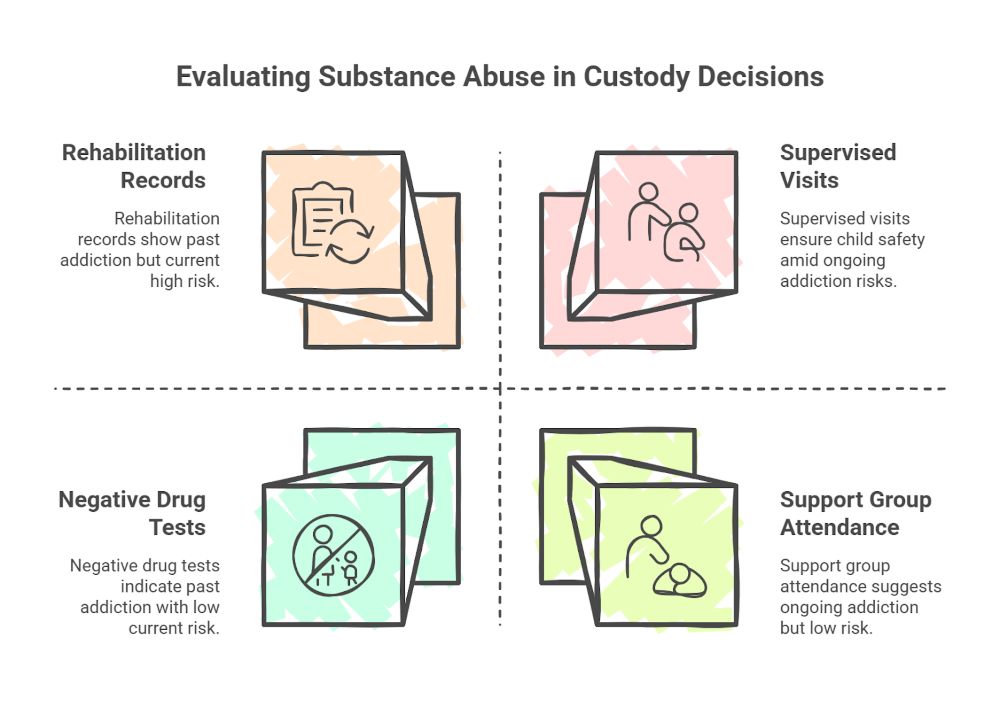
      Evidence of Recovery Courts Look For

      If you or your co-parent is trying to rebuild custody rights after substance abuse, the court expects steady progress. You’ll need reliable evidence of recovery, like:

      • Proof you finished a rehab or treatment program
      • Recent negative drug or alcohol tests
      • Consistent attendance at support groups like AA or NA
      • Letters or reports from counselors, therapists, or treatment providers
      • Stable employment or regular school attendance
      • Safe housing and a support network

      Court officials also consider whether you follow visitation rules and meet other requirements. Keeping records and support letters helps a lot.

      Being honest with the court and your co-parent can build trust, even if the process feels awkward. 

      Gradual Reintroduction Plans

      Regaining custody doesn’t happen overnight. Courts usually lean toward a step-by-step plan to protect your child’s well-being.

      Let’s talk about what these gradual reintroduction plans usually involve:

      • Supervised Visitation: Visits might begin with a neutral third party or a professional supervisor in the room.
      • Increased Parenting Time: If you show reliability, the court can allow you to spend more time with your child, sometimes without anyone else present.
      • Therapy or Counseling: You may need to keep attending therapy, sometimes together with your child, sometimes separately.
      • Review Hearings: Courts often schedule regular check-ins to assess the situation and ensure the child’s safety.

      It helps to log every positive step, meeting, and visit along the way. Courts want to see a steady pattern of stability before changing custody arrangements.

      Ready to file for custody modification? Cooper Trachtenberg Law Group can help you build the strongest case for your child’s protection. Take action today.

      Contact Us Today For An Appointment

        I have read the

        Frequently Asked Questions

        Can I get full custody if my co-parent is using drugs?

        Yes. If you can show that your co-parent’s drug use puts your child at risk, the court may grant you full custody or restrict their parenting time through supervised visitation.

        What evidence do I need to prove substance abuse in family court?

        Courts accept documentation like police reports, drug test results, rehab records, and text messages referencing drug use as evidence of a parent’s substance abuse.

        What is supervised visitation, and when is it used?

        Supervised visitation allows a parent to spend time with their child under the watch of a neutral third party when the court believes unsupervised contact may be unsafe.

        How do I file for emergency custody due to substance abuse?

        File a petition in family court requesting an emergency hearing. You must provide proof that the child’s safety is at immediate risk due to the other parent’s substance use.

        Can a parent regain custody after going to rehab?

        Yes. If the parent completes treatment, stays sober, and meets the court’s requirements (e.g., clean drug tests, stable housing), custody can be gradually reinstated.

        Will my child have to testify in a custody case involving substance abuse?

        Rarely. Courts usually avoid involving children directly. A guardian ad litem or custody evaluator may represent your child’s perspective during the proceedings.

        Can drug testing be ordered during a custody case?

        Yes. Family courts often require drug testing when one parent alleges the other is using substances, especially if child safety is a concern.

        Breaking Free: Managing a High-Conflict Divorce Without Sacrificing Your Wellbeing

        Going through a high-conflict divorce can feel overwhelming and isolating. Long battles, false accusations, and constant stress hit both mind and body pretty hard.

        You can manage a high-conflict divorce without losing yourself or your well-being, even when it feels impossible.

        Staying grounded, setting clear boundaries, and picking the right support can change the outcome. 

        People who protect their interests, seek help from helpful professionals, and focus on what they can control usually emerge stronger. 

        Knowing there are strategies to avoid manipulation and protect your rights matters for anyone in this situation.

        Key Takeaways

        Understanding What Makes A Divorce “High Conflict”

        A high-conflict divorce isn’t just a regular split. It’s usually full of repeated arguments, power struggles, and damaging behaviors that make co-parenting and decision-making impossible.

        Knowing the causes and common traits helps you prepare strategies to protect your mental health.

        Key Traits Of High-Conflict Personalities

        High-conflict personalities tend to show up in these divorces. You’ll often see a lot of blame, defensiveness, and a refusal to take responsibility.

        They repeat angry or dramatic behavior, even over things that seem small or long after the breakup. Refusing to compromise is a big red flag.

        If you’re divorcing a narcissist co-parent, you might notice ongoing manipulation, emotional outbursts, or using the kids as bargaining chips. There might be frequent false accusations or attempts to control the legal process.

        These behaviors make a toxic divorce even tougher. Arguments over parenting time, school choices, or money can drag you into court repeatedly.

        Legal And Emotional Triggers

        Legal and emotional events can quickly trigger conflict. Even simple things, like arranging parenting schedules, sharing documents, or going to meetings, can escalate.

        Money fights, custody battles, or property disputes often lead to threats or endless delays. Emotional triggers, like old resentment or jealousy, can spark sudden arguments or stonewalling.

        The kids usually take the biggest hit. They get stuck in the middle when parents argue or don’t communicate, and feel stressed or confused.

        Creating strong boundaries and planning how to respond to these triggers are crucial parts of surviving a high-conflict divorce.

        Feeling overwhelmed by constant conflict? Contact Cooper Trachtenberg Law Group to discuss your options for high-conflict divorce representation and protect your emotional and legal well-being from day one.

        If you’re ready to get started, call us now!

        Prioritizing Mental And Emotional Wellbeing

        Prioritizing Mental And Emotional Wellbeing

        A high-conflict divorce brings anxiety, mood swings, and daily stress. People often spot new emotional struggles or even physical symptoms, so starting early to protect your mental health matters.

        Recognizing Trauma Responses

        Trauma from a hostile divorce is common. Many people notice panic attacks, trouble sleeping, irritability, or feeling jumpy.

        Others lose interest in things they used to enjoy, feel down for weeks, or worry about daily tasks. These reactions are real and affect both mind and body.

        Common divorce trauma symptoms include:

        • Anxiety or dread before meetings or communications
        • Feeling “on edge” most of the time
        • Nightmares, flashbacks, or memories popping up out of nowhere
        • Social withdrawal or just not caring about things you used to love

        Spotting these reactions early helps you get support sooner. Realizing these feelings are part of a normal stress response can make you less hard on yourself.

        Some tips to stay calm are to take slow breaths, keep a daily routine, and limit contact with a hostile ex as much as possible.

        Therapeutic Support Options

        Therapy gives a safe space to vent and learn coping tools. Seeing a counselor, psychologist, or social worker can help you process anger, sadness, or fear.

        Group therapy and support groups let you hear from others in the same boat. Some people prefer private counseling, while others like the flexibility of online therapy.

        Kids can benefit from specialized child therapists who help them work through tough emotions. Beyond therapy, community classes, divorce support programs, or online resources, support is also available.

        Therapy and regular self-care—like exercise, eating well, and sleeping enough—are important  ways to protect your mental health during divorce.

        Making time for emotional care isn’t selfish—it’s necessary for healing and regaining strength.

        Setting Boundaries To De-Escalate Conflict

        Setting clear boundaries during divorce can lower arguments, reduce stress, and protect your mental health. 

        Strong boundaries also make it easier for parents to put their kids’ needs first, without endless fights with an ex.

        Parallel Parenting Vs. Co-Parenting

        Separated parents usually adopt one of two main approaches: parallel parenting or co-parenting. With parallel parenting, each parent takes care of the child on their own time and keeps contact with the other parent to a minimum.

        This style works best when tough communication helps avoid conflict, while kids see both parents. Co-parenting means more direct cooperation and shared decision-making.

        Parents talk more and try to agree on things like school, healthcare, and routines. This can go well if both parents can keep things civil.

        Choosing between parallel parenting and co-parenting depends on the level of conflict. High-conflict situations usually call for parallel parenting because it’s safer and healthier for everyone.

        For more on why boundaries matter, see these high-conflict divorce tips.

        Parenting StyleBest ForCommunication Level
        Parallel ParentingHigh conflict splitsMinimal
        Co-ParentingLow-conflict splitsFrequent

        Using Tools Like OurFamilyWizard Or TalkingParents

        Apps like OurFamilyWizard and TalkingParents help keep communication short, organized, and less emotional. These tools keep track of all messages, schedules, and important info about the child.

        They let parents avoid face-to-face arguments or angry calls. Written records help clear up misunderstandings and keep things focused on the kids.

        Features like shared calendars and expense logs help organize appointments, school events, and money without extra drama.

        Using third-party apps supports boundaries by encouraging calm, businesslike communication and giving you privacy from personal contact. 

        Working With The Right Legal Team

        The legal choices you make during a high-conflict divorce shape your future. 

        Professionals who know what they’re doing are essential for protecting your rights, lowering stress, and keeping boundaries clear.

        Choosing An Attorney Trained In High-Conflict Dynamics

        Picking the right divorce lawyer for a hostile ex can make a difference. Attorneys trained in high-conflict dynamics handle aggressive behavior, false accusations, and manipulative tactics without getting thrown off.

        They spot legal boundaries quickly and help you avoid common traps. When you’re searching, ask if the attorney has managed similar cases.

        • How have you handled high-conflict exes?
        • Are you comfortable with constant or tense negotiations?
        • What strategies do you use to keep the case focused and documented?

        A skilled lawyer will give legal tips for high-conflict separation, such as cutting unnecessary communication and focusing on evidence. Open communication and good documentation are key.

        An experienced team will also work with therapists or financial experts, creating a full support system. 

        Using Court Orders To Limit Contact

        Sometimes, courts step in with specific court orders to limit contact between parties. These might include restraining orders, temporary custody orders, or detailed rules about how parents must communicate about their kids.

        Such orders help protect people from ongoing harassment and emotional strain. If needed, a lawyer can ask for orders that require all communication to go through written channels or parenting apps.

        This creates a clear record and reduces misinterpretation. Sometimes, a judge will even set rules about where and how drop-offs happen to keep kids out of the conflict.

        If the other party breaks these orders, inform your attorney immediately so the court can intervene. 

        Ongoing custody disputes taking a toll? Schedule a consultation with Cooper Trachtenberg Law Group to explore legal strategies that enforce boundaries and prioritize your child’s safety during divorce.

        If you’re ready to get started, call us now!

        Protecting Your Children During A High-Conflict Divorce

        Protecting Your Children During A High-Conflict Divorce

        Kids often feel torn between parents in high-conflict divorces. Their emotional health and sense of security depend on what adults do to shield them from hostility and support their voice in custody cases.

        Shielding Them From Hostility And Legal Talk

        Kids feel the impact of emotional abuse and custody battles more than most adults realize. It’s so important to keep arguments and legal drama away from them.

        Talk to your children openly, but don’t drag them into blame or use them as messengers in disputes. They don’t need that extra stress on top of everything else.

        A calm home helps children feel safer. Some ways to protect kids in a toxic divorce:

        • Keep legal conversations private
        • Encourage kids to talk about their feelings
        • Reassure them that the divorce isn’t their fault

        Don’t criticize or badmouth the other parent in front of the kids. No child should feel stuck in the middle or forced to pick sides.

        Family counseling can offer a safe space for children to express emotions and manage stress. Sometimes, just having a neutral adult listen makes all the difference.

        Parenting during a messy divorce means putting your child’s needs before your conflicts. Open communication and reassurance help kids process tough changes with less anxiety.

        Guardian Ad Litem And Custody Evaluation Support

        A guardian ad litem (GAL) sometimes steps in during heated custody fights. This neutral professional focuses on what’s best for the child and represents their interests in court.

        The GAL might interview parents, teachers, and the child and observe family dynamics. Their report gives judges a clearer picture of which environment will best support the child’s well-being.

        During a custody evaluation, both sides share information to keep things fair, especially in tricky cases with a manipulative spouse. 

        Working with GALs and following their advice can protect kids from being pulled into emotional battles.

        Parents should cooperate honestly, provide documents, and avoid coaching the child. Support from a GAL can play a big role in protecting a child’s well-being during a high-conflict divorce.

        Managing Your Finances Without Being Exploited

        Protecting your financial well-being during a high-conflict divorce matters. Steps like locking down joint accounts and getting a clear picture of your finances can help prevent financial abuse or exploitation.

        Freezing Joint Credit, Gathering Records

        Move quickly to protect shared accounts. Freezing or closing joint credit cards and lines of credit can prevent a spouse from accruing debt that hurts both parties’ credit scores.

        Let your banks and credit card companies know about the divorce. Many people set up alerts for unusual transactions, a simple step that can save headaches later.

        Gathering full financial records matters just as much. Collect recent bank statements, tax returns, loan docs, pay stubs, and investment account info.

        Keep originals in a safe spot and make digital copies. Review transactions for missing funds or suspicious activity.

        Staying organized is one of the best ways to avoid being taken advantage of and keep control of your money. 

        Forensic Accounting And Asset Protection

        Accurate financial info helps you make better decisions in a divorce. Forensic accountants can be a lifesaver in high-conflict cases or when you suspect financial abuse.

        Forensic accountants dig for hidden accounts, overseas assets, or odd transfers. They analyze spending and give you a clear picture of assets and debts.

        This process can reveal attempts to hide money or cut off access to marital resources. Protecting assets also means changing passwords and alerting financial institutions about the divorce.

        Consider putting any cash settlements or new accounts in your name only. Checking in regularly with a trusted legal or financial advisor helps make sure nothing slips by.

        It’s easy to overlook details when stressed, but good advice can make a huge difference. 

        Long-Term Recovery After The Divorce Is Final

        Healing from a high-conflict divorce is about more than just paperwork. It takes steady effort and self-care to start feeling whole again and figure out how to parent in new ways.

        Rebuilding Identity And Autonomy

        After a high-conflict divorce, it’s not unusual to feel lost or unsure about who you are outside the marriage. Trauma recovery after divorce can bring waves of sadness, anxiety, and doubts about what’s next.

        To reclaim your identity, focus on personal values and goals that may have been pushed aside. Simple routines—journaling, joining a club, picking up old hobbies—can help you build a new self-image.

        Therapists or support groups can help if you’re dealing with deeper pain. Making your own decisions again, even small ones, slowly rebuilds confidence.

        Self-compassion matters a lot—be patient and forgiving with yourself. There’s no rush to “move on.” 

        Co-Parenting From A Distance

        Co-parenting after divorce can be stressful, especially if every conversation with your ex is tense. Clear communication is key, but it helps to keep messages short, focused on the kids, and free from emotional jabs.

        Setting boundaries and using shared calendars or co-parenting apps can reduce misunderstandings. Stable routines stabilize kids when they’re splitting time between two homes.

        Always prioritize the child’s well-being over any disagreements with your ex. A mediator or therapist can support healthier interactions if direct contact is too painful.

        Summary

        High-conflict divorces can wear you down, both emotionally and physically. Self-care matters, and setting boundaries is just non-negotiable in these situations.

        People do better when they have clear communication guidelines. Keeping messages short and having scheduled conversations helps reduce misunderstandings and keeps the drama at bay.

        If someone tries to pull you into an argument, just don’t take the bait. Protecting your mental and emotional health comes first, even if it sometimes feels awkward.

        Having a solid support system makes a huge difference. Friends, family, and professionals like therapists can help you get through the rough patches.

        Let’s not forget that professional legal advice is crucial for complicated decisions that suddenly arise.

        Co-parenting isn’t always a walk in the park. Focusing on your kids’ needs and using respectful language are aspects of parental behavior that lead to post-marriage success..

        Setting healthy boundaries protects everyone, including the kids. It’s just worth the effort.

        Ready to stop the emotional chaos? Let Cooper Trachtenberg Law Group guide your high-conflict divorce toward closure with clear legal boundaries and compassionate advocacy.

        Contact Us Today For An Appointment

          I have read the

          Frequently Asked Questions 

          What is considered a high-conflict divorce?

          A high-conflict divorce involves ongoing disputes, emotional volatility, controlling behaviors, or repeated litigation, especially involving children or finances.

          How do I emotionally survive a toxic divorce?

          Work with a therapist or divorce coach to reduce stress and maintain focus. Set strict communication boundaries and use structured tools like court-approved messaging apps.

          Can I limit contact with my ex during divorce?

          Yes. You can request court orders that limit direct communication, enforce boundaries, and restrict harassment through supervised tools or structured parenting plans.

          What’s the difference between parallel parenting and co-parenting?

          Parallel parenting reduces contact between parents and limits communication, while co-parenting involves collaborative decision-making. Parallel parenting works better in high-conflict cases.

          How can I protect my children from the conflict?

          Avoid talking negatively about your ex around your child. To reduce exposure, request a guardian ad litem, use structured exchanges, and follow court-approved parenting plans.

          Can my ex hide finances during divorce?

          Yes, and it’s common in high-conflict cases. A forensic accountant can uncover hidden income, assets, or misreported finances that affect fair distribution.

          How long does it take to recover from a high-conflict divorce?

          Emotional recovery varies, but with legal closure and mental health support, most individuals begin regaining stability within 12 to 24 months.

          Why 2025 Couples Shouldn’t Wait: The Prenuptial Agreement Advantage

          Couples tying the knot in 2025 face new financial realities and shifting family dynamics. They’re also asking tougher questions about how to protect their futures.

          While some still see prenuptial agreements (prenups) as a red flag, more people realize their real value. 

          A prenuptial agreement gives couples a clear plan, helping them dodge stress, protect their assets, and make important decisions together—before saying “I do.”

          Prenups aren’t just for the wealthy or those with complicated finances. As legal professionals in premarital agreements point out, they help couples clarify debts, protect business interests, and even prepare for surprises.

          Starting the conversation early relieves pressure and helps avoid last-minute confusion. 

          Misunderstandings about prenups are still common, but today’s couples are realizing these agreements can build trust. By planning, couples make thoughtful choices that benefit them both.

          Key Takeaways

          • Prenups offer protection and clarity for couples in 2025.
          • Practical benefits are replacing myths about prenups.
          • Early planning leads to stronger financial and personal foundations.

          The New Normal: Why Prenups Are on the Rise in 2025

          Couples in 2025 are changing how they approach marriage. New data and shifting social views explain why more people choose prenuptial agreements before saying “I do.”

          “62% of attorneys reported increased prenuptial agreements among Millennials.”

          American Academy of Matrimonial Lawyers (AAML), 

          Shifting Social Attitudes Toward Prenuptial Agreements

          Millennials and Gen Z are driving new trends in marriage. Many no longer see a prenup as a sign of mistrust—it’s just practical.

          The conversation isn’t as awkward or taboo as it used to be. Public discussion now highlights how prenuptial agreements can build trust by setting clear expectations.

          Some experts say both partners benefit when they work together on an agreement. For many, a prenup is about building a strong foundation, not planning for failure.

          Online forums and articles show couples feel more comfortable bringing up the topic. Some even see prenups as a modern must-have, especially if they have student debt or separate careers.

          Families want to take steps toward protecting their inheritances and personal assets, which is also fueling the trend.

          Data Driving the Demand

          Surveys in 2025 show a big spike in couples asking lawyers about prenuptial agreements. Forty percent of newlyweds this year said they considered a prenup—a significant jump from past years.

          Attorneys say most requests come from couples in their late 20s and early 30s, and economic changes are a big part of this shift.

          People are marrying later, often with more assets and debt, so financial planning before marriage matters more. 

          Millennials are likelier to own property, invest, or bring in unique business interests that need protection.

          Legal professionals point out that a prenuptial agreement clarifies rights about property, debt, and even future income. Sometimes parents or relatives encourage couples to use prenups to protect family assets.

          Planning your future together? Contact Cooper Trachtenberg Law Group to create a prenuptial agreement that protects love, legacy, and financial clarity..

          If you’re ready to get started, call us now!

          What a Prenuptial Agreement Really Covers

          A prenuptial agreement is a legal contract that protects each partner’s interests and sets out clear guidelines for finances and responsibilities. It covers dividing assets, debts, and possible inheritance if the marriage ends.

          Asset Protection and Debt Allocation

          A prenuptial agreement (prenup) outlines how property and money will be divided in the event of a divorce. Both partners can separate certain assets, such as money earned before marriage, savings, stocks, or business interests.

          If one person owns a business, the agreement ensures that the company stays with its original owner. 

          This premarital agreement offers financial protection, which is useful for business owners who wish to separate their personal and business finances.

          Financial debts are addressed, too. If one partner has student loans or credit card debt, the agreement holds them responsible for their debts.

          This way, one spouse won’t get stuck with bills that aren’t theirs after a divorce or separation. In short, the prenup sets clear rules for handling assets and debts during and after the marriage.

          Inheritance and Family-Owned Property

          Prenuptial agreements are crucial for protecting inheritance and family-owned property. 

          These agreements help people decide whether family heirlooms, inheritances, or shares in a family business will remain with the original family, regardless of the state of the marriage.

          Couples can use the prenup to state that inherited assets or future inheritances will not be divided as marital property. This is important for spouses who expect to receive property or cash gifts from relatives.

          A prenup can also help families feel confident that generational assets will remain in the family, even if the marriage fails. That kind of peace of mind matters to many people.

          Spousal Support and Income Expectations

          The agreement can set terms for spousal support (alimony), so both partners know what to expect if they separate. This might include a specific amount, a time limit, or even a full waiver of alimony.

          A prenup can also clarify income expectations during the marriage. Couples might agree on how to manage finances, who pays for what, or how to split household bills.

          If one partner plans to step back from work to raise kids, the agreement can explain how that later affects spousal support or property division. Clear rules can prevent headaches and make circumstances less stressful if life changes.

          Common Myths About Prenups (And the Truth)

          Prenuptial agreements still cause confusion and worry, but many beliefs about them are outdated. Understanding what prenups do helps couples feel more confident before getting married.

          “It’s Only for the Wealthy”

          Some people think prenups are just for people with huge bank accounts or valuable family assets. 

          In reality, prenuptial agreements are for anyone who wants to protect finances, set fair agreements, or avoid conflict if things change later.

          A prenup can help couples decide how to handle property, debts, or even pets. Even if you don’t have much now, a prenup can cover what happens if one or both partners inherit money, develop a business, or face debt.

          “It Means We Don’t Trust Each Other”

          Signing a prenup doesn’t mean you expect the marriage to fail or don’t trust each other. It’s a smart way to manage risks and make important decisions while everyone is calm and clear-headed.

          Honest talks about money can even bring couples closer. A prenup works best when people agree on terms and understand the plan.

          This means talking openly about expectations and working with a lawyer to ensure fairness. Couples aren’t predicting divorce—they’re planning for their future together.

          “We Don’t Own Much Yet”

          Some couples feel there’s no point in a prenup if they don’t own a house, have savings, or valuable property. But a prenup isn’t just about splitting what you have right now.

          A prenuptial agreement can cover future assets, retirement accounts, or debts people might take on after marriage. It is especially useful for couples still building their lives.

          These contracts offer clear rules for the future and can prevent costly court battles or confusion. This makes sense for young couples starting out and people remarrying or blending families.

          Having a lawyer helps ensure a prenup meets local laws and is fair. In some places, couples can draft terms themselves before asking a lawyer to review and finalize the agreement.

          That can make the process less stressful and conserve financial resources.

          Key Benefits of Signing a Prenup Before Marriage

          Key Benefits of Signing a Prenup Before Marriage

          A prenuptial agreement clearly states what happens to money and property if the marriage ends. It helps couples avoid common misunderstandings and supports a solid foundation for the relationship.

          Preventing Conflict and Legal Battles

          One of the biggest perks of a prenup is that it can reduce the chance of many legal fights before they begin.  These agreements define who owns what, and both partners know what to expect once the prenup is signed by both parties.

          This can lower stress if they ever separate or divorce. A prenuptial agreement can include rules for splitting property, debts, and even spousal support.

          When these issues are agreed on ahead of time, there’s less room for arguments or long court cases. Clear terms can mean a faster, less expensive process if problems arise.

          Couples can protect children or other dependents by setting aside property or a part of their estate just for them. 

          Protecting Individual and Shared Financial Goals

          A prenup lets both people control their savings, investments, or other assets before marriage. These might include a small business, a house, or money set aside for kids from a previous relationship.

          It can also establish rules for how new wealth is shared or divided. Couples decide together what counts as shared assets and what stays separate.

          This clarifies whether someone wants to keep an inheritance or protect a family business. 

          Enforcing Transparency and Communication

          Making a prenup means couples must be open about their finances immediately. Both partners share details like debts, income, investments, and whatever else matters.

          This step builds trust and honesty even before anything is signed. It’s not always easy, but it sets a real foundation for the relationship.

          A prenuptial agreement sparks important discussions about goals, money, and what matters most. It clarifies expectations and helps avoid surprises down the road.

          These conversations can bring two people closer, whether awkward or not. 

          Smart couples don’t wait. Schedule a consultation with Cooper Trachtenberg Law Group and draft a custom prenuptial agreement that reflects your shared values and protects your peace of mind.

          If you’re ready to get started, call us now!

          What Happens Without a Prenuptial Agreement?

          What Happens Without a Prenuptial Agreement?

          If couples don’t sign a prenup, state law decides how property and debt are divided during a divorce. Sometimes, important assets can end up divided in unexpected ways.

          State Law Will Decide

          The state’s rules govern property, savings, and debts without a prenup. These “default rules” apply if there is no legal agreement between the spouses.

          Some states use community property rules, splitting almost everything earned during marriage 50/50. Other states go with equitable distribution, so a judge divides things up in a way they think is fair, but not always equally.

          This can feel impersonal. Courts don’t care about personal feelings or verbal promises when they divide things.

          Postnuptial agreements work a bit like prenups, but couples sign them after they’re already married.

          Assets May Be Split Contrary to Your Intentions

          Family heirlooms, real estate, or even a business might be divided in ways neither partner wants. For example, a family business launched before marriage could be split or sold, even if one spouse wants to keep it together.

          Inheritance and gifts can also get messy if there’s no clear agreement. If the couple disagrees about what’s fair, arguments can break out.

          Divorce without a prenup often leads to longer, more stressful court battles that eat up time and money. 

          Courts can toss out a prenup if someone signed under pressure, if it is one-sided, or if it wasn’t prepared correctly. If that happens, the state’s default property laws still apply, and personal wishes get ignored.

          How to Create a Valid Prenup in 2025

          A valid prenup must meet legal standards and be made at the right time. Knowing what mistakes to avoid helps ensure that no one feels pressured or caught off guard.

          Legal Requirements and Timing

          To make a valid prenup in 2025, both partners must sign the agreement willingly and in writing. Everyone should share their full financial picture—debts, income, property, all of it.

          Most states require both parties to review the prenup with their lawyers. This ensures fairness and helps avoid lopsided deals.

          Finding a “prenup lawyer near me” can make things much easier. The best time to sign is weeks or months before the wedding, not the night before.

          Rushing can make the contract look forced and open the door to claims of stress or coercion. It makes sense to start early, get legal advice, and leave time for honest talks.

          The cost of a prenuptial agreement in 2025 depends on how complicated your finances are and how much back-and-forth negotiation you need.

          Mistakes to Avoid

          One big mistake is hiding assets or not being upfront about money. If information isn’t accurate, a prenup can be tossed out later.

          Another problem is skipping state rules or using generic templates that don’t fit local laws. Couples should use lawyers who know the local scene, so the prenup stands up in court.

          Don’t sign right before the wedding. Family law experts warn that last-minute agreements increase stress and make it easier to challenge the prenup later.

          While it may seem tempting to save a few bucks by skipping lawyers or grabbing a cheap online form, this usually leads to bigger headaches and court costs later on. 

          Being open, reviewing the agreement together, and getting expert help make life easier for everyone.

          Conclusion

          Making a prenuptial agreement gives couples money, plans, and responsibilities. Open conversations like this can set clear expectations for both people.

          A prenup lays out how to handle property, assets, and debts. When couples agree before the wedding, they can avoid confusion or heated arguments later.

          This kind of planning helps lower stress if life takes an unexpected turn.

          If you rush a prenup, you might run into trouble, stress, or even accusations of pressure. That’s why starting early makes sense and gives everyone space to speak up.

          A fair, straightforward prenup lets couples focus on their relationship. More people are choosing prenups these days to be honest and show respect for each other’s needs.

          Your marriage deserves security and honesty from day one. Contact Cooper Trachtenberg Law Group today to start your prenuptial agreement with trusted legal support and transparency.

          Contact Us Today For An Appointment

            I have read the

            Frequently Asked Questions

            Are prenuptial agreements legally binding in 2025?

            Yes. As long as both parties sign voluntarily, with full financial disclosure and preferably independent legal counsel, prenuptial agreements remain legally enforceable under most U.S. state laws.

            What can a prenup protect in a marriage?

            A prenup can protect individual property, future earnings, real estate, business interests, retirement accounts, and even how debt is divided if the marriage ends.

            Do both partners need a lawyer for a prenup?

            It’s strongly recommended. Courts are likelier to enforce a prenuptial agreement when each partner had separate legal counsel during the drafting and signing.

            Can a prenup include future income or inheritance?

            Yes. Prenups can outline how future income, business profits, or inheritance will be handled, offering legal clarity and protecting non-marital property.

            How much does a prenuptial agreement cost in 2025?

            Most prenups cost between $1,000 and $5,000, depending on complexity, attorney fees, and the need for negotiation. They are a one-time legal investment in future security.

            Can we update our prenup after marriage?

            Yes. Couples can create a postnuptial agreement after marriage to modify or replace terms in their original prenup based on new life circumstances.

            What happens if you don’t have a prenup?

            Without a prenup, state law determines how assets, debts, and income are divided during divorce, which might not align with your preferences or contributions.

            When Addiction Tears Families Apart: How to Navigate Divorce with a Substance-Abusing Spouse

            Living with a spouse struggling with addiction often feels like an emotional rollercoaster with no end in sight. The daily unpredictability, broken promises, and financial strain can leave families feeling hopeless and exhausted. 

            Many people stay in these difficult situations far longer than they should, hoping things will change.

            Divorcing a spouse with addiction issues comes with unique challenges that require specialized legal and emotional support to navigate effectively. 

            When substance abuse enters a marriage, it fundamentally changes the dynamics around child custody, financial decisions, and even basic safety considerations.

            Data shows that more than 7% of divorces occur due to substance abuse issues, making it a significant factor in family breakdown.

            The effects of addiction are felt by the entire family, especially children who may face long-term emotional impacts.

            While ending a marriage is never easy, when addiction is involved, having the right resources and support can make the difference between a chaotic separation and one that provides a foundation for healing and moving forward.

            Key Takeaways

            • Legal guidance is essential when navigating divorce with an addicted spouse, particularly for addressing complex custody and asset division issues.
            • Documentation of addiction-related incidents and behaviors provides critical evidence that can protect your interests and your children’s well-being during proceedings.
            • Creating a support network of mental health professionals, support groups, and trusted friends helps maintain emotional stability throughout the challenging divorce process.

            Understanding The Link Between Addiction And Divorce

            Understanding The Link Between Addiction And Divorce

            Addiction and divorce are often intertwined in complex ways that create significant strain on marriages. 

            The presence of substance abuse can erode trust, change behavior patterns, and create financial instability that threatens even previously strong relationships.

            Substance Abuse And Marital Breakdown: What The Data Shows

            In the United States, approximately 45% of marriages end in divorce, with substance abuse playing a significant role in these statistics. 

            Research indicates that more than 7% of divorces occur due to substance abuse issues, making addiction a notable factor in marital dissolution.

            Studies have found that rates of drug abuse are higher among divorced individuals compared to those who remain married. 

            However, this correlation raises questions about cause and effect—does addiction lead to divorce, or does divorce potentially trigger substance abuse?

            The evidence suggests both scenarios occur. Addiction can create patterns of dishonesty, financial strain, and emotional distance that damage marital bonds beyond repair. Substance abuse often leads to:

            • Breakdown in communication
            • Loss of trust and intimacy
            • Financial problems from spending on substances
            • Emotional or physical abuse
            • Neglect of family responsibilities

            Types Of Addictions That Impact Divorce Cases

            While alcohol and drug addictions commonly influence divorce proceedings, they aren’t the only dependencies that can destroy marriages. 

            Behavioral addictions such as gambling and sex addiction also frequently contribute to marital breakdown.

            Different types of addiction present unique challenges in divorce cases:

            Chemical Dependencies:

            • Alcohol addiction (most common)
            • Prescription drug abuse
            • Illegal substance use (methamphetamine, cocaine, heroin)

            Behavioral Addictions:

            • Gambling addiction (creating financial devastation)
            • Sex or pornography addiction (destroying intimacy and trust)
            • Gaming or internet addiction (leading to neglect of relationship)

            The effects of substance use disorders are felt by the entire family, often creating environments of unpredictability and stress. 

            Children are particularly vulnerable to these impacts, which can influence custody decisions in divorce proceedings.

            Legal professionals note that divorcing a person with an addiction involves unique complexities regarding custody, asset division, and safety concerns. These cases typically require specialized legal guidance to navigate effectively.

            How Illinois Law Treats Addiction In Divorce Cases

            Illinois divorce cases involving substance abuse present unique legal challenges. Courts consider addiction’s impact on family stability, financial security, and child welfare when making important decisions about property division and parental responsibilities.

            Addiction And Grounds For Divorce In Illinois

            Illinois operates as a “no-fault” divorce state, meaning couples can divorce citing “irreconcilable differences” without proving misconduct. 

            However, substance abuse problems can complicate the process significantly.

            While addiction itself isn’t an explicit ground for divorce, its consequences often create legitimate legal concerns. Courts examine how substance abuse affects:

            • Financial stability (spending family funds on drugs/alcohol)
            • Emotional well-being of family members
            • Physical safety concerns
            • Ability to maintain employment

            Judges take addiction particularly seriously when children are involved. A history of alcohol or drug abuse can impact child custody decisions dramatically, often resulting in supervised visitation or required treatment programs before normal parenting time resumes.

            Proving Addiction In Court: What You Need To Know

            When divorcing a spouse with an addiction, documentation becomes crucial. Illinois courts require substantial evidence rather than mere accusations.

            Effective evidence includes:

            • Medical records showing substance-related treatments
            • Police reports documenting incidents related to addiction
            • Testimonies from witnesses who observed problematic behavior
            • Results from court-ordered drug testing
            • Financial records showing unusual spending patterns

            It’s important to remember that addiction is considered a medical condition. The court’s primary concern is protecting vulnerable family members while encouraging treatment.

            Many Illinois judges may order substance abuse evaluations and even mandate rehabilitation programs as part of the divorce process. 

            A spouse actively engaging in recovery may receive more favorable consideration regarding parenting time and financial matters.

            Addiction doesn’t just affect your spouse—it impacts your entire family. Contact Cooper Trachtenberg Law Group today to schedule a private consultation with a family law attorney who understands complex situations.

            If you’re ready to get started, call us now!

            Protecting Children During Divorce From An Addicted Spouse

            Protecting Children During Divorce From An Addicted Spouse

            When divorcing a spouse with substance abuse issues, protecting your children becomes the top priority. 

            Courts examine parental fitness carefully, while parents must take specific steps to document concerns and create safe environments.

            The Court’s Standard: “Best Interests Of The Child”

            Family courts use the “best interests of the child” standard in Illinois and most states when making custody decisions. 

            When addiction is involved, judges look at how the substance abuse affects the parent’s ability to care for their children. Courts consider:

            • History of addiction and current recovery status
            • Impact of substance use on parenting abilities
            • Willingness to seek treatment
            • Existence of a support system

            Courts often order evaluations by professionals to assess the situation. These may include psychological evaluations, substance abuse assessments, and home studies.

            In Illinois, judges may order supervised visitation, drug testing, or completion of treatment programs before allowing unsupervised contact. 

            The disease of addiction creates environments of “secrecy, loss, conflict, violence or abuse, emotional chaos, role reversal, and fear” that courts recognize as harmful to children.

            Can Addiction Terminate Parental Rights?

            Addiction alone usually doesn’t terminate parental rights, but persistent substance abuse combined with other factors might. Courts consider:

            Factors that may lead to termination:

            • Severe neglect or abuse linked to addiction
            • Multiple failed treatment attempts
            • Ongoing legal problems related to substance use
            • Consistent endangerment of children
            • Refusal to participate in court-ordered services

            Illinois courts typically give parents opportunities to address their addiction before considering termination of rights. The goal is usually reunification when safe and possible.

            Parents struggling with addiction may receive modified parenting time with safety measures in place. 

            Courts prefer to maintain parent-child relationships when possible while protecting children from the chaos that often accompanies addiction.

            Steps For Parents Seeking Sole Or Primary Custody

            If you’re seeking custody due to your spouse’s addiction, documentation is critical. Here are the essential steps:

            1. Gather evidence of the addiction’s impact on parenting:
              • Medical records
              • Police reports
              • Witness statements
              • Text messages showing concerning behavior
            2. Establish stability in your home environment to show contrast.
            3. Work with professionals, including therapists for your children and a guardian ad litem if appointed.

            Addiction often creates chaos beyond the individual, affecting the entire family. Consider requesting temporary orders for protection during proceedings if necessary.

            Avoid speaking negatively about your co-parent to children. Instead, focus on creating routines and stability. 

            Consult with a family law attorney experienced in addiction cases, as they understand Illinois-specific laws regarding substance abuse and custody.

            Key Legal Steps To Take

            When divorcing a spouse with addiction issues, proper legal preparation can significantly impact the outcome of your case and protect your future. 

            Taking strategic steps with professional guidance can help navigate the complex intersection of addiction and family law.

            Working With Your Attorney On A Legal Strategy

            Finding an attorney with experience in addiction-related divorce cases should be your priority. Legal complexities arise regarding custody, asset division, and safety when addiction is involved, making specialized legal guidance essential.

            Be completely honest with your attorney about the extent of your spouse’s addiction. This information helps them build an appropriate strategy for your situation.

            Consider requesting specialized evaluations that may be admissible in court. These might include:

            • Substance abuse assessments
            • Psychological evaluations
            • Parenting capacity evaluations

            Discuss the possibility of requesting supervised visitation or mandatory treatment programs as part of custody arrangements if children are involved. Your attorney can help determine if pursuing fault-based divorce grounds related to substance abuse is advantageous in your state.

            Why Documentation Is Critical In Addiction-Based Divorces

            Courts require evidence to make determinations about how addiction has impacted your marriage.

            Keep a detailed chronological record of addiction-related incidents, including:

            • Dates and descriptions of concerning behavior
            • Financial records showing money spent on substances
            • Text messages or emails referencing the addiction
            • Police reports or DUI records
            • Medical records documenting addiction-related issues
            • Witness statements from people who have observed problematic behavior

            This documentation can significantly strengthen your case when addiction may affect your divorce outcome. It’s not about punishment but about demonstrating the reality of the situation to ensure fair resolution.

            Consider organizing evidence into clear categories. This makes it easier for your attorney to present a compelling case about how the addiction has impacted family finances, parenting abilities, or safety concerns.

            Financial Protection: Managing Joint Accounts & Assets

            Addiction often leads to financial instability that can jeopardize your economic future. Taking immediate steps to protect your finances is crucial.

            First steps to take:

            • Open individual bank accounts in your name only
            • Remove your name from joint credit accounts when possible
            • Monitor credit reports regularly for unexpected activity
            • Secure important financial documents and valuables

            Consider consulting with a financial advisor who specializes in divorce. They can help identify how addiction can affect your divorce settlement through hidden spending or depleted assets.

            If your spouse has accumulated addiction-related debt, discuss with your attorney how to protect yourself from liability. 

            In some cases, courts may consider addiction-related spending as “dissipation of marital assets” and adjust settlements accordingly.

            Document any instances where family funds were used to support the addiction. This evidence can be critical in determining equitable distribution of assets and debts during divorce proceedings.

            Feeling overwhelmed by the legal side of divorce and addiction? Schedule a confidential call with Cooper Trachtenberg Law Group to discuss your divorce options and protect your peace of mind.

            If you’re ready to get started, call us now!

            Emotional Preparedness And Mental Health Resources

            Facing divorce when addiction is involved creates unique emotional challenges that require both personal preparation and professional support. 

            The journey involves processing complex feelings while finding resources that guide through this difficult transition.

            Coping With Guilt, Fear, And Grief

            Divorcing a spouse with addiction often triggers overwhelming emotions. Many people experience guilt about “abandoning” their partner during illness, even when the decision is necessary for safety and well-being. This guilt isn’t a sign of failure but a natural response to a painful situation.

            Fear about the future is common too. Questions about financial stability, single parenting, or the ex-spouse’s well-being can create anxiety. It’s important to acknowledge these fears rather than suppress them.

            Grief deserves special attention, as many experience loss on multiple levels – mourning the relationship, shared dreams, and the person their spouse might have been without addiction. This grief process requires time and patience.

            Professional counselors specializing in both addiction and divorce can provide valuable guidance through these emotional stages.

            Resources That Can Help Families Cope

            Support groups offer a crucial connection with others who truly understand. 

            Individual therapy provides personalized emotional support. Look for therapists with experience in both substance abuse and family dynamics. Many offer sliding scale fees if cost is a concern.

            For those with children, family therapy helps the entire household process changes together. Child-focused resources like books, support groups, and school counseling can provide age-appropriate assistance.

            Legal aid services in many communities offer specialized help for divorcing an addicted spouse, combining practical guidance with emotional support.

            Why Legal Representation Matters In These Cases

            Divorcing a spouse with addiction creates unique legal challenges that require specialized knowledge and strategic planning

            Having skilled legal representation can make a critical difference in achieving fair outcomes for both you and your children.

            Complex Custody Battles Require Strategic Advocacy

            When addiction is involved in divorce cases, custody disputes become particularly complicated. Courts prioritize the best interests of children, and substance abuse significantly impacts parenting capacity evaluations. 

            A skilled divorce attorney for a spouse with addiction can present evidence of addiction in ways that protect children while being fair to all parties.

            These attorneys understand how to request court-ordered testing, monitoring programs, and supervised visitation when appropriate. They can also advocate for reunification plans that include sobriety milestones and treatment compliance.

            Family courts often require specialized documentation from addiction counselors or treatment facilities. 

            An experienced attorney knows which experts to consult and how their testimony can strengthen a case. This strategic advocacy is essential when navigating substance abuse in child custody cases.

            How Cooper Trachtenberg Law Group Supports Families Through Addiction-Based Divorce

            The Cooper Trachtenberg Law Group offers specialized support for clients facing divorce due to a spouse’s addiction. Their approach combines legal expertise with compassionate understanding of addiction’s impact on families.

            Their attorneys recognize that addiction is a disease requiring treatment, not just punishment. This balanced perspective helps them negotiate arrangements that protect clients while acknowledging recovery possibilities.

            For Chicago-area residents seeking the best divorce lawyer for addiction cases, Cooper Trachtenberg offers comprehensive services.

            Their services include emergency protective orders when safety is at risk. They can also help document addiction-related financial waste and advocate for fair asset division despite addiction-related complications.

            The firm maintains connections with local addiction specialists, therapists, and support groups to create a network of resources for clients during this difficult transition. This holistic approach addresses both immediate legal needs and long-term family healing.

            If your spouse’s addiction is putting your child at risk, take the next step. Call Cooper Trachtenberg Law Group to schedule a custody consultation tailored to your family’s safety and needs.

            Contact Us Today For An Appointment

              I have read the

              Frequently Asked Questions 

              Can I divorce my spouse because of their addiction?

              Yes.
              In Illinois, you don’t need to prove fault, such as addiction, to get a divorce. However, substance abuse can impact decisions related to child custody, parenting time, and financial matters.

              How does addiction affect child custody in Illinois?

              Addiction can limit parental rights.
              If a parent’s substance abuse threatens a child’s safety or well-being, Illinois courts may reduce or supervise their parenting time, or award sole custody to the other parent.

              Do Illinois courts require proof of addiction during divorce?

              Yes, if it’s influencing custody or safety.
              Courts require credible evidence such as drug test results, medical records, police reports, or witness testimony when addiction is a factor in custody or visitation decisions.

              Can a parent lose custody due to addiction?

              Yes, in severe cases.
              A parent may lose custody or face supervised visits if the addiction leads to neglect, abuse, or endangerment. Termination of parental rights may occur in extreme situations.

              What legal protections can I request during a divorce from a person with an addiction?

              You can request emergency orders.
              Illinois courts may issue temporary orders for custody, restraining orders, drug testing, and financial protections to ensure safety during the divorce process.

              What documentation helps in a divorce involving addiction?

              Keep records of behavior and incidents.
              Useful documentation includes texts, emails, rehab records, missed visitation logs, police reports, and any proof of drug use that supports your claims in court.

              Should I consider mediation if my spouse struggles with addiction?

              Mediation is usually not recommended.
              If your spouse is actively abusing substances, mediation may not be safe or productive. Litigation may be a better path to protect yourself and your children legally.

              Protecting Your Children: Establishing Safe Parenting Time with a Substance-Abusing Co-Parent 

              Navigating co-parenting with someone struggling with substance abuse presents unique challenges that can feel overwhelming. 

              When alcohol or drugs affect a parent’s behavior, it’s natural to worry about your children’s safety during their time with the other parent.

              Creating a safe environment for your children doesn’t mean completely cutting off their other parent.

              Many courts support parents actively working toward recovery while ensuring children remain protected.

              Options like supervised visits, safety-focused parenting plans, and substance testing can create structure that benefits everyone involved.

              With proper legal guidance and appropriate safeguards, families can navigate these difficult waters while prioritizing what matters most—the children’s well-being and security.

              Key Takeaways

              • Courts prioritize child safety when determining parenting arrangements with a parent struggling with substance abuse issues.
              • Legal options like supervised visitation and structured parenting plans can protect children while supporting parent-child relationships.
              • Documentation, professional evaluations, and monitoring tools provide essential evidence for establishing appropriate boundaries in custody arrangements.

              The Risks Of Co-Parenting With Someone Who Has A Substance Abuse Issue

              The Risks Of Co-Parenting With Someone Who Has A Substance Abuse Issue

              Co-parenting with someone struggling with substance abuse creates unique challenges that can significantly impact both the children and family dynamics. 

              These situations require careful handling to ensure children remain safe while maintaining appropriate relationships with both parents.

              Addiction’s Impact On Parenting Ability

              Substance abuse directly affects a person’s ability to parent effectively. When a parent is under the influence, their judgment becomes impaired, reaction times slow, and emotional regulation suffers. 

              According to the Substance Abuse and Mental Health Services Administration (SAMHSA), 1 in 8 children in the U.S. live with a parent who has a substance use disorder (SAMHSA, 2022).

              This affects custody decisions both during and after divorce proceedings.

              Addicted parents often struggle with:

              • Inconsistent presence: Missing important events, being emotionally unavailable
              • Poor decision-making: Making unsafe choices regarding childcare or transportation
              • Financial instability: Spending family resources on substances
              • Unpredictable behavior: Mood swings that confuse and frighten children

              Children need structure and stability to thrive. When addiction disrupts routines, children experience heightened anxiety and insecurity. In severe cases, a parent may lose custody due to their inability to provide proper care.

              Emotional And Physical Risks To Children

              Children of parents with substance use disorders face both immediate and long-term risks. 

              The unpredictable nature of addiction creates an environment where children never know what to expect.

              Physical risks include:

              • Neglect of basic needs (food, supervision, medical care)
              • Exposure to dangerous substances or paraphernalia
              • Potential physical harm during episodes of impairment
              • Transportation in vehicles while the parent is under the influence

              Emotional impacts are equally serious:

              • Development of anxiety, depression, or PTSD
              • Confusion and self-blame for parents’ behavior
              • Taking on adult responsibilities too early (parentification)
              • Difficulty forming healthy attachments

              Research shows children in these situations often develop coping mechanisms that may be unhealthy. 

              They might become hypervigilant, watching for signs of intoxication, or develop people-pleasing behaviors to avoid conflict. 

              Navigating co-parenting in these circumstances requires focusing primarily on what’s best for the child.

              Co-parenting with someone battling addiction isn’t easy. Contact Cooper Trachtenberg Law Group today to schedule a confidential consultation with a family law attorney who prioritizes your child’s safety.

              If you’re ready to get started, call us now!

              Legal Standards For Parenting Time In Illinois

              Illinois courts follow specific legal standards when determining parenting time arrangements, especially in cases involving substance abuse. 

              These standards prioritize child safety while recognizing the importance of maintaining parent-child relationships when appropriate.

              The ‘Best Interests Of The Child’ Standard

              In Illinois, courts determine parenting time according to thechild’s best interests. This standard considers multiple factors, including thechild’s needs, the quality of the parent-child relationship, and the parent’s ability to cooperate.

              The court examines each parent’s willingness to facilitate a relationship between the child and the other parent. This becomes particularly important when substance abuse is involved.

              The child’s physical health, safety, and emotional well-being are primary considerations. Courts evaluate each parent’s ability to provide a stable, nurturing environment.

              Other factors include the child’s adjustment to home and school, parents’ work schedules, and the child’s reasonable preference depending on their age and maturity.

              Substance Abuse As A Custody Factor

              Substance abuse significantly impacts parenting time decisions in Illinois. When a parent struggles with addiction, courts may restrict parental responsibilities if evidence shows the behavior endangers the child’s physical or emotional health.

              Courts can order several protective measures:

              • Supervised visitation with a trusted family member or professional
              • Substance abuse testing before or during parenting time
              • Completion of treatment programs as a condition for unsupervised time
              • Graduated parenting schedules that increase time as recovery progresses

              Parenting time restrictions must be proportional to the risk posed. The goal remains to maintain the parent-child relationship when it is safe to do so.

              Parents dealing with substance abuse issues in custody disputes should seek treatment proactively, as courts view this favorably when evaluating a parent’s commitment to their child’s well-being.

              Steps To Request Safe Or Supervised Parenting Time

              Steps To Request Safe Or Supervised Parenting Time

              When your children’s safety is at risk due to a co-parent’s substance abuse, taking legal action to establish safe parenting arrangements becomes necessary. 

              Courts generally favor parental involvement but prioritize child safety above all else.

              How To Document Concerns

              Building a strong case starts with thorough documentation. Keep a detailed log of concerning incidents related to your co-parent’s substance abuse, including:

              • Dates, times, and descriptions of concerning behavior
              • Witnesses who observed the behavior (include contact information)
              • Communications that indicate substance abuse issues
              • Photos or videos of unsafe conditions (if legally obtained)
              • Medical records showing injuries or health concerns related to inadequate care

              Text messages, emails, and social media posts can be valuable evidence. Illinois courts take substance abuse impacts on child custody seriously when documented properly.

              Consider requesting drug testing if appropriate. Document missed visitations, late pickups/drop-offs, or appearances where the parent seemed impaired.

              Filing A Petition To Restrict Parenting Time

              In Illinois, a parent can file for restricted parenting time when substance abuse creates safety concerns. This typically involves:

              1. File a petition with the family court requesting supervised or restricted visitation
              2. Complete the required forms specific to your county courthouse
              3. Pay filing fees (or request a fee waiver if you qualify)
              4. Serve papers to the other parent according to court requirements

              Be prepared to explain specifically how the substance abuse endangers your child. Courts may order different levels of supervision depending on risk severity:

              • Professional supervision at designated facilities
              • Supervision by trusted family members
              • Exchange monitoring without full supervision
              • Drug testing requirements before/during visitation

              Remember that courts aim to protect children while supporting parents in recovery. Presenting your concerns with evidence rather than accusations will strengthen your case.

              Need to request supervised parenting time or restrict access due to substance abuse? Schedule a call with Cooper Trachtenberg Law Group to discuss legal steps to safeguard your parenting rights.

              If you’re ready to get started, call us now!

              What Courts Look For When Evaluating Substance Abuse Claims

              Family courts prioritize child safety when handling cases involving parental substance abuse. 

              Judges examine specific evidence and patterns to determine appropriate custody arrangements that protect children while respecting parental rights.

              Evidence That Holds Up In Court

              Courts require substantial proof when evaluating substance abuse allegations.

              Medical documentation from professionals, such as treatment records or clinical diagnoses, carries significant weight in these proceedings.

              Drug test results are highly valued evidence. Courts may order random testing or ongoing monitoring to verify sobriety.

              In Illinois, family courts often require multiple clean tests over time before modifying restrictive custody orders.

              Documented patterns hold more significance than isolated incidents. This includes:

              • Police reports of DUIs or drug-related arrests
              • Witness testimonies from teachers, neighbors, or family members
              • Text messages or emails showing concerning behavior
              • Documented missed visitations or responsibilities due to substance use

              Family law courts may also order professional substance abuse evaluations to assess the severity of the problem and its impact on parenting abilities.

              Common Misconceptions Parents Have

              Many parents incorrectly assume that any evidence of substance use automatically results in loss of custody. 

              Judges typically try to maintain parent-child relationships while implementing appropriate safeguards.

              Another misconception is that informal evidence like social media photos is sufficient proof. 

              While these may support a case, courts generally require more substantial documentation showing how the substance abuse directly affects parenting.

              Parents often believe past addiction permanently disqualifies someone from custody. However, courts recognize recovery is possible. 

              A parent who demonstrates sobriety and completes court-ordered treatment programs can often regain expanded parenting time.

              Many also misunderstand the purpose of supervised visitation, viewing it as punishment rather than a protective measure. 

              However, courts implement supervision as a temporary safety measure while a parent works toward recovery.

              Monitoring Tools And Safety Strategies

              When co-parenting with someone struggling with substance abuse, implementing proper monitoring and safety measures can provide peace of mind and protect your children’s well-being.

              These tools create accountability and structure during parenting time.

              Supervised Visitation Centers In Illinois

              Illinois offers several supervised visitation centers designed specifically for families affected by substance abuse issues. 

              These centers provide safe, neutral environments where trained professionals monitor parent-child interactions.

              In Cook County, facilities like Chicago’s Family Visitation Centers offer structured supervision with staff trained to recognize signs of substance impairment. Parents can expect a thorough intake process that reviews court orders and establishes clear visitation rules.

              Many centers follow a graduated supervision model. This model allows parents who demonstrate consistent sobriety to progress toward less restrictive visitation arrangements.

               This approach rewards positive behavior while maintaining safety.

              For families dealing with court-ordered substance abuse monitoring, these centers often work in conjunction with testing programs. They share information with the court when authorized.

              Technology-Based Monitoring Options

              Modern technology provides innovative solutions for monitoring sobriety during parenting time.

               Remote breath alcohol testing devices like Soberlink allow real-time monitoring without constant in-person supervision.

              These systems work by:

              • Requiring scheduled breath tests with facial recognition
              • Sending real-time results to designated parties
              • Creating tamper-resistant documentation for court purposes
              • Establishing accountability without intrusive supervision

              Drug and alcohol testing programs can be integrated into parenting plans with clearly defined consequences for positive or missed tests. 

              Illinois courts typically require testing through approved facilities with chain-of-custody protocols to ensure admissible results.

              Parents can also utilize communication apps designed for high-conflict co-parenting situations. 

              These platforms document all exchanges and provide transparency about pick-up, drop-off, and parenting time activities.

              How Cooper Trachtenberg Law Group Can Help

              When facing custody issues with a substance-abusing co-parent, having experienced legal guidance is crucial.

              Cooper Trachtenberg Law Group offers specialized support for families navigating these complex situations.

              Legal Protection Rooted In Family Safety

              Cooper Trachtenberg Law Group offers comprehensive family law solutions. Their attorneys aim to protect children while establishing workable co-parenting arrangements.

              Their attorneys understand the delicate balance between maintaining parent-child relationships and ensuring safety.

              The firm can help create custody arrangements that include:

              • Supervised visitation plans that allow children to maintain relationships with both parents
              • Drug testing provisions to monitor and enforce sobriety
              • Emergency custody motions when immediate protection is needed
              • Modification of existing orders as circumstances change

              Their attorneys work closely with families to document substance abuse concerns properly. They can connect clients with valuable resources like family therapists and substance abuse professionals.

              The team at Cooper Trachtenberg recognizes that building successful co-parenting relationships requires patience and structure. 

              They advocate for arrangements that provide stability for children while supporting the recovery journey of the substance-abusing parent when possible.

              Your child’s well-being comes first. Call Cooper Trachtenberg Law Group to schedule a child custody consultation and build a parenting plan that prioritizes protection and structure.

              Contact Us Today For An Appointment

                I have read the

                Frequently Asked Questions 

                Can I limit my co-parent’s parenting time if they are using drugs?

                Yes. In Illinois, you can request restricted or supervised parenting time if substance use seriously endangers the child’s physical, emotional, or mental well-being.

                What evidence do I need to prove my co-parent has a substance abuse problem?

                Courts consider drug test results, police records, medical documents, missed visits, and credible third-party testimony as valid evidence of substance abuse.

                Can Illinois courts order supervised visitation?

                Yes. Under Illinois law, judges can order supervised visitation if a parent’s substance use poses a risk. Visits are held at approved centers or under professional supervision.

                How does addiction impact parenting decisions in Illinois custody cases?

                Addiction can affect parenting time, but not always legal custody. Before restricting parental rights, the court will assess whether the behavior endangers the child.

                Will my child have to testify about the other parent’s addiction?

                Rarely. Illinois courts aim to shield children from courtroom involvement. A Guardian ad Litem or child representative is typically appointed to speak for the child.

                What happens if my co-parent relapses after a court agreement is in place?

                If relapse endangers the child, you can file for a modification or emergency restriction of parenting time. Documentation is key to securing fast legal action.

                Can I request drug testing for my co-parent during custody proceedings?

                Yes. Courts may order random or scheduled drug testing if substance abuse is a concern and impacts the child’s safety or parenting arrangement.

                The Hidden Challenge: Recognizing Narcissistic Behavior in Your Divorce Proceedings

                Divorce is challenging for anyone, but when your former spouse exhibits narcissistic behaviors, the process can become increasingly difficult and emotionally draining. 

                Many people fail to recognize these behaviors until deep into divorce proceedings. This is when manipulation, gaslighting, and control tactics become more apparent.

                Recognizing narcissistic traits early can help individuals protect themselves throughout the divorce process.

                During divorce, a person with narcissistic tendencies might employ various tactics, including twisting facts, shifting blame, or using gaslighting techniques to make their spouse question reality. They may demonstrate a sense of entitlement and show little concern for fair division of assets or reasonable custody arrangements.

                Understanding these patterns can help individuals develop effective strategies for managing high-conflict interactions and protecting their well-being.

                Key Takeaways

                • Identifying narcissistic behaviors early enables better preparation and protection during divorce proceedings.
                • Proper documentation and setting firm boundaries are essential when dealing with a narcissistic ex-spouse.
                • Professional legal support is crucial for navigating the unique challenges of high-conflict divorces involving narcissistic personality traits.

                Clinical Definition of Narcissistic Personality Disorder (NPD)

                Divorcing someone with narcissistic traits creates unique obstacles that can intensify an already difficult process. Understanding these behaviors can help protect your well-being and legal interests.

                Narcissistic Personality Disorder is a formal mental health condition characterized by a pattern of grandiosity, need for admiration, and lack of empathy

                NPD affects roughly 6.2% of the U.S. population, with a higher prevalence among men (National Library of Medicine).

                According to mental health professionals, individuals with NPD typically display an inflated sense of self-importance and entitlement.

                They often believe they are special and can only be understood by other “special” people. 

                Healthcare providers, usually psychiatrists or psychologists, diagnose NPD through clinical interviews and evaluations.

                People with NPD frequently:

                • Exaggerate achievements and talents
                • Fantasize about unlimited success, power, or brilliance
                • Require excessive admiration
                • Demonstrate a sense of entitlement
                • Exploit relationships for personal gain
                • Lack of empathy for others’ feelings

                Common Red Flags in Relationships

                Several warning signs can indicate narcissistic behavior patterns in a relationship before or during divorce proceedings.

                One of the most common tactics involves manipulating truth, where facts become twisted and reality denied to maintain control.

                Excessive blame-shifting often occurs, with the narcissistic partner refusing to accept responsibility for problems in the relationship. 

                They may position themselves as the victim while painting their spouse as the villain.

                Other concerning behaviors include:

                • Communication control: Monitoring calls, texts, or limiting contact with family/friends
                • Financial manipulation: Hiding assets or creating financial dependence
                • Emotional volatility: Unpredictable mood swings and emotional outbursts
                • Gaslighting: Making the other person question their reality or memories

                These behaviors typically intensify during divorce as the narcissist feels their control slipping away.

                How Narcissism Can Complicate Divorce Proceedings

                How Narcissism Can Complicate Divorce Proceedings

                Narcissism can transform a standard divorce into a lengthy, emotionally draining battle. 

                Individuals with narcissistic traits often view divorce as a competition they must win at all costs rather than a legal process with fair outcomes.

                High-Conflict Tactics Narcissists Use in Divorce

                Narcissists frequently employ specific strategies to maintain control during divorce proceedings.

                They may drag out litigation unnecessarily, turning simple matters into complex disputes that extend the process for months or years.

                Asset hiding is another common tactic. A narcissistic spouse might conceal financial resources to prevent fair distribution, requiring extensive forensic accounting to uncover hidden accounts or properties.

                Creating and spreading falsehoods about their spouse is particularly damaging. These fabrications can affect custody arrangements and property division if not properly addressed.

                Communication manipulation is also prevalent. The narcissistic spouse may:

                • Refuse to respond to reasonable requests
                • Make excessive demands
                • Send confusing or contradictory messages
                • Use children as messengers or pawns

                Emotional and Financial Toll on the Other Spouse

                The impact of divorcing a narcissist extends far beyond legal proceedings. Spouses often experience significant emotional distress from constant conflict and manipulation, leading to anxiety, depression, and decreased self-confidence.

                Recognizing signs of narcissistic behavior early is crucial for self-protection. These include an excessive sense of entitlement, lack of empathy, and exploitative tendencies.

                Financial consequences can be severe.

                Legal fees often escalate due to:

                • Multiple court appearances
                • Unnecessary motions
                • Delayed discovery processes
                • Repeated negotiation failures

                Many spouses report spending their savings and even going into debt during these high-conflict divorces. 

                The narcissist’s refusal to compromise often means cases must proceed to trial rather than settling, significantly increasing costs.

                Professional support becomes essential, including specialized legal representation familiar with narcissistic traits in divorce mediations and therapeutic assistance to maintain emotional well-being throughout the process.

                If your spouse’s behavior feels manipulative or emotionally draining, it might be more than a tough divorce. Contact Cooper Trachtenberg Law Group to schedule a discreet consultation today.

                If you’re ready to get started, call us now!

                Legal Protections When Divorcing a Narcissist in Illinois

                Illinois law offers several specific protections for those divorcing a narcissist. The legal system recognizes the unique challenges faced when one spouse exhibits narcissistic traits and provides remedies to protect vulnerable parties throughout divorce proceedings.

                Emergency Orders and Protective Legal Strategies

                Illinois courts can issue emergency orders when a spouse demonstrates narcissistic behavior that threatens the well-being of the other party. 

                These orders can include:

                • Temporary restraining orders to prevent harassment or intimidation
                • Exclusive possession of the marital home
                • Emergency custody orders to protect children from manipulative behavior

                Attorneys experienced in handling narcissistic divorces often recommend filing for these protections early in the proceedings. 

                The court may assign a guardian ad litem where children are involved to protect their interests from manipulation.

                Illinois family courts also recognize parental alienation as a serious concern when dealing with narcissistic parents. 

                Judges can order specialized parenting coordinators to oversee communication and enforce boundaries.

                Documenting Abuse and Manipulation Tactfully

                Evidence collection becomes crucial when dealing with narcissistic personality disorder in divorce proceedings. 

                Illinois courts require substantial documentation to establish patterns of emotional abuse.

                Effective documentation strategies include:

                • Communication records: Saving texts, emails, and voicemails that demonstrate manipulation or threats
                • Incident journals: Keeping detailed accounts of concerning behaviors with dates and witnesses
                • Professional evaluations: Seeking assessments from mental health professionals qualified to identify narcissistic traits

                Legal experts recommend legal and psychological strategies, such as communicating only through court-approved channels like parenting apps.

                 These tools create admissible records that help establish patterns of emotional abuse in family court.

                Financial documentation is equally important, as narcissistic spouses often hide assets. Illinois courts can authorize forensic accountants to uncover hidden resources and ensure equitable distribution.

                Custody Challenges Involving a Narcissistic Co-Parent

                Navigating custody arrangements with a narcissistic co-parent creates unique obstacles that can impact both legal proceedings and children’s well-being. 

                These challenges require specific documentation strategies and professional evaluations to protect children’s best interests.

                Narcissistic Traits That Impact Parenting

                Parents with narcissistic tendencies often demonstrate behaviors that complicate custody arrangements. They may engage in manipulation and deception during court proceedings to gain control.

                One common issue is inconsistent parenting, where the narcissistic parent prioritizes their needs over the child’s emotional well-being. 

                This can manifest as broken promises, missed visitations, or using children as pawns in the ongoing conflict.

                Documentation becomes crucial in these cases. Parents should maintain detailed records of all interactions, including text messages and emails, visitation adherence, and behavioral changes in children after visits. 

                They should also keep track of instances of parental alienation attempts.

                Narcissistic parents might also manipulate evidence. They may present themselves as perfect caregivers while undermining the other parent’s capabilities.

                Guardian ad Litem and Psychological Evaluations

                Professional evaluations can be valuable tools when dealing with narcissists in divorce and custody cases. 

                Courts may appoint a Guardian ad Litem (GAL) to represent the child’s best interests and investigate family dynamics.

                These neutral third parties can often recognize narcissistic behaviors that might otherwise go unnoticed by the court. 

                They interview both parents, observe parent-child interactions, and may speak with teachers or therapists.

                Psychological evaluations provide another layer of professional assessment. These evaluations can identify narcissistic personality traits and how they affect parenting capacity.

                When preparing for these evaluations, parents should:

                • Be honest and transparent
                • Avoid speaking negatively about the co-parent
                • Focus discussions on the children’s needs
                • Provide documentation of concerning behaviors

                Courts in states like Illinois increasingly recognize the impact of narcissistic personality traits on co-parenting capabilities and may consider this in custody determinations.

                Worried about custody with a narcissistic co-parent? Schedule a call with Cooper Trachtenberg Law Group to create a child-focused legal strategy backed by decades of courtroom experience.

                If you’re ready to get started, call us now!

                Emotional Survival Strategies During the Divorce Process

                Divorcing someone with narcissistic traits requires specific emotional protection strategies. 

                The psychological toll can be immense, but with proper boundaries and support systems, individuals can navigate this challenging process more effectively.

                Setting Boundaries and Detaching from Manipulation

                When facing a narcissistic ex in divorce proceedings, clear boundaries are essential for emotional protection. 

                Understanding narcissistic personality disorder (NPD) helps individuals recognize manipulation tactics and respond appropriately.

                Communication should be limited to necessary topics only, preferably in writing. Emails and text messages create a paper trail that can be valuable in court.

                 This documentation helps establish patterns of behavior when dealing with a narcissist in court.

                Legal boundaries should be established early. A skilled attorney can help draft communication guidelines that limit opportunities for manipulation and harassment.

                Key boundary-setting strategies:

                • Use written communication only when possible
                • Respond only to relevant information about children or finances
                • Delay responses to non-urgent matters
                • Block access on social media platforms
                • Consider using a co-parenting app for all communications

                Finding Support Outside the Courtroom

                Working with a therapist who understands narcissistic abuse is crucial during this process. They can provide validation and coping strategies and help maintain perspective when manipulation attempts occur.

                Support groups specifically for those divorcing narcissists offer valuable insight and emotional understanding. Hearing others’ experiences helps individuals feel less isolated and provides practical strategies.

                Friends and family can provide essential emotional support, but they may not fully understand the complexities of narcissistic behavior. Overcoming emotional challenges often requires explaining these dynamics to loved ones.

                Self-care becomes non-negotiable during this process. Regular exercise, proper sleep, and healthy eating habits strengthen emotional resilience. Mindfulness practices such as meditation can help manage anxiety and stress.

                Building a support team might include:

                • A therapist experienced with narcissistic abuse
                • A knowledgeable divorce attorney
                • Support group participants
                • Trusted friends who respect boundaries
                • Financial advisor for practical matters

                When to Get Legal Help — And Why It Matters

                Seeking legal help early in a divorce involving a narcissist can make a significant difference in the outcome and your well-being throughout the process.

                Don’t Wait Until You’re Overwhelmed

                Identifying when to hire a family law attorney experienced with narcissistic personality traits should happen at the first signs of manipulation or control. Many people wait until they’re in crisis, which can put them at a disadvantage.

                Early warning signs that indicate it’s time to consult an attorney include:

                • Your spouse refuses to negotiate reasonably
                • They threaten to “take everything” in the divorce
                • Communication becomes increasingly hostile
                • They begin hiding assets or financial information
                • They attempt to alienate children or use them as pawns

                Documentation becomes crucial when dealing with a narcissistic spouse. Start keeping detailed records of all interactions, threats, and manipulation tactics to share with your attorney.

                Financial protection should be an immediate priority. A qualified attorney can help secure temporary orders to maintain financial stability during proceedings.

                Traits to Look for in the Right Family Law Attorney

                Not all family lawyers are equipped to handle the unique challenges of divorcing someone with narcissistic traits. The right attorney needs specific qualities to advocate for you effectively.

                Experience with high-conflict personalities should top your narcissist divorce checklist. Ask potential attorneys about their experience specifically with narcissistic opposing parties.

                Strong boundaries are essential. Your attorney should demonstrate an ability to resist manipulation and intimidation tactics that narcissists typically employ.

                Look for attorneys who offer a strategic approach rather than reactive responses. They should anticipate common narcissistic maneuvers in court and have countermeasures ready.

                Emotional intelligence matters greatly. The right attorney balances empathy for your situation with professional objectivity to make sound decisions without getting emotionally entangled.

                How Cooper Trachtenberg Law Group Supports Clients in High-Conflict Divorces

                Cooper Trachtenberg Law Group specializes in guiding clients through complex divorces involving narcissistic partners. 

                Their team combines legal expertise with emotional intelligence to protect clients’ rights and well-being.

                Over 30 Years of Resolving Narcissist-Related Custody Conflicts

                Cooper Trachtenberg Law Group brings more than three decades of specialized experience to narcissistic divorce cases.

                Their attorneys have developed proven strategies to counter the manipulation tactics commonly used by narcissistic ex-partners in custody battles.

                The firm’s approach includes detailed documentation systems that track patterns of behavior, creating compelling evidence for court proceedings.

                Despite high-conflict situations, this methodology has helped hundreds of clients secure fair custody arrangements.

                Their team works closely with a network of child psychologists and family therapists who provide expert testimony about the impact of narcissistic behaviors on children.

                This collaborative approach strengthens their clients’ positions in court.

                The attorneys at Cooper Trachtenberg excel at establishing firm boundaries and implementing communication protocols that minimize direct conflict while ensuring all legal requirements are met.

                High-conflict divorces require more than patience—they demand precision. Call Cooper Trachtenberg Law Group today to schedule a strategy session and confidently take control of your future.

                Contact Us Today For An Appointment

                  I have read the

                  Frequently Asked Questions 

                  What is narcissistic behavior in a divorce?

                  Narcissistic behavior in divorce includes manipulation, blame-shifting, emotional abuse, controlling tactics, and attempts to dominate legal or custody proceedings for personal gain.

                  Can I get legal protection from a narcissistic spouse in Illinois?

                  Yes. Illinois courts can issue protective orders, restrict contact, assign supervised parenting time, or appoint a Guardian ad Litem if emotional or psychological abuse is affecting the family.

                  How do I prove narcissistic abuse in divorce court?

                  Document repeated manipulation, threats, gaslighting, and financial control. Save emails and texts, and use secure communication platforms like Talking Parents to preserve admissible evidence.

                  How does a narcissist behave during divorce proceedings?

                  Narcissists often delay litigation, file excessive motions, refuse to compromise, and use charm in public while engaging in private intimidation or threats.

                  Can a narcissist get full custody of the children?

                  It’s unlikely that the narcissist’s behavior endangers the child. Illinois courts prioritize the child’s best interests and often involve third-party evaluations in high-conflict custody cases.

                  What should I avoid when divorcing a narcissist?

                  Avoid emotional arguments, impulsive responses, or relying on verbal agreements. Always document interactions and communicate through traceable, court-admissible tools.

                  Should I hire a lawyer experienced with narcissistic behavior?

                  Absolutely. A family law attorney who understands narcissistic dynamics can build a case rooted in fact, not emotion, and protect your rights throughout the divorce process.

                  Who Cheats More? Breaking Down Infidelity by Gender, Age, and Relationship Type

                  Infidelity remains one of the most challenging issues couples face in relationships. When examining the data, patterns emerge across different demographics.

                  Studies consistently show that men cheat more than women overall. According to the General Social Survey, approximately 20% of men report infidelity compared to 13% of women.

                  The landscape of infidelity changes significantly with age. Among millennials, the gender gap is narrowing, with 13% of women and 15.9% of men admitting to cheating.

                  Between 2000 and 2009, the highest rates of infidelity were found in men ages 60-69 (29%) and women ages 50-59 (17%). This suggests that mid-life and later years bring different relationship challenges.

                  Key Takeaways

                  • Men still cheat more than women overall, but the gender gap is narrowing among younger generations.
                  • Infidelity rates peak at different age ranges for men (60-69) and women (50-59), showing age-specific patterns.
                  • Both psychological factors and relationship dynamics influence cheating behavior across all demographics.

                  Who Cheats More? Breaking Down Infidelity By Gender, Age, And Relationship Type

                  Who Cheats More? Breaking Down Infidelity By Gender, Age, And Relationship Type

                  Infidelity affects relationships across demographics, with distinct patterns emerging when examining cheating behaviors by gender and age. 

                  Understanding these patterns can provide insight into the complexity of relationship dynamics.

                  Prevalence Among Men

                  Men have historically shown higher rates of infidelity across studies. According to recent data, 20% of men reported having sex with someone other than their spouse while married. This rate has remained fairly consistent over time.

                  Age plays a significant role in male cheating patterns. Men between 70-79 years old report the highest infidelity rates at 26%, while younger men show lower percentages.

                  Relationship length also factors into male cheating behavior. Men in long-term marriages of 20+ years show an increased likelihood of extramarital affairs compared to those in newer relationships.

                  Work environments with frequent travel and less supervision create more opportunities for infidelity among men. 

                  Additionally, dissatisfaction with the sexual aspects of primary relationships often surfaces as a common reason men cite for cheating.

                  Prevalence Among Women

                  Women show different infidelity patterns than men, with 13% of women reporting having extramarital affairs. However, this gap appears to be narrowing in younger generations.

                  Among millennials, the infidelity gender gap is significantly smaller, with 13% of women admitting to cheating compared to 15.9% of men. This suggests evolving relationship norms among younger women.

                  Emotional connection often plays a more central role in female infidelity. Women frequently report emotional dissatisfaction or feeling neglected as primary motivations for seeking connections outside their relationships.

                  Women in unhappy marriages are more likely to cheat than those reporting marital satisfaction. Interestingly, financially independent women show higher infidelity rates, potentially indicating that economic freedom provides more opportunities for relationship choices.

                  Gender Comparison And Trends

                  While men still cheat more overall, the gender gap in infidelity is narrowing, especially among younger generations. This shift suggests changing relationship dynamics and evolving gender norms.

                  Age creates different infidelity patterns: younger women are more likely to cheat than their male counterparts, while the pattern reverses in older age groups. This generational difference represents a significant shift in traditional infidelity statistics.

                  Digital technology has transformed how infidelity occurs across genders. Both men and women now report emotional affairs conducted primarily through text messages and social media, sometimes never becoming physical.

                  Relationship type also influences cheating behaviors. Married individuals report lower infidelity rates than those in dating relationships or cohabiting partnerships, suggesting that commitment level affects faithfulness.

                  The definition of cheating itself varies between genders, with women more likely to consider emotional connections as infidelity, while men more often define cheating primarily through physical acts.

                  Infidelity can shake the foundation of any relationship, but knowledge is power. Whether you’re questioning trust or navigating the aftermath, get the legal insight you need. Schedule yours today!

                  If you’re ready to get started, call us now!

                  The Role Of Age And Life Stages In Infidelity

                  Infidelity patterns shift noticeably across different age groups, with distinct motivations and behaviors emerging at each life stage. 

                  Research indicates that both men and women show varying rates of cheating as they progress through different phases of life.

                  Younger Adults (Under 35)

                  In younger adults, infidelity often stems from identity exploration and relationship inexperience. 

                  According to recent data, among married adults aged 18-29, women are slightly more likely to cheat than men. This contradicts the overall trend seen in other age groups.

                  Younger couples may face unique pressures that contribute to infidelity:

                  • Career establishment and financial stress
                  • Less relationship experience
                  • Social media and dating app accessibility
                  • Uncertainty about long-term compatibility

                  Many young adults who engage in infidelity report feeling they settled down before fully exploring their options. They may question their choices during these formative years when personal identity is still developing.

                  Middle-Aged Adults (35-60)

                  Middle age brings different infidelity triggers, often related to life transitions and relationship evolution. 

                  During this period, men typically show higher rates of infidelity than women, with approximately 20% of men reporting extramarital relationships compared to 13% of women.

                  Common factors influencing middle-aged infidelity include:

                  • Midlife crisis feelings
                  • Empty nest transitions
                  • Career achievements or disappointments
                  • Long-term relationship dissatisfaction

                  This life stage often coincides with major life reassessments. Individuals may feel they’re running out of time to experience certain things or question whether their current relationship will fulfill them in later years.

                  Older Adults (Over 60)

                  In older age groups, infidelity rates show interesting patterns. Women in their 60s report the highest rate of infidelity at 16%, though this percentage decreases significantly among women in their 70s and 80s.

                  For older adults, infidelity may connect to:

                  • Seeking emotional connection rather than physical attraction
                  • Health changes affecting intimate relationships
                  • Retirement adjustments altering relationship dynamics
                  • Reconnecting with past partners through social media

                  Many older individuals who engage in infidelity report feeling a desire for emotional intimacy that may be missing in their primary relationship. Others describe wanting to experience romance again after decades of marriage.

                  Psychological And Emotional Factors That Lead To Cheating

                  Infidelity rarely happens randomly—it typically stems from complex psychological factors and emotional needs that aren’t being met. 

                  People who cheat often experience internal struggles that push them toward seeking connections outside their relationships.

                  Evolutionary Perspectives

                  From an evolutionary standpoint, men and women may be driven to infidelity for different biological reasons. 

                  Men might seek multiple partners to maximize reproductive success, while women might look for partners with better resources or genes. This perspective on infidelity suggests our ancestors’ mating strategies still influence modern behavior.

                  However, these biological drives don’t excuse cheating behavior. Modern humans can override these impulses through conscious choice and commitment.

                  Research shows that while evolutionary factors play a role, they interact with social and cultural influences that shape how people express their relationship needs.

                  Attachment Styles

                  Our early childhood experiences create attachment patterns that affect adult relationships. People with insecure attachment styles—particularly anxious or avoidant types—may be more vulnerable to infidelity.

                  Those with anxious attachments might cheat to seek validation when feeling insecure. They crave emotional connection and may panic when feeling abandoned.

                  People with avoidant attachment often fear intimacy. They might cheat to maintain emotional distance from their primary partner while still meeting their needs for connection.

                  Secure attachment, developed through consistent early caregiving, typically leads to healthier relationship choices and better communication during relationship difficulties.

                  Personality Traits

                  Certain personality traits correlate with higher rates of infidelity. People scoring high in narcissism, impulsivity, or sensation-seeking may be more likely to cheat on partners.

                  Low conscientiousness—characterized by difficulty following rules and commitments—can predict unfaithful behavior. These individuals may struggle with long-term relationship dedication.

                  People with high scores in neuroticism might cheat due to emotional instability and difficulty managing relationship stress. Their emotional reactions after infidelity often include depression and anxiety.

                  Some personality factors protect against cheating, like high agreeableness, empathy, and emotional intelligence.

                  Emotional Dissatisfaction

                  Perhaps the most common factor in infidelity is emotional disconnection within the primary relationship. When emotional needs go unmet, people become vulnerable to outside connections.

                  Women especially may seek affairs due to emotional dissatisfaction, feeling unappreciated or invisible in their relationship. The affair provides the emotional validation they’re missing at home.

                  Feelings of anger, resentment, or loneliness can create emotional distance. When communication breaks down, partners may stop sharing their deepest needs.

                  Boredom and routine can also lead to affairs as people seek novelty and excitement. Some individuals use infidelity as an unconscious way to address problems they can’t express directly to their partner.

                  Legal Implications

                  Infidelity can substantially impact divorce proceedings in many jurisdictions. In states with “fault” divorce laws, cheating can be grounds for divorce and may influence financial settlements. 

                  About 54.5% of marriages where infidelity occurred end in divorce, showing how adultery frequently leads to marriage dissolution.

                  Some courts consider adultery when determining:

                  • Division of marital assets
                  • Alimony payments
                  • Child custody arrangements
                  • Attorney’s fees

                  However, the specific impact varies by location. In “no-fault” states, proof of infidelity might have a less direct influence on settlements, though it can still affect negotiations between spouses.

                  Documenting evidence of infidelity often becomes important if a spouse wants to use it in court. This might include texts, emails, witness statements, or even professional investigation results.

                  Emotional And Psychological Impact

                  The discovery of an affair typically causes significant emotional trauma. Depressive symptoms following disclosure are common for those betrayed by their partners. Many experience:

                  • Trust issues that may persist into future relationships
                  • Anxiety and depression
                  • Reduced self-esteem
                  • Post-traumatic stress symptoms

                  For the person who was unfaithful, guilt, shame, and fear often become dominant emotions. They may struggle with self-forgiveness even after the divorce is finalized.

                  Healing from infidelity takes time, whether couples choose to work through it or separate. Many individuals benefit from professional counseling to process their emotions during and after divorce. Support groups can also provide validation and understanding during this challenging transition.

                  Impact On Children

                  Children often suffer significant consequences when infidelity leads to divorce. They may experience:

                  • Confusion about loyalty to each parent
                  • Anger toward the parent who had the affair
                  • Increased anxiety about family stability
                  • Academic or behavioral problems

                  How parents handle discussions about infidelity dramatically affects children’s adjustment. Experts recommend age-appropriate honesty without burdening children with adult details or using them as emotional support.

                  Divorce and infidelity affect many people beyond just the couple, with children being particularly vulnerable. Parents should prioritize consistency, reassurance, and maintaining healthy co-parenting relationships despite their personal conflicts.

                  Professional support through family therapy helps many children process these complex emotions. 

                  Creating stability and routine during this transition period proves essential for helping children adjust to their new family structure.

                  If you’re facing child support, custody, or alimony concerns due to a cheating spouse, Cooper Trachtenberg Law Group, LLC is here to help. Get trusted legal guidance now!

                  If you’re ready to get started, call us now!

                  Conclusion

                  The data on infidelity reveals a complex picture rather than simple gender differences. While men cheat at slightly higher rates overall (20% compared to 13% for women), these patterns vary significantly across age groups and generations.

                  Among millennials, the gender gap is narrowing, with 13% of women and 15.9% of men admitting to infidelity. This suggests evolving relationship dynamics in younger populations.

                  Age plays a crucial role in infidelity patterns. The tendency to cheat generally increases until about age 60 for women and 70 for men, after which it declines at similar rates for both genders.

                  Research indicates that emotional and sexual infidelity can affect individuals differently, though gender and sexual orientation do not always significantly interact to determine these responses.

                  Addressing infidelity in relationships benefits from compassionate communication, professional support when needed, and a nuanced understanding of each person’s unique circumstances rather than relying on statistical generalizations.

                  Infidelity can have lasting legal consequences—don’t navigate this situation alone. Cooper Trachtenberg Law Group, LLC, is ready to advocate for your future, from divorce settlements to protecting your parental rights. Book a confidential case review today!

                  Contact Us Today For An Appointment

                    I have read the

                    Frequently Asked Questions

                    Who cheats more, men or women?

                    Men cheat more often than women, with 20% of men and 13% of women admitting to infidelity in marriage. However, younger generations show a smaller gap, with 15.9% of men and 13% of women reporting infidelity.

                    Has the gender gap in cheating changed over time?

                    Yes, the gap is narrowing. Women’s infidelity rates have gradually increased, particularly among younger generations, due in part to shifting relationship dynamics and changing social norms.

                    Which age group has the highest rate of infidelity?

                    People in their 20s and 30s cheat the most, often due to less relationship experience and commitment. Infidelity risk spikes again in middle age (40s-50s), usually linked to mid-life crises.

                    Does the length of a relationship affect cheating rates?

                    Yes, relationships in the 3-5 year range are considered a “danger zone” for infidelity, as partners may face emotional or physical disconnects.

                    Are infidelity rates increasing in modern times?

                    Overall rates remain stable, but female infidelity has risen. Digital technology, dating apps, and social media have created new forms of cheating, such as emotional affairs conducted online.

                    What are the top reasons people cheat?

                    The most common factors include:

                    • Emotional dissatisfaction (lack of connection)
                    • Sexual dissatisfaction (unfulfilled desires)
                    • Opportunity (frequent travel, close colleagues)
                    • Previous infidelity (cheaters are more likely to repeat the behavior)

                    Do men and women cheat for different reasons?

                    Yes. Men typically cheat for physical or sexual variety, while women are more likely to cheat due to emotional dissatisfaction in their relationship.

                    How does infidelity impact divorce cases?

                    Infidelity can influence divorce settlements, alimony, and child custody, depending on the state and legal system. While some states consider adultery a factor in divorce proceedings, many now follow no-fault divorce laws.

                    Are emotional affairs considered cheating?

                    Yes, many experts define emotional affairs as cheating. While there may not be physical intimacy, deep emotional bonds with someone outside the relationship can damage trust just as much.

                    Why is female infidelity increasing?

                    As gender roles evolve, women have more financial independence and opportunities for extramarital connections. Studies suggest they also feel more comfortable admitting infidelity compared to past generations.

                    Can a Marriage Be Saved After Divorce? Legal and Emotional Considerations

                    Many couples wonder if reconciliation is possible after a divorce has been finalized. It’s a question that touches on both legal complexities and emotional healing.

                    Once a divorce is legally finalized, the marriage ends legally, but this doesn’t mean a relationship between former spouses cannot be rebuilt with intention and care.

                    While the legal process of divorce dissolves the marriage contract, former spouses can create a new relationship and even remarry if they choose.

                     This journey requires addressing the issues that led to the divorce in the first place.

                    For some couples, the divorce process becomes a wake-up call that motivates them to work on their relationship before it’s finalized.

                    If divorce papers have been filed but not finalized, there’s still an opportunity to pause proceedings. 

                    Some couples find that a temporary separation provides the space needed to gain perspective and work on relationship issues, potentially saving a marriage that might otherwise end.

                    However, reconciliation requires both partners to be willing participants, as saving a relationship is challenging if one partner has emotionally moved on.

                    Key Takeaways

                    • While a finalized divorce legally ends a marriage, former spouses can rebuild their relationship and potentially remarry if both are committed to addressing past issues.
                    • Divorce filings can sometimes be stopped or withdrawn if couples decide to reconcile before the process is complete.
                    • Successful reconciliation requires mutual willingness, professional support, and addressing the root causes that led to the divorce consideration.

                    Prevalence And Motivations For Remarrying An Ex-Spouse

                    Prevalence And Motivations For Remarrying An Ex-Spouse

                    Reconciliation after divorce happens more often than many people realize. Some couples discover their love never truly died, while others gain new perspectives after time apart.

                    Statistical Insights Into Reconciliation

                    Research suggests that 10% to 15% of divorced couples eventually reconcile. This number might seem small, but it represents thousands of couples who decided to give their relationship another chance.

                    The success rate for second marriages to the same person varies widely. Factors such as the reason for the initial divorce, how issues were resolved, and personal growth during separation significantly impact outcomes.

                    Statistics show that couples who were married longer before divorcing have higher reconciliation rates

                    Additionally, those with children are more likely to attempt reconciliation than childless couples.

                    The time between divorce and remarriage also matters. Couples who rush back together without addressing underlying issues often face the same problems again.

                    Common Reasons For Reconciliation

                    Many couples who remarry cite personal growth as a primary motivation. Time apart allows individuals to mature, gain perspective, and develop better relationship skills.

                    Some reunite after realizing that the grass isn’t greener elsewhere. Dating experiences post-divorce sometimes highlight the positive qualities their former spouse possessed.

                    Family considerations play a significant role, especially when children are involved. Many parents recognize that their children benefit from having both parents together if the relationship can be healthy.

                    Unresolved feelings often drive reconciliation. Some couples discover that they never stopped loving each other despite the divorce.

                    Changed circumstances can also lead to successful reunions. For example, financial problems, work stress, or health challenges that contributed to the divorce might have improved over time.

                    Successful reconciliations typically involve couples who have worked through their previous conflicts and committed to rebuilding their relationship for at least a year before remarrying.

                    Thinking about rekindling your marriage after divorce? Before taking the next step, understand the legal and emotional factors that could impact your future. Schedule a confidential consultation today!

                    If you’re ready to get started, call us now!

                    Legal Considerations In Remarrying An Ex-Spouse

                    Remarrying a former spouse involves several important legal factors that differ from those involved in first marriages and marriages to new partners. 

                    These considerations impact financial arrangements and parental responsibilities and require careful attention to legal documentation.

                    Legality Of Remarrying A Former Spouse

                    Remarrying an ex-spouse is completely legal in the United States. Once a divorce is finalized, both parties are free to marry whomever they choose—including each other. 

                    There is no law that prohibits reuniting with a former spouse through remarriage.

                    The waiting period to remarry varies by state. Some states require individuals to wait until the divorce decree becomes final before remarrying anyone, which typically ranges from 30 to 90 days after the court grants the divorce.

                    To remarry a former spouse, the couple must follow the same legal process as any marriage:

                    • Obtain a new marriage license
                    • Pay associated fees
                    • Complete required waiting periods
                    • Participate in a legal ceremony

                    No special permissions or additional legal steps are required beyond the standard marriage process.

                    Impact On Previous Divorce Settlements

                    Remarriage to an ex-spouse can significantly affect existing divorce settlements. When couples remarry, previous spousal support arrangements typically terminate automatically, as the legal basis for such support no longer exists.

                    Property divisions from the previous divorce generally remain unchanged unless explicitly addressed in a new prenuptial agreement. Assets divided during divorce do not automatically revert to joint ownership.

                    Remarriage may affect certain rights established after divorce, particularly regarding financial matters. 

                    For protection, couples should consider:

                    • Creating a new prenuptial agreement that clearly outlines financial arrangements
                    • Specifying how previously divided assets will be handled
                    • Addressing potential inheritance rights
                    • Documenting any changes to previously established financial settlements

                    This provides clarity and protection for both parties if the second marriage doesn’t succeed.

                    Child Custody And Support Implications

                    Remarriage between parents can substantially impact existing child custody and support arrangements. 

                    Formal custody schedules may become unnecessary when parents reunite, though the legal custody determination remains important for decision-making authority.

                    Child support obligations established after divorce require formal modification through the court system. Parents cannot simply stop payments upon remarriage without legal approval.

                    The court will consider:

                    • Combined household income in the new marriage
                    • Current needs of the children
                    • Any changes in living arrangements
                    • Best interests of the children

                    Parents should file proper modification requests with the family court rather than making informal arrangements. This protects both parents’ rights and ensures children’s needs remain legally supported.

                    Necessity For Updated Legal Documentation

                    Remarrying an ex-spouse necessitates updating numerous legal documents. Planning for remarriage requires reviewing and revising:

                    Essential documents to update:

                    • Wills and trust documents
                    • Powers of attorney
                    • Healthcare directives
                    • Beneficiary designations on life insurance policies
                    • Retirement accounts and pension plans
                    • Property titles and deeds

                    Names on financial accounts, vehicle registrations, and property deeds should reflect the current marital status.

                    Estate planning deserves special attention to ensure assets are protected and distributed according to current wishes. Without updates, outdated documents might not reflect the couple’s reunited status.

                    Tax filing status will also change upon remarriage, potentially affecting tax liabilities and available deductions.

                    Emotional And Psychological Factors

                    The path to reconciliation after divorce involves complex emotional and psychological elements that must be carefully addressed. 

                    Understanding these factors can help couples determine if rebuilding their relationship is possible and healthy.

                    Assessing The Reasons For Initial Divorce

                    Couples considering reuniting must honestly examine why their marriage ended in the first place. This critical self-reflection helps prevent the repetition of past mistakes.

                    Divorce is often associated with feelings of loss – not just of a partner, but of hopes, dreams, and lifestyle. Understanding these losses is essential to healing.

                    Common reasons for divorce include:

                    • Communication breakdown
                    • Financial conflicts
                    • Infidelity
                    • Growing apart
                    • Substance abuse issues
                    • Domestic violence

                    Reconciliation may have better prospects if the issues were situational (like job stress or temporary life changes) rather than fundamental incompatibilities.

                     External factors that have changed significantly since the divorce can provide a new foundation.

                    Couples who divorced due to timing issues rather than character flaws often have higher success rates when reuniting. The time apart sometimes allows both individuals to gain perspective and maturity.

                    Importance Of Individual And Couples Therapy

                    Professional guidance is nearly essential for couples hoping to rebuild after divorce. The psychological impact of marriage and divorce can be profound, affecting mental health and well-being.

                    Individual therapy helps each person:

                    • Process grief and resentment
                    • Develop better communication skills
                    • Address personal issues that contributed to the divorce
                    • Build healthier attachment patterns

                    Couples therapy provides a structured environment to:

                    • Establish new relationship patterns
                    • Learn conflict resolution techniques
                    • Set appropriate boundaries
                    • Create a shared vision for the future

                    A qualified therapist can help identify if reconciliation is genuinely possible or if emotional attachment is clouding judgment. 

                    They can also provide tools to navigate the complex emotions that resurface during reconciliation attempts.

                    Therapy success rates for post-divorce reconciliation vary, but couples who commit to at least 6-12 months of consistent therapy show the most promising outcomes.

                    Rebuilding Trust And Intimacy

                    Trust is the foundation of any healthy relationship, and rebuilding it after divorce requires intentional effort.

                    When trust has been broken, reestablishing it demands patience and consistency.

                    Steps to rebuild trust:

                    1. Complete transparency in communication
                    2. Following through on promises—large and small
                    3. Acknowledging past hurts without defensiveness
                    4. Creating new positive shared experiences
                    5. Respecting boundaries during the rebuilding process

                    Physical and emotional intimacy typically redevelops gradually. Rushing this process can reactivate old wounds and defense mechanisms.

                    Partners must acknowledge that the relationship is fundamentally new—not simply a continuation of the previous marriage.

                    This perspective allows couples to establish healthier patterns rather than falling back into problematic dynamics.

                    Successful reconciliations often involve creating specific rituals and practices that symbolize the new relationship, such as weekly check-ins or relationship maintenance conversations.

                    Impact On Children And Family Dynamics

                    Children experience significant emotional effects from both divorce and reconciliation. Their adjustment depends largely on how parents handle these transitions.

                    The psychological stages of divorce affect the entire family system, not just the couple.

                    Children may develop complicated feelings, including:

                    • Hope for reunification
                    • Fear of repeated disappointment
                    • Confusion about family boundaries
                    • Loyalty conflicts
                    • Trust issues regarding relationships

                    Parents should consider family therapy to help their children process their emotions. It is important to be transparent and not burden the children with inappropriate adult concerns.

                    Extended family relationships also require recalibration.

                    In-laws and other family members who provided support during the divorce may have complicated feelings about reconciliation.

                    A gradual reintroduction of family routines works better than sudden announcements or changes. Children benefit from consistent co-parenting regardless of whether reconciliation succeeds.

                    From alimony adjustments to child custody concerns, Cooper Trachtenberg Law Group, LLC ensures your fresh start is legally sound. Let’s discuss your options—contact us today!

                    If you’re ready to get started, call us now!

                    Practical Steps Towards Reconciliation

                    Rebuilding a relationship after divorce requires intentional actions and commitment from both parties. These steps can help former spouses navigate the complex journey toward potential reunification.

                    Open And Honest Communication

                    Communication forms the foundation of any reconciliation effort between ex-spouses.

                    Establishing clear boundaries around communication helps both parties navigate the process more effectively.

                    Former couples should create a safe space where each person can express feelings without judgment or interruption.

                    It’s important to practice active listening – truly hearing what the other person is saying rather than forming rebuttals.

                    This means maintaining eye contact, acknowledging their perspective, and asking clarifying questions.

                    Ex-spouses might consider scheduling regular “check-in” conversations to discuss progress and concerns.

                    These conversations should focus on understanding rather than blame.

                    Professional guidance from a therapist can provide valuable communication tools.

                    They can help facilitate difficult conversations and teach healthy communication patterns that might have been missing in the original marriage.

                    Setting Realistic Expectations

                    When considering reconciliation, former spouses must approach the process with realistic expectations.

                    The relationship will not immediately return to its early honeymoon phase, nor should it replicate the failed marriage.

                    Thinking back to a time when the marriage had more positive than negative aspects can help establish a vision for what is possible again.

                    However, both parties need to acknowledge that rebuilding trust takes time.

                    It’s helpful to create a timeline that allows space for healing without rushing the process.

                    This might mean dating again before considering remarriage or living separately while working on the relationship.

                    These definitions may evolve over time, requiring ongoing conversation and adjustment of expectations.

                    Developing A Plan For Conflict Resolution

                    Every relationship faces conflicts, but reconciling couples must develop healthier ways to address disagreements.

                    Creating a specific conflict management plan can prevent falling back into destructive patterns.

                    Working with a psychologist to identify and resolve the problems that led to the original marital discord is strongly recommended.

                    A professional can help identify trigger points and teach de-escalation techniques.

                    Couples might consider establishing a “time-out” system when discussions become too heated.

                    This involves agreeing to pause conversations when emotions run high and returning to them when both parties are calmer.

                    It’s beneficial to focus on current issues rather than reopening past wounds.

                    While addressing historical patterns is important, dwelling exclusively on past hurts can impede progress toward reconciliation.

                    Reintegrating Social And Support Networks

                    Reconciling couples often face challenges when reintegrating into shared social circles.

                    Friends and family who supported each person through the divorce may have complicated feelings about the reconciliation.

                    The couple should discuss which relationships support their renewed commitment and which might create obstacles.

                    Establishing boundaries with people who express excessive negativity about the reconciliation may be necessary.

                    Seeking legal guidance while navigating reconciliation ensures that both parties understand the legal implications of their decisions.

                    This includes addressing any custody arrangements, financial agreements, or property divisions that were established during the divorce.

                    Building a new support network might include joining couples therapy groups, connecting with religious communities that support marriage, or finding other couples who have successfully reconciled after separation.

                    Conclusion

                    The journey to save a marriage after divorce papers have been filed is complex but not impossible. Research shows that many couples find their way back to each other through dedicated effort and appropriate support systems.

                    After divorce proceedings have begun, reconciliation requires an honest assessment of whether the relationship can be repaired. Many unhappy marriages become happy again if couples commit to working through their issues.

                    The decision to reconcile or proceed with divorce deserves careful consideration so mutual agreement is. Stopping divorce proceedings requires the plaintiff’s willingness to withdraw the petition, making mutual agreement essential.

                    Establishing new relationship boundaries and communication patterns becomes vital if both parties commit to reconciliation.

                    The process should include acknowledging past issues and concrete plans to handle future conflicts.

                    Some marriages benefit from a second chance, while others have reached their natural conclusion. Each couple must determine what path offers the healthiest future for everyone involved.

                    Rebuilding a marriage after divorce is a big decision. Cooper Trachtenberg Law Group, LLC is here to support you if you’re considering reconciliation or need guidance on legal implications. Take the first step—book your consultation now!

                    Contact Us Today For An Appointment

                      I have read the

                      Frequently Asked Questions

                      Can you remarry your ex-spouse after divorce?

                      Yes, you can legally remarry your ex-spouse after divorce. There are no legal restrictions on remarrying the same person, but it is important to address past issues before deciding.

                      How common is remarrying an ex after divorce?

                      Studies suggest 6% of divorced couples remarry their ex-spouse, while 10-15% reconcile without remarrying. Success rates depend on addressing the original reasons for the divorce.

                      What are the legal implications of remarrying an ex-spouse?

                      Remarrying an ex can affect alimony, child support, and property agreements from the original divorce. A new marriage may nullify past divorce settlements, requiring legal updates.

                      What percentage of divorced couples get back together?

                      Research indicates that about 30% of divorced couples attempt reconciliation, with some successfully remarrying. However, second marriages have a higher divorce rate than first marriages.

                      How do you rebuild trust after divorce?

                      Rebuilding trust requires open communication, therapy, setting boundaries, and addressing past issues. Couples who succeed in reconciliation prioritize emotional healing before considering remarriage.

                      What factors determine whether remarriage will work?

                      Successful remarriages depend on mutual personal growth, improved conflict resolution, and a willingness to create a new relationship dynamic. Therapy and commitment to change are key factors.

                      Does getting back together after divorce impact children?

                      Children may have mixed emotions about their parents reuniting. To help them adjust to the changes, it’s essential to communicate openly, provide stability, and involve family counseling.