

Approximately 6% of divorced couples remarry each other, and 10–15% of separated couples reconcile before the divorce is finalized, according to research compiled from the Journal of Divorce & Remarriage and Journal of Marriage and the Family.
Reconciliation estimates vary widely depending on the methodology — academic studies place the range between 12% (Tumin et al., 2015) and 44% of separated women who attempt reconciliation (Wineberg, 1996), though only one-third of those attempts succeed in the long term.
A study by Hawkins published in the Journal of Divorce & Remarriage found that 75% of divorced couples report at least one spouse regretting the divorce within one year.
Illinois couples considering reconciliation during active divorce proceedings can request dismissal or placement on the court’s reconciliation calendar before the final judgment is entered under 750 ILCS 5/401.
Key Takeaways
- Approximately 6% of divorced couples remarry each other, and 30% of those who do divorce a second time — a rate lower than the 60%+ second-marriage divorce rate overall, suggesting renewed marriages carry greater commitment (Psychology Today, 2022).
- Academic estimates of reconciliation range from 12% (Tumin et al., 2015) to 25% (Binstock & Thornton, 2003) to 44% who attempt it (Wineberg, 1996) — but Wineberg’s research shows that only 32% of women who attempted reconciliation remained together after one year.
- Illinois law allows couples to dismiss a pending divorce case or request the court’s reconciliation calendar before the final judgment is entered — but once the dissolution is final, remarrying requires a new marriage license with no waiting period.
- Younger marriage age correlates with higher reconciliation attempts: women who married before age 19 reconciled at 16.6%, while women who married at 25 or older reconciled at only 3.5% (Wineberg, Journal of Divorce & Remarriage).
Reconciliation raises legal questions about property, custody, and support agreements already in progress — Cooper Trachtenberg Law Group, LLC has guided Chicagoland families through these decisions since 1988. Schedule a free consultation at (847) 995-8800.
How Often Do Divorced Couples Actually Remarry Each Other?
Approximately 6% of divorced couples choose to remarry each other after finalizing their divorce, according to research cited by Dr. Mark Banschick in Psychology Today (2022). Remarriage to the same person, sometimes called “re-marriage” or “marital recycling” by researchers, remains a small but consistent phenomenon across multiple decades of data.
Among couples who remarry each other, approximately 30% go on to divorce a second time. The overall divorce rate for second marriages to a different person exceeds 60%, which means that couples who remarry the same spouse actually have roughly half the re-divorce risk of those who remarry someone new.
Researchers attribute this lower re-divorce rate to the greater self-selection involved — couples who return to each other after divorce typically do so after significant personal reflection and therapy.
The broader reconciliation picture is more nuanced than the 6% remarriage figure alone suggests. During active divorce proceedings — before the final judgment is entered — reconciliation rates are substantially higher.
Dr. Banschick noted that up to 60% of people going through a divorce process may be open to reconciliation at some point during the proceedings, even if most ultimately complete the divorce.
| Measure | Rate | Source |
| Divorced couples who remarry each other | ~6% | Psychology Today (Banschick, 2022) |
| Reconciliation during separation (range) | 12–25% | Tumin et al. (2015); Binstock & Thornton (2003) |
| Separated women who attempt reconciliation | 44% | Wineberg (1996), Population Research and Policy Review |
| Of those who attempted, stayed together 1+ year | 32% | Wineberg (1994), Journal of Marriage and the Family |
| Re-divorce rate for same-spouse remarriage | ~30% | Psychology Today (Banschick, 2022) |
| Divorce rate for second marriages (different spouse) | 60%+ | Multiple sources |
| People in the divorce process are open to reconciliation | Up to 60% | Psychology Today (Banschick, 2022) |
What Does Academic Research Show About Reconciliation Rates?
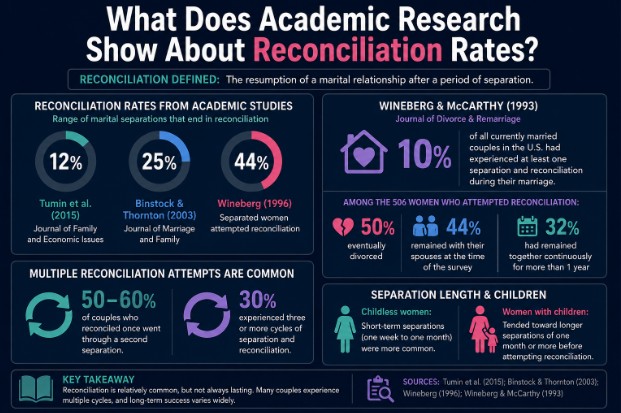
Reconciliation, defined as the resumption of a marital relationship after a period of separation, has been studied by several researchers using different methodologies and populations.
A 2025 literature review by Brown et al. published in the Journal of Marriage and Family summarized the academic range: 12% of marital separations end in reconciliation according to Tumin et al. (2015), 25% according to Binstock and Thornton (2003), and 44% of separated women attempted reconciliation according to Wineberg (1996).
Dr. Howard Wineberg of Portland State University conducted the most detailed analysis of reconciliation patterns using data from the 1987–88 National Survey of Families and Households.
Wineberg and McCarthy (1993) reported in the Journal of Divorce & Remarriage that 10% of all currently married couples in the United States had experienced at least one separation and reconciliation during their marriage.
Among the 506 women in Wineberg’s sample who attempted reconciliation, 50% eventually divorced, 44% remained with their spouses at the time of the survey, and only 32% had remained together continuously for more than 1 year.
Multiple reconciliation attempts were common. Wineberg found that 50–60% of couples who reconciled once went through a second separation, and 30% experienced three or more cycles of separation and reconciliation.
Short-term separations (one week to one month) were more common among childless women, while women with children tended toward longer separations of one month or more before attempting reconciliation.
If you’re ready to get started, call us now!
What Factors Increase or Decrease the Chance of Getting Back Together?
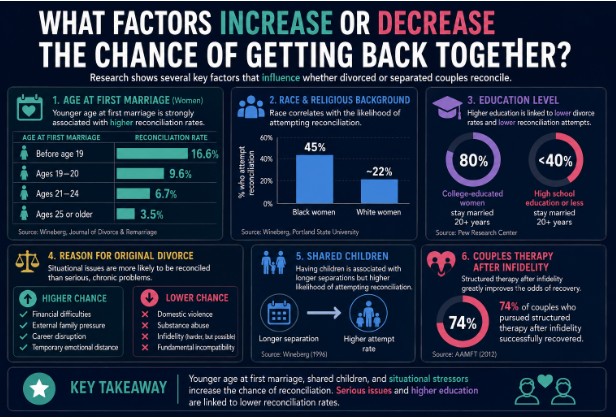
Age at first marriage is one of the strongest predictors of reconciliation. Wineberg’s research found a clear inverse relationship: women who married before age 19 reconciled at 16.6%; women who married at 19–20 reconciled at 9.6%; women who married at 21–24 reconciled at 6.7%; and women who married at 25 or older reconciled at only 3.5%.
Younger couples who divorce often lack the relationship skills and life experience that older adults bring to conflict resolution — but that same lack of entrenchment makes them more willing to try again.
Race and religious background also correlate with reconciliation rates. Wineberg found that Black women attempted reconciliation at 45%, roughly twice the rate of white women.
The Pew Research Center found that women with a college education have an 8-in-10 chance of remaining married after 20 years, compared to less than 40% for women with only a high school education — suggesting that higher education correlates with both lower divorce rates and lower reconciliation attempts.
The reason for the original divorce matters substantially. Couples who separated due to situational stressors — financial difficulties, external family pressure, career disruption, or temporary emotional distance — show higher reconciliation rates than those whose marriages ended due to domestic violence, substance abuse, or fundamental incompatibility.
Infidelity occupies a middle ground: while affair-driven divorces are harder to reconcile, the AAMFT’s 2012 survey found that 74% of couples who pursued structured therapy after infidelity successfully recovered.
| Factor | Effect on Reconciliation | Source |
| Married before age 19 | 16.6% reconciliation rate | Wineberg, J. of Divorce & Remarriage |
| Married age 25+ | 3.5% reconciliation rate | Wineberg, J. of Divorce & Remarriage |
| Black women | 45% attempt reconciliation | Wineberg, Portland State University |
| White women | ~22% attempt reconciliation | Wineberg, Portland State University |
| Shared children | Longer separation but higher attempt rate | Wineberg (1996) |
| Couples therapy post-infidelity | 74% recovery rate | AAMFT (2012) |
| College-educated women | 80% stay married 20+ years | Pew Research Center |
If you are weighing reconciliation against finalizing your divorce, understanding the legal implications of each path will help protect your rights. Cooper Trachtenberg Law Group, LLC, represents families across Cook, Lake, DuPage, Kane, and McHenry counties. Request your confidential consultation.
How Does Illinois Law Handle Reconciliation During Divorce Proceedings?
Illinois couples who reconcile during active divorce proceedings have two primary legal options before the final judgment is entered. The petitioner — the spouse who filed — can voluntarily dismiss the case at any time before the court enters the final dissolution order.
Both spouses remain legally married throughout the entire proceedings until that final order, so dismissal simply ends the court process and preserves the existing marriage.
Alternatively, Illinois courts can place a case on the “reconciliation calendar,” effectively pausing the proceedings while the couple attempts to repair the relationship.
The court retains jurisdiction, and either party may request reactivation of the case if reconciliation fails. This option preserves the legal groundwork already completed — temporary orders regarding child custody, support, and property will remain in effect if the case resumes.
Once a final dissolution judgment has been entered, the marriage is legally terminated. Couples who wish to reunite after a finalized divorce must obtain a new marriage license and remarry. Illinois imposes no waiting period between a finalized divorce and a new marriage.
However, one critical legal consequence applies: if a spouse was receiving maintenance (alimony), that obligation terminates upon remarriage under 750 ILCS 5/510.
Couples who reconcile and later re-divorce must go through a new 6-month separation period to re-establish the irrebuttable presumption of irreconcilable differences under 750 ILCS 5/401(a-5).
If you’re ready to get started, call us now!
What Challenges Do Couples Face When Remarrying an Ex-Spouse?
Couples who remarry face a distinct set of challenges that differ from those in first marriages or in marriages to new partners. The 30% re-divorce rate among same-spouse remarriages — while lower than the 60%+ rate for second marriages to different people — indicates that roughly one in three renewed marriages ultimately fail again. Addressing the original causes of divorce before remarrying is the single strongest predictor of success.
Unresolved conflict patterns represent the most common obstacle. Relationship researchers note that without structured professional intervention, couples tend to re-enter the same communication dynamics that drove the original divorce.
The AAMFT found that couples who pursued therapy before reconciling had substantially better outcomes than those who reunited based solely on emotion.
Legal and financial complexity adds a practical layer. Previous divorce settlements may have divided retirement accounts, real estate, and other assets — remarriage does not automatically reverse those divisions.
New prenuptial agreements, updated estate plans, and revised beneficiary designations all require attention.
Child custody arrangements established during the divorce may need to be modified by the court if parenting time or decision-making authority changes following reconciliation.
External skepticism from family, friends, and children of the marriage creates social pressure that first-time couples do not face.
Children who experienced the divorce may struggle with confusion, hope, or fear about the reunion. Experts recommend age-appropriate communication and family therapy to help children process the transition.
Does Regretting a Divorce Lead to Reconciliation?
Regret after divorce is far more common than actual reconciliation. A study by Hawkins, published in the Journal of Divorce & Remarriage, found that in 75% of divorced couples, at least one spouse expressed regret about the divorce within 1 year of finalization.
The gap between regret (75%) and actual remarriage (6%) reveals that emotional longing rarely translates into practical reunification.
Several factors explain the disconnect. The logistics of post-divorce life — separate households, divided finances, new routines, and sometimes new partners — create practical barriers to reconciliation even when emotional desire exists.
The emotional weight of having gone through the legal process itself can make returning feel like a failure rather than a source of growth. Social stigma around “going back” to an ex-spouse discourages many who might otherwise attempt reconciliation.
Gender differences in regret patterns also emerge in the data. Wineberg’s research found that among male cheaters who divorced, 61% were currently married (often to someone else). In comparison, only 44% of female cheaters who divorced were currently married, according to IFS analysis of GSS data.
Men remarry at higher rates than women after divorce, which means men’s regret is more likely to be channeled into a new relationship rather than a return to the original spouse.
Roughly 80% of all divorced Americans ultimately remarry someone, according to Pew Research Center analysis of U.S. Census data.
Infidelity can reshape your family’s future, and reconciliation raises complex legal questions about property, custody, and support agreements already in place.
Cooper Trachtenberg Law Group, LLC, led by Miriam Cooper (practicing since 1988), protects Chicagoland families’ rights whether you are finalizing a divorce or navigating a second chance. Book your confidential case review at (847) 995-8800.
Contact Us Today For An Appointment
Frequently Asked Questions
What Percentage of Divorced Couples Remarry Each Other?
Approximately 6% of divorced couples choose to remarry each other after their divorce is finalized, according to research cited by Dr. Mark Banschick in Psychology Today. Among those who remarry the same spouse, roughly 30% go on to divorce a second time — a rate significantly lower than the 60%+ divorce rate for second marriages to different partners.
How Many Separated Couples Reconcile Before Divorce Is Final?
Academic estimates of reconciliation during separation range from 12% (Tumin et al., 2015) to 25% (Binstock & Thornton, 2003), while Wineberg’s 1996 research found that 44% of separated women attempted reconciliation. Dr. Mark Banschick noted in Psychology Today that up to 60% of people in the divorce process report being open to reconciliation at some point.
Does Age at Marriage Affect Reconciliation Chances?
Wineberg’s research, published in the Journal of Divorce and Remarriage, found a strong inverse relationship between age at first marriage and reconciliation rates. Women who married before age 19 reconciled at 16.6%; women who married at 19–20 at 9.6%; women at 21–24 at 6.7%; and women who married at 25 or older at only 3.5%.
How Many Divorced People Regret the Decision Within a Year?
A study by Hawkins published in the Journal of Divorce and Remarriage found that in 75% of divorced couples, at least one spouse expressed regret about the divorce within one year of finalization. The gap between regret at 75% and actual remarriage at 6% indicates that emotional longing rarely translates into practical reconciliation.
Can You Stop a Divorce in Illinois if You Reconcile?
Illinois law allows the petitioner to voluntarily dismiss a divorce case at any time before the court enters the final dissolution order. Courts can also place cases on a reconciliation calendar to pause proceedings while couples attempt to repair their relationship. Once the final judgment is entered, the marriage is legally terminated, and reconciliation requires a new marriage license.
Is There a Waiting Period to Remarry in Illinois After Divorce?
Illinois imposes no waiting period between a finalized divorce and a new marriage. Couples who wish to remarry each other or marry a different person can obtain a new marriage license immediately after the dissolution judgment is entered. However, maintenance obligations terminate upon the recipient’s remarriage under 750 ILCS 5/510.
What Happens to Custody Agreements if Divorced Parents Reconcile?
Existing parental responsibility allocations established during the divorce remain legally enforceable until formally modified by the court. Reconciled parents who resume cohabitation or remarry must petition the court to modify custody and parenting time orders if they want the legal framework to reflect their changed living arrangement under 750 ILCS 5/610.5.
Do Couples Who Remarry Each Other Have Better Outcomes Than New Second Marriages?
Couples who remarry their former spouse divorce a second time at approximately 30%, compared to the 60%+ divorce rate for second marriages to a different partner, according to Psychology Today. Researchers attribute the lower re-divorce rate to the greater self-selection involved and the personal growth that typically precedes a decision to return to a former spouse.
Does Race Affect Reconciliation Rates After Divorce?
Wineberg’s research at Portland State University found that Black women attempted reconciliation at 45%, roughly twice the rate of white women, who attempted it at 22%. The study attributed this difference partly to cultural factors and partly to the finding that Black couples are more likely to use separation as an alternative to formal divorce.
What Is the Success Rate of Reconciliation After Infidelity?
The American Association for Marriage and Family Therapy found that 74% of couples who pursued structured therapy after infidelity successfully recovered their relationship in a 2012 survey. Without professional intervention, reconciliation rates after infidelity drop substantially, and couples who attempt reunion based solely on emotion face significantly higher re-separation risk.
How Long Does Reconciliation Typically Take?
Wineberg’s research found that short-term separations of one week to one month were most common among childless couples. In contrast, couples with children tended toward longer separations of one month or more before attempting reconciliation. Relationship therapy research suggests the full healing and rebuilding process typically spans two to five years for couples who ultimately succeed.
Should You Consult a Lawyer Before Reconciling With an Ex-Spouse?
Legal consultation before reconciliation protects both parties’ rights regarding property, maintenance, and custody arrangements established during the divorce. Remarriage terminates maintenance obligations under 750 ILCS 5/510, and previous property divisions are not automatically reversed. An Illinois family law attorney can advise on prenuptial agreements and custody modifications.