
Orders of Protection in Illinois Divorce: Evidence, Hearings, and How It Impacts Custody

Data Last Verified: March 2026

An Illinois order of protection is a civil court order issued under the Illinois Domestic Violence Act. An Illinois judge can issue an emergency order without advance notice under 750 ILCS 60/217, and the order can restrict contact, remove a respondent from a home, and temporarily affect parenting time during a divorce. 

Abuse findings can also shape parental-responsibility decisions under 750 ILCS 5/602.7

An order of protection in an Illinois divorce is not just a safety order. An order of protection can affect residence access, communication, parenting time, and the long-term direction of the divorce case. 

If abuse allegations overlap with parenting disputes, start with the core child custody framework so the protective-order strategy and the parenting strategy stay aligned. 

Key Takeaways

  • Illinois defines abuse broadly under 750 ILCS 60/103, including physical abuse, harassment, intimidation of a dependent, interference with personal liberty, stalking, and willful deprivation.
  • Illinois courts issue emergency, interim, and plenary orders. Emergency orders can be entered without prior notice; interim orders can last up to 30 days; and plenary orders are entered after notice and a hearing. 
  • A protective-order record can affect parenting-time and parental-responsibility decisions in the divorce case under 750 ILCS 5/602.7
  • Violating an order of protection is a criminal offense under 720 ILCS 5/12-3.4. Some violations are misdemeanors, and some repeat or qualifying violations become felonies. 
  • The outcome of a protective-order case can influence leverage, custody arguments, and the court’s credibility throughout the divorce case. 

Cooper Trachtenberg Law Group, LLC can help you evaluate whether a protective-order filing or defense will affect custody, access to the home, and your next court steps. Contact us.

What Is an Order of Protection in an Illinois Divorce?

An Illinois order of protection is a civil remedy that limits abuse, contact, residence access, and related conduct between family or household members. 

In a divorce case, the order can also include temporary remedies that affect the home, the children, and the structure of the case while the divorce is pending.

Illinois defines abuse under 750 ILCS 60/103, and Illinois does not require visible physical injury before issuing relief. 

That matters because many divorce-related petitions are based on harassment, stalking, coercive control, threats, or interference with personal liberty rather than a documented physical assault.

A divorce-related order of protection is different from a financial restraining order. A financial restraining order usually targets asset transfers or spending. An order of protection targets personal safety, contact, and related restrictions on living or parenting. 

Parents comparing safety remedies with broader divorce strategies should also understand how orders of protection interact with the rest of the family case. 

Types of Illinois Orders of Protection

Order TypeTypical DurationNotice to RespondentMain Use
EmergencyUp to 21 daysNo, can be ex parteImmediate danger
InterimUp to 30 daysYesBridge to fuller hearing
Plenary2 yearsYesLonger-term final relief

Emergency orders are governed by 750 ILCS 60/217. Interim orders are governed by 750 ILCS 60/218. Plenary orders are governed by 750 ILCS 60/219

What Can an Illinois Order of Protection Do?

An Illinois judge can order far more than “no contact.” Under 750 ILCS 60/214, the court can prohibit abuse, restrict communications, grant exclusive possession of a residence, impose stay-away terms, and enter other tailored remedies that fit the safety problem presented. 

Common Remedies

  • No contact by phone, text, email, social media, or third-party messaging
  • Stay-away restrictions for a home, workplace, school, or other protected location
  • Exclusive possession of a shared residence
  • Temporary parenting-time restrictions or conditions
  • Protection of property and personal effects
  • Firearm-related restrictions where the statute or federal law applies 

An order of protection can affect parenting issues while the case is pending, but a protective-order hearing does not permanently resolve every custody issue. 

If you’re ready to get started, call us now!

What Evidence Do Illinois Courts Require?

What Evidence Do Illinois Courts Require?

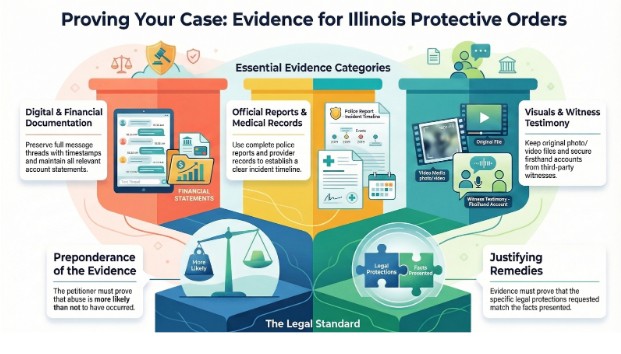
Illinois courts generally apply a preponderance-of-the-evidence standard in civil protective-order proceedings. The petitioner must show that abuse is more likely than not to have occurred and that the requested remedies are appropriate to the facts presented.

Evidence That Commonly Matters

Evidence TypeWhy It HelpsBest Practice
Texts, emails, voicemailsShows threats, harassment, or repeated contactPreserve full threads with timestamps
Photos or videoShows injury, damage, or stalking presenceKeep original files
Police reportsSupports incident historyObtain complete reports
Medical recordsSupports injury or treatment timelineKeep provider records together
Witness testimonyAdds third-party corroborationUse firsthand witnesses
Financial recordsCan support willful deprivation claimsPreserve statements and account records

Digital evidence often matters most in modern protective-order cases, but digital evidence still needs context. 

A judge needs the sender’s identity, the timing, and an explanation of why each communication constitutes harassment, intimidation, or another statutory form of abuse. 

A cropped screenshot without explanation is much weaker than a fully preserved thread with dates, context, and supporting testimony. 

Illinois also identifies specific conduct that can qualify as harassment under 750 ILCS 60/103. That list includes repeated calls, surveillance, following, and threats to remove or conceal a child. 

If the allegations overlap with divorce communications, preserve the same records that may later be relevant to the consequences of ignoring court orders or other parenting disputes. 

How Does the Illinois Hearing Process Work?

An Illinois protective-order case usually starts with an emergency filing, then moves to service, then to an interim or plenary hearing. 

The first order can be entered quickly, but longer-term relief requires notice and a fuller opportunity to be heard. 

Step-by-Step Process

  1. File the petition in circuit court.
  2. Request emergency relief if immediate danger exists.
  3. Attend the emergency hearing.
  4. Serve the respondent.
  5. Return for interim or plenary proceedings.
  6. Present testimony, exhibits, and witnesses at the plenary stage.

Hearing Timeline

StageTypical TimingWho AppearsWhat Happens
Emergency hearingOften the same dayPetitioner and judgeThe judge may enter an ex parte order
Interim stageShort extension periodUsually both sidesMaintains protection while the case advances
Plenary hearingAfter notice and serviceBoth sides and witnessesFull evidentiary hearing

Illinois also allows after-hours emergency access in some circumstances under 750 ILCS 60/217. In Chicago-area cases, local court procedure matters too. 

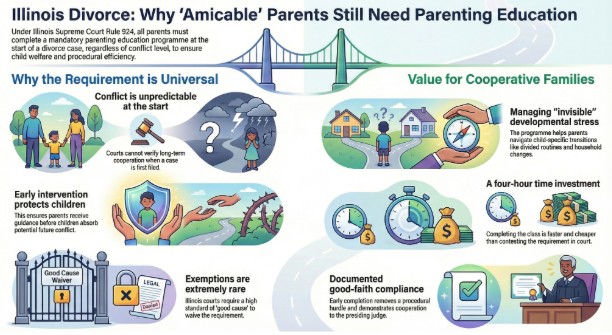
The Cook County parent education program can affect when final parenting judgments enter, and the related divorce case often moves on a parallel timeline that parents should compare against the Illinois divorce timeline

When emergency safety issues overlap with parenting disputes, Cooper Trachtenberg Law Group, LLC can help you prepare evidence, protect access rights, and respond before the next hearing. Schedule an appointment.

If you’re ready to get started, call us now!

How Does an Order of Protection Affect Custody in Illinois?

A protective-order record can materially affect parenting time and parental responsibilities. Illinois courts evaluate the child’s best interests under 750 ILCS 5/602.7, and abuse findings can shape restrictions, safeguards, and the final parenting structure. (Illinois General Assembly)

That means the protective-order case is not separate from the divorce case in any practical sense. A granted order can influence supervision arguments, safety planning, and the judge’s view of future parenting orders. 

A dismissed or narrowed order can also matter because the respondent may preserve credibility and challenge the petitioner’s framing of the dispute.)

Custody Impact by Outcome

Order OutcomeImmediate EffectLikely Divorce Impact
Emergency order enteredTemporary restrictions may start immediatelyEarly leverage and safety framing
Plenary order enteredLonger restrictions possibleStrong influence on parenting structure
Petition dismissedRestrictions end unless other orders applyRespondent may gain credibility
Order modifiedTerms change prospectivelyParenting issues may shift back to the family-court framework

Parents handling both safety allegations and parenting disputes should compare the protective-order record with the firm’s guidance on child custody and, when settlement remains possible, divorce mediation

Those tracks do not always move together, but they need to be evaluated together. 

How Should a Respondent Defend Against an Order of Protection?

A respondent has the right to contest the allegations, cross-examine witnesses, present exhibits, and argue that the petitioner has not met the required civil standard. 

The first rule, however, is strict compliance with the current order pending the challenge.

Core Defense Priorities

  • Comply with every current term of the order
  • Preserve all communications and records
  • Identify contradictory evidence early
  • Prepare firsthand witnesses
  • Challenge weak authentication or missing context
  • Build a fact-by-fact response instead of a vague denial

A respondent who violates the order while preparing a defense usually damages both the criminal and family-law positions. Respondents should never try to “clear things up” through direct contact. 

If the protective-order case sits inside a larger divorce, respondents should also review orders of protection and consequences of ignoring court orders together because the judge will likely view compliance as a credibility issue across the entire case. 

What Happens If Someone Violates an Illinois Order of Protection?

Violation of an order of protection is a criminal offense under 720 ILCS 5/12-3.4. A first violation is generally a Class A misdemeanor. 

Some repeat or qualifying violations are Class 4 felonies. Illinois law also authorizes law-enforcement action when probable cause exists for a violation. 

Penalty Snapshot

Violation ScenarioLikely Classification
First violationClass A misdemeanor
Repeat or qualifying violationClass 4 felony in listed circumstances
Firearms issue under a qualifying federal orderSeparate federal exposure may apply

Federal law can matter too. Under 18 U.S.C. § 922, some qualifying protective orders create firearm restrictions while the order remains in effect. 

A violation record can also hurt the respondent in parenting and compliance disputes, even apart from the criminal case. 

Before a protective-order hearing changes parenting time, home access, or the course of your divorce, talk with Cooper Trachtenberg Law Group, LLC about protective-order strategy, custody risk, and next-step options. Contact us today.

Contact Us Today For An Appointment

    I have read the

    Frequently Asked Questions

    Can Illinois courts issue an emergency order the same day?

    Yes. Illinois courts can issue an emergency order quickly, including ex parte relief, under 750 ILCS 60/217. 

    Does an order of protection automatically decide custody?

    No. A protective order can affect temporary parenting conditions, but final parental-responsibility decisions are governed through the family-law framework, including 750 ILCS 5/602.7.

    Can harassment alone support an Illinois order of protection?

    Yes. Illinois defines abuse broadly, and the statutory definition includes harassment and related conduct under 750 ILCS 60/103

    What should a respondent do first after service?

    Comply with the order immediately, preserve evidence, and prepare for the plenary hearing. A respondent should not contact the petitioner directly.

    Can an order of protection affect access to the home?

    Yes. Illinois courts can award exclusive possession and related stay-away relief under750 ILCS 60/214

    Does Cook County add any special family-case requirements?

    Yes. Cook County requires a parent education program in covered family cases before certain final parenting judgments are entered. 

    Can a violation affect the divorce case even without a conviction?

    A documented violation allegation or record can still affect credibility, compliance arguments, and parenting disputes in the family case. 

    Can I Move Out With the Kids Before Divorce Is Final in Illinois? Risks and Safer Steps

    Data Last Verified: March 2026

    An Illinois parent can usually leave the marital home before the divorce is final. An Illinois parent cannot assume the same freedom applies to moving out with the children. 

    A move with the children can affect parenting time, trigger relocation rules under 750 ILCS 5/609.2, and create custody risk if the move disrupts the other parent’s access or the children’s stability. 

    Parents facing that issue should first review the existing child custody framework and any current court orders. 

    Illinois divorce law treats leaving the home and moving the children as different legal decisions. 

    An Illinois parent who leaves the home alone usually creates fewer legal problems than an Illinois parent who changes the children’s primary living arrangement during a pending divorce. 

    Illinois courts focus on the children’s best interests, temporary parental responsibility, existing parenting expectations, and statutory relocation rules. 

    Key Takeaways

    • An Illinois parent can usually move out of the marital home before the divorce is final, but taking the children creates a separate parenting-time and custody issue. 
    • Illinois courts can enter temporary parental responsibility orders before final judgment under 750 ILCS 5/603.5, including temporary parenting-time arrangements and temporary relief tied to the children’s living situation. 
    • Not every move with a child is a legal relocation. Illinois uses mileage thresholds that vary by county and by whether the move crosses state lines under 750 ILCS 5/609.2
    • A unilateral move involving the children can undermine a parent’s position if it disrupts the other parent’s relationship, school continuity, or the court’s expectation of child-centered cooperation.
    • A safer move strategy starts with immediate safety, court-order review, factual documentation, and temporary court relief when conflict risk is high. Parents dealing with conflict should also understand parental rights.

    Can You Move Out With the Kids Before Divorce Is Final in Illinois?

    Yes, sometimes. The legal answer depends on the type of move, the current parenting arrangement, and whether the move qualifies as a statutory relocation under Illinois law. 

    Illinois law treats moving out alone differently from moving out with the children. Illinois law also treats moving across town differently from relocating beyond a statutory mileage threshold. 

    An Illinois parent can often leave the marital home before the divorce is final. The harder legal question is whether that parent can also change the children’s day-to-day residence without disrupting parenting time, violating temporary expectations, or triggering relocation rules. 

    TermMeaning in Practice
    Moving outOne parent leaves the marital home
    Moving out with the kidsOne parent changes the children’s day-to-day residence
    Temporary parental responsibilityA court’s temporary order about decision-making or parenting time before final judgment
    RelocationA move that crosses Illinois statutory mileage thresholds and triggers notice, consent, or court approval rules

    Illinois courts may enter temporary orders of parental responsibility before the divorce is finalized. 

    A pending divorce does not leave parents without structure. An Illinois judge can set temporary rules while the case is ongoing.

    If moving out with the kids could affect custody, Cooper Trachtenberg Law Group, LLC can help you assess risk early and protect your next step. Contact us.

    If you’re ready to get started, call us now!

    When Does a Move Count as a Legal Relocation in Illinois?

    A move with the children does not automatically qualify as a legal relocation. Illinois relocation law uses county-based mileage thresholds, and those thresholds matter because a relocation usually requires notice and either written consent or court approval under 750 ILCS 5/609.2

    Under 750 ILCS 5/609.2, a parent with a majority of parenting time, or either parent with equal parenting time, may seek to relocate with a child. 

    The statute also requires written notice, filing a copy with the clerk, and at least 60 days’ notice unless notice is impracticable or the court orders otherwise. 

    If the non-relocating parent objects or does not sign the notice, the parent seeking relocation must file a petition for permission to relocate. 

    Illinois Legal Aid also explains an important nuance. If a move does not qualify as a statutory relocation, a parent with the majority of parenting time may sometimes move the child without seeking court approval or notifying the other parent. 

    That rule is fact-specific and should not be treated as a blanket permission. 

    Illinois Relocation Thresholds

    Where the child currently livesA move counts as a relocation when the move is…
    Cook, DuPage, Kane, Lake, McHenry, or Will CountyMore than 25 miles from the child’s current primary residence
    Any other Illinois countyMore than 50 miles from the child’s current primary residence
    Any Illinois county to another stateMore than 25 miles from the child’s current primary residence

    A short move can still create a custody dispute even when the move does not meet the statutory relocation threshold. 

    A short move can still affect school logistics, daycare access, exchange burdens, and weekday parenting time. 

    Parents who want a deeper Illinois-specific explanation should review moving out with kids and the broader child custody guide.

    What Are the Biggest Risks of Moving Out With the Kids Too Early?

    What Are the Biggest Risks of Moving Out With the Kids Too Early?

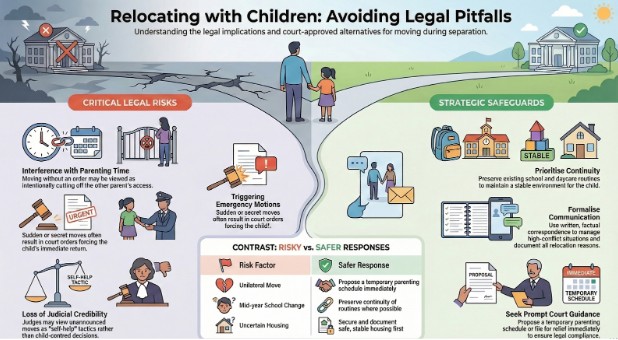
    Moving out with the children too early can hurt a parent’s position if the move looks unilateral, disruptive, or strategically motivated. 

    Illinois judges evaluate the children’s best interests, and Illinois judges may view a rushed move very differently from a documented, safety-based move followed by a prompt request for court guidance

    Risk Matrix

    RiskWhy It MattersWhen Risk Is HighestSafer Response
    Interfering with parenting timeThe other parent may argue that the move cuts off accessNo temporary order existsPropose a temporary parenting schedule immediately
    Triggering emergency motion practiceThe other parent may ask the court to force the child’s returnThe move was sudden or secretFile for temporary relief quickly
    Weakening credibilityThe judge may view the move as self-helpThe move changed the status quo without warningDocument child-centered reasons
    Disrupting school or daycareInstability can weaken the moving parent’s positionThe move changes routines mid-yearPreserve continuity where possible
    Escalating conflictTension can worsen during exchanges or communicationDomestic conflict is already highUse written, factual communication
    Creating housing concernsTemporary or unstable housing can become evidenceThe new home is uncertain or crowdedSecure safe, documented housing first

    A move can also affect how the court evaluates a parent’s judgment. A parent who acts first and explains later may appear less cooperative than a parent who documents the concern, preserves continuity, and seeks the court’s temporary guidance. 

    That pattern often overlaps with disputes about parental rights and temporary control of the children’s daily routine.

    When safety, parenting time, or relocation rules collide, Cooper Trachtenberg Law Group, LLC can help you pursue temporary relief and a workable parenting plan. Schedule an appointment.

    If you’re ready to get started, call us now!

    What Should You Do First If You Need to Leave Home?

    The safest first step depends on the home’s condition. An unsafe home requires immediate safety action. A tense but non-dangerous home usually calls for a temporary legal structure, not a surprise move with the children. 

    Illinois parents should separate immediate safety decisions from longer-term custody decisions. 

    An emergency exit protects safety. A durable parenting arrangement protects the long-term case. Parents facing domestic conflict should review orders of protection and, where relevant, temporary vs. plenary protective orders.

    Safer First Steps

    • Review any existing court orders or informal parenting arrangements.
    • Separate immediate safety concerns from relocation strategy.
    • Preserve school, medical, and daycare continuity where possible.
    • Gather essential documents, medication, school contacts, and child records.
    • Document the reason for the move in factual terms.
    • Avoid withholding the children without a clear legal basis.
    • Seek temporary parental responsibility or parenting-time relief when conflict risk is high.

    Under 750 ILCS 5/603.5, a court may order a temporary allocation of parental responsibilities in the child’s best interests before final judgment, and the court may also order temporary relocation before final judgment if the move is in the child’s best interests and follows the Section 609.2 protocol.

    What Are the Safer Legal Steps Before You Move With the Kids?

    The safer legal approach is to build a record before the move, not after the conflict. An Illinois parent who wants to move with the children during a pending divorce should confirm whether the move is a relocation, whether consent is realistic, and whether temporary court intervention is necessary. 

    Safer Steps Checklist

    • Confirm whether the move qualifies as a legal relocation under 750 ILCS 5/609.2.
    • Review the current status of the divorce and any temporary parenting orders.
    • Prepare a child-centered temporary plan that protects school, healthcare, and exchanges.
    • Give formal written notice when required by relocation law.
    • Seek written consent if it is realistic.
    • File for temporary relief if the other parent will object.
    • Avoid inflammatory texts, social media posts, or surprise departures.
    • Keep communications factual and child-focused.

    Structured negotiation can reduce risk when the dispute is not about immediate safety. Mediation can help when the disagreement involves logistics, timing, school continuity, or a temporary parenting structure.

    How Will Illinois Courts Evaluate a Move With the Kids During Divorce?

    Illinois courts do not reward the parent who moved first. Illinois courts evaluate the child’s best interests, the reason for the move, the effect on the child’s stability, and the effect on the other parent’s relationship with the child under the relocation framework in 750 ILCS 5/609.2

    A moving parent usually helps the case by showing planning, stable housing, school continuity, and a realistic proposal for preserving the other parent’s time. 

    A moving parent usually hurts the case by acting secretly, abruptly changing the child’s routine, or using the move as leverage in the divorce.

    Facts That Usually Help

    • The move was driven by safety, work necessity, or stable housing.
    • The parent preserved school and medical continuity.
    • The parent proposed a realistic parenting-time solution.
    • The parent documented concerns and sought temporary court relief.

    Facts That Usually Hurt

    • The move was secret or rushed.
    • The move cut off the other parent’s routine contact.
    • The move caused housing instability or school disruption.
    • The parent used the move to gain leverage in the divorce.

    The Cook County parent education program adds another procedural layer for many Chicago-area cases. 

    Cook County states that no final judgment regarding allocation of parental responsibilities, parenting time, or relocation will be entered without certificates of completion unless the court excuses attendance or allows more time. 

    Parents already dealing with a contested timeline should also understand the Illinois divorce timeline and the broader Illinois child custody guide.

    Before a disputed move creates bigger custody problems, talk with Cooper Trachtenberg Law Group, LLC about child-focused options, mediation, or court action. Contact us today.

    Contact Us Today For An Appointment

      I have read the

      Frequently Asked Questions 

      Can I move out with my kids in Illinois if there is no court order yet?

      Possibly. A missing court order does not eliminate legal risk. A move can still create problems if the move disrupts the other parent’s access or qualifies as a statutory relocation.

      Can I move out of the house before the divorce is final, without the kids?

      Usually yes. Moving out alone is generally easier legally than changing the children’s residence, but the move can still affect strategy, finances, and temporary parenting arrangements.

      Do I need the other parent’s permission before moving with the children?

      If the move qualifies as a relocation, Illinois law generally requires notice and either written consent or court approval. If the move does not qualify as a relocation, the analysis becomes more fact-specific. 

      Does moving across town count as relocation in Illinois?

      Not always. Illinois uses mileage thresholds that vary by county and whether the move crosses state lines. In Cook County and several surrounding counties, a move of more than 25 miles can be considered a relocation. 

      What if I need to leave the home for safety reasons?

      Safety comes first. A parent facing danger should focus on immediate protection, preserve evidence, and seek temporary relief as quickly as possible. Parents dealing with immediate risk should also review orders of protection.n

      Can moving out with the kids hurt my custody case?

      Yes. A unilateral move can hurt a custody case if it appears to be interference, causes instability, or is designed to create leverage rather than protect the chi.ld

      Can a judge order temporary custody or parenting arrangements before the divorce is final?

      Yes. Illinois courts can enter temporary parental responsibility orders before final judgment under 750 ILCS 5/603.5

      What documents should I gather before moving with the kids?

      Gather court papers, school records, medical information, insurance cards, contact information, calendars, childcare details, and written evidence explaining why the move is necessary.

      Should I tell the other parent before I leave with the children?

      In many cases, yes. Immediate safety cases are different. Outside of immediate safety cases, secret moves often create more litigation risk than documented, child-focused communication.

      Can mediation help if we disagree about moving out with the kids?

      Sometimes. Mediation can help when the dispute involves logistics, timing, or temporary parenting structure rather than immediate safety or coercive control. Parents exploring that route should review divorce mediation.

      What is the safest practical step before I move with the children?

      The safest step is usually to assess safety, review existing orders, document the reason for the move, and seek temporary legal relief before making a contested move with the children. 

      Child Custody Evaluations in Chicago: Understanding the Differences Between a GAL, a Custody Evaluator, and a Child Representative

      Data Last Verified: March 2026

      Chicago courts use different professionals in contested child custody cases because each appointment serves a different legal function. 

      A Guardian ad Litem (GAL) investigates the facts and recommends what serves the child’s best interests. A Child Representative acts as the child’s lawyer for best-interests advocacy, but does not testify or submit an evidentiary report. 

      A Section 604.10 evaluator provides the court with a written best-interests evaluation to help the court decide on parental responsibilities and parenting time. Illinois law treats these roles as distinct appointments under 750 ILCS 5/506 and 750 ILCS 5/604.10

      Key Takeaways

      • A GAL investigates the case, submits recommendations, and may be examined about those recommendations.
      • A Child Representative advocates for the child’s best interests through litigation, but a Child Representative does not testify or submit a report as evidence.
      • A Section 604.10 evaluator provides the court with a written best-interests evaluation in cases that require deeper analysis of family dynamics, parenting capacity, or complex child-related concerns.

      What Is the Difference Between a GAL, a Child Representative, and a Custody Evaluator in Chicago?

      What Is the Difference Between a GAL, a Child Representative, and a Custody Evaluator in Chicago?

      A Chicago custody case can involve a GAL, a Child Representative, or a Section 604.10 custody evaluator, but each appointment serves a different legal function. 

      The difference matters because each professional gathers information differently, communicates with the court differently, and influences the judge through a different procedural channel. 

      Parents who want a broader overview of Illinois allocation cases should also review Illinois child custody standards before focusing on appointment strategy.

      What a Guardian ad Litem Does?

      What a Guardian ad Litem Does?

      A Guardian ad Litem is a licensed attorney appointed under Illinois law to investigate the facts and recommend what outcome serves the child’s best interests. 

      A GAL typically interviews both parents and the child, reviews records, and may speak with teachers, therapists, physicians, or other collateral sources. 

      A GAL can also observe parent-child interactions and evaluate the stability of each home environment.

      The GAL’s defining feature is the recommendation function. Under Illinois practice, a GAL may submit a written recommendation to the court and may be called to be examined regarding that recommendation. 

      A GAL therefore operates as an investigator with a reporting function, not as a traditional advocate for either parent.

      A GAL does not represent what a child wants in the same way a traditional attorney would represent a client’s objectives. 

      A GAL focuses on what the GAL concludes is in the child’s best interests after investigating the facts. That distinction becomes important in high-conflict cases, special-needs cases, and cases involving disputed parenting capacity.

      If you’re ready to get started, call us now!

      What a Child Representative Does

      A Child Representative is also a licensed attorney, but the Child Representative serves a different role from a GAL. Section 506 states that a Child Representative advocates for the child’s best interests after reviewing the facts and circumstances of the case. 

      A Child Representative can investigate the matter, meet with the child and the parties, participate in hearings, file pleadings, call witnesses, and make legal arguments.

      A Child Representative does not submit a formal report to the court and does not testify as a witness on the issues the Child Representative is appointed to address. Instead, the Child Representative presents an evidence-based litigation position through motions, advocacy, and a pretrial memorandum. That structure gives the court advocacy without converting the Child Representative into a witness.

      A Child Representative is often useful when the court needs an active participant in the litigation rather than an investigating witness. 

      That role can matter in cases involving repeated motions, contested school or medical decisions, or serious communication failures that may later require parenting coordination.

      What a Section 604.10 Custody Evaluator Does

      A Section 604.10 custody evaluator does not represent either parent or the child. A Section 604.10 evaluator acts as the court’s professional and provides a written opinion to help the court determine the child’s best interests. 

      Cook County Family Court Services describes these evaluations as best-interest evaluations. Cook County also states that these evaluations are not the same as mental health evaluations, even though mental health issues may still become relevant in some cases.

      A custody evaluator may interview parents and children, review records, observe parent-child interactions, and gather information from collateral sources. 

      Some evaluations involve psychological testing or clinical methods, but a Section 604.10 evaluation is not automatically a full psychological evaluation in every case. The scope depends on the court’s order, the evaluator’s methods, and the issues in dispute.

      A Section 604.10 evaluator is especially important when the court needs a detailed analysis of parenting capacity, the child’s needs, family dynamics, relocation issues, or allegations that require more depth than a standard fact investigation. 

      Cases involving substance-related parenting concerns often require close scrutiny of safety, supervision, and judgment, which is why parents facing those issues should understand how courts analyze substance abuse and child custody.

      When Do Illinois Courts Appoint Each One in a Chicago Child Custody Case?

      Illinois judges appoint different professionals based on the kind of information the court needs, not because one role is automatically better than another. The appointment decision usually turns on the level of conflict, the complexity of the child-related issues, the need for litigation advocacy, and the need for deeper professional assessment. 

      A judge may appoint one professional, or a judge may use more than one professional if the case presents layered concerns.

      Cases That Often Lead to a GAL or Child Representative

      Courts often appoint a GAL or a Child Representative when the case involves serious disagreement over parenting time, decision-making, child safety, or the child’s daily functioning. 

      Allegations of domestic conflict, repeated co-parenting breakdowns, educational disputes, and noncompliance with temporary orders can all create a strong record for appointment.

      A GAL is often useful when the judge wants an investigator who can gather facts and make a recommendation. 

      A Child Representative is often useful when the judge wants a child-focused attorney who can litigate actively throughout the case. The difference affects discovery, hearings, negotiation posture, and trial preparation.

      Cases involving developmental, educational, or therapeutic complexity may also warrant focused child-centered investigation. 

      Parents dealing with neurodivergence, developmental support plans, or specialized care issues should understand how these disputes intersect with special-needs GAL work in Illinois practice.

      Cases That Often Lead to a Section 604.10 Evaluation

      A Section 604.10 evaluation is more likely when the judge needs a deeper best-interests analysis than a standard attorney investigation can provide. 

      Common triggers include relocation disputes, persistent allegations of parental alienation, conflicting mental health narratives, complex developmental needs, and highly disputed claims about parenting judgment or emotional regulation.

      A relocation dispute can be a strong example. When one parent wants to relocate with the child, the court may need a more comprehensive record of school continuity, parent-child attachment, travel burdens, and the move’s effect on the child’s long-term stability. Parents facing those issues should also understand how Illinois courts view moving out with kids.

      A Section 604.10 evaluation may also become more likely when the case involves allegations that require professional analysis rather than simple credibility determinations. 

      In those situations, the evaluator’s task is to help the court understand the child’s best interests through a structured professional process.

      Can More Than One Be Involved in the Same Case?

      Yes. A Chicago custody case can involve both a Child Representative or GAL and a Section 604.10 evaluator. 

      The combination usually appears in high-conflict or fact-intensive cases where the court wants both ongoing child-focused litigation participation and a deeper professional evaluation.

      The dual-appointment structure can increase cost and complexity, but it can also provide the court with two distinct forms of insight. One professional can participate throughout the litigation, while the other provides a formal evaluation record that may shape settlement or trial.

      How Does Each Professional Gather Information and Influence the Judge?

      Each role influences the judge through a different blend of investigation, communication, and courtroom procedure. 

      Parents who understand those mechanics can prepare more effectively, respond more strategically to information requests, and avoid conduct that damages credibility.

      Interviews, Records, Home Visits, and Collateral Contacts

      A GAL, Child Representative, or custody evaluator may interview the parents, interview the child, review records, and contact people who have meaningful information about the child’s life. 

      Relevant records often include school records, medical records, therapy records, communications between the parents, and documents showing attendance, routines, or participation in care.

      Collateral contacts can include teachers, school counselors, therapists, physicians, daycare providers, coaches, relatives, and other adults with firsthand knowledge. 

      Home observations may also occur when the professional needs to assess routines, safety, supervision, sleeping arrangements, or parent-child interaction patterns.

      Parents should assume that organization, consistency, and accuracy matter. A parent who cannot provide school or treatment records or a reliable schedule may appear less credible and less prepared. 

      If you’re ready to get started, call us now!

      Reports, Pretrial Memoranda, and Testimony

      A GAL, a Child Representative, and a Section 604.10 evaluator influence the judge in different ways. That difference affects evidence, testimony, cross-examination, and settlement leverage. 

      Under 750 ILCS 5/506, a GAL investigates and can submit written recommendations, while a Child Representative advocates through evidence-based legal argument and cannot be called as a witness on the assigned issues.

      ProfessionalMain Court FunctionWritten OutputCan Be Examined?
      Guardian ad Litem (GAL)Investigates and recommends what serves the child’s best interestsWritten report, recommendations, or proposed parenting planYes
      Child RepresentativeAdvocates for the child’s best interests as a lawyerPretrial memorandum and legal argument, not evidenceNo, on assigned issues
      Section 604.10 EvaluatorProvides the court with a best-interests evaluationWritten evaluationYes, if called or if an objection is raised

      What parents should know

      • A GAL can investigate, submit recommendations, and be cross-examined about the report or recommendation under 750 ILCS 5/506.
      • A Child Representative has the same litigation authority as an attorney for a party, but the Child Representative cannot submit a report as evidence and cannot testify on the assigned issues under 750 ILCS 5/506.
      • A Section 604.10 evaluation is sent to counsel and the court, and the writing may be admitted unless a party objects. The professional then testifies as the court’s witness and is subject to cross-examination.
      • In Cook County Family Court Services, the evaluator prepares a comprehensive report focused on the child’s best interests.

      Why this matters strategically

      • A lawyer challenging a GAL or evaluator usually attacks gaps in the investigation, the reliability of sources, missing records, or weak methodology.
      • A lawyer responding to a Child Representative usually attacks the strength of the evidence supporting the Child Representative’s best-interests position.
      • A strong report or recommendation often changes settlement pressure before trial.

      Confidentiality and What Parents Should Not Assume

      Parents should not assume privacy with any court-appointed professional. A GAL is not your lawyer. A Section 604.10 evaluator is not your therapist. Statements to either professional can become part of the court record or the evaluation process.

      Confidentiality is more nuanced with a Child Representative because the Child Representative is the child’s attorney, not either parent’s attorney. 

      Under 750 ILCS 5/506, a Child Representative “shall not disclose confidential communications made by the child,” except as required by law or by the Rules of Professional Conduct. 

      That protection applies to the child, not to the parents.

      Do not assume

      • Your side conversations are off the record.
      • Emotional venting helps your case.
      • The professional will hide damaging admissions.
      • The professional is there to support your position.

      Better approach

      • Stay factual.
      • Stay child-focused.
      • Answer directly.
      • Do not exaggerate.
      • Do not coach the child.

      Parents facing addiction allegations should be especially careful. Statements about relapse history, treatment compliance, household sobriety, and missed parenting duties can directly affect how the court evaluates parenting judgment and safety.

      Who Pays for a GAL, Child Representative, or Custody Evaluator in Chicago?

      Court-appointed professionals can add high cost to a custody case. In Cook County, the court has discretion to order fees for a GAL, Child Representative, or Attorney for the Child, and the order may include a retainer. 

      The court may require payment by one or both parents, the marital estate if applicable, or the child’s separate estate if applicable.

      How Courts Allocate Fees

      Judges usually allocate fees based on financial resources, case complexity, and what the court believes is necessary to protect the child’s interests.

      Common fee-allocation factors

      • Each parent’s income
      • Each parent’s ability to pay
      • Case complexity
      • Whether one parent increased unnecessary litigation
      • The court’s view of fairness under the facts

      Do not assume equal parenting claims lead to equal fee responsibility. Under 750 ILCS 5/506, appointed professionals must file detailed invoices every 90 days, and the court reviews whether the fees are reasonable and necessary.

      Are Lower-Cost or Public Options Available in Cook County?

      Some families may qualify for lower-cost options. Cook County states that if parties cannot afford to pay, the court may appoint a Child Representative from the Office of the Cook County Public Guardian, which uses sliding-scale fees, or appoint a pro bono Child Representative or GAL from the Domestic Relations Division’s approved roster. 

      Cook County also states that Public Guardian appointments in Domestic Relations cases may be made when all parties and children live in Cook County, at least one party is represented by counsel, and the parties have attempted mediation before the appointment.

      Which Option Is Better for Your Case: GAL, Child Representative, or Custody Evaluator?

      The best option depends on what problem the judge needs to solve.

      • Some cases need a fact investigator.
      • Some cases need a child-focused litigator.
      • Some cases need a professional best-interests evaluation.

      That is why the real question is not which role sounds strongest in theory. The real question is which role fits the dispute before the court.

      What Should Chicago Parents Expect If the Court Appoints One?

      A court appointment changes the pace and pressure of a custody case. Parents should expect interviews, document requests, closer review of communications, and scrutiny of routines, credibility, and parenting judgment.

      In Cook County Family Court Services, evaluators may interview parents individually, meet with children individually and with each parent, and speak with teachers, therapists, grandparents, and other adults involved in the children’s lives.

      How to Prepare Without Looking Performative

      Good preparation is organized, stable, and authentic.

      What helps

      • Keep the home safe and functional.
      • Maintain normal routines.
      • Gather school, medical, and treatment records.
      • Keep a reliable parenting calendar.
      • Present accurate information.
      • Stay calm in child-related communications.

      Parents who expect a more thorough review should prepare early by reviewing the custody evaluation process and the broader standards that govern child custody in Illinois.

      What hurts

      • Coaching the child
      • Sudden cosmetic parenting changes
      • Exaggerating strengths
      • Hiding weaknesses that records will reveal

      Mistakes Parents Make During an Evaluation or Investigation

      The most damaging mistake is making the case about punishing the other parent instead of protecting the child.

      • Overstating risk
      • Refusing to cooperate
      • Hiding records
      • Coaching the child
      • Ignoring deadlines
      • Failing to produce the requested documents
      • Attacking the professional without factual support

      Every communication may later be judged for tone, judgment, and child focus. That is why parents should also understand the consequences of ignoring court orders in Illinois divorce when temporary parenting terms or case directives are already in place.

      Contact Us Today For An Appointment

        I have read the

        How This Process Can Affect Settlement and Trial

        A strong report, recommendation, or advocacy position can quickly change settlement leverage.

        Typical effects

        • A favorable report can strengthen one parent’s negotiating position.
        • An unfavorable report can increase pressure to settle.
        • A clear best-interests position can narrow the disputed issues.
        • Better information often produces more durable parenting arrangements.

        In Cook County, a 604.10(b) evaluation is designed to provide the judge with a comprehensive best-interests report, and the recommendation may help the judge make a ruling that improves parent-child relationships, co-parenting, communication, and cooperation.