
Mother’s Rights In Illinois Custody Cases. Debunking Common Myths And What Family Court Judges Actually Consider

Data last verified: March 2026

Illinois courts do not favor mothers or fathers in custody cases. Judges allocate parenting time and decision-making based on the child’s best interests, not a parent’s gender. 

The court weighs the caregiving history, stability, safety, and cooperation, as well as each parent’s ability to support the child’s relationship with the other parent.

Illinois’s custody strategy improves when a parent builds arguments around best-interest factors and admissible proof. A parent can start with a practical baseline in the child custody overview.

Illinois Custody Reality. Rights Are Gender Neutral, Outcomes Are Evidence-Based

Illinois Custody Reality. Rights Are Gender Neutral, Outcomes Are Evidence-Based

Illinois judges apply gender-neutral custody standards. Illinois judges allocate parenting time and decision-making responsibilities based on statutory best-interest factors, not a parent’s gender, under 750 ILCS 5/602.5 and 750 ILCS 5/602.7.

Illinois custody outcomes usually track three courtroom themes. Stability protects school continuity and daily routines. Cooperation reduces child exposure to conflict. Safety concerns can justify restrictions and supervision.

Illinois custody cases reward specific asks. A parenting time request needs a schedule. A decision-making request needs defined categories, such as education and healthcare.

Cooper Trachtenberg Law Group helps Illinois mothers build custody plans around judge factors, not myths. Start with a confidential consult today. Schedule an appointment.

What “Mother’s Rights” Means In Illinois Custody Language

What “Mother’s Rights” Means In Illinois Custody Language

Illinois law does not create special custody rights for mothers. Illinois custody law gives both parents equal standing to request parenting time and decision-making responsibilities, then requires the court to choose the allocation that best serves the child. (Illinois General Assembly)

Illinois custody disputes often start with disagreements about parental rights. Illinois custody disputes also hinge on enforceable orders rather than informal understandings.

Illinois custody arguments get stronger when each sentence ties to a judge’s decision point. A parent who claims “primary custody” without logistics invites an attack on feasibility. 

A parent who offers a child-centered schedule, workable exchanges, and stable routines creates a court-ready request.

If you’re ready to get started, call us now!

Parenting Time Vs Decision-Making Responsibilities

Illinois separates custody into two buckets. Parenting time is the schedule for where the child lives and when the child lives with each parent. 

Decision-making responsibilities cover major life decisions, including education, healthcare, religion, and extracurricular activities. 

Illinois judges can allocate joint decision-making while allocating majority parenting time to one parent. Illinois judges can also make split decisions, such as one parent handling healthcare and both parents sharing educational decisions, when the evidence supports that allocation. 

Illinois judges treat parenting time and decision-making as related but separable determinations. 

A parent can win a strong parenting time schedule and still lose joint decision-making if the evidence shows persistent decision conflict.

Myth Vs Reality. The Claims That Mislead Mothers In Custody Cases

Custody myths create predictable strategic mistakes. A myth-based strategy often fails because Illinois judges must apply best-interest factors to the child’s actual circumstances.

Myth 1. Mothers Automatically Get Primary Custody

Illinois courts do not award parenting time based solely on a parent’s gender. Illinois judges evaluate caretaking history, the child’s adjustment to routines, and each parent’s willingness to facilitate the child’s relationship with the other parent.

Primary caregiving evidence can matter. Primary caregiving evidence does not guarantee the majority of parenting time when the other parent shows consistent involvement and a workable schedule.

A parentage dispute can change early leverage in never-married cases. A parent can ground father-related custody questions with the biological father’s rights.

Myth 2. Illinois Is Automatically 50/50

Illinois law does not require equal parenting time. Illinois courts can allocate equal parenting time, majority parenting time, or another schedule based on best interests and practical feasibility, including distance, school schedule, and parental availability. 

A 50/50 schedule often requires strong logistics. A 50/50 schedule often requires close proximity to school and high parent cooperation.

Myth 3. The Child Chooses

Illinois courts can consider a child’s preference. Illinois courts treat a child’s preference as one factor in the best-interest analysis, and the child’s preference does not control the outcome. 

A parent damages credibility by coaching a child. A parent protects a child by letting counsel and court procedures handle the child’s input.

What Judges Weigh. Illinois Best-Interest Factors With A Judge-Factor List

Illinois courts allocate decision-making under 750 ILCS 5/602.5 and allocate parenting time under 750 ILCS 5/602.7. 

Judge-Factor List. Best Interests In Plain English

  • The child’s needs and developmental stage. 
  • Each parent’s wishes and proposed parenting plan. 
  • The child’s preference when mature supports reliable input.
  • The child’s adjustment to home, school, and community. 
  • Each parent’s caretaking history and performance of daily parenting functions. 
  • Each parent’s ability to cooperate on child-related decisions. 
  • Each parent’s willingness to support the child’s relationship with the other parent. 
  • Any history of violence, threats, abuse, or safety risks affecting the child. 
  • Practical logistics, including work schedules and the distance between homes. 

Illinois judges often treat safety, stability, and cooperation as heavyweight themes because those themes shape the child’s day-to-day experience.

A parent in a high-conflict dynamic can reduce predictable friction points by using structured communication and neutral exchanges, including strategies discussed in high-conflict divorce help.

When custody myths derail negotiations, a clear plan matters. Speak with Cooper Trachtenberg Law Group about parenting time and decision-making options. Contact us now.

If you’re ready to get started, call us now!

Proof Framework. Evidence That Supports A Mother’s Custody Position

Illinois judges reward patterns supported by documents, witnesses, and consistent behavior. Illinois judges discount broad claims that lack dates, records, and practical detail.

Caregiving History. How To Prove Day-To-Day Parenting

A custody case gets stronger when caregiving evidence shows repeat involvement. A mother can build a caregiving record with school portal logs, teacher emails, attendance records, medical appointment summaries, therapy coordination, and activity registrations.

A custody case also improves when evidence shows parental competence under pressure. A parent can prepare for interviews and home observations using a practical checklist for custody evaluation.

A court also weighs follow-through. A parent who consistently attends parent-teacher conferences and schedules medical care shows reliable caretaking.

Communication And Co-Parenting. Proof Without Over-Sharing

A judge can assess communication quality from a small representative set of messages. A parent should present child-focused messages that show schedule coordination, information sharing, and a neutral tone.

A parent can show cooperation by following a pattern of reasonable responses, not by sending hundreds of screenshots. A parent can show facilitation by offering makeup time, sharing school updates, and supporting routine calls when appropriate.

A parent who needs a structured conflict-management tool can consider parenting coordination when parenting conflict becomes chronic.

The Parenting Plan As Evidence. Why “Workable” Beats “Perfect”

A workable parenting plan solves logistics. A workable parenting plan defines exchanges, holiday rotations, school breaks, transportation responsibilities, and communication rules. A workable parenting plan also defines decision-making categories and tie-breaker methods when joint decision-making is requested.

Illinois relocation law creates special rules for moving with a child after an allocation order. Illinois relocation law is found at 750 ILCS 5/609.2.

A parent can reduce relocation mistakes by treating relocation as a legal process and an evidence problem, not a personal preference.

Courtroom Behavior That Helps Or Hurts. Do And Don’t Table For Mothers

Judges notice demeanor and compliance. Judges treat court behavior as a proxy for rule-following and stability in the child’s life.

DoDon’t
Follow temporary orders preciselyIgnore orders or withhold parenting time as “self-help.”
Arrive early with organized materialsArrive late or appear unprepared
Address the judge as “Your Honor.”Interrupt the judge or argue in open court
Keep communication factual and child-focusedSend insulting, threatening, or escalating messages
Present a workable parenting planDemand vague outcomes without logistics
Stay calm under provocationDisplay contempt, sarcasm, or emotional outbursts
Keep phones off and out of sightUse a phone in court or allow alerts

Illinois courts can enforce orders through sanctions and contempt remedies. A parent can avoid predictable damage by understanding the consequences of ignoring court orders.

High-Impact Scenarios Where “Mother’s Rights” Questions Spike

Certain custody fact patterns raise stakes because early decisions can harden into a temporary status quo.

Unmarried Mothers, Parentage, And Initial Parenting Time

Never-married custody cases often start with parentage. Illinois parentage law provides the framework for adjudicating parentage under the Illinois Parentage Act of 2015, including 750 ILCS 46.

Illinois practice resources commonly describe a default where the mother has sole custodial authority until parentage and court orders establish enforceable allocations. 

A never-married father typically needs parentage recognition before a court enters parenting time and decision-making allocations.

Moving Out, Relocation, And The Status-Quo Trap

A move-out can create a new routine that a judge may keep temporarily to reduce disruption. A parent can protect long-term goals by planning the timing of move-out, interim schedules, and temporary relief requests.

A parent can reduce the risk of avoidable custody during separation planning by moving out.

Relocation disputes also require notice and a showing of best interests. Illinois relocation law requires written notice for qualifying moves and defines distance thresholds and procedures in 750 ILCS 5/609.2. 

Safety Concerns, Substance Use, And Protective Orders

Safety concerns can quickly change the parenting time structure. Illinois best-interest analysis includes safety factors and allows restrictions when evidence shows risk to the child. 

A parent facing domestic violence risk often needs fast, structured help, including the process described in orders of protection.

A parenting time dispute involving addiction often turns on proof, treatment compliance, and child safety planning. 

A parent can frame those issues through parenting time and a practical co-parenting framework in an addicted co-parent.

If you need a strategy for evidence, parenting plans, or safety concerns, request a custody consultation with Cooper Trachtenberg Law Group. Contact us.

Contact Us Today For An Appointment

    I have read the

    Frequently Asked Questions 

    Do Illinois courts favor mothers in custody cases?

    Illinois courts do not favor mothers or fathers in custody cases. Illinois judges must apply best-interest factors under 750 ILCS 5/602.5 and 750 ILCS 5/602.7, which focus on the child’s welfare and parenting evidence rather than a parent’s gender. 

    What rights do mothers have in Illinois custody cases?

    Illinois law gives mothers the same custody rights as fathers. Illinois mothers can request parenting time and decision-making responsibilities, then must support those requests with evidence aligned to statutory best-interest factors. 

    What do Illinois judges consider when deciding parenting time?

    Illinois judges allocate parenting time based on the best interests under 750 ILCS 5/602.7. Illinois judges consider caretaking history, the child’s adjustment to routines, parental cooperation, facilitation of the other parent’s relationship, safety concerns, and practical logistics.

    What do Illinois judges consider when allocating decision-making responsibilities?

    Illinois judges allocate significant decision-making responsibilities under 750 ILCS 5/602.5. Illinois judges evaluate the decision history, capacity for cooperation, and the child’s best interests for each major category, such as education and healthcare.

    Does Illinois require 50/50 parenting time?

    Illinois does not require 50/50 parenting time. Illinois courts allocate parenting time according to the child’s best interests, and the resulting schedule can be equal, majority, or another feasible structure. 

    What mistakes hurt a mother’s custody case most often?

    Custody cases often suffer when a parent ignores orders, interferes with parenting time, escalates communications, coaches the child, or creates instability through repeated schedule disruption. Those behaviors conflict with best-interest factors that reward stability, safety, and facilitation of the child’s relationship with both parents. 

    Illinois Divorce Mediation vs Collaborative Divorce: Comparing Cost, Speed, Privacy, and Control

    Data last verified: March 2026

    Illinois divorce mediation is a negotiated settlement process led by a neutral mediator, so spouses retain control over decisions and often reduce costs and scheduling delays. 

    Illinois collaborative divorce is a team-based settlement process under the Illinois Collaborative Process Act, so spouses negotiate with collaborative attorneys and, when needed, neutral specialists. 

    Mediation uses one neutral mediator to facilitate settlement discussions. Collaborative divorce uses collaboratively trained attorneys for both spouses and a written participation agreement under the Illinois Collaborative Process Act

    Key Takeaways

    • Illinois divorce mediation uses one neutral mediator, thereby lowering professional headcount and lowering total fees for cooperative spouses.
    • Illinois collaborative divorce uses collaborative attorneys and a participation agreement, so it adds structure and can include neutral specialists. 
    • Mediation typically moves faster when spouses exchange financial documents early and schedule sessions consistently.
    • Collaborative divorce can protect decision quality in complex cases, but team scheduling and specialist coordination can extend timelines.

    What Each Process Is In Illinois

    What Each Process Is In Illinois

    Illinois divorce mediation is a facilitated negotiation led by a neutral mediator. A divorce mediator does not represent either spouse and does not impose a decision. 

    A divorce mediator manages the agenda, communication, and option-building so spouses can reach a voluntary settlement.

    Illinois collaborative divorce is a structured settlement process that requires each spouse to retain a collaborative process lawyer. 

    The Illinois Collaborative Process Act defines a collaborative process participation agreement as a written agreement in which the spouses agree to discharge collaborative counsel if the collaborative process fails. 

    Mediation and collaborative divorce both still require court filing to finalize the divorce. A court filing converts settlement terms into enforceable orders, even when negotiations occur outside the courtroom.

    A spouse seeking a broader range of process options can compare divorce options in Illinois before choosing a settlement path.

    Cooper Trachtenberg Law Group helps Illinois couples choose mediation or collaborative divorce based on cost, privacy, and control. Schedule an appointment.

    If you’re ready to get started, call us now!

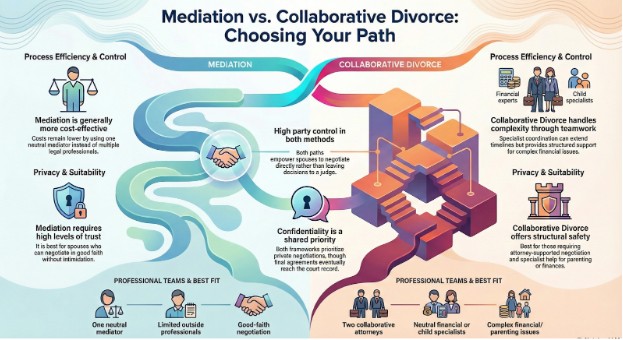
    Comparison Table. Cost, Speed, Control, Privacy, Suitability

    Comparison Table. Cost, Speed, Control, Privacy, Suitability
    FactorMediationCollaborative Divorce
    CostOften lower because one neutral mediator leads sessions, and spouses can limit outside professionalsOften higher because each spouse retains a collaborative attorney, and the process may include neutral financial or child specialists
    SpeedOften faster when spouses exchange documents early and schedule sessions consistentlyIt can be efficient for complex cases, but team scheduling and specialist coordination can extend the timeline 
    ControlHigh party control because spouses negotiate directly with the mediator facilitationHigh party control with structured attorney support and team input during negotiations 
    PrivacyNegotiations are generally confidential, and mediation communications receive statutory protections under the Illinois Uniform Mediation Act Negotiations are generally private within the collaborative framework, but final agreements still reach the court record
    SuitabilityBest fit for spouses who can negotiate in good faith without intimidation and who can exchange financial documents voluntarilyBest fit for spouses who want attorney-supported negotiation, added structure, and specialist help for complex parenting or financial issues 

    Cooper Trachtenberg Law Group can match case goals to a mediation or collaborative structure, so spouses reduce avoidable delay and conflict. Schedule an appointment.

    Cost Drivers And What You Pay For In Each Process

    Mediation costs depend on the mediator’s hours, the number of sessions, and the level of professional review each spouse wants before signing. 

    Mediation costs rise when spouses arrive unprepared, postpone document exchange, or add issues late in the process.

    Collaborative divorce cost depends on attorney time, meeting cadence, and the number of neutral specialists involved. 

    Collaborative divorce costs rise when a case requires a business valuation, complex compensation analysis, or a detailed parenting plan supported by child-focused professionals.

    A spouse who wants a preparation framework that reduces paid meeting time can use a mediation planning checklist, such as mediation preparation.

    A collaborative breakdown creates a specific cost risk because the participation agreement may require the withdrawal of collaborative counsel if the process fails. The Illinois Collaborative Process Act defines the withdrawal trigger within the participation agreement definition

    Speed And Case Flow: What Makes Each Process Faster Or Slower

    Mediation speed improves when spouses exchange financial documents early and batch issues into agenda blocks. Mediation speed slows when spouses treat mediation sessions as discovery rather than decision-making sessions.

    Collaborative divorce speed improves when the team uses structured meeting agendas, defined homework assignments, and a single shared financial dataset. 

    Collaborative divorce speed slows when multiple calendars create long gaps between meetings or when specialists wait on valuations and appraisals.

    Court scheduling does not control the pace of mediation, so mediation can move as fast as spouses’ readiness allows. 

    Court scheduling still affects the filing and approval timeline after settlement, regardless of the negotiation method.

    A spouse seeking an Illinois baseline for duration expectations can refer to an Illinois divorce timeline overview.

    If you’re ready to get started, call us now!

    Privacy And Control: What Stays Private And Who Steers Decisions

    Mediation confidentiality and privilege protections come from the Illinois Uniform Mediation Act, which defines mediation communications and sets confidentiality and privilege rules with exceptions.

    Collaborative divorce emphasizes private negotiation within a defined legal framework, but court filings still exist because court filings finalize divorce terms. Collaborative divorce also concentrates sensitive discussion inside a smaller settlement team rather than open court hearings.

    Mediation gives spouses direct control over negotiation because the mediator facilitates without advocating for either spouse. 

    Collaborative divorce gives spouses the support of negotiated control because each spouse receives attorney guidance during negotiation sessions.

    A spouse who wants an attorney-supported settlement structure without trial escalation can explore the firm’s collaborative process approach through collaborative law.

    Who Should Not Use Mediation in Illinois Divorce Proceedings

    Mediation requires safe, voluntary negotiation because mediation relies on good-faith disclosure and balanced participation. 

    Mediation can produce unfair outcomes when one spouse controls information, controls access to funds, or uses intimidation.

    A spouse should avoid mediation when domestic violence, coercive control, or credible safety concerns prevent free negotiation. 

    A spouse should also avoid mediation when chronic nondisclosure prevents a reliable financial agreement, because mediation does not grant subpoena power within the mediation room.

    A spouse facing financial concealment often needs formal tools that compel disclosure, including the discovery approach described in divorce discovery.

    Choose Mediation Or Collaborative Based On Your Goals

    • Choose mediation when both spouses can exchange documents voluntarily and negotiate without intimidation, so spouses keep the process costs lean and scheduling flexible.
    • Choose mediation when the case involves straightforward assets, stable income, and a parenting plan that needs coordination rather than dispute resolution.
    • Choose collaborative divorce when both spouses want attorney-supported negotiation at the table, so spouses receive real-time guidance on legal and financial tradeoffs. 
    • Choose collaborative divorce when complex finances or parenting complexity benefit from neutral specialists, so spouses reduce rework and miscommunication. 
    • Avoid mediation and escalate structure when safety risks, coercion, or chronic nondisclosure block good-faith negotiation, so the process protects the vulnerable spouse and the children.

    Cooper Trachtenberg Law Group can guide settlement strategy, disclosure, and parenting planning for mediation or collaborative divorce in Illinois. Contact us today.

    Contact Us Today For An Appointment

      I have read the

      Frequently Asked Questions 

      What is the main difference between divorce mediation and collaborative divorce in Illinois?

      Illinois divorce mediation uses a neutral mediator to facilitate negotiation, while Illinois collaborative divorce uses collaborative attorneys and a participation agreement under the Illinois Collaborative Process Act. 

      Which is usually cheaper in Illinois, mediation or collaborative divorce?

      Mediation often costs less because the process typically involves one mediator and fewer professionals. Collaborative divorce often costs more because each spouse retains a collaborative attorney and may use neutral specialists.

      Which is faster, mediation or collaborative divorce?

      Mediation often moves faster when spouses exchange financial documents early and schedule sessions consistently. Collaborative divorce can be efficient for complex issues, but coordinating attorneys and specialists can extend timelines.

      Is mediation confidential in Illinois?

      Illinois mediation communications receive confidentiality and privilege protections under the Illinois Uniform Mediation Act, subject to statutory exceptions.

      What happens if collaborative divorce fails in Illinois?

      Illinois collaborative divorce typically uses a participation agreement that can require collaborative attorneys to withdraw if the process ends without settlement, which can increase restart costs. 

      Who should not use mediation for an Illinois divorce?

      Mediation is a poor fit when domestic violence, coercion, or chronic nondisclosure prevents safe, good-faith negotiation. A spouse facing concealed finances may need formal discovery tools instead.

      What Happens If My Spouse Won’t Disclose Income In An Illinois Divorce? 

      Data last verified: March 2026

      Illinois divorce courts require financial transparency because child support, maintenance, and property division all depend on verified income figures. 

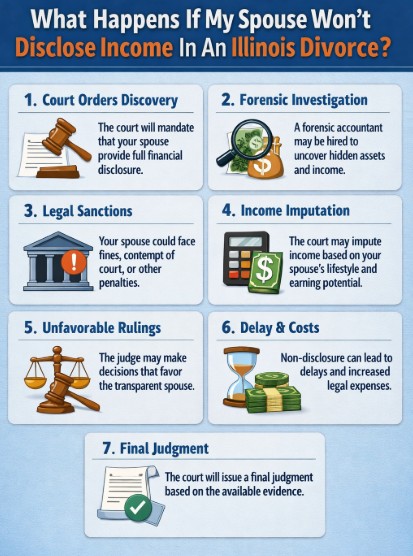
      When a spouse conceals pay, underreports business revenue, or hides cash income, Illinois law provides multiple overlapping tools to force disclosure — and those tools can run in parallel, not in a rigid sequence.

      Illinois judges can order a non-disclosing spouse to produce income records, comply with written discovery, and respond to subpoenas. 

      Illinois judges can also impose discovery sanctions under Illinois Supreme Court Rule 219 when a spouse refuses to comply with court orders.

      Key Takeaways

      • Illinois divorce cases require sworn financial disclosure, including a statewide financial affidavit supported by documents under 750 ILCS 5/501.
      • The requesting party’s tender of their own Financial Affidavit with supporting documents is the triggering event. Once tendered, the requesting party can issue written discovery, serve third-party subpoenas at any time, notice depositions of parties and third parties, and retain forensic accountants, valuators, and other experts — simultaneously and in any order the case requires.
      • When a spouse fails to comply with a discovery after it is issued and past due, attorneys must complete a mandatory 201(k) conference as a good-faith prerequisite before filing a motion to compel.
      • A spouse who documents noncompliance and builds a proof file positions the court to order compliance and assign consequences under Illinois Supreme Court Rule 219.

      Why Income Disclosure Matters In Illinois Divorce

      Why Income Disclosure Matters In Illinois Divorce

      Illinois divorce financial disclosure supports accurate child support, maintenance, attorney fee allocation, and equitable property division. Illinois judges cannot evaluate cash flow, earning capacity, or marital estate structure without reliable income records, because income affects both ongoing payment obligations and settlement leverage.

      Illinois law requires a standardized financial affidavit in divorce and family cases, supported by tax returns, pay stubs, and banking statements under 750 ILCS 5/501(a)(1)

      A sworn financial affidavit creates a legal record because a party signs it under oath, making incomplete or false disclosure a serious exposure point.

      Illinois divorce “income” often exceeds taxable wages. Illinois support analysis can include bonuses, commissions, self-employment draws, investment distributions, and other recurring compensation streams when the evidence supports the classification. Cases involving high-conflict divorce dynamics often surface the most aggressive income concealment patterns.

      A spouse who wants to translate income findings into a workable settlement plan often benefits from structured divorce financial planning from the start.

      If you’re ready to get started, call us now!

      What Triggers The Right To Pursue Income Disclosure

      What Triggers The Right To Pursue Income Disclosure

      The requesting party’s tender of their own Financial Affidavit with supporting documents to the other party is the triggering event for all income disclosure tools. 

      Once that affidavit is tendered, the requesting party can issue written discovery, serve third-party subpoenas, serve notice of depositions, and retain experts — and none of these tools requires that the others be completed first.

      Illinois courts expect both parties to meet the same disclosure baseline. Under Cook County Court Rule 13.3.1, the petitioner must serve a completed Financial Affidavit no later than 30 days after service of the initial pleading, and the respondent must do the same within 30 days of filing an appearance. 

      A spouse who withholds income records after the other side has tendered full disclosure creates a court record that supports sanctions, fee shifting, and other remedial orders.

      Cases involving business ownership, self-employment, or complex compensation structures often benefit from divorce discovery tools deployed simultaneously from the start of the case.

      Discovery Tools Available After Financial Affidavit Is Tendered

      Illinois divorce discovery does not follow a mandatory linear sequence. The tools below can be used in parallel and in any combination that the facts of the case require.

      Written Discovery — Interrogatories And Requests For Production

      Interrogatories force sworn written answers about employment history, compensation structure, side income, business interests, and account locations under Illinois Supreme Court Rule 213

      Requests for production compel the delivery of documents, including electronically stored information, under Illinois Supreme Court Rule 214. Illinois written discovery commonly runs on a 28-day response window unless a court order adjusts the schedule.

      A spouse who receives evasive or partial answers should treat incomplete disclosure as a compliance problem that requires escalation, not a negotiation issue to resolve informally.

      Third-Party Subpoenas

      A third-party subpoena can be served at any time after the requesting party tenders their Financial Affidavit — it does not need to wait for written discovery to be issued or to go unanswered. 

      Subpoenas under Illinois Supreme Court Rule 204 pull records directly from employers, banks, investment platforms, and tax preparers, bypassing the non-disclosing spouse entirely. 

      Third-party documents carry independent business-record reliability, which typically makes them stronger evidence than self-reported disclosure.

      Cook County practitioners can review the county-specific process for financial subpoenas in Cook County divorce cases; DuPage County cases follow related procedures under DuPage County discovery.

      Depositions Of Parties And Third Parties

      Depositions allow sworn oral testimony from the opposing spouse, employers, business partners, accountants, bookkeepers, and other third parties with knowledge of income and assets. 

      Deposition testimony creates a record that is difficult to walk back and frequently surfaces inconsistencies between a spouse’s sworn affidavit statements and third-party documents. Illinois Supreme Court Rule 206 governs deposition procedures in divorce cases.

      Forensic Accountants, Valuators, And Other Experts

      Income concealment tied to business ownership, self-employment, or complex compensation structures often requires expert analysis to reconstruct and present clearly to the court. 

      Forensic accountants can rebuild income from bank deposits, business records, and lifestyle spending patterns. 

      Valuators assess business interests and asset values that affect both support calculations and equitable division. 

      Experts can also identify cash flow manipulation and hidden assets that standard written discovery does not surface on its own. The Illinois CPA Society maintains a directory of forensic accounting professionals with family law experience.

      When A Spouse Doesn’t Comply With Discovery

      A spouse who ignores or evades discovery after it is properly issued triggers an enforcement sequence. Illinois practice under Illinois Supreme Court Rule 201(k) requires attorneys to make a good-faith effort to resolve discovery disputes before filing a motion to compel. 

      That effort includes completing a mandatory 201(k) conference — a direct attorney-to-attorney communication that must occur after discovery is past due and before seeking court intervention.

      If the 201(k) conference does not resolve the dispute, the requesting party can file a motion to compel. A strong motion to compel package includes the original discovery requests, the deficiency notice, documentation of the 201(k) conference, and a clear itemized list of missing items with dates.

      Illinois judges often issue compliance orders with explicit deadlines and follow-up status dates to evaluate whether a spouse is acting in good faith. 

      A spouse who ignores a court order creates an enforcement posture that invites escalating consequences. A spouse who wants a plain-language explanation of what order violations entail can review the consequences of court order violations in Illinois divorce.

      When income records stay missing, Cooper Trachtenberg Law Group can escalate from written discovery to subpoenas, depositions, and motions to compel. Contact us today.

      If you’re ready to get started, call us now!

      Sanctions — What Judges Can Do When Income Disclosure Fails

      Illinois discovery sanctions exist to correct unfairness and deter noncompliance, not simply to punish. Illinois Supreme Court Rule 219(c) is designed to coerce compliance with discovery rules and orders, and courts must strike a balance between enforcing discovery rules and resolving cases on the merits.

      Illinois judges can order fee shifting when one spouse’s obstruction drives unnecessary motion practice. 

      Illinois Supreme Court Rules 137 and 219(c) allow for attorney fees and monetary penalties when the court finds sanctionable conduct by another party or attorney. 

      Illinois judges can also restrict the use of evidence, strike pleadings, or enter other remedial orders designed to prevent a spouse from benefiting from nondisclosure, depending on the procedural posture and the record.

      Illinois financial affidavits carry special risk because 750 ILCS 5/501(a)(1) requires the financial affidavit to be supported by documentary evidence, including income tax returns, pay stubs, and banking statements. 

      A spouse who submits an incomplete affidavit often triggers deeper discovery because the gaps in the affidavit serve as a roadmap to what is missing.

      Proof Checklist — Court-Usable Evidence For Missing Income

      Proof Checklist — Court-Usable Evidence For Missing Income

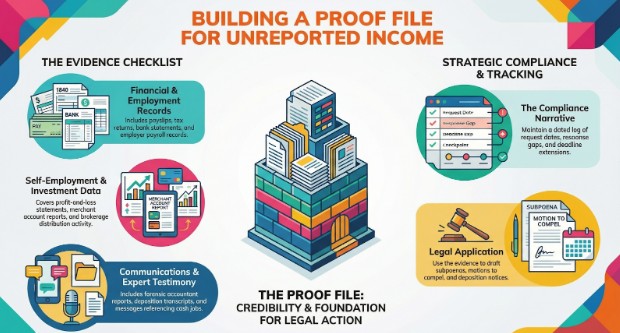
      A proof file wins credibility because it lets the judge see a pattern. A proof file also provides counsel with the information needed to draft subpoenas, motions to compel, deposition notices, and targeted expert-retention letters.

      • Recent pay stubs and year-to-date earnings summaries
      • Prior-year W-2, 1099, K-1, and full tax returns with schedules
      • Bank statements showing deposits, transfers, and cash withdrawals
      • Credit card statements showing recurring spending and lifestyle indicators
      • Employer payroll records, bonus statements, commission reports, and benefits summaries
      • Self-employment records, including profit-and-loss statements, invoices, general ledgers, and merchant account reports
      • Retirement or brokerage statements showing distributions and account activity
      • Written communications referencing side work, bonuses, cash jobs, or business revenue timing
      • Deposition transcripts and sworn third-party testimony records
      • Expert reports from forensic accountants or business valuators
      • A dated log of requests, non-responses, partial responses, and deadline extensions

      A spouse improves court outcomes by documenting request dates, response gaps, and follow-up steps, as this documentation supports a clear compliance narrative for the judge. 

      A spouse who expects settlement talks can also pair the proof file with a mediation preparation posture that uses defined income categories and verified timelines.

      Discovery Tools And Decision Points — Reference Table

      Illinois divorce discovery timelines vary by county, judge, and case complexity. The table below reflects the corrected framework — tools run in parallel after the Financial Affidavit is tendered, not in a mandatory sequence.

      StageToolWhat Gets Served Or FiledTypical Response WindowDecision Trigger
      1Financial Affidavit tenderThe requesting party serves its own affidavit with supporting documents30 days after initial pleading (Cook County Rule 13.3.1)Activates all discovery rights
      2Written discoveryInterrogatories under Rule 213; RFP under Rule 214Often 28 days unless ordered otherwiseEvasive answers, missing sources, incomplete documents
      3Third-party subpoenasRecords from employers, banks, tax preparers under Rule 204Varies by recipientAvailable any time after affidavit tender; bypasses spouse entirely
      4DepositionsSworn oral testimony of spouse or third parties under Rule 206Scheduled by noticeInconsistencies between affidavit and third-party records
      5Expert retentionForensic accountant, valuator, or other specialistOngoingComplex income, business interests, or suspected hidden assets
      6201(k) conferenceMandatory good-faith attorney conference after discovery is past dueBefore motion to compelRequired prerequisite before court intervention
      7Motion to compelCourt motion with deficiency list and 201(k) documentationHearing set by courtNonresponse after written discovery and 201(k) conference
      8SanctionsRule 219 remedies requestCourt-specificContinued noncompliance after court order

      A spouse who needs a faster path should prioritize third-party subpoenas and expert retention when payroll, bank, and business records exist outside the spouse’s direct control.

      If nondisclosure is delaying your divorce, request a strategy call with Cooper Trachtenberg Law Group to build proof, enforce orders, and move forward. Contact us.

      Contact Us Today For An Appointment

        I have read the

        Frequently Asked Questions

        What can I do first if my spouse won’t disclose income in an Illinois divorce? 

        The first step is to tender your own Financial Affidavit, with supporting documents, to the other party. That tender activates your right to issue written discovery, serve third-party subpoenas, notice depositions, and retain experts — all simultaneously.

        Can an Illinois judge force my spouse to provide pay stubs and tax returns? 

        Illinois judges can order the production of income documents through discovery orders. Sanctions under Illinois Supreme Court Rule 219 apply when a spouse disobeys discovery rules or court orders and may include fee shifting, evidentiary restrictions, and other remedial orders.

        What discovery requests work best for hidden income? 

        Written discovery under Illinois Supreme Court Rule 213 and Rule 214 targets income sources and supporting documents. Third-party subpoenas under Rule 204 compel employers and banks to produce records directly. Depositions and forensic accountant analysis are also effective when income concealment involves business ownership, self-employment, or complex compensation structures.

        Can I subpoena my spouse’s employer or bank before written discovery is complete? 

        Yes. A third-party subpoena under Illinois Supreme Court Rule 204 can be served at any time after the requesting party tenders its Financial Affidavit with supporting documents. Subpoenas do not need to wait for written discovery to be issued or to go unanswered.

        What is a 201(k) conference, and when does it happen? 

        A 201(k) conference is a mandatory good-faith attorney communication required before a party can file a motion to compel. It occurs after discovery has been issued, and the response deadline has passed without adequate compliance, not before discovery is served.

        What happens if my spouse lies on a financial affidavit? 

        Illinois requires a statewide financial affidavit, along with supporting documents, under 750 ILCS 5/501. A false or incomplete affidavit can trigger deeper written discovery, third-party subpoenas, depositions, expert analysis, and potential sanctions depending on the record.

        How long does it take to force income disclosure in an Illinois divorce? 

        Timing depends on county scheduling, case complexity, and compliance. Many cases move from written discovery to subpoenas and depositions within weeks, then escalate to a motion to compel and sanctions if a spouse continues refusing. Third-party subpoenas often produce records faster than waiting for a spouse to comply directly.