
The Complete Illinois Prenuptial Agreement Guide: What Engaged Couples Need to Know

A prenuptial agreement in Illinois is a written contract signed by two people before marriage that defines how assets, debts, and financial rights will be divided if the marriage ends in divorce or death. 

Illinois courts enforce prenuptial agreements under the Illinois Uniform Premarital Agreement Act, 750 ILCS 10/1 et seq., provided both parties signed voluntarily, with full financial disclosure, and without unconscionable terms.

Key Takeaways

  • Illinois enforces prenuptial agreements under 750 ILCS 10/1 et seq. when both parties sign voluntarily with full financial disclosure.
  • A prenuptial agreement can protect separate property, business interests, inheritance rights, and define spousal maintenance terms.
  • Courts will void a prenup signed under duress, without independent legal counsel, or without honest asset disclosure.
  • Illinois does not require a waiting period, but signing well before the wedding date strengthens the enforceability of the agreement.

What Is a Prenuptial Agreement Under Illinois Law?

A prenuptial agreement in Illinois is a legally binding contract that two people execute before marriage to govern property rights, financial obligations, and spousal support in the event of divorce, legal separation, or death. 

Illinois courts treat prenuptial agreements as enforceable contracts under the Illinois Uniform Premarital Agreement Act, 750 ILCS 10/1 et seq., which the state adopted to standardize how courts review and uphold these documents.

ElementRequirement Under 750 ILCS 10
FormWritten and signed by both parties
ConsiderationMarriage itself
DisclosureFull and fair financial disclosure
VoluntarinessNo fraud, duress, or coercion
Effective dateUpon marriage

Couples use prenuptial agreements to protect premarital assets, clarify debt responsibility, preserve inheritance rights for children from prior relationships, and define spousal maintenance terms before conflict arises. 

The agreement does not cover child support because Illinois courts determine those matters based on the best interests of the child at the time of divorce, not on a prior contract.

What Can a Prenuptial Agreement Cover in Illinois?

Illinois law under 750 ILCS 10/4 allows parties to address a wide range of financial matters in a prenuptial agreement. 

Understanding what the agreement can and cannot govern helps couples draft terms that Illinois courts will actually enforce.

Covered topics include rights and obligations regarding marital and separate property, the right to buy, sell, lease, or manage property, the disposition of assets upon separation or death, the modification or elimination of spousal maintenance, ownership of life insurance proceeds, and the choice of law governing interpretation. Parties may also address any matter not in violation of public policy or criminal law.

A prenuptial agreement cannot govern child custody or parenting time arrangements, child support obligations, or any provision that incentivizes divorce or places one party at a disadvantage through fraud or misrepresentation.

PermittedNot Permitted
Property rights and divisionChild custody or parenting time
Spousal maintenance termsChild support amounts
Debt allocationProvisions encouraging divorce
Inheritance and estate rightsTerms violating public policy
Business ownership interestsFraudulent or coercive clauses

The distinction between marital and non-marital property matters significantly in Illinois. Under the Illinois Marriage and Dissolution of Marriage Act, 750 ILCS 5/503, marital property is subject to equitable distribution at divorce. 

A well-drafted prenuptial agreement can reclassify certain assets or limit what qualifies as marital property, reducing ambiguity when the marriage ends. 

Couples navigating property division in an Illinois divorce benefit from understanding how prenuptial terms interact with equitable distribution law before signing.

If you’re ready to get started, call us now!

How Illinois Courts Decide Whether to Enforce a Prenuptial Agreement

Illinois courts will void a prenuptial agreement if the challenging party proves one of the grounds listed in 750 ILCS 10/7. Enforceability turns on four core factors: voluntariness, disclosure, unconscionability, and procedural fairness.

Voluntariness

A court will invalidate a prenuptial agreement signed under duress, fraud, or coercion. Pressure applied close to the wedding date, particularly when one party had no time to consult independent legal counsel, is a common basis for challenge.

Illinois courts look at the totality of circumstances surrounding signing, not just the document itself. Couples working through sensitive financial negotiations before marriage often find that collaborative law provides a structured environment where both parties feel heard and respected throughout the process.

Full Financial Disclosure

Each party must provide a fair and reasonable disclosure of all property and financial obligations before signing. A prenuptial agreement signed without honest disclosure of assets or debts is unenforceable under 750 ILCS 10/7(a)(2). 

Courts do not require a precise dollar-for-dollar accounting, but deliberate concealment of significant assets — real estate, business interests, retirement accounts — is grounds for invalidation. 

Clients with complex marital assets should ensure their prenuptial agreement reflects a complete financial picture from the outset.

Unconscionability

A prenuptial agreement is unconscionable when its terms are so one-sided that no reasonable person would agree to them under fair circumstances. Illinois courts evaluate unconscionability at the time of signing, not at the time of enforcement. 

An agreement that leaves one spouse with no financial support after a long marriage may face a stronger unconscionability challenge than one with proportionate terms. Understanding Illinois maintenance law helps couples draft prenuptial maintenance waivers that courts are more likely to uphold.

Procedural Fairness

Courts also examine whether both parties had a meaningful opportunity to review the agreement, consult their own attorneys, and propose changes. 

A prenuptial agreement presented as a take-it-or-leave-it document days before the wedding, with no opportunity for negotiation, is procedurally suspect. 

Illinois does not mandate a minimum waiting period by statute, but signing at least 30 days before the wedding date is a widely recommended best practice. Couples who want structured, transparent prenuptial negotiations benefit from working with attorneys experienced in Illinois mediation.

Protecting Business Interests With a Prenuptial Agreement

Business owners entering marriage face particular exposure without a prenuptial agreement. In Illinois, an increase in the value of a premarital business during marriage may qualify as marital property subject to division under 750 ILCS 5/503(a)(7), even if the business itself was owned before the marriage. 

A prenuptial agreement can define the business as separate property, cap any marital interest in business appreciation, and establish whether a spouse has any claim to business income generated during the marriage.

Business ScenarioWithout PrenupWith Prenup
Business owned before marriageAppreciation may be maritalAppreciation is defined as separate
Business started during marriageLikely marital propertyCan be designated separately
Business income during marriageSubject to equitable distributionTerms defined in advance
Buyout of co-ownersCourt-ordered valuation possibleAn agreement can govern the process

Family-owned businesses, professional practices, and closely held corporations each carry unique valuation challenges in Illinois business divorce proceedings. 

A prenuptial agreement that addresses business ownership directly protects both spouses from protracted valuation disputes later. 

Couples who did not execute a prenuptial agreement and are now facing business valuation in divorce should review how complex assets affect Illinois divorce outcomes before proceeding.

Prenuptial Agreements and Spousal Maintenance in Illinois

Illinois calculates spousal maintenance under a statutory formula tied to the length of the marriage and the parties’ incomes, per 750 ILCS 5/504

A prenuptial agreement can modify or waive that formula entirely, provided the waiver does not leave one spouse eligible for public assistance at the time of enforcement. 

Courts scrutinize maintenance waivers more carefully when the marriage was long, and one spouse sacrificed career advancement for the household.

Couples choosing to limit or waive maintenance in a prenuptial agreement should clearly document their reasoning and ensure that both parties have received independent legal advice before signing. 

Maintenance provisions in prenuptial agreements can also address duration, amount, and conditions for modification. A couple may agree that maintenance terminates upon cohabitation or remarriage, or that it follows a fixed schedule rather than the statutory formula. 

These terms are enforceable in Illinois as long as they meet the voluntariness and disclosure standards under 750 ILCS 10/7. 

Clients who want to understand how maintenance interacts with the broader Illinois divorce timeline will find that context useful before finalizing any prenuptial maintenance waiver.

If you’re ready to get started, call us now!

How to Draft an Enforceable Prenuptial Agreement in Illinois

An enforceable Illinois prenuptial agreement requires more than two signatures on a document. The drafting process, timing, and negotiation structure all affect whether a court will uphold the agreement when challenged.

The core requirements are: the agreement must be in writing, signed by both parties, supported by full financial disclosure, and entered into voluntarily without fraud, duress, or coercion. 

Both parties benefit from separate legal representation throughout the process. When both spouses have their own attorney reviewing and negotiating terms, the risk of a successful enforceability challenge drops significantly.

Attorneys experienced in collaborative divorce are well-positioned to help couples negotiate prenuptial terms because the collaborative process is built around interest-based negotiation and mutual disclosure — the same values that make prenuptial agreements enforceable. 

Couples who approach prenuptial negotiations with transparency and professional guidance are far more likely to produce an agreement that courts uphold, and both parties view as fair.

Practical steps for a sound prenuptial agreement include beginning negotiations at least 60 to 90 days before the wedding, retaining separate attorneys, exchanging complete financial statements, reviewing multiple drafts, and signing the final agreement well before the wedding date with no last-minute pressure. 

Clients entering a subsequent marriage after a previous divorce often bring specific asset protection priorities to prenuptial negotiations that require particularly careful drafting.

What Happens to a Prenuptial Agreement During Divorce

When a couple files for divorce in Illinois, a valid prenuptial agreement becomes a governing document for property division and spousal maintenance. 

The court will enforce its terms unless one spouse successfully challenges enforceability under 750 ILCS 10/7. The burden of proof falls on the party seeking to invalidate the agreement.

If no prenuptial agreement exists, or if the court voids it, Illinois applies equitable distribution principles under 750 ILCS 5/503 to divide marital property. 

Equitable does not mean equal — courts weigh the length of the marriage, each spouse’s contributions, economic circumstances, and other statutory factors. Clients who did not execute a prenuptial agreement should review how property division in Illinois works before filing.

A prenuptial agreement that addresses retirement accounts must also be reviewed against federal law. Certain retirement plans governed by ERISA require a specific spousal waiver that a prenuptial agreement alone may not satisfy. 

Addressing the division of retirement accounts separately in both the prenuptial agreement and estate planning documents protects both parties from unintended gaps in coverage.

Prenuptial Agreements vs. Postnuptial Agreements in Illinois

A postnuptial agreement serves the same function as a prenuptial agreement but is executed after the marriage has already taken place. 

Illinois courts apply heightened scrutiny to postnuptial agreements because the parties are already in a legally defined relationship with existing rights and obligations. The voluntariness and disclosure standards under 750 ILCS 10/7 still apply, but courts are particularly attentive to power imbalances that may emerge within an existing marriage.

Couples who did not sign a prenuptial agreement before marriage, or who want to update existing terms after significant life changes — a new business, an inheritance, or children from a prior relationship — can pursue a postnuptial agreement with experienced Illinois family law counsel. 

The post-divorce modification process similarly allows parties to revisit financial arrangements as circumstances change after a divorce is finalized.

Contact Us Today For An Appointment

    I have read the

    Frequently Asked Questions 

    Does Illinois require both parties to have separate attorneys for a prenuptial agreement to be valid? 

    Illinois law does not mandate separate attorneys for a prenuptial agreement to be valid, but courts treat independent legal representation as strong evidence of voluntariness. A prenuptial agreement signed without independent counsel is not automatically invalid, but it faces a higher risk of a duress or misunderstanding challenge, particularly when one spouse had significantly more legal or financial sophistication than the other.

    How long before the wedding should a prenuptial agreement be signed in Illinois? 

    Illinois law sets no statutory minimum waiting period for prenuptial agreements, but family law practitioners consistently recommend finalizing and signing the agreement at least 30 days before the wedding. Agreements signed within days of the ceremony are more vulnerable to a duress challenge, because courts may find that social and logistical pressure made truly voluntary consent impossible at that point.

    Can a prenuptial agreement in Illinois eliminate spousal maintenance entirely? 

    A prenuptial agreement in Illinois can waive or limit spousal maintenance under 750 ILCS 10/4(a)(3), with one important exception: a court will not enforce a maintenance waiver that leaves the receiving spouse eligible for public assistance at the time of divorce. Outside that threshold, Illinois courts generally enforce voluntarily negotiated maintenance waivers when both parties have legal counsel and full financial disclosure at the time of signing.

    What financial information must both parties disclose before signing? 

    Each party must provide a fair and reasonable disclosure of all property and financial obligations before signing a prenuptial agreement in Illinois. This includes real estate, investment accounts, retirement funds, business interests, outstanding debts, and any significant anticipated inheritance. Deliberate concealment of material assets is grounds for the court to void the agreement under 750 ILCS 10/7(a)(2).

    Can a prenuptial agreement address what happens to property inherited during the marriage? 

    A prenuptial agreement in Illinois can specify that inheritance received during the marriage remains the separate property of the recipient spouse and does not become marital property subject to division. Without that provision, inherited assets that become commingled with marital funds risk losing their separate-property classification under Illinois law, exposing them to equitable distribution upon divorce.

    Will an Illinois court enforce a prenuptial agreement if one spouse did not read it before signing? 

    A spouse who signs a prenuptial agreement without reading it generally cannot later claim lack of understanding as grounds for invalidation, provided they had a reasonable opportunity to review the document and access to legal counsel. Illinois courts expect parties to take responsibility for agreements they sign. However, if the document was withheld until signing day, with no time for review, a court may view that as procedural unfairness that supports a duress or fraud claim.

    Can a prenuptial agreement protect a business one spouse starts during the marriage? 

    A prenuptial agreement can designate a business formed during the marriage as the separate property of the founding spouse, but courts scrutinize such provisions carefully, as Illinois presumes assets acquired during the marriage are marital property. Clear, specific language defining the business’s separate property status — combined with evidence that both spouses understood and agreed to that classification — significantly strengthens the enforceability of that provision.

    What makes a prenuptial agreement unconscionable under Illinois law? 

    An Illinois court finds a prenuptial agreement unconscionable when its terms are so one-sided that enforcement would be fundamentally unjust to one party. Courts evaluate unconscionability at the time of signing, not at the time of divorce. Provisions that strip one spouse of all financial rights after a long marriage, or that were negotiated under conditions preventing meaningful review, are the most common unconscionability targets in Illinois prenuptial agreement litigation.

    What Can and Cannot Be Included in an Illinois Prenuptial Agreement

    An Illinois prenuptial agreement can include property rights, debt allocation, spousal maintenance terms, and business ownership designations — but cannot govern child custody, child support, or any provision that violates Illinois public policy.

     Illinois courts enforce the terms of a prenuptial agreement under the Illinois Uniform Premarital Agreement Act, 750 ILCS 10/4, when both parties signed voluntarily and with full financial disclosure.

    Key Takeaways

    • Illinois law under 750 ILCS 10/4 defines what a prenuptial agreement can and cannot cover.
    • Property division, spousal maintenance, debt allocation, and business interests are all permissible topics for a prenuptial agreement.
    • Child custody, parenting time, and child support cannot be predetermined in a prenuptial agreement under Illinois law.
    • Any prenuptial provision that violates public policy or was obtained through fraud or coercion is unenforceable in Illinois courts.

    What Illinois Law Says a Prenuptial Agreement Can Include

    What Illinois Law Says a Prenuptial Agreement Can Include

    Illinois courts enforce prenuptial agreement terms that fall within the categories authorized by 750 ILCS 10/4. Couples who understand these categories draft stronger agreements and face fewer enforceability challenges at divorce. 

    The complete Illinois prenuptial agreement guide covers the full legal framework, including voluntariness and disclosure requirements that apply to every term in the agreement.

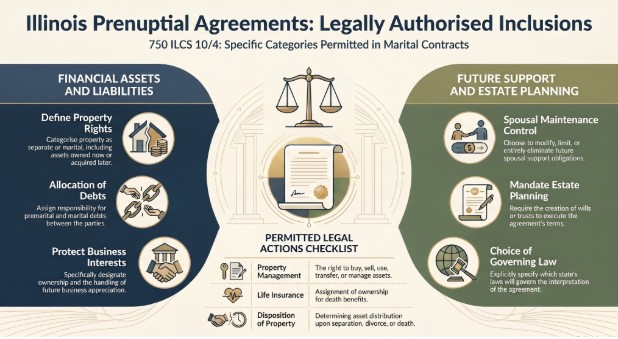
    The statute authorizes prenuptial agreements to address the rights and obligations of each party with respect to property owned at the time of marriage or acquired afterward, the right to buy, sell, use, transfer, or otherwise manage and control property, the disposition of property upon separation, divorce, or death, modification or elimination of spousal maintenance, the making of a will or trust to carry out the agreement, ownership of life insurance policy death benefits, choice of law governing the agreement, and any other matter not in violation of public policy or a criminal statute.

    Permitted CategoryWhat the Agreement Can Do
    Property rightsDefine separate vs. marital property
    Debt allocationAssign premarital and marital debts
    Spousal maintenanceModify, limit, or waive maintenance
    Business interestsDesignate ownership and appreciation
    Estate planningRequire wills or trusts consistent with the agreement
    Life insuranceAssign death benefit ownership
    Choice of lawSpecify which state’s law governs

    Property Rights and Division

    A prenuptial agreement in Illinois can define which assets each spouse retains as separate property and which assets will be treated as marital property subject to equitable distribution at divorce. 

    Without a prenuptial agreement, Illinois courts apply 750 ILCS 5/503 to classify and divide marital property, which can result in outcomes neither spouse anticipated.

    Couples commonly use prenuptial agreements to protect premarital real estate, investment portfolios, retirement savings, and family heirlooms from being reclassified as marital property through commingling during the marriage. 

    An agreement can specify that certain assets remain separate regardless of how they are titled or used during the marriage, providing clarity that courts will enforce.

    Inheritance received before or during the marriage presents a particular planning opportunity. A prenuptial agreement can designate anticipated or received inheritances as separate property, protecting family wealth transfers from exposure in a future Illinois divorce

    Without that designation, inherited assets that are commingled with marital funds risk losing their separate property status under Illinois law.

    If you’re ready to get started, call us now!

    Debt Allocation

    A prenuptial agreement in Illinois can assign responsibility for premarital debts to the spouse who incurred them, protecting the other spouse from creditor claims after marriage. Illinois courts do not automatically hold one spouse liable for the other’s premarital debts, but a prenuptial agreement adds a contractual layer of protection that clarifies each party’s obligations from the outset.

    A prenuptial agreement can also address how marital debts incurred during the marriage will be allocated at divorce. 

    Couples with student loan balances, business liabilities, or anticipated credit obligations benefit from prenuptial debt allocation provisions that courts can enforce without requiring lengthy financial discovery.

    Debt TypeWithout PrenupWith Prenup
    Premarital student loansMay create marital exposureAssigned to the originating spouse
    Business liabilitiesSubject to equitable allocationDesignated as a separate obligation
    Credit card debt incurred during marriageDivided equitablyAllocated per agreement terms
    Mortgage on premarital propertyCommingling risk at divorceClarified as a separate obligation

    Spousal Maintenance Modification and Waiver

    Illinois calculates spousal maintenance under a statutory formula in 750 ILCS 5/504, which ties award amounts and duration to the length of the marriage and each spouse’s income as of 2026. 

    A prenuptial agreement can modify that formula, set a fixed maintenance amount, cap the duration of payments, or waive maintenance entirely — subject to one statutory limit.

    Under 750 ILCS 10/7(b), an Illinois court will not enforce a prenuptial maintenance waiver that leaves the receiving spouse eligible for public assistance at the time of divorce. Outside that threshold, courts generally respect voluntarily negotiated maintenance terms when both parties had independent legal counsel and full financial disclosure. 

    Clients planning to include a maintenance waiver should also understand how Illinois maintenance law applies at divorce, so the waiver is drafted with appropriate precision.

    A prenuptial agreement can also define the conditions under which maintenance terminates — upon remarriage, cohabitation with a new partner, or a specific calendar date. 

    These conditional termination provisions are enforceable in Illinois when they are clearly drafted, and both parties understand their implications at signing.

    Business Ownership and Appreciation

    Business owners use prenuptial agreements in Illinois to protect premarital business interests from being classified as marital property at divorce. Under 750 ILCS 5/503(a)(7), the increase in value of a premarital business during marriage can qualify as marital property if that appreciation resulted from marital effort or contributions. 

    A prenuptial agreement can contractually define business appreciation as separate property, removing it from the marital estate regardless of how the business grows during the marriage.

    The agreement can address the founding spouse’s premarital business, a business started during the marriage that one spouse intends to own separately, buyout obligations if the other spouse has any involvement in the business, and restrictions on the non-owning spouse’s ability to claim an interest in business income. Couples facing complex asset division at divorce without a prenuptial agreement often encounter business valuation disputes that a well-drafted prenuptial provision would have avoided.

    Estate Planning Integration

    A prenuptial agreement in Illinois may require either or both spouses to execute a will, a trust, or a beneficiary designation consistent with the agreement’s terms. 

    This provision is particularly important for spouses who have children from prior relationships and want to ensure that estate assets pass to those children rather than being subject to a surviving spouse’s elective share claim under Illinois law.

    Without coordinated estate planning, a prenuptial agreement’s property designations may conflict with Illinois’s default inheritance rules. 

    The post-divorce modification process similarly highlights that financial arrangements made during marriage require ongoing attention as circumstances change — the same principle applies to estate planning documents that should track the terms of a prenuptial agreement throughout the marriage.

    If you’re ready to get started, call us now!

    What a Prenuptial Agreement Cannot Include in Illinois

    Illinois law imposes firm limits on the content of prenuptial agreements. Courts will void individual provisions — or the entire agreement — when terms cross into prohibited categories. Understanding these limits is as important as knowing what the agreement can cover.

    Child Custody and Parenting Time

    A prenuptial agreement cannot predetermine child custody arrangements or parenting time schedules. Illinois courts retain exclusive authority to determine custody and parenting time based on the best interests of the child at the time of divorce, per 750 ILCS 5/602.7

    No prenuptial provision can override that standard. Parents who want structured parenting frameworks in place before conflict arises benefit from working with collaborative law attorneys who can help establish cooperative co-parenting agreements outside the prenuptial context.

    Child Support

    A prenuptial agreement cannot set, waive, or limit child support obligations. Illinois courts calculate child support under the Income Shares model established in 750 ILCS 5/505, which bases support on both parents’ incomes and the child’s needs at the time of the order. 

    A prenuptial provision purporting to fix or eliminate child support is void and unenforceable as against public policy.

    Provisions That Encourage Divorce

    Illinois courts will not enforce prenuptial provisions that create a financial incentive for one spouse to seek divorce. An agreement structured so that one party receives a substantial windfall upon filing for divorce, for example, violates public policy because it undermines the institution of marriage rather than planning for its possible end. 

    Courts distinguish between fair planning provisions and provisions designed to make divorce financially attractive.

    Unconscionable or Fraudulent Terms

    Any prenuptial provision that is unconscionable at the time of signing — meaning so one-sided that no reasonable person would have agreed to it voluntarily — is subject to invalidation under 750 ILCS 10/7. 

    Courts also void provisions obtained through fraud, duress, or deliberate concealment of material financial information. Couples who negotiate prenuptial terms through the collaborative divorce process significantly reduce the risk of unconscionability challenges because the process is built around transparent, interest-based negotiation.

    Personal Conduct Provisions

    Illinois courts are reluctant to enforce prenuptial provisions that attempt to regulate personal behavior during the marriage — fidelity clauses, lifestyle restrictions, or social conduct requirements. While some states have enforced such provisions in limited circumstances, Illinois courts focus prenuptial enforcement on financial and property matters rather than personal conduct regulation.

    How to Ensure Every Provision Is Enforceable

    Drafting enforceable prenuptial provisions requires attention to both content and process. A term that falls within a permitted category can still be invalidated if the agreement itself was signed under duress, without adequate financial disclosure, or without a meaningful opportunity for both parties to consult independent counsel.

    Both parties should retain separate attorneys before negotiations begin. Each spouse needs independent legal advice to understand the implications of every provision, and courts treat separate representation as strong evidence of voluntariness. 

    Couples who approach prenuptial negotiations through collaborative law benefit from a structured process that builds in the transparency and mutual understanding that makes agreements enforceable.

    Full financial disclosure is non-negotiable. Each party must provide a complete accounting of assets, debts, income, and financial obligations before signing. 

    An agreement signed without honest disclosure is voidable under 750 ILCS 10/7(a)(2) regardless of how well the individual provisions are drafted. 

    Clients with complex marital assets should prepare detailed financial schedules as exhibits to the agreement, documenting the disclosure that supports each property designation.

    Timing matters. An agreement signed under pressure days before the wedding faces a higher duress challenge than one negotiated and finalized months in advance. 

    The Illinois divorce timeline illustrates how courts review the full history of a marriage when evaluating disputed agreements — the circumstances of signing become part of that record.

    Contact Us Today For An Appointment

      I have read the

      Frequently Asked Questions 

      Can an Illinois prenuptial agreement define which spouse keeps the marital home at divorce? 

      An Illinois prenuptial agreement can designate the marital home as the separate property of one spouse, specify how equity will be divided at divorce, or establish a buyout formula. Without that designation, the marital home is subject to equitable distribution under 750 ILCS 5/503, which applies to all marital property at divorce.

      Can a prenuptial agreement in Illinois protect a spouse from the other’s student loan debt? 

      A prenuptial agreement in Illinois can assign premarital student loan debt to the spouse who incurred it, protecting the other spouse from any repayment obligation during the marriage or at divorce. Without that provision, courts may consider the educational benefit to the marriage when allocating debt under equitable distribution principles.

      Can an Illinois prenuptial agreement address retirement accounts? 

      A prenuptial agreement in Illinois can designate premarital retirement account balances as separate property and specify how marital contributions will be treated at divorce. Certain ERISA-governed plans require a separate spousal waiver that a prenuptial agreement alone does not satisfy. Addressing retirement account division in both the prenuptial agreement and a coordinated estate plan closes that gap.

      Can a prenuptial agreement waive the right to a share of the other spouse’s future income? 

      A prenuptial agreement in Illinois can limit or waive spousal maintenance rights tied to the other party’s income, but cannot waive child support obligations. Child support under 750 ILCS 5/505 is calculated based on both parties’ actual incomes at the time of a support order. A maintenance waiver leaving one spouse eligible for public assistance at divorce will not be enforced under 750 ILCS 10/7(b).

      Does an Illinois prenuptial agreement need to list every asset to be enforceable? 

      Illinois law requires fair and reasonable financial disclosure rather than a precise asset-by-asset inventory. Courts look for evidence that both parties had a general understanding of each other’s financial picture before signing. Detailed financial schedules attached as exhibits strengthen the showing, particularly for high-value assets such as real estate, business interests, or retirement accounts.

      Can a prenuptial agreement include provisions about social media or public conduct? 

      Illinois courts focus on enforcing prenuptial agreements in financial and property matters. Personal conduct provisions — including social media restrictions, fidelity clauses, or lifestyle requirements — are generally unenforceable in Illinois because they fall outside the financial scope of 750 ILCS 10/4 and raise public policy concerns about regulating private conduct through contract.

      Can an Illinois prenuptial agreement be changed after the wedding? 

      A prenuptial agreement in Illinois can be amended or revoked after the wedding through a written postnuptial agreement signed by both parties. The same voluntariness and disclosure standards that apply to prenuptial agreements apply to any post-marriage modification. Couples wanting to update their agreement after significant life changes should work with experienced Illinois family law attorneys to ensure the modification is enforceable.

      What happens if one provision in an Illinois prenuptial agreement is invalid? 

      Illinois courts apply a severability analysis to prenuptial agreements. If one provision is unenforceable — because it crosses into a prohibited category or was obtained through fraud — courts will typically void that provision while enforcing the remainder of the agreement, provided the invalid provision was not so central to the overall agreement that its removal defeats the parties’ intent.

      How to Bring Up a Prenup With Your Partner Without Damaging the Relationship

      Bringing up a prenuptial agreement with a partner works best when framed as a shared financial planning conversation rather than a statement of distrust. 

      Couples who introduce the topic early, explain their reasoning honestly, and allow time for both partners to consult independent attorneys report significantly less relationship strain than couples who raise the subject close to the wedding date.

      Key Takeaways

      • Timing matters: raising a prenuptial agreement at least 90 days before the wedding reduces pressure and strengthens enforceability under Illinois law.
      • Framing the conversation around shared financial goals rather than divorce planning reduces partners’ defensive reactions.
      • Both partners retaining independent legal counsel before signing protects the relationship by ensuring neither party feels pressured or uninformed.
      • Illinois courts treat last-minute prenuptial agreements as a red flag of duress — early conversations protect both the relationship and the document’s legal standing.

      Why the Timing of the Prenup Conversation Matters

      Raising a prenuptial agreement early in the engagement protects both the relationship and the agreement’s enforceability under the Illinois Uniform Premarital Agreement Act, 750 ILCS 10/1 et seq. 

      Illinois courts examine the circumstances of signing when evaluating enforceability challenges — an agreement presented weeks before the wedding carries a higher risk of duress than one negotiated months in advance. 

      The complete Illinois prenuptial agreement guide explains in detail how voluntariness and timing interact with enforceability.

      Couples who begin the prenuptial conversation at least 90 days before the wedding give both partners time to process the request, consult independent attorneys, review financial disclosures, and negotiate terms without social or logistical pressure. 

      That timeline also signals to a reviewing court that neither party was coerced by the imminence of the wedding.

      Waiting until the final weeks before the ceremony creates two compounding problems. The emotional stakes of the wedding itself make rational financial negotiation harder, and the compressed timeline gives courts reason to question whether both parties had a genuine opportunity for independent review. 

      Illinois family law practitioners consistently advise clients to treat the prenuptial conversation as a pre-engagement or early-engagement priority rather than a last-minute checklist item.

      How to Frame the Prenup Conversation Constructively

      The most effective prenuptial conversations begin with the reason behind the request, not the document itself. A partner who hears “I want us to talk about financial planning before we get married” responds differently than a partner who hears “I want you to sign a prenup.” 

      Leading with the underlying goal — protecting both parties, clarifying financial expectations, preserving family assets — shifts the conversation from adversarial to collaborative.

      Couples entering marriage with significantly different financial profiles, business interests, children from prior relationships, or family inheritance expectations have concrete, explainable reasons for wanting a prenuptial agreement. 

      Naming those reasons directly — “I own a business that my family helped build, and I want to protect their investment” or “I have significant student debt, and I don’t want that to affect you if things change” — makes the request specific rather than abstract.

      Collaborative law attorneys trained in interest-based negotiation can help couples structure the prenuptial conversation around shared goals rather than competing interests. The collaborative process is built on mutual disclosure and joint problem-solving, which makes it particularly well-suited to prenuptial negotiations, where both parties seek a fair outcome and a strong relationship.

      What to Say When You Bring Up a Prenup

      Specific language matters in the prenuptial conversation. Vague framing — “I just think it’s a good idea” — gives a partner little to engage with and can come across as dismissive. Concrete, personal framing gives both partners something substantive to discuss.

      Effective opening framing includes statements that connect the prenuptial agreement to shared values rather than anticipated failure. 

      Examples of constructive openings include: “I want us to talk openly about our finances before we get married so we both go in with clear expectations.” Or: “I’ve been thinking about how to protect both of us financially, and I’d like to explore whether a prenuptial agreement makes sense for our situation.” 

      Or: “My family has assets that go back generations, and I have an obligation to address that before we marry — I want to do it in a way that feels fair to both of us.”

      What to avoid is equally important. Framing the prenuptial agreement as protection against the partner specifically — “in case you leave” or “if you decide this isn’t working” — personalizes the request in a way that creates defensiveness. The agreement plans for a legal contingency, not a predicted outcome.

      If you’re ready to get started, call us now!

      How to Handle a Partner Who Reacts Negatively

      A negative initial reaction to a request for a prenuptial agreement is common and does not necessarily mean the conversation has failed. 

      Partners who feel surprised, hurt, or defensive when first hearing the request often reach a different position once they have time to understand the purpose of the agreement and consult independent legal counsel.

      A partner who needs space to react should receive that space without immediate pressure toward agreement. 

      Acknowledging the emotional weight of the request — “I understand this feels uncomfortable, and I want to talk through it at whatever pace works for you” — keeps the conversation open without abandoning the prenuptial planning goal.

      Partners who remain opposed after initial discussion often benefit from speaking with their own attorney before the next conversation. 

      An independent attorney can explain what a prenuptial agreement can and cannot do under 750 ILCS 10/4, address misconceptions about the document’s implications, and help the resistant partner identify their own interests within the negotiation. 

      Couples who each retain independent counsel before negotiating terms are significantly more likely to reach an agreement both parties feel is fair.

      If a partner’s objection is that the prenuptial agreement signals distrust, explaining what the agreement cannot cover often helps. 

      A prenuptial agreement cannot govern child custody, cannot require a specific outcome at divorce, and cannot override Illinois courts’ equitable distribution authority for assets acquired jointly during the marriage. 

      A partner who understands those limits is better positioned to evaluate the agreement on its actual terms rather than on assumptions about its scope.

      Common Concerns Partners Raise and How to Address Them

      Common Concerns Partners Raise and How to Address Them

      Partners who resist prenuptial agreements typically raise a small number of recurring concerns. Addressing each concern directly and factually moves the conversation forward more effectively than general reassurance.

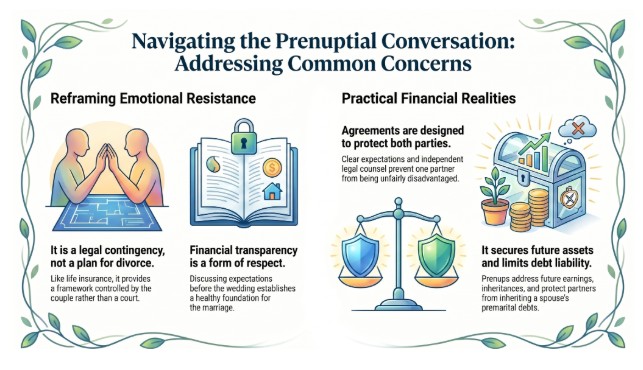
      “A prenup means you’re planning to divorce me.” A prenuptial agreement plans for a legal contingency, the same way life insurance plans for death or a will plans for incapacity. The agreement provides a framework that both parties control together, rather than leaving financial outcomes to a court that does not know the couple.

      “A prenup protects you but not me.” A well-drafted prenuptial agreement protects both parties by establishing clear financial expectations before conflict arises. A partner who waives spousal maintenance rights without understanding the implications, for example, may be disadvantaged, which is exactly why independent legal counsel for both parties is essential. The agreement can be structured to protect both spouses, not just the one initiating the request.

      “I don’t have assets, so this doesn’t apply to me.” A prenuptial agreement applies to future assets as well as current ones. A partner who earns significant income during the marriage, receives an inheritance, or builds a business after the wedding has financial interests worth protecting in a prenuptial agreement. The agreement also addresses debt allocation, which protects a lower-asset partner from inheriting the other spouse’s premarital liabilities.

      “This feels unromantic.” Financial transparency before marriage is a form of respect, not a failure of romance. Couples who discuss property division, debt, and financial expectations before the wedding establish a foundation of financial transparency that benefits the marriage regardless of whether the prenuptial agreement is ever invoked.

      If you’re ready to get started, call us now!

      How to Approach the Prenup Conversation If You Have Children From a Prior Relationship

      Parents entering a second or subsequent marriage have a concrete, sympathetic reason for requesting a prenuptial agreement that most partners understand. 

      Protecting assets intended to pass to children from a prior relationship is a straightforward estate planning goal that does not imply distrust of the new partner.

      Framing the prenuptial request around the children’s interests — “I want to make sure my kids’ inheritance is protected regardless of what happens between us” — gives a new partner a reason to support the agreement that has nothing to do with anticipated conflict. 

      Most partners respond constructively to a request framed around parental responsibility rather than marital suspicion.

      A prenuptial agreement in this context can designate inherited assets, premarital property, and any assets for which the children are named beneficiaries as separate property not subject to equitable distribution at divorce. 

      A prenuptial agreement coordinated with estate planning documents — wills, trusts, beneficiary designations — ensures the children’s interests are protected at every level. Clients navigating a previous divorce and entering a new marriage often bring these concerns to prenuptial negotiations precisely.

      The Role of Collaborative Law in Prenuptial Negotiations

      The collaborative divorce process offers an unusually effective framework for prenuptial negotiations because it is designed for exactly the situation couples face: two parties who care about their relationship and want a fair financial outcome without adversarial positioning.

      In a collaborative prenuptial negotiation, both partners retain their own collaboratively trained attorneys, share financial information transparently, and work toward terms both parties understand and accept. 

      The process avoids the dynamic where one party’s attorney drafts an agreement and presents it to the other party as a take-it-or-leave-it document — a dynamic that creates resentment and enforceability risk in equal measure.

      Collaborative prenuptial negotiations also produce agreements that Illinois courts are more likely to enforce. 

      When both parties participated in structured, transparent negotiations with independent counsel, the voluntariness and disclosure requirements of 750 ILCS 10/7 are clearly satisfied, and enforceability challenges based on duress or lack of understanding have little factual basis to stand on.

      What to Do After the Initial Conversation

      Once both partners have agreed in principle to explore a prenuptial agreement, the practical steps are straightforward. Each partner should retain independent legal counsel before the next substantive discussion. 

      Both parties should prepare a complete inventory of assets, debts, income sources, and financial obligations to support the disclosure requirements under Illinois law.

      The negotiation should proceed at a pace both parties find comfortable, with neither partner pressuring the other toward a signing deadline driven by the wedding calendar. 

      Signing the final agreement at least 30 days before the wedding date — and ideally 60 to 90 days before — gives courts no procedural basis for a duress challenge.

      Couples who complete the prenuptial process collaboratively and on a comfortable timeline often report that the financial conversations required by the process strengthened their relationship rather than straining it. 

      Clients who want to understand what the agreement will govern at divorce should review what a prenuptial agreement can and cannot include under Illinois law before finalizing terms.

      Contact Us Today For An Appointment

        I have read the

        Frequently Asked Questions 

        How early in an engagement should you bring up a prenuptial agreement? 

        Raising a prenuptial agreement at least 90 days before the wedding gives both partners time to retain independent attorneys, review financial disclosures, and negotiate terms without pressure. Illinois courts examine the timeline of prenuptial negotiations when evaluating enforceability challenges, and agreements signed close to the wedding face a higher duress challenge.

        What if your partner refuses to discuss a prenuptial agreement? 

        A partner who refuses cannot be compelled to sign a prenuptial agreement under Illinois law. Explaining the specific reasons behind the request and offering to have both partners speak with independent attorneys before the next conversation addresses most initial refusals. Persistent refusal after full information and independent counsel is a legitimate signal about the partner’s approach to financial transparency.

        Can bringing up a prenup actually strengthen a relationship? 

        Prenuptial conversations that result in open financial disclosure, shared goal-setting, and mutual agreement on financial expectations often strengthen the relationship by establishing a foundation of financial transparency. Couples who complete the collaborative prenuptial process report that the structured financial discussions improved their understanding of each other’s financial history and priorities before the wedding.

        Should both partners have separate attorneys for the prenup conversation?

        Both partners retaining separate attorneys before prenuptial negotiations begin is the single most effective step for protecting the relationship and the agreement’s enforceability. Independent counsel ensures neither party feels pressured, both parties understand every term, and Illinois courts have clear evidence of voluntariness under 750 ILCS 10/7.

        What if one partner earns significantly more than the other? 

        Income disparity between partners makes prenuptial planning more important, not less. The higher-earning spouse has financial interests to protect, and the lower-earning spouse has spousal maintenance rights that deserve careful attention in the negotiation. A well-structured prenuptial agreement addresses both parties’ interests explicitly, which reduces resentment and produces a more durable agreement.

        Is it normal to feel uncomfortable bringing up a prenuptial agreement? 

        Discomfort is a normal response to raising a prenuptial agreement, particularly when the request comes from the partner with more assets. Framing the conversation around shared financial planning rather than anticipated divorce, giving the partner time to react and consult counsel, and approaching the negotiation through a collaborative process all reduce the discomfort for both parties over time.

        Can a prenuptial agreement be signed after the wedding if the couple did not get around to it before? 

        A prenuptial agreement cannot be signed after the wedding — by definition, a prenuptial agreement is executed before marriage. Couples who did not complete a prenuptial agreement before their wedding can pursue a postnuptial agreement. Illinois courts apply heightened scrutiny to postnuptial agreements, making the involvement of independent legal counsel for both parties even more important.

        What is the biggest mistake couples make when discussing a prenuptial agreement? 

        The biggest mistake couples make when discussing a prenuptial agreement is waiting too long to raise the topic. An agreement introduced weeks before the wedding creates time pressure, emotional stress, and a risk of non-enforceability simultaneously. Raising the prenuptial conversation early gives both partners time to approach the negotiation as the financial-planning exercise it is, rather than as a last-minute legal demand.

        How Illinois Courts Enforce (or Void) a Prenuptial Agreement

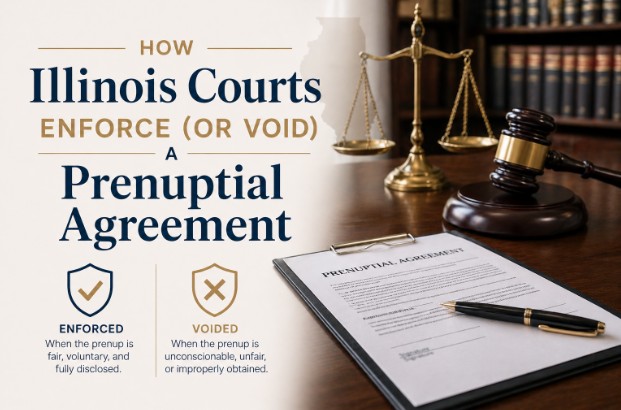
        Illinois courts enforce prenuptial agreements that satisfy the voluntariness, disclosure, and content requirements of the Illinois Uniform Premarital Agreement Act, 750 ILCS 10/1 et seq. 

        A court will void a prenuptial agreement — in whole or in part — when the challenging spouse proves duress, fraud, inadequate financial disclosure, or unconscionable terms at the time of signing. 

        Couples who want enforceable agreements should review the complete Illinois prenuptial agreement guide before drafting begins.

        Key Takeaways

        • Illinois courts enforce prenuptial agreements under 750 ILCS 10/7 when both parties signed voluntarily with full financial disclosure and without unconscionable terms.
        • The spouse challenging a prenuptial agreement bears the burden of proof under Illinois law.
        • Courts evaluate enforceability at the time of signing, not at the time of divorce.
        • A single unenforceable provision does not automatically void the entire agreement — Illinois courts apply severability analysis to prenuptial documents.

        The Legal Standard Illinois Courts Apply to Prenuptial Agreements

        Illinois courts apply the enforceability standard in 750 ILCS 10/7 to every prenuptial agreement challenge. 

        A prenuptial agreement is unenforceable in Illinois when the challenging party proves the agreement was not executed voluntarily, the agreement was the product of fraud, duress, coercion, or misrepresentation, the agreement was unconscionable at the time of execution, or the party did not receive fair and reasonable disclosure of the other party’s property and financial obligations before signing.

        Illinois courts place the burden of proof on the spouse seeking to void the agreement. A prenuptial agreement that appears valid on its face is presumed enforceable — the challenging spouse must produce evidence that one of the 750 ILCS 10/7 grounds applies. 

        Couples who structured their prenuptial negotiations through collaborative law enter any enforceability challenge from a stronger position because the collaborative process generates a documented record of transparent negotiation and mutual disclosure.

        Enforcement GroundCourt’s Standard
        VoluntarinessWas the signing free from duress, fraud, or coercion?
        Financial disclosureDid both parties receive fair and reasonable disclosure?
        UnconscionabilityWere the terms so one-sided that no reasonable person would agree?
        Legal representationDid both parties have a meaningful opportunity for counsel?
        Content limitsDo terms fall within categories permitted by 750 ILCS 10/4?

        How Illinois Courts Evaluate Voluntariness

        Illinois courts find a prenuptial agreement involuntary when the challenging spouse demonstrates that duress, coercion, fraud, or misrepresentation removed the ability to make a free and informed decision. 

        A prenuptial agreement presented days before the wedding, with no prior discussion and no time to consult independent counsel, is the most common factual basis for a voluntariness challenge in Illinois courts.

        Courts look at the totality of circumstances surrounding the signing rather than a single factor. 

        Relevant considerations include how far in advance the agreement was presented, whether both parties had independent legal representation, whether either party was told the wedding would be canceled if the agreement was not signed, and whether the signing party had a realistic opportunity to negotiate terms rather than accept a final document. 

        Couples who began prenuptial discussions at least 90 days before the wedding and retained separate attorneys give courts little basis to find voluntariness.

        The presence of independent legal counsel for both parties is a strong indicator of voluntariness. Illinois courts do not require independent representation as a condition of enforceability.

        Clients who want to understand how signing circumstances affect the Illinois divorce process benefit from reviewing those dynamics before the prenuptial agreement is finalized.

        If you’re ready to get started, call us now!

        How Illinois Courts Evaluate Financial Disclosure

        Illinois courts void prenuptial agreements when the challenging spouse proves that fair and reasonable disclosure of the other party’s property and financial obligations did not occur before signing, per 750 ILCS 10/7(a)(2). 

        Courts do not require a precise asset-by-asset accounting — the standard is fair and reasonable, not exhaustive — but deliberate concealment of material assets is grounds for invalidation regardless of how well the remaining provisions are drafted.

        Financial disclosure failures that Illinois courts have found sufficient to void prenuptial agreements include concealing real estate holdings, understating business valuations, omitting significant retirement account balances, and failing to disclose outstanding debts that would affect the other party’s financial planning. 

        A prenuptial agreement that includes detailed financial schedules as exhibits — listing each party’s assets, debts, income, and obligations at signing — gives courts clear evidence that disclosure occurred and reduces the evidentiary basis for a challenge.

        Clients with complex marital assets face the highest disclosure risk because the number and variety of assets create more opportunity for omission, whether intentional or inadvertent. 

        Attaching complete financial schedules, having both parties sign them, and retaining independent appraisals for business interests and real estate are the most effective steps to close disclosure gaps before signing.

        How Illinois Courts Evaluate Unconscionability

        Illinois courts evaluate unconscionability at the time of signing, not at the time of divorce. A prenuptial agreement that seemed commercially reasonable when executed but produces a harsh result decades later is not unconscionable under Illinois law — the relevant question is whether the terms were so one-sided at execution that no reasonable person would have agreed to them voluntarily.

        Unconscionability challenges in Illinois prenuptial cases most commonly target maintenance waivers in long marriages where one spouse left the workforce, business ownership provisions that assign all appreciation to one party with no compensating benefit to the other, and property division terms that leave one spouse with no share of assets accumulated during a marriage of substantial duration. 

        Courts distinguish between provisions that are merely unfavorable to one party — which are enforceable — and provisions that are so extreme that enforcement would be fundamentally unjust.

        A prenuptial agreement that waives spousal maintenance entirely survives an unconscionability challenge more reliably when the waiving spouse received other meaningful consideration in the agreement, had independent counsel who explained the waiver’s long-term implications, and signed well before the wedding under no apparent pressure. 

        Illinois courts applying 750 ILCS 10/7 look at the full package of terms, not individual provisions in isolation.

        If you’re ready to get started, call us now!

        The Public Assistance Exception to Maintenance Waivers

        Illinois courts will not enforce a prenuptial maintenance waiver that leaves the receiving spouse eligible for public assistance at the time of divorce, per 750 ILCS 10/7(b). 

        A maintenance waiver that was commercially reasonable at signing can become partially unenforceable at divorce if the circumstances of the marriage — a long duration, a spouse who left the workforce, a significant income disparity — create a situation in which enforcement would shift financial support obligations to the state.

        Courts apply the public assistance exception narrowly. A maintenance waiver does not become unenforceable simply because the divorce produces a financially difficult outcome for one spouse — the threshold is actual eligibility for public assistance programs, not general financial hardship. 

        Clients planning to include a maintenance waiver should review how Illinois maintenance law calculates support at divorce so the waiver is drafted with the public assistance threshold explicitly in mind.

        Maintenance Waiver ScenarioCourt’s Likely Response
        Short marriage, both parties employedWaiver enforced
        Long marriage, spouse left workforce, public assistance threshold metWaiver voided under 750 ILCS 10/7(b)
        Long marriage, spouse left workforce, above public assistance thresholdWaiver enforced if voluntarily signed with counsel
        Waiver signed under duress, regardless of financial outcomeWaiver voided on voluntariness grounds

        How Illinois Courts Handle Partial Invalidity

        Illinois courts apply severability analysis to prenuptial agreements when one provision is unenforceable, but the remainder of the agreement is valid. A single void provision does not automatically void the entire prenuptial agreement — courts will enforce the remaining terms unless the invalid provision was so central to the overall agreement that removing that provision defeats the parties’ original intent.

        Severability analysis gives courts flexibility to reach equitable outcomes without discarding agreements that the parties negotiated in good faith. 

        A maintenance waiver voided under the public assistance exception, for example, does not affect property division provisions, business ownership designations, or debt allocation terms that satisfy all other enforceability requirements. 

        Clients facing a high-conflict divorce in which a prenuptial agreement is being challenged benefit from understanding severability, as it limits the scope of successful challenges to the specific provisions at issue.

        A prenuptial agreement drafted with an explicit severability clause gives courts clear authority to apply this analysis. 

        Illinois courts will generally imply severability into the agreement’s structure even without an express clause, but an explicit provision removes any ambiguity about the parties’ intent that might otherwise support a broader invalidation argument.

        What Happens After a Court Voids a Prenuptial Agreement

        What Happens After a Court Voids a Prenuptial Agreement

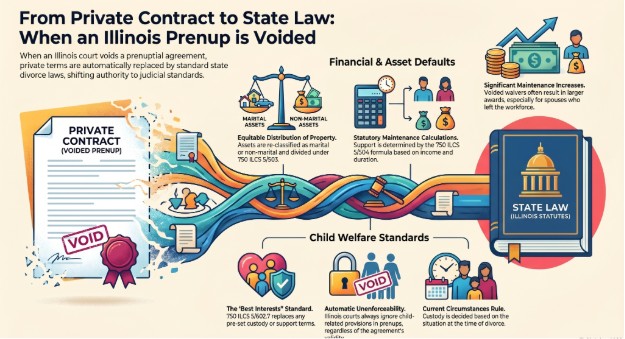
        When an Illinois court voids a prenuptial agreement — in whole or in part — the court applies standard Illinois divorce law to the matters the agreement was meant to govern. 

        Voided property division provisions are replaced by equitable distribution under 750 ILCS 5/503, which requires the court to classify assets as marital or non-marital and divide the marital estate equitably based on statutory factors.

        Voided maintenance waivers are replaced by the 750 ILCS 5/504 statutory formula as of 2026, which calculates maintenance based on both parties’ incomes and the length of the marriage. 

        A spouse whose maintenance waiver is voided may receive a significantly larger maintenance award than the prenuptial agreement contemplated, particularly in a long marriage where one spouse left the workforce. 

        Clients who did not execute a prenuptial agreement and want to understand the default framework should review how property division in Illinois works before filing.

        Voided child-related provisions — which Illinois courts will not enforce regardless of the prenuptial agreement’s overall validity — are replaced by the best interests of the child standard under 750 ILCS 5/602.7

        Courts determine child custody and child support based on circumstances at the time of divorce, not on prenuptial terms that attempted to predetermine those outcomes.

        Contact Us Today For An Appointment

          I have read the

          Frequently Asked Questions 

          Who has the burden of proof when a prenuptial agreement is challenged in Illinois? 

          The spouse seeking to void a prenuptial agreement bears the burden of proof under Illinois law. A prenuptial agreement that appears valid on its face is presumed enforceable, and the challenging party must produce evidence satisfying one of the grounds in 750 ILCS 10/7 — voluntariness, disclosure, or unconscionability — to overcome that presumption.

          Can an Illinois court void only part of a prenuptial agreement? 

          Illinois courts apply severability analysis and will void individual provisions while enforcing the remainder when the invalid provision is not central to the overall agreement. A maintenance waiver voided under 750 ILCS 10/7(b) does not affect property division or debt allocation terms that independently satisfy all enforceability requirements under Illinois law.

          Does Illinois require independent legal counsel for a prenuptial agreement to be enforceable? 

          Illinois law does not require independent legal counsel as a condition for the enforceability of a prenuptial agreement. Courts treat independent representation as strong evidence of voluntariness. A prenuptial agreement signed without independent counsel faces a higher risk of a successful voluntariness challenge under 750 ILCS 10/7.

          At what point in time does Illinois evaluate unconscionability? 

          Illinois courts evaluate unconscionability at the time of signing, not at the time of divorce. A prenuptial agreement that produces a harsh outcome decades after execution is not unconscionable under 750 ILCS 10/7 unless the terms were so one-sided at signing that no reasonable person would have agreed voluntarily.

          Can a prenuptial agreement be voided if one spouse hid assets before signing? 

          An Illinois court will void a prenuptial agreement when the challenging spouse proves that deliberate concealment of material assets prevented fair and reasonable financial disclosure under 750 ILCS 10/7(a)(2). Common examples include hidden real estate, understated business valuations, and undisclosed retirement account balances in Illinois prenuptial litigation.

          What happens to property division if a prenuptial agreement is voided in Illinois? 

          When an Illinois court voids property division provisions, equitable distribution under 750 ILCS 5/503 governs the marital estate. Courts classify assets as marital or non-marital and divide the marital estate based on the length of the marriage, each spouse’s contributions, and the economic circumstances of both parties at the time of divorce.

          Can a prenuptial agreement signed under emotional pressure be voided in Illinois? 

          Emotional pressure alone does not void a prenuptial agreement under Illinois law. The standard under 750 ILCS 10/7 requires duress, coercion, or fraud that removed the ability to make a free decision. Courts examine how far in advance the agreement was presented and whether independent counsel was available to both parties.

          Does a long marriage make a prenuptial agreement easier to void in Illinois? 

          Marriage duration does not directly affect the enforceability of a prenuptial agreement under Illinois law. Courts evaluate validity based on circumstances at the time of signing. Marriage duration becomes relevant only when a long marriage creates conditions that trigger a maintenance waiver under the public assistance exception in 750 ILCS 10/7(b).