

An Illinois prenuptial agreement can include property rights, debt allocation, spousal maintenance terms, and business ownership designations — but cannot govern child custody, child support, or any provision that violates Illinois public policy.
Illinois courts enforce the terms of a prenuptial agreement under the Illinois Uniform Premarital Agreement Act, 750 ILCS 10/4, when both parties signed voluntarily and with full financial disclosure.
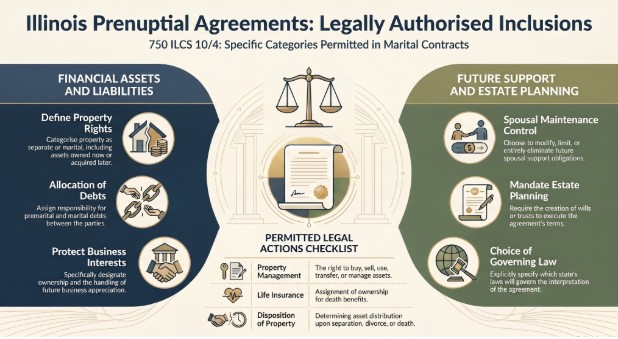
Illinois courts enforce prenuptial agreement terms that fall within the categories authorized by 750 ILCS 10/4. Couples who understand these categories draft stronger agreements and face fewer enforceability challenges at divorce.
The complete Illinois prenuptial agreement guide covers the full legal framework, including voluntariness and disclosure requirements that apply to every term in the agreement.
The statute authorizes prenuptial agreements to address the rights and obligations of each party with respect to property owned at the time of marriage or acquired afterward, the right to buy, sell, use, transfer, or otherwise manage and control property, the disposition of property upon separation, divorce, or death, modification or elimination of spousal maintenance, the making of a will or trust to carry out the agreement, ownership of life insurance policy death benefits, choice of law governing the agreement, and any other matter not in violation of public policy or a criminal statute.
| Permitted Category | What the Agreement Can Do |
| Property rights | Define separate vs. marital property |
| Debt allocation | Assign premarital and marital debts |
| Spousal maintenance | Modify, limit, or waive maintenance |
| Business interests | Designate ownership and appreciation |
| Estate planning | Require wills or trusts consistent with the agreement |
| Life insurance | Assign death benefit ownership |
| Choice of law | Specify which state’s law governs |
A prenuptial agreement in Illinois can define which assets each spouse retains as separate property and which assets will be treated as marital property subject to equitable distribution at divorce.
Without a prenuptial agreement, Illinois courts apply 750 ILCS 5/503 to classify and divide marital property, which can result in outcomes neither spouse anticipated.
Couples commonly use prenuptial agreements to protect premarital real estate, investment portfolios, retirement savings, and family heirlooms from being reclassified as marital property through commingling during the marriage.
An agreement can specify that certain assets remain separate regardless of how they are titled or used during the marriage, providing clarity that courts will enforce.
Inheritance received before or during the marriage presents a particular planning opportunity. A prenuptial agreement can designate anticipated or received inheritances as separate property, protecting family wealth transfers from exposure in a future Illinois divorce.
Without that designation, inherited assets that are commingled with marital funds risk losing their separate property status under Illinois law.
If you’re ready to get started, call us now!
A prenuptial agreement in Illinois can assign responsibility for premarital debts to the spouse who incurred them, protecting the other spouse from creditor claims after marriage. Illinois courts do not automatically hold one spouse liable for the other’s premarital debts, but a prenuptial agreement adds a contractual layer of protection that clarifies each party’s obligations from the outset.
A prenuptial agreement can also address how marital debts incurred during the marriage will be allocated at divorce.
Couples with student loan balances, business liabilities, or anticipated credit obligations benefit from prenuptial debt allocation provisions that courts can enforce without requiring lengthy financial discovery.
| Debt Type | Without Prenup | With Prenup |
| Premarital student loans | May create marital exposure | Assigned to the originating spouse |
| Business liabilities | Subject to equitable allocation | Designated as a separate obligation |
| Credit card debt incurred during marriage | Divided equitably | Allocated per agreement terms |
| Mortgage on premarital property | Commingling risk at divorce | Clarified as a separate obligation |
Illinois calculates spousal maintenance under a statutory formula in 750 ILCS 5/504, which ties award amounts and duration to the length of the marriage and each spouse’s income as of 2026.
A prenuptial agreement can modify that formula, set a fixed maintenance amount, cap the duration of payments, or waive maintenance entirely — subject to one statutory limit.
Under 750 ILCS 10/7(b), an Illinois court will not enforce a prenuptial maintenance waiver that leaves the receiving spouse eligible for public assistance at the time of divorce. Outside that threshold, courts generally respect voluntarily negotiated maintenance terms when both parties had independent legal counsel and full financial disclosure.
Clients planning to include a maintenance waiver should also understand how Illinois maintenance law applies at divorce, so the waiver is drafted with appropriate precision.
A prenuptial agreement can also define the conditions under which maintenance terminates — upon remarriage, cohabitation with a new partner, or a specific calendar date.
These conditional termination provisions are enforceable in Illinois when they are clearly drafted, and both parties understand their implications at signing.
Business owners use prenuptial agreements in Illinois to protect premarital business interests from being classified as marital property at divorce. Under 750 ILCS 5/503(a)(7), the increase in value of a premarital business during marriage can qualify as marital property if that appreciation resulted from marital effort or contributions.
A prenuptial agreement can contractually define business appreciation as separate property, removing it from the marital estate regardless of how the business grows during the marriage.
The agreement can address the founding spouse’s premarital business, a business started during the marriage that one spouse intends to own separately, buyout obligations if the other spouse has any involvement in the business, and restrictions on the non-owning spouse’s ability to claim an interest in business income. Couples facing complex asset division at divorce without a prenuptial agreement often encounter business valuation disputes that a well-drafted prenuptial provision would have avoided.
A prenuptial agreement in Illinois may require either or both spouses to execute a will, a trust, or a beneficiary designation consistent with the agreement’s terms.
This provision is particularly important for spouses who have children from prior relationships and want to ensure that estate assets pass to those children rather than being subject to a surviving spouse’s elective share claim under Illinois law.
Without coordinated estate planning, a prenuptial agreement’s property designations may conflict with Illinois’s default inheritance rules.
The post-divorce modification process similarly highlights that financial arrangements made during marriage require ongoing attention as circumstances change — the same principle applies to estate planning documents that should track the terms of a prenuptial agreement throughout the marriage.
If you’re ready to get started, call us now!
Illinois law imposes firm limits on the content of prenuptial agreements. Courts will void individual provisions — or the entire agreement — when terms cross into prohibited categories. Understanding these limits is as important as knowing what the agreement can cover.
A prenuptial agreement cannot predetermine child custody arrangements or parenting time schedules. Illinois courts retain exclusive authority to determine custody and parenting time based on the best interests of the child at the time of divorce, per 750 ILCS 5/602.7.
No prenuptial provision can override that standard. Parents who want structured parenting frameworks in place before conflict arises benefit from working with collaborative law attorneys who can help establish cooperative co-parenting agreements outside the prenuptial context.
A prenuptial agreement cannot set, waive, or limit child support obligations. Illinois courts calculate child support under the Income Shares model established in 750 ILCS 5/505, which bases support on both parents’ incomes and the child’s needs at the time of the order.
A prenuptial provision purporting to fix or eliminate child support is void and unenforceable as against public policy.
Illinois courts will not enforce prenuptial provisions that create a financial incentive for one spouse to seek divorce. An agreement structured so that one party receives a substantial windfall upon filing for divorce, for example, violates public policy because it undermines the institution of marriage rather than planning for its possible end.
Courts distinguish between fair planning provisions and provisions designed to make divorce financially attractive.
Any prenuptial provision that is unconscionable at the time of signing — meaning so one-sided that no reasonable person would have agreed to it voluntarily — is subject to invalidation under 750 ILCS 10/7.
Courts also void provisions obtained through fraud, duress, or deliberate concealment of material financial information. Couples who negotiate prenuptial terms through the collaborative divorce process significantly reduce the risk of unconscionability challenges because the process is built around transparent, interest-based negotiation.
Illinois courts are reluctant to enforce prenuptial provisions that attempt to regulate personal behavior during the marriage — fidelity clauses, lifestyle restrictions, or social conduct requirements. While some states have enforced such provisions in limited circumstances, Illinois courts focus prenuptial enforcement on financial and property matters rather than personal conduct regulation.
Drafting enforceable prenuptial provisions requires attention to both content and process. A term that falls within a permitted category can still be invalidated if the agreement itself was signed under duress, without adequate financial disclosure, or without a meaningful opportunity for both parties to consult independent counsel.
Both parties should retain separate attorneys before negotiations begin. Each spouse needs independent legal advice to understand the implications of every provision, and courts treat separate representation as strong evidence of voluntariness.
Couples who approach prenuptial negotiations through collaborative law benefit from a structured process that builds in the transparency and mutual understanding that makes agreements enforceable.
Full financial disclosure is non-negotiable. Each party must provide a complete accounting of assets, debts, income, and financial obligations before signing.
An agreement signed without honest disclosure is voidable under 750 ILCS 10/7(a)(2) regardless of how well the individual provisions are drafted.
Clients with complex marital assets should prepare detailed financial schedules as exhibits to the agreement, documenting the disclosure that supports each property designation.
Timing matters. An agreement signed under pressure days before the wedding faces a higher duress challenge than one negotiated and finalized months in advance.
The Illinois divorce timeline illustrates how courts review the full history of a marriage when evaluating disputed agreements — the circumstances of signing become part of that record.
Can an Illinois prenuptial agreement define which spouse keeps the marital home at divorce?
An Illinois prenuptial agreement can designate the marital home as the separate property of one spouse, specify how equity will be divided at divorce, or establish a buyout formula. Without that designation, the marital home is subject to equitable distribution under 750 ILCS 5/503, which applies to all marital property at divorce.
Can a prenuptial agreement in Illinois protect a spouse from the other’s student loan debt?
A prenuptial agreement in Illinois can assign premarital student loan debt to the spouse who incurred it, protecting the other spouse from any repayment obligation during the marriage or at divorce. Without that provision, courts may consider the educational benefit to the marriage when allocating debt under equitable distribution principles.
Can an Illinois prenuptial agreement address retirement accounts?
A prenuptial agreement in Illinois can designate premarital retirement account balances as separate property and specify how marital contributions will be treated at divorce. Certain ERISA-governed plans require a separate spousal waiver that a prenuptial agreement alone does not satisfy. Addressing retirement account division in both the prenuptial agreement and a coordinated estate plan closes that gap.
Can a prenuptial agreement waive the right to a share of the other spouse’s future income?
A prenuptial agreement in Illinois can limit or waive spousal maintenance rights tied to the other party’s income, but cannot waive child support obligations. Child support under 750 ILCS 5/505 is calculated based on both parties’ actual incomes at the time of a support order. A maintenance waiver leaving one spouse eligible for public assistance at divorce will not be enforced under 750 ILCS 10/7(b).
Does an Illinois prenuptial agreement need to list every asset to be enforceable?
Illinois law requires fair and reasonable financial disclosure rather than a precise asset-by-asset inventory. Courts look for evidence that both parties had a general understanding of each other’s financial picture before signing. Detailed financial schedules attached as exhibits strengthen the showing, particularly for high-value assets such as real estate, business interests, or retirement accounts.
Can a prenuptial agreement include provisions about social media or public conduct?
Illinois courts focus on enforcing prenuptial agreements in financial and property matters. Personal conduct provisions — including social media restrictions, fidelity clauses, or lifestyle requirements — are generally unenforceable in Illinois because they fall outside the financial scope of 750 ILCS 10/4 and raise public policy concerns about regulating private conduct through contract.
Can an Illinois prenuptial agreement be changed after the wedding?
A prenuptial agreement in Illinois can be amended or revoked after the wedding through a written postnuptial agreement signed by both parties. The same voluntariness and disclosure standards that apply to prenuptial agreements apply to any post-marriage modification. Couples wanting to update their agreement after significant life changes should work with experienced Illinois family law attorneys to ensure the modification is enforceable.
What happens if one provision in an Illinois prenuptial agreement is invalid?
Illinois courts apply a severability analysis to prenuptial agreements. If one provision is unenforceable — because it crosses into a prohibited category or was obtained through fraud — courts will typically void that provision while enforcing the remainder of the agreement, provided the invalid provision was not so central to the overall agreement that its removal defeats the parties’ intent.



About the Author
Founder of Cooper Trachtenberg Law Group, LLC · Illinois Family Law Attorney · Certified Mediator · Collaborative Divorce Practitioner
Miriam E. Cooper is the founder of Cooper Trachtenberg Law Group, LLC and an Illinois family law attorney with more than 30 years of experience helping individuals and families navigate divorce, custody, parenting time, child support, spousal maintenance, property division, and post-decree family law matters throughout the Chicago metropolitan area.
A certified mediator and collaborative divorce practitioner, Miriam completed mediation training through Northwestern University and serves clients through mediation, collaborative law, and litigation when necessary. She is also qualified as a Child Representative and Guardian ad Litem, allowing her to provide informed guidance in complex family law disputes involving children and families.
Drawing on more than three decades of family law experience, Miriam regularly advises clients on legal issues affecting Illinois families and is committed to helping clients reach practical, durable resolutions tailored to their unique circumstances.
Practice Areas: Divorce, Mediation, Collaborative Divorce, Child Custody, Parenting Time, Child Support, Spousal Maintenance, Property Division, Post-Decree Matters
Practice Areas
Legal Support When You Need It Most
Testimonials



Main Office
3601 Algonquin Road, Suite 610
Rolling Meadows, Illinois 60008
Lincolnshire Office
250 Parkway Drive, Suite 150
Lincolnshire, IL 60069
By Appointment Only
Phone:
847-995-8800


We represent parties across the Chicago area, including Arlington Heights, Barrington, Buffalo Grove, Carol Stream, Evanston, Glenview, Highland Park, Hinsdale, Inverness, Lincolnshire, Long Grove, Mt. Prospect, Palatine, Rolling Meadows, Schaumburg, Skokie, Streamwood, Wheeling and more. We also represent clients from Cook, Lake, DuPage, Kane and McHenry counties.
© 2026 by Cooper Trachtenberg Law Group, LLC. All Rights Reserved.
Disclaimer |
Site Map
