
Category Archives: Uncategorized

Couples Planning for a Disabled Spouse or Adult Child: Illinois Guardianship Steps for Chicagoland Households

If your spouse or adult child has a disability, planning for their future care can feel overwhelming. Many couples in Chicagoland assume guardianship happens automatically or put off the legal work because it seems complicated.

In Illinois, parental legal decision-making authority generally ends at age 18. After that, families often use powers of attorney, supported decision-making, or, when necessary, court-ordered adult guardianship to continue assisting an adult child with disabilities.

The guardianship process here has steps that differ from those for planning for a minor. It’s important to know what Illinois guardianship for disabled adults requires before your child turns 18, or when your spouse’s condition changes.

Cook County has its own approach, with timelines that determine how quickly you can obtain legal authority.

Key Takeaways 

  • At age 18, parental legal authority generally ends in Illinois. Families may use powers of attorney or supported decision-making when appropriate, or pursue adult guardianship if court authority is necessary.
  • Illinois courts can tailor guardianship to the person’s needs. When guardianship is granted, the court may appoint a limited guardian for specific decision areas or a broader guardian only when the evidence supports it.
  • File in the correct county and plan the documentation timeline. Adult guardianship is typically filed where the disabled adult resides, and the petition should be supported by a current clinical report and complete notice materials to avoid delays.

The Planning Problem Couples Face In Illinois (Why This Isn’t Just “Paperwork”)

Illinois courts require specific evidence and adhere to strict legal standards before granting guardianship. The process changes depending on whether you’re planning for a spouse or for an adult child with disabilities.

Two Common Scenarios: Disabled Spouse Vs Disabled Adult Child

Planning for a disabled spouse isn’t the same as planning for an adult child. When your spouse has a disability, you might think you automatically have decision-making authority, but Illinois law doesn’t always agree.

Doctors and banks often want legal proof before they let you act for your spouse. If you don’t have guardianship or power of attorney, you could hit roadblocks when you need to access accounts or make healthcare calls in an emergency.

For parents, everything shifts when your child turns 18. You lose parental authority on their 18th birthday. Even if your child can’t make decisions alone, you need court approval to keep managing their affairs.

Parents seeking guardianship for adult disabled children have to file a petition and provide medical evidence of incapacity. The court won’t grant guardianship just based on a diagnosis.

The Court Standard Couples Should Understand Up Front

Illinois courts stick to a strict legal standard for guardianship. You must show that your loved one can’t make or communicate responsible decisions about their care or finances.

The court expects medical documentation, evaluations, and, in some cases, testimony from doctors. Just having a disability diagnosis doesn’t meet the standard for adult guardianship. The petition needs to show specific ways your loved one can’t make decisions independently.

Judges prefer less restrictive options before granting full guardianship. You may need to explain why powers of attorney or supported decision-making won’t work. The judge will also consider if your loved one understands the choices and their consequences.

Cooper Trachtenberg Law Group, LLC helps Chicagoland couples map the right guardianship path and paperwork before a crisis. Contact us to discuss next steps.

If you’re ready to get started, call us now!

Step One—Pick The Right Legal Path (Least Restrictive Decision Tree)

Illinois law requires families to try the least restrictive option before resorting to guardianship. The best tool depends on whether your spouse or adult child can still help make decisions.

Option A — Powers Of Attorney (When Capacity Exists To Sign)

If your disabled spouse or adult child understands what they’re signing, a power of attorney is usually the easiest way forward. A power of attorney lets them pick you (or someone else they trust) to handle finances, healthcare, or both without needing court approval.

This preserves their legal rights while giving you the authority to assist. They can revoke the POA at any time.

There are two main types:

  • Financial POA — covers banking, bills, property, and contracts
  • Healthcare POA — authorizes medical decisions and HIPAA access

It’s smart to have a lawyer draft documents that comply with Illinois law. The person signing must understand what they’re doing at the time.

This path works well if someone has a condition that might worsen, but still has capacity now.

Option B — Supported Decision-Making (Adults With ID/DD)

Supported decision-making lets your adult child with intellectual or developmental disabilities make their own choices, but with your help. Your role shifts from deciding to guiding them.

A supported decision-making agreement lists you and others as supporters in certain areas of life. Your adult child keeps the right to vote, marry, and sign contracts.

This model respects their independence while still providing the help they need. Illinois recognizes these agreements as alternatives to guardianship.

The agreement should specify which decisions require support and how you’ll help. Common topics include healthcare, housing, and managing benefits.

Option C — Adult Guardianship (When Court Authority Is Required)

Guardianship deprives a person of major rights and requires a court order. You’ll need this route if your spouse or adult child can’t make sound decisions and other options won’t suffice.

Illinois courts can appoint limited or plenary guardians. Limited guardians only control certain areas. Plenary guardians get almost all decision-making authority.

You must provide medical evidence to establish disability and lack of capacity. Courts prefer less restrictive options before approving guardianship.

The process includes:

  • Filing a petition in circuit court
  • Medical evaluations showing incapacity
  • Notice to your spouse or adult child
  • A court hearing, sometimes with testimony
Legal ToolBest ForCourt Required?Rights Removed
Power of AttorneyAdults who can sign and understand documentsNoNone (voluntary delegation)
Supported Decision-MakingAdults with ID/DD who can participate in choicesNoNone
Limited GuardianshipAdults who need help with specific decisions onlyYesOnly areas specified by the court
Plenary GuardianshipAdults who cannot make safe decisionsYesNearly all rights

If Guardianship Is Necessary: The Illinois “Non-Negotiables”

Illinois courts consider each guardianship petition on its own merits, but some rules always apply. 

The court decides whether you need limited or plenary guardianship, whether clinical reports must be current, and whether temporary arrangements impose strict restrictions.

What The Court Can Appoint And Why Scope Matters

Illinois law recognizes two main types of adult guardianship, based on the disabled person’s capacity. Limited guardianship grants the guardian control only over specific areas. Plenary guardianship covers most or all life decisions when someone can’t manage on their own.

The court can name a guardian of the person for healthcare and daily living. A guardian of the estate handles money and property. Sometimes you need both, sometimes just one.

Your petition must specify which powers you want. Courts lean toward the least restrictive choice that still protects the disabled adult. You’ll need to show exactly which decisions need outside help.

In adult guardianship cases, the court generally appoints a guardian ad litem (GAL) to investigate and report on the respondent’s best interests, unless the court finds a GAL is not necessary to protect the respondent or make an informed decision.

The Required Clinical/Physician Report Timing

Your petition needs a physician’s report or clinical evaluation documenting the adult’s alleged disability

Illinois requires the petition to be accompanied by a report based on evaluations performed within three (3) months of filing (with a special rule allowing certain psychological evaluations for intellectual disability to be within one year).

The doctor must examine your loved one and provide specific findings regarding their limitations. Vague statements won’t cut it. The report needs to discuss the person’s ability to make and communicate decisions regarding healthcare, finances, and safety.

If you file using an old report, the court will reject your filing. You’ll lose time and money getting a new evaluation. It’s smart to schedule the medical appointment so the 90-day window doesn’t expire before your hearing.

Temporary Guardianship For Emergencies 

Illinois lets courts appoint a temporary guardian if a disabled adult faces immediate harm. This process is fast, but you must demonstrate a genuine emergency.

Temporary guardianship usually lasts up to 60 days. You need to show the court that waiting would cause serious injury or financial trouble. Medical crises or cases of exploitation sometimes qualify.

The court may still notify the respondent and appoint a guardian ad litem in emergencies. 

Temporary orders don’t guarantee permanent guardianship later. You’ll still need to complete the full process for a long-term appointment.

Chicagoland Steps: How The Process Typically Starts (Cook County Focus)

Cook County handles adult guardianship at a specific downtown location. Some judges focus on these cases, and you have to use county-approved forms and follow local court rules—these are different from rules in other Illinois counties.

Where Cook County Adult Guardianship Cases Are Handled

In Cook County, adult guardianship cases are handled through the Probate Division at the Richard J. Daley Center, and local procedures (forms, scheduling, and help-desk support) can affect timing.

You’ll file and process your guardianship petition at this one location. Suburban Cook County courthouses won’t accept adult guardianship petitions.

Cook County offers pro se guardianship resources, including a help desk at the Daley Center for form/procedure guidance, and disability/elder law assistance programs located at 205 W. Randolph (Suite 1610) in Chicago. 

You can also contact the Pro Se Adult Guardianship Help Desk for support. They offer in-person appointments at the Daley Center and remote phone support.

Use The Correct Cook County Forms And Report Format

Illinois Supreme Court-approved Statewide Standardized Forms must be accepted in all Illinois courts, and Cook County also provides commonly used Probate Division forms and local filing guidance. 

Most counties provide their own forms through the probate court clerk, and every probate court prefers its own paperwork.

Your guardianship petition needs to include several documents:

  • Petition for guardianship explaining why guardianship is needed
  • Summons to notify the disabled person
  • Notice of motion for your guardianship hearing
  • Medical reports about the disability
  • Financial disclosures if you’re seeking estate guardianship

If you can’t afford filing costs, you might qualify for a fee waiver. Ask the clerk’s office about fee waiver applications when you hand in your paperwork.

These forms use Cook County-specific designations and numbering. If you use the wrong forms, your case can get delayed or even rejected.

What Couples Should Expect Procedurally

After you file your petition, the court will set a date for a guardianship hearing. They’ll give you a hearing date, usually a few weeks after filing.

The disabled person must receive proper notice and has the right to attend.

The court might appoint a guardian ad litem to determine whether guardianship is appropriate. This person will speak with you, your spouse, or your adult child and review your medical records before the hearing.

At the hearing, you’ll present evidence showing guardianship is necessary. Bring medical documentation and be ready to explain your loved one’s inability to make decisions.

The judge will ask about your relationship and whether you’re fit to serve as a guardian.

Guardianship cases may cover care decisions, estate and financial matters, or both. You’ll need to specify which type you want in your paperwork.

When capacity, benefits, or finances are involved, planning becomes technical quickly. Work with Cooper Trachtenberg Law Group, LLC to reduce delays. Schedule an appointment.

If you’re ready to get started, call us now!

Couples-Only Planning Issues (What Changes When You’re Managing A Household)

If you’re planning as a couple with a disabled spouse or adult child, you’ll face financial and legal challenges that single guardians don’t.

 Managing finances together can be more challenging when one person can’t participate in decisions, or when you need to protect government benefits for an adult child.

Household Finance Protection When A Spouse Can’t Manage Money

If your spouse can’t manage money due to disability, you’ll need legal authority to handle joint accounts and pay bills. Without planning, you might get locked out of accounts you both use every day.

A financial power of attorney lets you manage your spouse’s finances without going to court. It’s best to create this before a crisis hits.

Illinois recognizes durable powers of attorney that remain in effect even if someone becomes incapacitated.

You’ll also have to decide whether to keep joint accounts or split them up for protection. Joint accounts can be at risk if creditors come after your disabled spouse, but separating everything can make paying bills a headache.

Consider setting up:

  • Individual checking accounts for each spouse’s personal needs
  • One joint account for shared household expenses like mortgage and utilities
  • Separate savings to shield assets from potential legal claims

Financial planning for couples means tackling these questions before your spouse loses the ability to sign legal documents.

Benefit-Safe Planning For An Adult Child (ABLE + Trust Planning Concepts)

If your adult child receives Medicaid or SSI benefits, you need to protect their eligibility while planning for their future. Direct gifts or inheritances can knock them off benefits they rely on for healthcare and living expenses.

ABLE accounts generally use the federal annual gift tax exclusion as the baseline contribution cap; for 2026, that amount is $19,000 (with additional contributions available for eligible working beneficiaries under ABLE-to-Work rules).

Effective January 1, 2026, ABLE eligibility expands to individuals whose disability began before age 46 (previously before age 26).

Special needs trusts can hold larger amounts without affecting benefits. You can fund these with:

  • Life insurance proceeds
  • Inheritance money
  • Personal injury settlements
  • Savings you want to leave to your child

First-party trusts use the disabled person’s own money. Third-party trusts use money from parents or other relatives. Third-party trusts offer better protection and don’t require Medicaid payback after death.

It’s smart to coordinate both tools in your estate plan. Use ABLE accounts for immediate needs, and trusts for long-term security and bigger assets.

Pre-Filing Checklist For Chicagoland Couples (Reduce Delays And Gaps)

Illinois guardianship cases move faster when you gather the right medical records, figure out which decisions need court approval, and time your physician evaluations to fit the court’s three-month window. 

If you’re missing documents or your petition isn’t clear, judges might schedule extra hearings that push your case back by weeks or months.

Decision Map: What Decisions Must Be Covered (Person Vs Estate)

You need to say whether you want guardianship of the person, estate, or both when you file in Illinois. A guardian of the person makes healthcare, living, and personal care decisions for your disabled spouse or adult child.

A guardian of the estate handles money, benefits, property sales, and bills.

Illinois courts want you to explain why your disabled family member can’t make these decisions alone. You must include concrete examples in your petition.

For a disabled spouse, you might mention they can’t manage insulin or remember medications. An adult child with developmental delays may not understand lease agreements or manage monthly expenses.

The court only grants authority over decisions you request and prove are necessary. If your spouse can still handle their own bank account, the judge may deny estate authority. Be specific about what needs help and what your family member can still do independently.

Evidence Prep: Records That Support The Report And The Petition

Your petition has to include a physician’s report describing your family member’s disability and why they can’t make decisions. Illinois law says this report can’t be more than 90 days old when you file.

Gather medical records from neurologists, psychiatrists, primary care doctors, or any specialists who treat your spouse or adult child regularly.

Key documents to collect:

  • Diagnosis letters or psychological evaluations
  • Hospital discharge summaries
  • Medication lists and treatment plans
  • School IEP records for adult children
  • Social Security disability determination letters

Illinois guardianship cases include safeguards such as a required clinical report and (in many cases) a GAL investigation, designed to protect the respondent’s rights and ensure any guardianship is appropriately limited. Strong medical evidence helps them see why guardianship is in your family member’s best interest. Include records that show real functional limitations, not just a diagnosis.

You also need proof of your relationship to the disabled person. Bring a marriage certificate for a spouse or a birth certificate for an adult child.

If other family members object, these documents demonstrate your legal standing to file.

Calendar Backward From The 3-Month Evaluation Window

Schedule your family member’s physician evaluation carefully, since Illinois courts reject medical reports older than 90 days. Count backward from your planned filing date to book the doctor appointment.

If you’re filing on February 1st, the evaluation has to be on or after November 3rd.

Some Chicagoland doctors take weeks to finish guardianship reports after the appointment. Ask the office how long it usually takes. Build that time into your calendar so your report stays within the 90-day window.

Court hearing dates in Cook County and the suburbs often land 30 to 60 days after you file. If you schedule the evaluation too early, your report might expire before the hearing.

Many couples schedule the physician visit 30 to 45 days before filing to allow a buffer.

Timeline example:

TaskTiming
Schedule a physician evaluation6-8 weeks before filing
Attend evaluation appointment4-6 weeks before filing
Receive completed report2-4 weeks before filing
File a guardianship petitionFiling date
Court hearing4-8 weeks after filing

If your hearing gets continued past the original date, ask your attorney if you’ll need updated records. Some judges accept the 90-day-old report from filing, even if the hearing happens later.

How Cooper Trachtenberg Law Group, LLC Helps Chicagoland Households

Cooper Trachtenberg Law Group helps families across the Chicago area with legal support for guardianship matters.

The firm has spent decades advising clients in Cook County and nearby communities.

If you need a guardianship attorney, the firm’s legal team walks you through every step. They really get the challenges that come up when you’re planning for a disabled spouse or adult child.

The firm offers several ways to help:

  • Mediation services
  • Negotiated settlements
  • Traditional litigation, when necessary
  • Collaborative legal strategies

Helena L. Trachtenberg and Miriam Cooper lead the legal team. They bring a lot of experience in family law and work with you to find solutions that fit your family’s unique situation.

You get comprehensive legal support for both urgent guardianship concerns and long-term planning. The attorneys take time to learn about your family before recommending any next steps.

The firm handles complex family law issues with care and attention. Their Rolling Meadows office is convenient if you live in the Chicagoland area and need help with guardianship.

If you need to set up guardianship, change an existing arrangement, or plan for future care, the firm offers free consultations. You can discuss your situation and options without worrying about cost.

Protect decision-making and benefit eligibility with a plan built for Cook County and the Chicagoland suburbs. Schedule an appointment with Cooper Trachtenberg Law Group, LLC.

Contact Us Today For An Appointment

    I have read the

    Frequently Asked Questions 

    Do parents automatically keep decision-making rights after a child with disabilities turns 18 in Illinois?

    No. In Illinois, parental legal authority generally ends at 18. Families often use powers of attorney, supported decision-making, or adult guardianship to keep healthcare, financial, and daily-life decisions covered when an adult child cannot manage independently.

    Do spouses automatically have legal authority to make medical or financial decisions in Illinois?

    Not always. Hospitals, banks, and agencies may require a signed healthcare power of attorney, property power of attorney, or a court order. Planning early can prevent delays when urgent decisions or access to accounts are needed.

    What is the “least restrictive” approach Illinois courts prefer for adult guardianship?

    Illinois policy is to use guardianship only when necessary and to preserve as much independence as possible. Limited guardianship, powers of attorney, or supported decision-making may be appropriate depending on the adult’s abilities and needs.

    How recent must the medical/clinical report be for an Illinois adult guardianship filing?

    The petition should include a report based on evaluations performed within three months of filing. For certain intellectual disability cases, a qualifying psychological evaluation may be acceptable within one year, depending on the situation.

    Will the court appoint an investigator in an Illinois adult guardianship case?

    Often, yes. Courts commonly appoint a guardian ad litem to investigate and report on the respondent’s best interests, unless the court finds that appointment is not necessary to protect the respondent or decide the petition.

    Where are adult guardianship cases handled in Cook County?

    Adult guardianship cases are handled through the Cook County Probate Division at the Richard J. Daley Center. Local procedures, forms, and scheduling can affect how quickly a case moves from filing to hearing and appointment.

    Do ABLE accounts protect benefits, and what changed in 2026?

    ABLE accounts can help preserve SSI/Medicaid planning when used correctly. Starting January 1, 2026, eligibility expanded to disabilities beginning before age 46, and the standard annual contribution cap aligns with the 2026 gift exclusion amount.

    Orders of Protection in Illinois Divorce: What Families Need to Know- Legal Insights

    Divorce is tough enough on its own. When domestic violence or abuse enters the picture, families need extra legal help to stay safe.

    Illinois courts understand this. They offer orders of protection to keep family members safe during and after divorce proceedings.

    An order of protection is a court document that stops an abuser from contacting, harassing, or coming near their victim—even during divorce. 

    Anyone abused by a family or household member can ask for these orders.

    They work alongside divorce cases to keep vulnerable family members safe. That’s the bottom line.

    Understanding how orders of protection work in Illinois divorce cases helps families make better decisions. You’ll want to know the process, requirements, and what these orders actually do.

    Key Takeaways

    • Orders of protection legally block abusers from contacting or approaching victims during divorce.
    • Abused family or household members can request these orders from Illinois courts.
    • Breaking an order of protection can have severe legal consequences and may significantly impact the outcome of a divorce.

    What Is an Order of Protection in Illinois Divorce?

    An Order of Protection is a legal tool to stop one spouse from contacting or harassing the other during a divorce. These orders protect victims of domestic violence during a stressful time.

    Definition Under the Illinois Domestic Violence Act (IDVA)

    The Illinois Domestic Violence Act calls Orders of Protection court orders meant to prevent abuse between family members. 

    The law covers spouses, former spouses, and other family members—pretty much anyone in a household.

    Under the IDVA, domestic violence isn’t just physical. It includes harassment, intimidation, threats, stalking, and messing with someone’s freedom.

    Judges can issue three types of orders:

    • Emergency Order: Lasts up to 21 days
    • Interim Order: Temporary protection while the court is ongoing
    • Plenary Order: Long-term protection, up to two years

    You don’t have to show proof of physical injury. If you’ve got evidence of threats or fear, that’s often enough for a judge to step in.

    Common Protections (No Contact, Stay-Away, Temporary Custody, Property Restrictions)

    Orders of Protection can set out all kinds of restrictions, depending on what’s going on. The most common ones address contact, location, kids, and property.

    Contact Restrictions:

    • No phone calls, texts, or emails
    • No social media contact
    • No contact using third parties
    • No sending letters or gifts

    Stay-Away Orders:

    • Must keep away from the home
    • Can’t go to the person’s workplace
    • Banned from kids’ schools
    • Can’t visit places the person usually goes

    Temporary Custody Provisions:

    • Temporary custody of children
    • Supervised visitation only
    • No visitation rights
    • Kids covered by the order

    Property Restrictions:

    • Can’t sell or destroy shared property
    • Temporary use of the family home
    • Temporary possession of a car
    • Protection of personal belongings

    When Orders of Protection Overlap With Divorce Petitions

    Many people file for divorce and an Order of Protection simultaneously. That’s usually when domestic violence is part of the reason for the split.

    You can file the protective order as part of your divorce or as a separate case. Both ways give you the same legal protection.

    If both cases occur simultaneously, the protective order often influences divorce decisions. It can impact who gets custody of the kids and who stays in the family home.

    Courtrooms focus on safety above all else. If there’s a protection order, that spouse usually gets temporary custody and use of the home while the divorce is sorted out.

    The protective order remains active even after the divorce is finalized, although some provisions may be modified according to the final agreement.

    If you’re ready to get started, call us now!

    Types of Orders of Protection in Illinois

    Types of Orders of Protection in Illinois

    Illinois courts have three main types of protection orders. Each one covers a different time frame and situation.

    Emergency orders give immediate safety. Interim orders fill the gap until a full hearing. Plenary orders last up to two years and bring long-term relief.

    Emergency Orders of Protection (EOP) — Immediate, Short-Term Relief

    Emergency Orders of Protection offer immediate safety if someone’s in real danger. Judges can issue these orders just based on the victim’s word—the alleged abuser doesn’t even have to be there.

    These orders kick in right away and usually last 14 to 21 days. That gives victims a chance to breathe and get ready for the next steps.

    The court doesn’t need much evidence for emergency orders. If you’re in immediate danger, that’s enough.

    Common protections include:

    • No contact with the victim
    • Abuser must leave shared home
    • Stay away from work or school
    • Give up firearms

    Emergency orders work best when things are urgent. They buy time to gather proof and plan for longer-term protection.

    Interim Orders of Protection — Bridge Between Emergency and Full Hearings

    Interim orders act as a bridge between emergency and permanent protection. Courts use these after emergency orders run out, but before the big hearing happens.

    You’ll need more proof for these than for an emergency order. Both sides get notified, but you might not get a full hearing yet.

    Interim orders usually last about 30 days, but courts can extend them.

    Key differences from emergency orders:

    • Both parties get advance notice
    • Stronger evidence required
    • Alleged abuser can give some input
    • More detailed protection terms

    The court looks at evidence more closely for interim orders. Victims should gather any available paperwork, statements, and other relevant proof before requesting assistance.

    Plenary Orders of Protection — Long-Term Protection, Up to 2 Years

    Plenary orders are the strongest and longest-lasting protection in Illinois. These require a full hearing, with both sides there. It’s smart to have a lawyer for this.

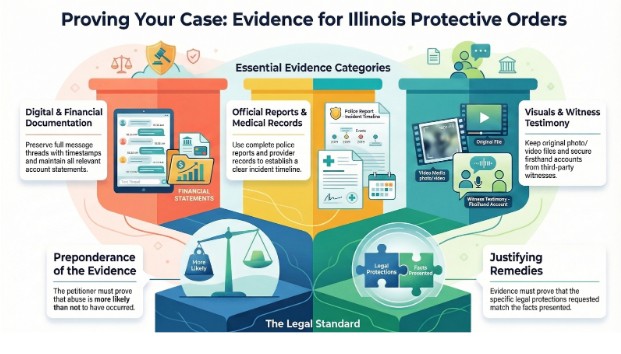
    The court wants solid evidence for plenary orders. Victims need to show abuse happened—testimony, documents, medical records, or witnesses help a lot. Both sides can present their case and question witnesses.

    Plenary orders can last:

    • Up to 2 years at first
    • Can be extended with new evidence
    • Sometimes permanent in extreme cases

    These orders cover everything—exclusive home use, child custody, money, and even counseling.

    The process takes longer, but the protection is much stronger. Courts dig deep into the evidence before granting these long-term orders.

    Comparison of Emergency, Interim, and Plenary Orders 

    Order TypeDurationEvidence RequiredNotice RequiredHearing Type
    Emergency14-21 daysVictim testimony onlyNone to the alleged abuserEx parte (one-sided)
    Interim30 days (extendable)Moderate evidenceAdvance notice givenLimited hearing
    PlenaryUp to 2 yearsSubstantial proofFull notice requiredComplete hearing

    Scope of relief grows with each order type. Emergency orders focus on immediate safety. Interim orders add more specific restrictions. Plenary orders can involve complicated arrangements for custody, finances, and property.

    Requirements get stricter at every step. Emergency orders need to address basic safety concerns. Interim orders want clearer evidence. Plenary orders require strong proof of ongoing abuse.

    Victims often move through all three stages, starting with emergency protection, then interim, and finally plenary if needed.

    How Orders of Protection Affect Divorce Proceedings

    Orders of protection shake up divorce cases right away. They affect where kids live, how property gets split, and what financial support looks like during the process.

    Impact on Child Custody and Visitation 

    When a court issues an order of protection, it usually spells out what happens with kids and parenting time. The protected parent almost always gets temporary custody right away.

    The court might stop visits between the abusive parent and the kids completely. Sometimes, the court only allows supervised visitation—meaning a third party is always present.

    These orders can last anywhere from weeks to months. During that time, the custody setup from the order often becomes the default for the divorce case.

    Judges take domestic violence seriously when deciding final custody. If a parent has an order of protection against them, they’re going to have a tough time getting equal parenting time.

    The protected parent has to show proof of abuse to get these restrictions. Police reports, medical records, and witness statements can help build a strong case.

    Impact on Use of Marital Residence and Property Division

    Orders of protection often give the victim exclusive use of the family home. This can happen even if both spouses own the house jointly.

    The abusive spouse has to leave the home immediately when the order takes effect. They can’t return, not even to pick up personal belongings, unless the court or police allow it.

    This living arrangement shapes how courts later divide property in a divorce. The spouse who stays in the home may have a stronger claim to keep it.

    Key property impacts include:

    • Temporary exclusive use of the marital home
    • Restricted access to shared vehicles
    • Limited ability to access joint bank accounts
    • Prohibition from selling or transferring marital assets

    The court may also order the removal of firearms from the home. This protects the victim and lines up with federal laws on domestic violence and guns.

    Financial Implications — Temporary Support, Payment Restrictions

    Orders of protection can include temporary financial support for the victim and children. The court may order the abusive spouse to keep paying household bills like mortgage, utilities, and insurance.

    Common financial orders include:

    • Temporary spousal support payments
    • Child support during the protection period
    • Payment of household expenses
    • Health insurance continuation
    • Attorney fee assistance

    The abusive spouse can’t access joint accounts or credit cards if the order restricts financial abuse. This blocks them from hiding money or cutting off the victim’s funds.

    Court-ordered wage garnishment often ensures support payments keep coming. This can give the victim some financial stability during the divorce process.

    Who Can Request an Order of Protection in Divorce Cases?

    Illinois law lets specific people file for orders of protection during divorce. Parents can also request protection for their kids, and attorneys play a big part in preparing these legal documents.

    Eligible Petitioners Under Illinois Law

    Primary petitioners include spouses, ex-spouses, and people who share a child. They can file directly with the court.

    Family members living in the same household can request protection, too. This covers parents, kids, and other relatives sharing the home.

    Dating relationships count under Illinois law. If you’ve dated or had an intimate relationship, you can file for protection from each other.

    The person filing has to show they’ve been abused or threatened. Abuse includes physical harm, harassment, or threats of violence.

    Courts want clear evidence of the relationship between the parties. Marriage certificates, birth certificates, or other documents help prove the connection.

    Age requirements say petitioners must be at least 18. Younger people need a parent or guardian to file for them.

    How Parents Can File on Behalf of Children

    Parents can file orders of protection to protect their children from the other parent. This happens if there’s evidence of abuse or threats toward the child.

    The parent filing needs to provide specific details about the abuse. Courts want clear examples of what happened and when.

    Documentation helps build the case. Medical records, photographs, or witness statements can support the request.

    Kids usually don’t have to testify. The parent can speak for them and explain why protection is needed.

    Emergency situations allow for immediate filing. Courts can grant temporary protection while they review the full case.

    The protected child might have limited or no contact with the abusive parent. Courts might order supervised visits instead of regular custody time.

    Role of Attorneys in Preparing and Filing Petitions

    Attorneys help families determine which type of protection order best suits their situation. Illinois offers different types of protective orders, each with its own requirements.

    Legal preparation means gathering evidence and organizing documents. Lawyers are familiar with the information courts typically seek in protection orders.

    Attorneys can file the petition directly with the court. This saves families time and helps ensure paperwork gets completed correctly.

    Court representation matters during hearings. Lawyers can present evidence and argue for protection.

    Free legal help is available through domestic violence programs. These services can help people who can’t afford private attorneys.

    Attorneys also explain how protection orders work with divorce cases. They help coordinate both legal processes to keep families protected.

    If you’re ready to get started, call us now!

    Steps to Obtain an Order of Protection During Divorce

    Steps to Obtain an Order of Protection During Divorce

    To obtain an Order of Protection in an Illinois divorce, families must file a petition, present evidence, and attend a court hearing.

    Filing the Petition (With or Without a Divorce Case Pending)

    You can file for an order of protection at any time during the divorce process. You can also file before starting a divorce case.

    Filing Options Include:

    • Going to the local circuit court clerk’s office
    • Having an attorney file the petition
    • Requesting the order as part of an existing divorce case
    • Getting help from a domestic violence program

    The petition must show you need protection from a family or household member. This includes spouses, ex-spouses, people who live together, or people who have kids together.

    Required Information:

    • Details about the abuse or threats
    • Dates and times of incidents
    • Any witnesses to the abuse
    • Photos of injuries or property damage
    • Police reports, if available

    The court clerk hands out the necessary forms. Many courts have staff who can help fill out the paperwork correctly.

    Presenting Evidence and Testimony

    Strong evidence helps judges decide on protection orders. The person asking for protection has to prove abuse happened or threats were made.

    Types of Evidence:

    • Medical records showing injuries
    • Text messages or emails with threats
    • Photos of bruises or damaged property
    • Police reports from domestic violence calls
    • Witness statements from people who saw the abuse

    The petitioner should be ready to tell their story clearly. Writing down what happened ahead of time helps. Dates, times, and specific details matter.

    Testimony Should Include:

    • What the abuser said or did
    • How often does abuse happen
    • Whether children saw the abuse
    • Fear for the safety of the children

    Some people are afraid to testify against their spouse. Court staff and victim advocates can offer support during this tough process.

    Court Hearings and Judicial Discretion

    Judges can grant emergency orders of protection right away. These temporary orders remain in effect until a full hearing, which typically occurs within 14 to 21 days.

    At the emergency hearing, only the person seeking protection appears. The judge reviews the petition and determines whether immediate protection is necessary.

    The full hearing includes both parties. The accused can bring a lawyer and present their side of the story. Both sides can call witnesses and show evidence.

    Judges look at several factors:

    • Severity of abuse – How serious the threats or violence were
    • Pattern of behavior – Whether abuse happened more than once
    • Risk to children – If kids are in danger
    • Credibility – Whether the evidence backs up the claims

    The judge can grant a plenary order that lasts up to two years. These orders can be renewed if needed.

    Importance of Legal Representation From Cooper Trachtenberg Law Group

    Having an experienced attorney really matters in protection order cases. Lawyers know how to present evidence effectively and advocate for their clients’ rights.

    Benefits of Legal Help:

    • Proper preparation of court documents
    • Knowledge of what evidence works best
    • Experience with local judges and procedures
    • Protection during cross-examination

    An attorney can coordinate the protection order with the divorce case. This helps avoid conflicts between court orders.

    Cooper Trachtenberg Law Group understands how frightening domestic violence situations can get. They help clients feel safe through the legal process.

    The firm’s lawyers prepare clients for court hearings. They explain what questions the judge might ask and how to answer in a clear, honest way.

    Having legal support takes some pressure off during a stressful time. Clients can focus on their safety and let their attorney handle the legal strategy..

    Orders of Protection affect custody, property, and safety. Cooper Trachtenberg Law Group helps families navigate these challenges with care. Don’t wait until it escalates—reach out and contact us now.

    What Happens If an Order of Protection Is Violated?

    Violating an order of protection in Illinois brings serious criminal penalties and quick law enforcement action. These violations can also affect divorce and custody decisions.

    Criminal Penalties for Violating Orders

    Illinois treats order of protection violations as criminal offenses with increasing penalties. A first violation usually gets charged as a Class A misdemeanor.

    First Offense Penalties:

    • Up to 364 days in jail
    • Fines up to $2,500
    • Probation with strict conditions

    Repeat Offense Penalties:

    • Second violation becomes a Class 4 felony
    • 1 to 3 years in prison
    • Fines up to $25,000

    Penalties get harsher if the violation involves other crimes. For example, if someone violates the order while committing assault or damaging property, they face charges for both.

    Aggravating Factors:

    The court considers these factors when determining sentences. Even attempting to contact the victim through someone else constitutes a violation.

    Enforcement by Police and Prosecutors

    Illinois has mandatory arrest policies for violations of orders of protection. Police have to arrest someone if they have probable cause to believe a breach has happened.

    Officers can’t use their own judgment to skip an arrest. This policy protects victims by ensuring that police act promptly when violations occur.

    Police Response Process:

    1. Investigate the reported violation
    2. Determine if probable cause exists
    3. Arrest the violator without a warrant
    4. File charges with the prosecutor

    Prosecutors take these cases seriously and rarely drop charges. They often push for jail time, even for a first offense, to send a strong message.

    Evidence Police Collect:

    • Text messages or emails
    • Witness statements
    • Photos of property damage
    • Medical records if an injury occurred

    The protected person’s consent doesn’t matter. Even if they invite contact, the violation still leads to criminal charges.

    How Violations Affect Ongoing Divorce Proceedings

    Order of protection violations can seriously affect divorce cases and child custody outcomes. Family courts see violations as evidence of poor judgment or even potential danger.

    Impact on Child Custody:

    • Reduced parenting time
    • Supervised visitation only
    • Loss of overnight visits
    • Mandatory counseling requirements

    Judges put child safety first—always. When someone violates an order, it signals they can’t follow court rules or respect boundaries.

    Impact on Property Division:

    • May influence spousal support decisions
    • Can affect the distribution of marital assets
    • Legal fees for violations may reduce available funds

    Impact on Future Court Orders:

    • The judge may issue stricter protective measures
    • Longer duration for protection orders
    • Additional conditions or restrictions

    Violations create a paper trail. This record sticks with the person through future court proceedings and can sway decisions for years.

    Alternatives and Supportive Measures Beyond Protective Orders

    Illinois families have a few other legal options and support tools when protective orders aren’t quite the right fit. 

    These alternatives can help lower conflict and provide safety through various court processes or professional assistance.

    Temporary Restraining Orders (TROs) vs. Orders of Protection

    Temporary Restraining Orders offer short-term legal fixes in civil matters. They typically last 10-14 days and require a court hearing to be extended.

    TROs often arise in property disputes or business conflicts during divorce proceedings. They can freeze assets or limit access to shared accounts in the meantime.

    Orders of Protection specifically address abuse and harassment. These orders can last up to two years and are accompanied by more rigorous enforcement.

    Key differences include:

    • Duration: TROs are shorter-term solutions
    • Purpose: TROs handle civil disputes; Orders of Protection address safety concerns
    • Penalties: Violating an Order of Protection carries criminal charges

    Some families use TROs when they need fast legal help but aren’t alleging abuse. Courts can issue TROs within a day or two if the matter is urgent.

    Parenting Coordinators for Conflict Resolution

    Parenting Coordinators step in to help divorced parents resolve disagreements about their children. Illinois courts can appoint these trained professionals when communication just isn’t working.

    Coordinators make binding calls on day-to-day parenting issues. They handle scheduling, activities, and those smaller disputes that inevitably arise.

    Benefits include:

    • Reduced court appearances
    • Faster problem resolution
    • Lower legal costs
    • Better communication skills

    Parents usually split the coordinator’s fees. Sessions can happen face-to-face, by phone, or over video—whatever works.

    Coordinators don’t have the power to change major custody arrangements. They’re there to help enforce what the court already ordered, just more smoothly.

    This process works best when both parents actually try to follow the recommendations. Courts can step in and enforce the coordinator’s decisions if someone refuses to cooperate.

    Counseling and Support Services for Families

    Individual therapy helps family members deal with the stress and trauma of divorce. Plenty of therapists focus on family transitions and domestic issues.

    Family counseling can open up communication between parents and kids. These sessions often keep going even after the divorce wraps up.

    Support groups connect families with others facing similar issues. Many organizations offer free or affordable group sessions.

    Available services include:

    • Crisis hotlines for immediate support
    • Legal aid clinics for low-income families
    • Child therapy programs
    • Co-parenting classes

    Domestic violence organizations offer safety planning and emergency resources. They provide confidential help—even if families don’t want to go through the courts.

    Insurance often covers mental health services. Community centers and religious groups sometimes offer extra support at lower costs.

    Why Choose Cooper Trachtenberg Law Group for Protective Orders in Divorce

    When safety and stability are on the line, you need attorneys who act quickly and advocate with compassion. Cooper Trachtenberg Law Group has built a strong reputation for guiding families through high-conflict divorces involving protective orders.

    The firm moves fast in urgent domestic violence situations, securing immediate protection while managing custody, property, and financial issues that often arise alongside. 

    Their approach strikes a balance between strategic legal advocacy and human support, providing clients with the reassurance they need during a crisis.

    With decades of combined experience, Miriam Cooper and Helena Trachtenberg are recognized leaders in Illinois family law. 

    Both attorneys have been honored by their peers with prestigious Best Lawyers and Super Lawyers designations, underscoring their authority and credibility in cases involving protective orders and family law.

    Your safety and your children’s security matter most. Cooper Trachtenberg Law Group provides trusted representation in Illinois divorce and protective order cases. Take the first step—contact us to schedule.

    Contact Us Today For An Appointment

      I have read the

      Frequently Asked Questions 

      What is an Order of Protection in an Illinois divorce?

      An Order of Protection is a court order that restricts an abusive spouse or partner from certain actions. In Illinois divorce cases, it may include no-contact provisions, exclusive possession of the home, temporary custody, and restrictions to safeguard children and family members.

      Who can file for an Order of Protection during divorce?

      Spouses, former spouses, children, household members, or family members can petition for an Order of Protection in Illinois. A parent or guardian may file on behalf of a child, and attorneys can help prepare petitions and present evidence.

      How long does an Order of Protection last in Illinois?

      Illinois courts issue three types: emergency orders (up to 21 days), interim orders (up to 30 days), and plenary orders (up to 2 years). Plenary orders can be extended if ongoing safety concerns exist.

      Will an Order of Protection affect child custody?

      Yes. If safety is a concern, courts can restrict or supervise parenting time. Protective orders often influence custody arrangements, prioritizing the child’s well-being while ensuring appropriate safeguards for both parents.

      Can an Order of Protection be issued without a divorce case?

      Yes. Orders of Protection can be filed independently under the Illinois Domestic Violence Act. However, if a divorce is pending, protective orders may be consolidated into the divorce proceedings for streamlined case management.

      What proof is needed for an Order of Protection?

      Evidence can include testimony, police reports, medical records, photos, texts, emails, or witness statements. Judges evaluate whether abuse, harassment, or threats occurred and if ongoing protection is necessary for safety.

      What happens if an Order of Protection is violated?

      Violating an Order of Protection is a criminal offense in Illinois. Consequences may include arrest, fines, and imprisonment. Violations can also impact divorce outcomes, including custody, visitation, and property arrangements.

      How do I get an Order of Protection during a divorce?

      File a petition with the court, present evidence, and attend a hearing. Emergency orders can be granted quickly without the presence of the other party. An attorney helps ensure petitions are accurate and arguments are strong.

      Dividing Emotional Property: Heirlooms, Photos, and Keepsakes in Illinois Divorce

      Divorce isn’t just about splitting bank accounts or the house. In Illinois, family heirlooms, photos, and keepsakes with deep emotional value get divided, too, all under state property laws.

      These things hold memories you really can’t put a price on. It’s tough to divide these types of items during a divorce.

      Dividing sentimental assets during divorce can catch people off guard. A grandmother’s ring, photo albums, or a kid’s artwork—these can cause real arguments when both sides feel attached to them.

      Illinois courts have rules about who gets what, but most couples try to avoid a big court fight over their most cherished belongings. If you know how the law views these things, you can find ways to protect family heirlooms during divorce and cut down on the stress of material possession division.

      Key Takeaways

      • Illinois courts sort sentimental items as marital or non-marital, depending on when and how you obtained them.
      • You can work out your own agreement and skip letting a judge decide about emotional property.
      • Putting heirloom and keepsake clauses in a prenuptial agreement can help protect family treasures before you even get married.

      How Does Illinois Divorce Law Treat Sentimental Property Like Heirlooms?

      Illinois courts look at family heirlooms based on how and when you got them—not how much they mean to you. 

      Heirlooms often count as non-marital property if you inherited them or got them as gifts before marriage, or even during marriage, from someone outside your spouse’s family.

      Marital vs. Non-Marital Classification Under Illinois Law

      Illinois uses equitable distribution for marital property. The court splits things up fairly, but not always 50/50.

      Marital property means stuff you got during the marriage, usually with joint money. That includes things you bought together or gave each other.

      Non-marital property typically remains with the person who owned it first. Illinois divorce laws treat gifts and inheritances differently from other assets.

      Heirlooms usually end up as non-marital property. What matters most is when and how you got the item, not how you feel about it.

      Courts require proof—such as wills, gift receipts, or family testimony. If you can show you inherited or received the item as a gift, you’re in a stronger position.

      Heirlooms Often Excluded if Inherited or Gifted Before or During Marriage

      Inherited heirlooms can be tricky because of their meaning, but Illinois law usually protects them.

      If you inherited something before marriage, it’s non-marital property. You get to keep it.

      Heirlooms inherited during marriage also stay with you, even if you both used or displayed them.

      Gifts from your family follow the same rules. If your aunt gave you a wedding gift, it’s yours—not your spouse’s.

      You’ll need to prove the item’s status. Bank records, estate papers, or witnesses can help.

      Exception: If you used marital money to restore or upgrade the item, your spouse might get a share of any increased value. That’s where it gets messy.

      If you’re facing divorce and worried about heirlooms or keepsakes, Cooper Trachtenberg Law Group can help protect what matters most. Contact us today to schedule a consultation.

      If you’re ready to get started, call us now!

      Who Gets Family Photos, Albums, or Digital Archives in Divorce?

      Family photos and albums are tough to split. Both parents and kids care about them, and you can’t exactly cut a photo in half. 

      Courts usually allow each spouse to keep the photos they’re in, but digital photos and videos add another layer—those files live on numerous devices and accounts.

      Importance of Preserving Children’s Access to Family History

      Kids need their family photos and memories, from both sides. Courts recognize that these pictures help children stay connected to their roots and sense of self.

      When parents split up their photo collections, they should prioritize their kids’ emotional needs first—should they toss or hide photos of the other parent? That can really hurt a child’s sense of family.

      Key things for children’s access:

      • Vacation and milestone photos
      • Pics with both parents and the kids
      • Big family gatherings
      • School events, childhood moments

      Family photos sometimes matter more than money in divorce. Illinois courts push for solutions that let kids keep their full family story.

      Children do better when they can discuss their photos with both parents. It helps maintain their identity and relationships during a challenging time.

      Practical Solutions: Digital Scans, Shared Cloud Folders

      Tech offers some real help here. You can scan old photos and give both parents a copy—nobody has to lose out.

      Ways to share photos:

      SolutionBest ForConsiderations
      Digital scanningPhysical albumsTime-consuming but permanent
      Shared cloud foldersDigital photosNeeds cooperation
      USB drivesSmall collectionsSimple, but not easily updated

      Modern families have photos everywhere—on phones, laptops, and in the cloud. During a divorce, parents need to locate all their digital files.

      Cloud storage enables both parents to access the same library. Google Photos or iCloud can work if you set them up right.

      Couples should include digital assets in their divorce agreement to avoid disputes later. That means passwords, access rights—all of it.

      If you’ve got a massive photo collection, professional digitization services can help. Sometimes it’s easier than sorting through memories together, especially if things are tense.

      What Happens to Wedding Rings, Jewelry, and Keepsakes in Illinois Divorce?

      Wedding rings and jewelry are treated as property in an Illinois divorce. Engagement rings given before marriage are typically considered non-marital property, whereas gifts received during marriage may be considered marital assets.

      Rings, Anniversary Gifts, Special Jewelry

      Wedding rings almost always remain with the person who wore them. They’re considered conditional gifts and separate property in Illinois.

      The Illinois Marriage and Dissolution of Marriage Act lays out rules for gifts. If you received jewelry as a gift, it’s non-marital property. You keep it.

      Anniversary gifts work the same way. If you received jewelry for a special occasion, it’s yours. You keep it during property division.

      Key jewelry categories in divorce:

      • Wedding rings: Stay with the wearer.
      • Engagement rings: Usually stay with the recipient.
      • Anniversary gifts: Belong to the recipient.
      • Family heirlooms: Depends on where they came from

      Expensive jewelry bought with joint money might get treated differently. Courts examine the source of the money.

      Emotional Significance vs. Legal Property Definition

      The law prioritizes ownership, not emotions. Even if something means a lot to you, property division still goes by how you got it.

      Keepsakes and mementos typically remain with the person who owns them. Photos, letters, and little personal things rarely become a court fight—unless they’re worth a lot of money.

      Emotional vs. Legal Considerations:

      • Legal focus: Who owns it, on paper
      • Emotional focus: Who feels attached
      • Court priority: Law wins over feelings

      Heirlooms passed down through generations usually originate from the side of the family they came from. For example, a grandmother’s ring given to a daughter-in-law might end up back with the husband’s family.

      Personal collections—such as books, art, and hobby items—typically remain with the person who collected them. An emotional connection doesn’t significantly alter legal ownership.

      Courts rarely order someone to give up sentimental items that are legally theirs.

      Sentimental property disputes can feel overwhelming. Cooper Trachtenberg Law Group guides Illinois families through fair solutions with care and strength. Don’t wait—reach out to us now.

      If you’re ready to get started, call us now!

      Can Spouses Negotiate Division of Emotional Property Outside of Court?

      Mediation enables couples to determine how to divide heirlooms, photos, and keepsakes without the need for court intervention. This is often less stressful and more respectful of emotional ties.

      Using Mediation or Collaborative Divorce

      Mediation gives divorcing couples a real opportunity to work together on dividing their emotional assets. 

      A neutral mediator steps in and helps the two parties discuss their emotional attachments to certain heirlooms or photos.

      The mediator never makes decisions for the couple. They just guide the conversation and let each spouse explain what different things mean to them.

      This approach works especially well for emotional property. People have the opportunity to share their stories and feelings without pressure.

      Collaborative divorce involves both spouses and their attorneys, all working together as a team. Everyone signs an agreement to keep things out of court and handle them privately.

      This method gives the couple more control, especially when it comes to family heirlooms. It’s a relief to know you’re deciding, not a judge.

      • Privacy in discussions about personal items
      • Time to make thoughtful decisions
      • Lower costs compared to the court
      • Preserved relationships for future family events

      Spouses can negotiate settlements outside of court with help from attorneys or mediators. This route feels less stressful, especially when emotions run high.

      Creative Solutions — Alternating Items, Making Duplicates, Rotating Possession

      Sometimes, creative solutions help both sides keep their connection to meaningful items. Honestly, these ideas work way better than the old “winner takes all” approach.

      Alternating possession is one way to go. Spouses take turns keeping certain items for set periods, like a grandmother’s china, spending holidays with one person, then moving to the other.

      This works great for seasonal decorations or those quirky family traditions. It keeps everyone involved.

      Making duplicates can also help. Professional photographers can copy old family photos, and jewelers might create a similar piece from an original heirloom.

      Digital copies of documents and letters are inexpensive and easy to obtain. Both people get to hold onto the memories.

      Rotating schedules lett both spouses enjoy things throughout the year. Maybe a family piano stays with one spouse for six months, then moves to the other’s home.

      Sure, this needs cooperation, but it keeps special items in use. Sometimes creative solutions are the best way to handle sentimental objects.

      A personal property memorandum can spell out these arrangements. This document lists the specific items and explains the rotation or alternating plan.

      Illinois law lets couples reference this memorandum in their divorce decree. It’s surprisingly practical.

      These solutions only work if both people want to preserve family connections. You need trust and a willingness to compromise.

      How Do Illinois Courts Handle Disputes Over Sentimental Items?

      Illinois judges don’t have much power to assess emotional value when dividing property. They’d much rather couples figure out sentimental items themselves than leave it up to the court.

      Limits of Judicial Discretion in Valuing Emotion

      Courts can’t really measure the emotional worth of personal belongings. Judges consider fair market value, not personal feelings, when dividing property.

      Family photos and children’s artwork often have deep sentimental value but almost no monetary worth. That makes things tricky for judges who have to make practical decisions.

      Illinois follows equitable distribution rules. Judges divide marital property fairly, but not always equally.

      • Financial contribution to acquiring the item
      • Length of marriage
      • Economic circumstances of each spouse
      • Practical utility of the object

      Judges rarely spend much time weighing emotional attachments. They simply don’t have the tools—or the time—to gauge personal feelings about their belongings.

      Why Judges Encourage Settlement Before Trial

      Courts often encourage couples to negotiate their own agreements regarding personal property. Settlement saves everyone time, money, and a lot of emotional stress.

      Fighting over household items usually means the divorce isn’t friendly and could signal bigger conflicts ahead. Judges know couples understand their priorities better than anyone else.

      • Faster resolution
      • Lower legal costs
      • More creative solutions
      • Reduced emotional trauma

      Spouses can make arrangements that courts can’t order. They might share custody of heirlooms, make copies of photos, or trade items based on personal meaning.

      If couples can’t agree, judges make quick decisions based on practicality—not emotional significance. It’s not ideal, but sometimes it’s all that’s left.

      Should You Include Sentimental Property in a Prenuptial or Postnuptial Agreement?

      Prenuptial and postnuptial agreements provide Illinois couples with protection for their individual assets and establish clear financial expectations.

       These documents can actually name family heirlooms, photos, and keepsakes before any disputes pop up.

      Benefits of Planning for Family Treasures

      Prenuptial agreements offer the best protection for family heirlooms by listing inherited items right there in writing. That can stop expensive court battles over things that mean a lot.

      • Clear ownership rules – The agreement says who keeps what
      • Reduced conflict – Both spouses know the deal from the start
      • Cost savings – Less time fighting in court over sentimental stuff

      Couples can decide what stays separate and what becomes marital property. That protects family treasures passed down through generations.

      Prenuptial agreements can designate important family heirlooms as separate property, ensuring they pass to the intended family members. This works well with estate planning, too.

      Postnuptial agreements work for couples who are already married. These agreements can outline property and financial details with terms that courts will enforce.

      The agreement should list exact items by description, location, and estimated value. It’s smart to get specific—photos, rings, antiques, artwork —so everything is identified and there’s no confusion later.

      Why Work With Cooper Trachtenberg Law Group on Emotional Property Division?

      Cooper Trachtenberg Law Group knows its way around complex property disputes—and understands how family emotions can affect legal decisions. 

      They help clients handle the legal requirements and the personal challenges of dividing meaningful items. That’s not something every firm does well.

      Experience with High-Conflict Property Cases

      Cooper Trachtenberg Law Group supports clients through tough property division disputes, offering more than just standard legal help. Emotional property cases often grow more complicated than regular asset splits.

      The firm handles cases involving families who dispute the ownership of valuable heirlooms. Sometimes, several family members have competing claims to the same item, and the situation can quickly become messy.

      Their attorneys are well-versed in Illinois property laws. They know how to determine which items constitute marital property and which ones are separate. That knowledge protects what belongs to each spouse.

      • Family heirloom disputes
      • Photo and document division
      • High-value collectibles
      • Items with sentimental value
      • Multi-generational property claims

      The attorneys bring in appraisers when it makes sense. They help determine fair market values for valuable items, which prevents arguments about what things are truly worth.

      Client Testimonials about Cooper Trachtenberg Law Group

      “Very good and thorough!!!”
      Snyder JL, ★★★★★

      “Helena Trachtenberg helped me through some really rough times and was steady and wonderful.”
      Sarah U., ★★★★★

      “Cooper Trachtenberg took all my worries away… focused on your needs and will provide honest feedback.”
      John, ★★★★★

      “Helena Trachtenberg is very professional and works diligently with the client. Highly recommend.”
      Recent client, ★★★★★

      Your memories and security deserve protection. Cooper Trachtenberg Law Group provides trusted representation in Illinois divorce cases. Take the first step by contacting us to schedule a confidential consultation.

      Contact Us Today For An Appointment

        I have read the

        Frequently Asked Questions 

        Do Illinois courts consider emotional value when dividing property?

        No. Courts focus on the classification of marital versus non-marital assets and their financial value. Emotional significance is not a legal factor, although it may influence the outcomes of negotiation or mediation.

        Who usually gets family photo albums in an Illinois divorce?

        Courts may award originals to one spouse, but often encourage copies or digital scans so both parties can preserve family memories.

        How are heirlooms treated in divorce cases?

        Inherited heirlooms are generally considered non-marital property and remain with the original owner, unless they are commingled with marital assets.

        Can prenuptial agreements cover sentimental property?

        Yes. Illinois courts will enforce prenuptial or postnuptial agreements that clearly state who retains heirlooms, keepsakes, or family treasures.

        What happens if spouses can’t agree on sentimental items?

        If no agreement is reached, judges apply standard laws governing property division. Because courts can’t assign emotional value, they often urge mediation first.

        Are engagement rings divided in an Illinois divorce?

        No. Engagement rings are considered non-marital property since they are conditional gifts given before marriage.

        Can mediation help resolve disputes over keepsakes?

        Yes. Mediation often leads to creative solutions, such as rotating possession, creating duplicates, or trading other assets to achieve a fair balance.

        Can protective orders include pets or sentimental property?

        Yes. Illinois protective orders may cover pets and certain belongings if they are tied to threats, harassment, or safety concerns during a divorce.

        Temporary vs. Plenary Protective Orders During Divorce in Illinois: Your Legal Protection Options

        Divorce is stressful enough on its own. When domestic violence enters the picture, things get a whole lot more complicated.

        Illinois courts offer various protective orders to help keep people safe during divorce, but determining the difference between temporary and permanent orders can be a challenge.

        Temporary protective orders provide immediate, short-term protection in emergencies—plenary protective orders, on the other hand, last longer but only after a full court hearing.

        Judges can issue emergency temporary orders immediately if someone faces an urgent threat, but these only remain in effect until the court hears the case and issues a final order.

        The type of protective order someone receives during divorce can significantly impact child custody, property division, and other major decisions.

        Key Takeaways

        • Temporary protective orders provide emergency protection quickly, while plenary orders offer long-term security following a hearing.
        • Protective orders can change child custody and property division in divorce cases.
        • Violating any protective order can bring serious legal consequences—potentially including criminal charges.

        What Is a Temporary Protective Order in an Illinois Divorce?

        Temporary protective orders offer immediate protection from abuse during divorce. Courts issue these orders quickly, and the other party doesn’t even have to be present.

        These orders typically last only a short while and usually include provisions such as no-contact rules and property restrictions.

        Duration and Validity

        Emergency orders of protection in Illinois remain in effect for up to 21 days from the date the judge signs them. That short window gives people some breathing room and lets the court schedule a proper hearing.

        If the petitioner wants more protection after those 21 days, they’ve got to ask for an extension or go for a plenary order. If they don’t, the temporary order just ends.

        Certain situations let courts extend emergency orders. That usually happens if the respondent can’t be served or if court calendars become overloaded.

        These orders work throughout Illinois and in other states that recognize protective orders. Police can enforce them immediately once they review the paperwork.

        Issued Without the Other Party Present

        Court issues emergency protective orders ex parte—basically, without telling the other spouse first. That’s crucial when someone needs protection right away.

        The petitioner must demonstrate an immediate and real danger. Judges consider all available evidence, such as police or hospital records, to make their decision.

        No advance notice keeps victims safer. The abusive spouse only finds out after getting served with the order.

        To qualify for an order of protection in Illinois, someone has to prove abuse or threats happened recently under the Illinois Domestic Violence Act.

        Common Protections Included

        No-contact provisions stop the abusive spouse from calling, texting, emailing, or approaching the protected person. That even covers indirect contact through friends or social media.

        Residence restrictions can kick the abusive spouse out of the marital home. The court may allow the protected spouse and children to stay there during the divorce.

        Stay-away orders set a minimum distance—usually 100 to 500 feet—that the respondent has to keep from the petitioner’s home, work, or kids’ school.

        Other possible protections:

        • Temporary child custody
        • Firearm restrictions (the respondent has to hand over any weapons)
        • Financial support for the protected spouse
        • Personal property retrieval with police there to keep the peace

        Orders of protection during divorce can also block access to shared vehicles or require the abusive spouse to pay for housing, at least for now.

        If you’re ready to get started, call us now!

        What Is a Plenary Protective Order in Illinois Divorce?

        A plenary order of protection gives long-term legal protection to victims of domestic abuse during divorce. The court reviews evidence and testimony, then sets restrictions that can last up to two years.

        How Plenary Orders Are Requested After a Temporary Order

        Typically, someone begins with an emergency or interim order before requesting a plenary order. That temporary order gives them time to prepare their case.

        The petitioner files a new petition before the temporary order expires. This one needs to spell out the abuse or harassment in detail.

        Required Documentation:

        • Written petition with specific incidents
        • Police reports (if there are any)
        • Medical records showing injuries
        • Witness statements
        • Photos of injuries or damage

        The court sets a hearing within two to three weeks after the filing. Both sides get notice about the hearing date.

        The respondent can appear, present their own evidence, and challenge the claims. They might even call their own witnesses.

        Court’s Evaluation of Evidence and Testimony

        The judge considers everything both sides present at the hearing. The petitioner has to prove abuse happened by “a preponderance of the evidence.”

        Evidence the Court Reviews:

        • Testimony from the petitioner
        • Witnesses
        • Physical evidence, like photos
        • Medical records
        • Police reports
        • Text messages or emails

        The respondent has the opportunity to cross-examine witnesses and challenge the evidence. They can also bring their own proof.

        Judges often ask questions themselves to ensure they have the facts straight. Illinois courts don’t take domestic violence allegations lightly in divorce cases.

        The standard of proof here isn’t as tough as in criminal court. The petitioner just needs to show it’s more likely than not that abuse happened.

        Rights and Obligations Set in the Order

        A plenary order can last up to two years and lays out specific restrictions. The respondent must follow every term or risk facing criminal charges.

        Common Protections Include:

        • No contact with the petitioner
        • Stay away from home, work, and school
        • No harassment or intimidation
        • Surrender firearms within 24 hours
        • Temporary child custody
        • Temporary financial support

        The order might give the petitioner exclusive use of the family home. Sometimes it grants temporary custody of the kids, with only supervised visits for the respondent.

        Financial obligations don’t just disappear during the protection order. The respondent may still be required to pay temporary spousal or child support.

        If the respondent breaks any part of the order, they can face contempt of court charges. Police can arrest them on the spot—even if they didn’t see the violation happen.

        How Do Temporary and Plenary Protective Orders Compare?

        How Do Temporary and Plenary Protective Orders Compare?

        Temporary orders provide fast but short-term safety, while plenary orders offer longer-lasting protection with court oversight.

        Comparison of Temporary vs. Plenary Orders

        FeatureTemporary (Emergency) OrderPlenary Order
        DurationUp to 21 daysUp to 2 years
        Hearing RequiredNo, issued ex parteYes, both parties present evidence
        Scope of ProtectionImmediate reliefLong-term, comprehensive protection
        RenewalConverted to plenary if neededCan be extended upon petition

        Temporary and plenary orders both provide vital safeguards during the divorce process. Cooper Trachtenberg Law Group guides Illinois families through the process. Don’t wait—reach out and contact us now.

        If you’re ready to get started, call us now!

        How Do Protective Orders Affect Divorce Proceedings in Illinois?

        Protective orders influence divorce by restricting contact, affecting custody, and impacting access to marital property. Judges prioritize safety when making temporary and long-term decisions.

        Impact on Parenting Time and Visitation

        Protective orders can seriously change child custody arrangements during an Illinois divorce. The court tries to balance child safety with each parent’s rights when abuse comes up.

        Supervised Visitation Requirements

        If there’s a protective order against a parent, the court usually requires supervised visits. A neutral adult must be present for every visit with the kids.

        Modified Parenting Schedules

        The protected parent often gets temporary primary custody. The parent under the order might lose overnight visits or have their communication with the kids limited.

        Exchange Protocols

        Court orders set up specific pickup and drop-off rules to keep the parents apart. That might mean:

        • Exchanges in public places
        • Using a third-party facilitator
        • Staggered arrival times

        Orders of protection can affect how the court allocates parental responsibilities throughout the divorce. Judges consider any protective orders when making final decisions regarding custody.

        Exclusive Possession of Marital Residence

        Protective orders often give the protected spouse exclusive use of the family home. This can happen even if both spouses own the property together.

        Immediate Removal

        Once the court grants the order, the restrained spouse must leave immediately. They can’t return unless the court explicitly allows it, regardless of what the deed states.

        Duration of Possession

        Temporary protective orders can last up to 30 days. Plenary orders might stretch that out for as long as two years.

        The protected spouse stays in the home for the full length of the order.

        Property Access Issues

        The restrained spouse cannot simply come back and reclaim their belongings. They require court permission and typically a police escort or a court-supervised visit to collect essentials.

        Financial Responsibilities

        Mortgage, utilities, and maintenance bills don’t stop during a protective order. Courts might address who pays what in temporary support orders.

        Financial and Property-Related Restrictions

        Protective orders put immediate financial protections in place. These go beyond the usual divorce freezes and block the restrained party from certain accounts or property.

        Bank Account Limitations

        If financial abuse is occurring, courts may restrict access to joint accounts. The protected spouse often gets control over funds for daily living.

        Credit and Debt Protection

        The order can stop the restrained spouse from opening new credit lines or making big purchases. This helps protect the protected spouse from new marital debt.

        Insurance Continuity

        Protective orders can require health insurance coverage to continue for the protected spouse and children. The restrained spouse can’t cancel or change those policies.

        Vehicle and Asset Access

        The court may allow the protected spouse to use vehicles or other key property temporarily. This keeps them independent and, honestly, safer during divorce.

        What Happens If a Protective Order Is Violated?

        What Happens If a Protective Order Is Violated?

        Breaking a protective order in Illinois can result in criminal charges and impact divorce proceedings. Violating a protective order carries criminal or civil penalties that can impact custody decisions and property division.

        Criminal Penalties Under Illinois Law

        Illinois treats violations of protective orders as serious crimes. A violation is typically classified as a Class A misdemeanor under state law.

        Class A Misdemeanor Penalties:

        • Up to 1 year in jail
        • Fines up to $2,500
        • Possible probation
        • Community service

        A Class A misdemeanor can result in up to a year in jail and a fine of up to $2,500. Judges sometimes add extra penalties, depending on the circumstances.

        Repeat violations can quickly turn into felonies. Every text or call can count as a separate violation, which adds up fast.

        Enforcement by Police and Prosecutors

        If police have probable cause, they have to arrest anyone violating a protective order. They don’t need to see it happen—they can act on reports and evidence.

        Prosecutors tend to go after these cases hard, especially when domestic abuse is involved. Even if the victim doesn’t want to press charges, the state can take over and pursue the case.

        Common evidence includes:

        • Text messages or voicemails
        • Witness statements
        • Security camera footage
        • Location data from phones

        Court-issued bench warrants let police arrest violators anywhere in Illinois. The violation remains on the person’s criminal record permanently.

        Influence on Custody and Property Division

        Violating a protective order can seriously hurt your case in divorce court. Judges view violations as signs of poor judgment and potential danger to the family.

        Custody Effects:

        • Supervised visitation only
        • Reduced parenting time
        • Mandatory counseling requirements
        • Complete loss of custody in severe cases

        Judges prioritize child safety above all else. If a parent can’t follow court orders, it raises big questions about their ability to co-parent.

        Property division might change, too. Courts sometimes give the victim a bigger share of marital assets and can adjust spousal support based on the violation.

        Violations on your record can haunt you. Even after the divorce, judges look at that history when deciding future custody arrangements.

        Why Work With Cooper Trachtenberg Law Group on Protective Orders?

        Cooper Trachtenberg Law Group offers real expertise in family law matters, particularly in protective orders during divorce. 

        Their attorneys understand the urgency and complexity of these cases, and they’ve built a solid reputation in Illinois courts.

        Experience in High-Conflict and Domestic Violence Cases

        Cooper Trachtenberg Law Group has decades of experience in family law. They handle tough cases involving domestic violence and protective orders all the time.

        The attorneys understand the sensitivity of these situations and are aware of the legal complexities that arise when protective orders and divorce intersect. 

        They’ve represented both sides—helping victims get orders and defending against them when needed.

        This gives them a good sense of what the other side might try, which helps them build a stronger case. They’re familiar with Illinois domestic violence laws and know what evidence courts want to see in protective order hearings.

        They also know what paperwork is required for temporary orders and how to prepare for plenary hearings. Their legal team understands the emotional toll these cases can take.

        They provide clients with clear advice, but let them decide what’s best for their safety and future. No one wants to go through this, but having someone who gets it makes a difference.

        Ability to Act Quickly in Emergencies

        Temporary protective orders can be issued quickly, often on short notice. Cooper Trachtenberg Law Group knows things can spiral quickly during a divorce.

        They’ve set up systems to handle emergency protective order requests right away. Their attorneys can quickly gather paperwork and appear in court when someone’s safety is at risk.

        Timing matters in these cases. Waiting even a day can put someone at risk or weaken the legal case.

        The attorneys can work with law enforcement if needed and guide clients through getting emergency protective orders, even outside normal business hours. Sometimes that’s what it takes.

        Trusted Reputation in Illinois Courts

        Cooper Trachtenberg Law Group has established strong relationships within the Illinois court system by consistently providing professional representation. The firm represents clients throughout the Chicago area and is well-versed in local court procedures.

        This reputation means clients’ cases actually get the attention they deserve. The attorneys are familiar with local court rules and the sometimes-confusing standing orders that can impact protective order cases.

        Your safety and children’s well-being come first. Cooper Trachtenberg Law Group provides trusted representation in Illinois protective order and divorce cases. Take the first step—contact us to schedule today.

        Contact Us Today For An Appointment

          I have read the

          Frequently Asked Questions 

          How long does a temporary protective order last in Illinois?

          A temporary protective order, also known as an Emergency Order of Protection, lasts up to 21 days and provides immediate safety until a full court hearing can be held.

          What is the difference between temporary and plenary protective orders?

          Temporary orders provide short-term relief without a hearing, while plenary orders last up to two years and require both parties to present evidence in court.

          Can a temporary order turn into a plenary protective order?

          Yes. After a hearing, judges can extend protections by issuing a plenary order based on the evidence provided.

          Do protective orders affect custody during divorce?

          Yes. Illinois courts may restrict parenting time or require supervision to protect children if abuse or threats are involved.

          What happens if someone violates a protective order in Illinois?

          Violating a protective order is a criminal offense. Consequences may include arrest, fines, jail time, and a profound impact on custody and property issues in divorce.

          Do I need a lawyer to get a protective order?

          Not legally, but having an attorney ensures the petition is complete, evidence is presented correctly, and your rights are protected during the process.

          Can plenary protective orders be extended beyond two years?

          Yes. Courts may extend plenary orders if ongoing risks are proven before the original order expires.

          Are protective orders and restraining orders the same thing in Illinois?

          No. Protective orders are issued under the Illinois Domestic Violence Act and focus on family safety, while restraining orders address broader civil disputes.

          Illinois Parenting Plans for Autism, ADHD & Sensory Needs: What Courts Consider

          Illinois courts consider medical needs, therapy schedules, educational supports, and individualized routines when creating parenting plans for children with Autism, ADHD, or sensory challenges. 

          Judges prioritize the child’s best interests, making accommodations tailored to their developmental needs.

          Illinois courts put the child’s best interests at the center when deciding on parenting plans for kids with autism, ADHD, or sensory needs.

          Family court professionals need extra training and experience with high-functioning autism cases, showing how seriously Illinois treats these situations.

          Parents who understand what judges look for in these plans can advocate for arrangements that truly meet their child’s emotional and developmental needs.

          Key Takeaways

          • Illinois courts expect parenting plans to address the specific therapeutic and educational needs of kids with autism, ADHD, or sensory processing differences.
          • Judges look at each parent’s ability to keep routines steady, handle medical care, and support the child’s special needs during custody decisions.
          • Documentation from therapists, doctors, and teachers helps show how a proposed plan supports the child’s development.

          Illinois Parenting Plans for Autism, ADHD & Sensory Needs

          Illinois courts know that kids with high-functioning autism need custom parenting plans that fit their unique needs. 

          When parents have children with autism, ADHD, or sensory processing disorders, judges check for certain details.

          Key Areas Courts Evaluate:

          • Daily routines and structure – Children with autism often rely on a steady schedule.
          • Therapy appointments – Judges want to know about ongoing ABA, speech, or occupational therapy needs.
          • Medical care coordination – Specialized doctors and treatments require careful planning.
          • School support – Involvement in IEP meetings and educational accommodations matters.

          Transitions between homes can be extra tough for children with special needs. Courts sometimes order longer stays with each parent, rather than frequent back-and-forth arrangements.

          Sensory needs also play a significant role. Some children require quiet spaces or specific accommodations in both homes, and judges take note of this.

          The court examines each parent’s track record in handling meltdowns and behavioral issues. They also verify who is taking the lead on medical appointments and therapy sessions.

          Family court professionals must consider comorbid disorders like anxiety or ADHD that often go hand in hand with autism.

          Parents must prove they can maintain consistency in both homes for the sake of their child.

          What Makes Parenting Plans Different for Children with Autism or ADHD?

          Kids with autism or ADHD need specialized parenting plans that fit their sensory, behavioral, and developmental needs. 

          Illinois courts recognize that standard custody schedules often don’t work for these children and frequently approve modifications that make more sense.

          Why “One-Size-Fits-All” Parenting Plans Rarely Work

          Most traditional parenting plans assume all kids handle schedule changes just fine. That’s just not true for children with autism or ADHD.

          Kids with autism often struggle when their routines change suddenly. Standard every-other-weekend setups can be really distressing, and some kids need more time to adjust between homes.

          Sensory processing differences add another layer. Some children get overwhelmed by new sounds, lighting, or textures in a different house. What seems normal in one place can trigger a meltdown in another.

          ADHD brings its own set of hurdles. Kids might forget which parent’s house they’re supposed to be at, or struggle to pack up their stuff and follow new rules in each home.

          Parenting children with ADHD and autism means understanding these behaviors. Courts are beginning to recognize that imposing rigid schedules can actually exacerbate the problems for these children.

          Legal Emphasis on Best Interests of the Child

          Illinois courts always prioritize the child’s best interests, not the parents’ convenience. For children with special needs, this principle is fundamental.

          Key factors courts examine include:

          • The child’s specific therapy needs
          • How steady the care is between both homes
          • Each parent’s ability to handle behavioral challenges
          • Access to specialized medical care and services

          Judges often seek the opinions of therapists, doctors, and special education experts. These professionals help courts understand how autism or ADHD affects the child’s daily life.

          Understanding the unique challenges is critical during custody evaluations. Parents who truly understand their child’s diagnosis usually receive more favorable consideration.

          The court reviews which parent has been responsible for managing medical appointments, therapy sessions, and school meetings in the past. 

          Maintaining steady healthcare relationships is crucial for children with developmental needs.

          Examples of Adjustments Courts May Approve

          Illinois courts sometimes allow all sorts of changes to fit children with autism or ADHD. The focus is on reducing stress and maintaining stability.

          Schedule modifications might include:

          • Longer transitions (like 2-3 days instead of overnight swaps)
          • Schedules that rarely change
          • Mid-week phone calls instead of in-person visits
          • Slow, gradual introductions to new arrangements

          Some courts require both homes to have similar bedtime routines. Others make both parents attend therapy sessions together so their approaches stay consistent.

          Communication requirements get more detailed, too. Parents might need to share daily behavior logs or coordinate medication through special apps.

          Sometimes, courts decide that one home should serve as the primary residence during school. That way, kids aren’t overwhelmed by constant transitions.

          Parenting strategies for children with ADHD and autism can even become part of court-ordered classes. Both parents may need to demonstrate their ability to handle meltdowns or attention issues.

          Discover how Cooper Trachtenberg Law Group can help with child custody in Illinois. Protect your family’s future and ensure your parenting plan fits your child’s needs—contact us today.

          If you’re ready to get started, call us now!

          How Illinois Courts Evaluate the Child’s Best Interests in Special Needs Cases

          Illinois courts use specific legal standards to decide what’s best for a child in custody cases involving autism, ADHD, or sensory processing disorders. 

          These reviews go beyond the usual custody factors and delve into the child’s unique therapeutic, educational, and developmental needs.

          Statutory “Best Interest” Factors Under Illinois Law

          Illinois law requires courts to consider at least 15 factors when determining what’s in a child’s best interest. These factors take on extra weight in special needs cases.

          Key factors include:

          • Each parent’s wishes about custody
          • The child’s adjustment to their home, school, and community
          • The mental and physical health of everyone involved
          • Each parent’s willingness to encourage the child’s relationship with the other parent
          • Any history of violence or abuse

          Special considerations for neurodivergent children:

          Courts closely examine which parent has managed the child’s therapy and medical needs. They check each parent’s understanding of the child’s diagnosis and treatment.

          The child’s routine and stability are crucial. Kids with autism or ADHD can have a hard time with changes to their environment or schedule.

          Additional Considerations for Neurodivergent Children

          In addition to the usual best interest factors in Illinois child custody cases, courts consider some details unique to children with special needs.

          Therapeutic relationship continuity: Courts want to see which parent keeps up relationships with therapists and medical providers. They assess who can manage complex care schedules.

          Understanding of the child’s needs: Judges look for parents who understand their child’s triggers, coping strategies, and how to manage behaviors.

          Home environment suitability: Courts need to know if each home has the right sensory environment. Some children need quiet, while others require specific lighting or temperature conditions.

          Advocacy skills: Parents who can effectively communicate with schools and healthcare providers, and navigate IEP meetings and insurance processes, often receive more favorable consideration.

          Impact of School and Healthcare Continuity

          The child’s adjustment to home, school, and community is particularly important in special needs cases. Disrupting support systems can really set back a neurodivergent child’s progress.

          Educational stability considerations:

          Courts often prefer to keep children in their current school if it offers the necessary services. They look at the quality of special education programs at each potential school.

          IEP follow-through and parent involvement in planning are important. Judges check which parent has been more active in advocating for the child’s needs at school.

          Healthcare provider relationships:

          It can take a considerable amount of time to establish relationships with specialists. Courts consider how close each parent’s home is to the current providers.

          Insurance coverage and the ability to adhere to current treatment plans also influence custody decisions. Some therapies require a steady schedule, which can be challenging with frequent moves between homes.

          Key Elements of Parenting Plans for Children with Autism & ADHD

          Courts want parenting plans to address the needs of kids with autism and ADHD directly. 

          They request detailed provisions regarding medical care, educational support, daily routines, and methods of communication.

          These details help maintain a child’s behavioral and developmental needs, regardless of which parent they’re with.

          Therapy and Medical Treatment Schedules

          Kids with autism and ADHD usually have a lot of therapy and medical appointments. The parenting plan should specify which parent is responsible for scheduling, transportation, and who attends each appointment.

          Essential therapy considerations include:

          • Speech therapy sessions
          • Occupational therapy appointments
          • Applied Behavior Analysis (ABA) therapy
          • Physical therapy sessions
          • Mental health counseling

          The plan needs to clearly outline who’s responsible for each therapy. Some parents switch off weeks, others split things up based on work or who’s more comfortable with a certain treatment.

          Medical appointments need the same kind of coordination. Understanding the unique challenges of parenting children with ADHD and autism shows why the details matter so much.

          Insurance is another big one. The plan should specify who will keep the health insurance and how parents will split the therapy copays.

          School Support Services (IEPs, 504 Plans)

          Educational support takes ongoing parent involvement and teamwork. The plan should specify who attends IEP meetings, who signs school documents, and who communicates with teachers.

          Key educational provisions include:

          • IEP meeting attendance – Both parents or a main contact
          • Document signing authority – Joint or primary decision-maker
          • School communication – One contact or shared responsibility
          • Placement decisions – How parents choose schools or programs

          Some kids need special placements or services. The plan should explain how parents will research and agree on options.

          Effective communication with teachers and therapists requires clear rules. Some plans state that both parents should receive all school information, while others designate one parent to share updates.

          Transportation for specialized programs often looks different than regular school rides. The plan should specify who will be picking up and dropping off for therapy schools or special classrooms.

          Consistency of Routines and Sensory Accommodations

          Kids with autism and ADHD do better with steady routines. Parenting plans should outline how both homes will maintain a similar environment.

          Routine consistency requirements:

          AreaSpecifications
          Bedtime routinesSame time, same steps, same comfort items
          Meal schedulesConsistent timing and preferred foods
          Homework timeSame location setup and support level
          Screen time limitsMatching rules and consequences

          Sensory accommodations also need to be coordinated. That could mean matching lighting, noise levels, textures, and comfort items between homes.

          Both parents should use similar behavioral strategies. The plan should include discipline approaches, reward systems, and strategies for handling crises.

          Strategies for managing children with ADHD and autism stress how important it is to keep environments consistent.

          Transition protocols help kids move between homes with less stress. Some children need advance notice, visual schedules, or specific comfort items for these moves.

          Parent Communication Protocols

          Clear parent communication helps avoid conflicts that might unsettle the child. The parenting plan should lay out how parents will share updates about the child’s needs, progress, and any issues.

          Communication methods should specify:

          • Frequency – Daily, weekly, or as needed
          • Format – Text, email, phone, or apps
          • Content – What needs to be shared right away
          • Emergency procedures – When and how to reach out during the other parent’s time

          Sharing info can include therapy progress, medication changes, behavior incidents, and school news. Some plans ask for daily logs or weekly summaries.

          Professional guidance for parents of children with special needs, combined with structured communication, can help reduce misunderstandings.

          Crisis communication needs its own rules. Plans should define what constitutes an emergency and require immediate contact, regardless of whose parenting time it is.

          Some plans require shared calendars, therapy logs, or behavior tracking sheets to keep both parents informed.

          Special Accommodations Illinois Courts May Approve

          Illinois courts get that kids with autism, ADHD, and sensory differences need more than standard parenting arrangements

          Judges can approve details for transitions, schedules, transportation, and even professional support during parenting time.

          Quiet Transitions and Structured Handoffs

          Courts often sign off on special exchange protocols between parents. These arrangements can help lower anxiety and prevent meltdowns.

          Approved transition methods include:

          • Exchanges at neutral, familiar spots like libraries or therapy centers
          • Longer transition periods—maybe 30-60 minutes instead of a quick handoff
          • Visual schedules or countdown timers before exchanges
          • Always using the same times and places for exchanges

          Sometimes, parents ask to do handoffs without seeing each other. One parent drops off, leaves, and then the other arrives. Kids who are sensitive to conflict can benefit from this.

          Courts can also require that certain items accompany the child every time, such as comfort objects, sensory tools, weighted blankets, or headphones. 

          The custody considerations for special needs children often get into this level of detail.

          Adjusted Visitation Times (Aligned with Therapy/Bedtime)

          Standard every-other-weekend schedules simply don’t work for many kids with special needs. Illinois courts regularly adjust parenting time to fit therapy and sleep schedules.

          Common schedule modifications:

          • Shorter, more frequent visits instead of long weekends
          • Daytime-only visits for strict bedtime routines
          • Holiday schedules that keep routines steady
          • Flexibility for makeup time if therapy appointments clash

          Courts know that sticking to bedtimes is crucial for kids with ADHD and autism. They might limit or skip overnights if it messes with sleep.

          Therapy always comes first in court-approved schedules. Speech, occupational, and behavioral appointments shouldn’t be missed for parenting time. The court can order the visiting parent to handle transportation to therapy, too.

          Specialized Transportation Needs

          Some kids with sensory issues or autism need special transportation setups. Courts can order specific requirements for safe travel between homes.

          Transportation accommodations include:

          • Car seat requirements beyond age minimums
          • Window tinting or sunshades for light sensitivity
          • Required sensory items like lap pads or fidgets
          • Rules about music volume or radio use

          Courts may ask both parents to use the same car seats and setups. Maintaining consistency can help children feel safer during rides.

          For kids who might run off or act unsafely, courts can require child locks, GPS trackers, or extra restraints. Safety comes first, but the ultimate goal is to maintain strong parent-child relationships.

          Inclusion of Behavioral Therapists or Aides

          Courts can order that trained professionals assist during parenting time if a child requires additional support. This way, kids receive the care they need, and parents still have meaningful time together.

          Professional support options:

          • Board-certified behavior analysts (BCBAs) for early transitions
          • Behavioral aides for outings
          • Respite care workers with autism training
          • Therapeutic supervised visitation with licensed professionals

          The court may require specific qualifications for aides or therapists, such as training in de-escalation techniques or autism and ADHD management.

          Usually, professional supervision is temporary as parents build their skills. Judges tend to prefer parents taking a more active role as they become more comfortable. 

          The primary goal is to maintain a strong parent-child bond while ensuring the child’s needs are met.

          Struggling with creating fair parenting plans in Illinois? Cooper Trachtenberg Law Group guides families through custody and visitation challenges with care and precision. Schedule a confidential consultation now.

          If you’re ready to get started, call us now!

          How Judges Handle Disagreements in Parenting Plans Involving Special Needs

          When parents argue over how to care for a child with special needs, judges turn to expert testimony and detailed records. Courts usually try mediation first, but if parents can’t agree, the judge decides based on what’s best for the child.

          Role of Child Specialists, GALs, and Medical Professionals

          Disputes regarding children with special needs call for experts. Child specialists look at the child’s needs and suggest custody setups that support their development.

          Guardians ad Litem (GALs) act as the child’s voice in court. They check if both parents can handle the special needs and look into any abuse or violence that might put the child at risk.

          Medical professionals provide crucial testimony about:

          • Treatment needs and schedules
          • Medication management requirements
          • Behavioral intervention strategies
          • Educational accommodations

          Family court judges can consult with clinical experts to better understand autism, ADHD, and other conditions. These experts help shape custody agreements that fit the child’s reality.

          Specialists sometimes recommend specific parenting time arrangements, such as shorter transitions or routines that help alleviate sensory issues.

          Documentation Judges Rely On

          Court decisions regarding special needs children often rely on extensive documentation. Attorneys, judges, and mental health professionals require detailed records to assess the situation accurately.

          Essential documents include:

          • Medical records and diagnoses
          • IEP or 504 plan documents
          • Therapy session notes
          • Behavioral incident reports
          • School performance records

          Judges also consider which parent is more likely to attend medical appointments and therapy sessions. Evidence of domestic violence or abuse gets special attention.

          Treatment provider reports matter a lot. These professionals see firsthand how kids respond to different parenting styles and can point out who better manages the child’s needs.

          Mediation vs. Litigation in High-Conflict Special Needs Cases

          Mediation offers a less adversarial approach for resolving special needs custody disputes. Trained mediators guide parents to focus on their child’s needs instead of personal grievances.

          This process typically yields more detailed and workable custody agreements.

          Mediation benefits include:

          • Faster resolution times
          • Lower costs than litigation
          • More flexible arrangements
          • Reduced stress on children

          Mediation just doesn’t work when domestic violence is present or if one parent won’t recognize the child’s needs. High-conflict cases involving children with special needs may require a judge to intervene.

          Litigation comes into play when parents can’t agree on matters such as treatment or school placements. Judges weigh expert testimony and try to act in the child’s best interests.

          If safety is a concern, courts may order supervised visits for the child’s protection.

          Practical Steps Parents Can Take to Strengthen Their Parenting Plan

          Parents can actually take some concrete steps to build stronger cases for kids with autism, ADHD, or sensory needs. 

          Documentation, realistic planning, cooperation, and expert support all help lay a solid foundation for a parenting plan that works.

          Keep Therapy and Medical Documentation Updated

          Up-to-date medical records demonstrate to the court what a child truly needs. Parents should keep files with recent evaluations, therapy notes, and treatment recommendations.

          Essential documentation includes:

          • IEP or 504 plan updates from school
          • Occupational therapy progress reports
          • Speech therapy assessments
          • Behavioral therapy summaries
          • Medication changes and effects

          Request copies of all reports within 30 days of the appointment. Some therapists only hold onto notes for so long, so don’t wait too long.

          Medical professionals need to document triggers, successful interventions, and environmental needs. These details help judges see what daily life actually looks like.

          Recent paperwork matters more than old reports. Judges want to know how things are going right now, not last year.

          Parents can ask therapists to recommend parenting time schedules. When professionals weigh in on overnights or transitions, it gives the court something concrete to work with.

          Propose Realistic, Child-Centered Routines

          Parenting plans are most effective when they align with the child’s actual abilities and needs. Suggest schedules that reduce stress and support the child’s growth.

          Key factors to address:

          • Consistent bedtime routines across both homes
          • Meal schedules that fit sensory preferences
          • Transition time between parents
          • Quiet spaces for regulation breaks
          • Backup plans for meltdowns or tough days

          Think about travel time between homes—kids with autism often need more time to adjust. School schedules should shape parenting time, since tired kids tend to struggle more.

          Include specific strategies that actually help the child. Courts can’t do much with vague, generic language.

          Flexibility clauses matter. Children with special needs often have challenging days, and rigid plans can fall apart when things become unpredictable.

          Show Cooperation and Flexibility

          Courts take notice when parents work together for the benefit of their child. Cooperation shows you’re putting the child’s needs first.

          Written communication, such as email, helps create a record of what has been discussed or agreed upon.

          Ways to show cooperation:

          • Sharing therapy appointment information
          • Discussing medication changes promptly
          • Agreeing on consistent rules between homes
          • Supporting the other parent’s relationship with the child
          • Attending school meetings together

          Flexibility during tough times demonstrates good judgment. Kids with special needs can be unpredictable, and parents who adapt come across as reasonable.

          Refusing reasonable accommodations can make a parent appear uncooperative. Judges pick up on it quickly when someone blocks helpful arrangements.

          Keep records of cooperative efforts. Save emails that show joint problem-solving—they can be a lifesaver in court.

          Prepare Testimony or Expert Letters

          Professional testimony makes a huge difference in special needs custody cases. Expert letters give courts specialized insight into a child’s condition.

          Helpful expert witnesses include:

          • Child psychologists
          • Developmental pediatricians
          • Occupational therapists
          • Special education teachers
          • Behavioral specialists

          Experts should see the child a few times before writing anything. Courts look skeptically at opinions based on a single visit.

          Letters should address specific aspects of the parenting plan. Vague recommendations don’t help anyone make a decision.

          Parents should prep questions about daily routines, environmental needs, and what strategies actually work. The more specific, the better.

          Expert testimony can be expensive, but it often significantly influences the outcome. If your child has complex needs, it’s worth budgeting for professional input.

          Why Professional Legal Guidance Is Critical in Autism & ADHD Parenting Plans

          Creating effective parenting plans for children with autism and ADHD takes specialized legal know-how. You need someone who understands both family law and special needs issues. 

          Many parents underestimate the complexity of these cases and end up making costly mistakes.

          Benefits of Specialized Family Law Attorneys

          An attorney with experience in special needs law brings knowledge that generalists often lack. They actually get how developmental disabilities shape custody arrangements and can build plans that make sense for the child.

          Specialized attorneys provide several key advantages:

          • Deep knowledge of special education laws and disability rights
          • Experience with complex medical and therapy scheduling
          • Understanding of how courts evaluate special needs custody cases
          • Connections to expert witnesses,such ase child psychologists and developmental specialists

          These individuals know how to present evidence about a child’s unique needs so that it actually resonates. They can explain to the court why a standard parenting schedule just won’t work for a child with autism or ADHD.

          Lawyers experienced in special needs custody also factor in financial realities. They know how to address therapy costs, medical bills, and educational expenses in the agreement.

          Common Mistakes Parents Make Without Guidance

          Parents often make significant mistakes when they attempt to create parenting plans without legal assistance. These errors can hurt both the child and the parents’ custody rights.

          Common errors include:

          • Using standard custody templates that ignore special needs
          • Not addressing therapy and medical appointment schedules
          • Leaving out provisions for school decisions and IEP meetings
          • Forgetting the need for consistent routines in both homes

          Lots of parents also struggle to properly document their child’s needs. Courts require specific proof about disabilities and their impact on day-to-day life.

          Without legal support, parents sometimes agree to schedules that don’t fit their child’s sensory needs or behavior. This usually leads to more conflict and expensive changes down the road.

          It’s easy to forget that a child’s needs will change with time. A good attorney helps create flexible plans that can grow and adapt as the child does.

          How Cooper Trachtenberg Law Group Advocates for Children with Special Needs

          Cooper Trachtenberg Law Group takes a comprehensive approach to special needs custody cases. Their attorneys get to know families and dig into each child’s unique challenges and strengths.

          The firm collaborates with medical professionals, therapists, and educational specialists to build strong cases. They gather detailed documentation about the child’s needs and look at how different custody arrangements might impact day-to-day life.

          The legal team focuses on creating parenting plans that actually work in real life. They delve into specifics, such as medication schedules, therapy appointments, and school transportation needs.

          The attorneys help parents understand their rights under federal disability laws. They make sure parenting plans address decision-making authority and include explicit provisions for ongoing medical and educational decisions.

          Cooper Trachtenberg Law Group understands that these cases often require ongoing support. They help families adjust their plans as children’s needs change and offer guidance on enforcement when things get complicated.

          When it comes to divorce mediation, Cooper Trachtenberg Law Group provides compassionate solutions that put your child’s well-being first. Take the next step and contact us to schedule today.

          Contact Us Today For An Appointment

            I have read the

            Frequently Asked Questions 

            Do Illinois parenting plans account for a child’s autism diagnosis?

            Yes. Illinois courts consider a child’s autism diagnosis when creating parenting plans, ensuring routines, therapies, and medical needs are addressed in the best interest of the child.

            How do judges handle therapy schedules in Illinois parenting plans?

            Judges often integrate therapy, medical treatments, and educational support schedules into parenting plans to reduce disruptions and maintain consistency for the child.

            Can Illinois parenting plans include accommodations for sensory needs?

            Yes. Courts may approve sensory accommodations, such as quiet transitions, adjusted visitation times, or specific environments, to support a child’s unique needs.

            What evidence helps parents in autism-related parenting plan cases?

            Strong evidence includes medical records, therapy reports, Individualized Education Plans (IEPs), and expert testimony that highlight the child’s developmental and behavioral needs.

            Can parenting time be modified if autism needs change?

            Yes. Illinois law allows modifications to parenting plans if there’s a significant change in the child’s needs, therapies, or overall well-being.

            Do Illinois courts require both parents to agree on medical decisions?

            Generally, yes. Courts encourage joint decision-making for major medical and therapy choices unless one parent is shown to act against the child’s best interests.

            How can parents reduce conflict in autism-related parenting plans?

            Parents can reduce conflict by using mediation, following therapy recommendations, documenting progress, and being flexible in adjusting schedules to meet the child’s needs.

            Guardian ad Litem & Child Representative: Roles in Special-Needs Cases

            When families with special-needs children go through custody disputes or abuse cases, the court system can feel overwhelming. 

            Kids with disabilities bring their own set of communication challenges, medical needs, and developmental issues that really need specialized attention in legal settings.

            A Guardian ad Litem (GAL) or Child Representative steps in as the child’s voice in court, ensuring their needs and best interests are not overlooked. 

            These court-appointed advocates thoroughly investigate the child’s situation, consult with family members, and provide recommendations that help judges determine what’s truly in the child’s best interest.

            Special-needs cases need extra attention. These children may not be able to express their thoughts or comprehend what’s happening around them. 

            The right legal advocate can bridge that gap, translating the child’s disabilities, care requirements, and daily realities for the court.

            Key Takeaways

            • Courts appoint GALs or Child Representatives to protect the interests of special-needs children when they can’t speak up for themselves in legal matters.
            • These advocates examine the child’s medical, educational, and developmental needs to assist judges in making informed decisions about custody and care.
            • Proper legal representation helps special-needs children get the right services and placements for their long-term well-being.

            Why Special-Needs Cases Require Extra Legal Support

            Children with special needs face challenges that make legal cases more complex. These situations can involve tricky medical decisions, educational plans, and sometimes heated disputes between parents about care.

            Complexity of Medical, Therapy, and Educational Issues

            Kids with special needs often need constant medical care, therapy, and tailored education plans. These needs create legal questions that most custody cases just don’t have to tackle.

            Medical Decision-Making can mean juggling multiple specialists, treatment plans, and insurance headaches. Parents might not see eye-to-eye on which treatments are necessary or even helpful for their child.

            Educational Requirements include:

            • Individualized Education Programs (IEPs)
            • Section 504 plans
            • Specialized school placements
            • Therapies provided at school

            GALs in special education disputes become vital when parents can’t agree about schooling. The GAL steps in to ensure the child receives the support they need.

            Therapy Coordination is another challenge. Physical, occupational, speech, and behavioral therapies all require scheduling and payment.

            Court decisions hinge on detailed information about these needs. GALs gather and explain all the moving parts to recommend what will help the child most.

            Higher Risk of Parental Conflict

            Special-needs cases often crank up the stress between parents. The constant care and tough choices can lead to serious conflict and frustration.

            Financial Pressures from medical bills, therapy, and equipment add up fast. Parents might argue over how to pay for treatments or which services are even worth it.

            Care Philosophy Differences pop up when parents disagree about treatment. One might stick to traditional medicine, while the other wants to try alternative therapies.

            Daily Care Responsibilities can become lopsided, leaving one parent feeling burned out or unsupported.

            The Child Abuse Prevention and Treatment Act says courts must consider the child’s safety in custody decisions. In high-conflict situations, special-needs kids can be at greater risk for neglect or poor care.

            GALs help refocus attention on the child, rather than the parents’ arguments. They provide neutral recommendations tailored to the child’s needs for health and development.

            Importance of Ensuring Child-Centered Outcomes

            Children with special needs often struggle to speak up or understand what’s happening in court. Someone needs to keep their best interests at the forefront.

            Communication Barriers can make it impossible for the child to express what they want clearly. Some children are unable to communicate their needs to adults or judges.

            Long-term Planning matters because these children may require ongoing support throughout their lives. Guardianship for individuals with special needs involves planning for their future needs well in advance.

            Protection from Harm covers both physical safety and emotional health. Kids with disabilities are especially vulnerable, so abuse prevention has to take their unique risks into account.

            Quality of Life Factors aren’t just about getting by. They include:

            • Chances to socialize
            • Fun activities that fit their abilities
            • Keeping up important relationships
            • Access to technology that helps them

            GALs consider the entire picture—living situation, care quality, and support systems—to recommend what will actually help the child thrive.

            The court system recognizes that special needs cases require specialized expertise to protect these vulnerable children effectively.

            What is a Guardian ad Litem (GAL) in Illinois?

            A Guardian ad Litem is a licensed attorney the court appoints to represent a child’s best interests in family law cases. 

            The GAL investigates, meets with all parties involved, and provides recommendations to assist judges in determining custody and parenting arrangements.

            GAL’s Investigative Role

            The GAL investigates custody and visitation situations involving children. This special advocate examines every aspect of the child’s living situation and needs.

            They review medical records, school reports, and therapy notes. The GAL also checks out each parent’s home and parenting style.

            Key Investigation Areas:

            • Home safety and environment
            • Parent-child bonds
            • School performance and needs
            • Medical and therapy requirements
            • Relationships with extended family

            The GAL consults with teachers, doctors, therapists, and other professionals who are familiar with the child. They also reach out to family friends and relatives who have insight into the family situation.

            This deep dive helps the GAL determine what would best serve the child’s physical, emotional, and developmental needs.

            Meetings With Child, Parents, and Professionals

            The GAL sits down with the child to gauge their feelings and preferences. These chats happen in a way that’s comfortable for the child’s age and abilities.

            Who the GAL Typically Meets:

            • The child or children
            • Both parents or guardians
            • Teachers and counselors
            • Doctors and mental health pros
            • Daycare workers or sitters
            • Extended family

            Parents also meet with the GAL to discuss their parenting approach and any concerns. The GAL pays close attention to how parents and kids interact during these visits.

            Professional meetings focus on the child’s needs. Mental health providers share updates on therapy and emotional health.

            The GAL keeps records of all meetings and observations. This information is included in their final report for the court.

            Written or Oral Recommendations for Custody or Parenting Plans

            After wrapping up the investigation, the GAL recommends services or support the child needs. They present these findings to the judge in reports or by testifying in court.

            The recommendations spell out custody arrangements and parenting time schedules. The GAL will determine which parent should have primary custody, if that’s in the best interest of the child.

            Common GAL Recommendations:

            • Primary custody
            • Parenting time schedules
            • Decision-making responsibilities
            • Therapy or counseling
            • School accommodations
            • Medical care plans

            The GAL can testify in court about what they found. Unlike the other attorneys, the GAL represents only the child’s interests.

            Judges often lean on GAL recommendations for final custody decisions. The GAL’s independent investigation gives the court a clearer picture of what will help the child grow and develop.

            Facing a custody case involving a child with special needs? Cooper Trachtenberg Law Group can guide you through Illinois parenting plan challenges—contact us today to schedule your consultation.

            If you’re ready to get started, call us now!

            What is a Child Representative in Illinois?

            A Child Representative is an attorney who advocates for what they think is in the child’s best interests in court. 

            Child representatives participate in litigation by filing motions and arguing legal points, blending investigative work with full courtroom advocacy.

            Advocacy Role in Court Proceedings

            A Child Representative (CR) is an attorney who takes a position and then fights for what they believe is best for the child. The CR makes independent decisions about what serves the child’s welfare, not just what the child or parents want.

            The Child Representative thoroughly investigates the family situation. They speak with parents, teachers, doctors, and others who are essential in the child’s life. They also review school records and medical files.

            After gathering the facts, the CR forms an opinion on what will help the child most. They utilize their legal expertise to determine the best course of action, rather than simply following the child’s wishes or the parents’ requests.

            Key responsibilities:

            • Thorough investigations
            • Making independent judgments about the child’s needs
            • Taking clear positions in court
            • Advocating strongly for their chosen position

            Ability to File Motions, Cross-Examine, and Argue

            The Child Representative has the same authority and obligation to participate in the litigation as does an attorney for a party. They get full litigation powers in family court proceedings.

            The CR can file legal motions to request specific court actions. They might ask for custody changes, visitation modifications, or protective orders.

            They also respond to motions filed by other parties. During hearings, the Child Representative conducts cross-examinations of witnesses.

            They question parents, experts, and others to gather information or challenge testimony. This helps them build a case for what they think benefits the child.

            Full litigation powers include:

            • Filing and responding to motions
            • Cross-examining all witnesses
            • Presenting evidence and arguments
            • Calling their own witnesses
            • Making opening and closing statements

            Distinction from a Traditional Attorney for the Child

            A child representative carries out functions that are similar to both a Guardian ad Litem and an attorney for the child. Still, the Child Representative role stands apart from a traditional attorney for the child in a few important ways.

            An attorney for the child adheres to the child’s expressed wishes, even when those wishes may not be in the child’s best interest. The attorney acts like any lawyer representing an adult client.

            They advocate for what the client wants, not always what is in the best interest of the child’s welfare. The Child Representative, on the other hand, makes independent decisions about what’s best for the child.

            The CR listens to the child’s wishes but doesn’t automatically follow them. If a child wants something that could be harmful, the Child Representative will push back.

            An attorney for the child is usually appointed when the child is older and their preferences carry more weight in a custody dispute. 

            Child Representatives work with all age groups and rely on their own judgment, not just the child’s stated preferences.

            Guardian ad Litem vs. Child Representative: Key Differences

            A Guardian ad Litem acts as an investigator who reports findings to the judge. A Child Representative serves as an advocate for the child’s interests throughout the legal process, acting as an attorney.

            The court picks each role based on the case’s needs.

            GAL = Investigator for the Judge

            A Guardian ad Litem serves as the court’s investigative arm in family law cases. The GAL investigates facts, interviews children and parents, and provides testimony to the court.

            The GAL’s main job is gathering information, not taking legal positions. They conduct home visits and speak with teachers, doctors, and therapists.

            They review medical records and school reports.

            Key GAL responsibilities include:

            • Interviewing all family members
            • Observing parent-child interactions
            • Consulting with medical professionals
            • Reviewing educational records
            • Assessing living environments

            Unlike a child representative, the GAL can submit written reports to the judge with recommendations about the child’s best interests. These reports often influence the court’s decisions.

            The GAL stays neutral. They don’t advocate for any party’s position but just lay out the facts for the judge to use.

            Child Representative = Advocate During Litigation

            A Child Representative functions as an attorney who takes a position and advocates for the child’s best interests. They participate in litigation just like any other attorney in the case.

            The Child Representative has full litigation authority. They file motions, examine witnesses, and present arguments.

            They cross-examine parties and challenge evidence that could harm the child.

            Child Representative powers include:

            • Filing legal motions
            • Conducting depositions
            • Calling witnesses
            • Presenting opening and closing arguments
            • Appealing court decisions

            Child Representatives participate by filing documents and making court appearances. They help shape the legal strategy, rather than just reporting findings.

            The Child Representative takes clear positions on custody, visitation, and support. They argue for outcomes that they believe serve the child’s best interests.

            AspectGuardian ad Litem (GAL)Child Representative
            Primary RoleInvestigator for the judgeAdvocate for the child
            FunctionGathers facts and provides recommendationsActs as an attorney representing the child’s best interests
            Court InteractionSubmits written reports or testifies with findingsFiles motions, presents arguments, and participates in full litigation
            Responsibilities• Interview children and parents • Observe parent-child interactions • Review medical and school records • Consult with teachers, doctors, and therapists • Assess living environments• File legal motions • Conduct depositions • Call and cross-examine witnesses • Present opening and closing arguments • Appeal court decisions if necessary
            Neutrality vs. AdvocacyNeutral fact-finder; does not take sidesAdvocates for specific legal outcomes
            Decision-Making InfluenceProvides recommendations that often guide the judge’s custody and visitation decisionsShapes case strategy and argues for custody, visitation, and support outcomes
            Use in Special-Needs CasesEvaluates therapy schedules, medical needs, and education plans to advise the courtArgues for accommodations and court orders that directly protect the child’s developmental and medical needs

            When Each Is Appointed in Special-Needs Cases

            Courts bring in GALs when they need a detailed investigation into complicated special-needs situations. 

            GALs are typically appointed when parents and children have conflicting interests and require additional oversight.

            GAL appointment occurs when:

            • Medical needs require extensive evaluation
            • Educational placements are disputed
            • Therapy recommendations conflict
            • Parents disagree on treatment approaches
            • Long-term care planning is needed

            Child Representatives come in when special-needs children need active legal advocacy. The court wants someone fighting for their interests during litigation.

            Child Representative appointment happens when:

            • Parents want different custody arrangements
            • Special education disputes pop up
            • Insurance coverage battles happen
            • Guardianship changes are contested
            • Complex financial support is involved

            Special-needs cases often involve both roles working together. The GAL examines medical and educational needs, while the Child Representative advocates for legal positions that safeguard those needs in court.

            Unsure whether a Guardian ad Litem or Child Representative will be appointed in your case? Cooper Trachtenberg Law Group helps parents prepare with confidence—schedule a call with us today.

            If you’re ready to get started, call us now!

            How GALs and Child Representatives Address Special-Needs Issues

            GALs and child representatives must closely examine therapy schedules, medical documentation, and educational plans for children with special needs. 

            They ensure that custody arrangements support the child’s development and access to necessary services.

            Evaluating Therapy Schedules and Medical Records

            GALs start by collecting medical records from all the child’s doctors, therapists, and specialists. They usually look back at least two years to get a clear picture of the child’s condition and treatment history.

            Key medical documents include:

            • Diagnostic reports and evaluations
            • Physical therapy progress notes
            • Occupational therapy assessments
            • Speech-language pathology records
            • Psychiatric or psychological evaluations

            The GAL checks therapy frequency and timing to see which parent can better support regular attendance. For example, if a child receives speech therapy three times a week, they require a parent with a flexible schedule or one who lives close to the clinic.

            They also assess whether current treatments meet the child’s needs. If they spot gaps or outdated plans, GALs might suggest more evaluations.

            Medical records reveal how the child’s condition impacts their daily life. This helps the GAL determine the best type of custody schedule or living arrangement.

            Considering Individualized Education Plans (IEPs) and Accommodations

            GALs review the child’s current IEP to gain an understanding of their educational needs and accommodations. They attend IEP meetings to observe how parents become involved and advocate.

            Critical IEP elements GALs examine:

            ComponentWhat GALs Look For
            Goals and objectivesRealistic, measurable targets
            Service minutesAdequate therapy time allocation
            AccommodationsAppropriate classroom modifications
            Transition planningAge-appropriate future planning

            A Guardian ad Litem plays a crucial role in representing the interests of children during educational disputes. Sometimes, they recommend that parents pursue additional services or file complaints if schools fail to provide adequate education.

            The GAL assesses each parent’s understanding of special education rights and their willingness to advocate. They observe who attends school meetings, speaks with teachers, and follows up at home.

            GALs also size up the school district and its resources. They might recommend keeping the child in a stable district, even if it complicates custody arrangements.

            Ensuring Parenting Plans Align With Developmental Requirements

            GALs create detailed parenting plans tailored to the child’s developmental needs and daily care requirements. Standard custody schedules just don’t always work for special-needs kids.

            Common plan modifications include:

            • Consistent bedtime routines in both homes
            • Coordinating medication schedules
            • Arranging transportation for therapy
            • Setting up communication between parents and providers

            The GAL considers how well the child handles moving between homes. Some kids with autism or anxiety need more time to adjust or fewer transitions.

            They also check each home for safety and accessibility. A child in a wheelchair, for example, needs barrier-free entry and the right bathroom setup.

            GALs outline who handles appointments, transportation, and communication with therapists. They want therapy schedules kept up during parenting time.

            The plan usually covers sharing medical info and making care decisions together. Both parents need to stay informed about progress and any changes in treatment.

            How Courts Decide Whether to Appoint a GAL or Child Representative

            Courts consider several factors when selecting between a GAL and a child representative. The complexity of the evidence, the length of the case, and the financial resources available to families all play a role.

            High-Conflict or Unclear Evidence → GAL Recommended

            Courts often bring in a GAL when parents tell very different stories about what’s best for the child. This often occurs in special-needs cases where medical plans don’t align.

            GALs get appointed when parents and children have conflicting interests. The court needs someone neutral to check out everyone’s claims.

            Key situations that trigger GAL appointments:

            • Parents fight over special education placements
            • Doctors suggest different treatments
            • There’s a hint of abuse or neglect
            • People disagree about the child’s developmental needs

            GALs talk to teachers, doctors, and therapists. They review medical and school records independently.

            The GAL writes reports for the court. These reports outline what the child needs and provide recommendations for custody.

            Long-Term Litigation and Advocacy Needs → Child Representative Appointed

            Child representatives are best suited for cases that drag on for months or even years. They’re lawyers who stand up for the child’s position throughout.

            Child representatives take part in litigation by filing motions and actively advocating. They get the same authority as attorneys for parents.

            Courts usually appoint child representatives when:

            • Cases have ongoing modification requests
            • There are several court hearings lined up
            • Special-needs services get complicated
            • Insurance disputes need a legal push

            Child representatives show up at every hearing. They cross-examine witnesses and present evidence to support their position.

            They also check in with schools and service providers between court dates. That way, the child’s needs don’t fall through the cracks while the case drags on.

            Costs and Fees Considerations for Parents

            Both GALs and child representatives charge by the hour, and parents usually split the bill. These fees can really add up, especially in custody cases involving special-needs kids.

            Here’s a typical fee breakdown:

            ProfessionalHourly RateInvestigation TimeCourt Time
            GAL$150-40015-40 hours5-15 hours
            Child Representative$200-50010-20 hours20-50 hours

            GALs usually cost less in the end because they focus on investigation rather than courtroom battles. Child representatives often incur higher expenses due to the numerous court appearances and motions.

            Some courts require a retainer fee upfront, ranging from $2,500 to $10,000, depending on the complexity of the case.

            If parents can’t afford it, they can request a fee reduction or have a court-appointed professional. Judges consider both parents’ financial situations before determining the fees.

            Benefits of Having a GAL or Child Representative in Special-Needs Cases

            Children with special needs face challenges that require specialized advocacy in court. 

            Guardian ad Litem advocates step in to offer unbiased support, protect the rights of vulnerable individuals, and sometimes help de-escalate tension between parents.

            Independent Perspective for the Judge

            Judges often struggle to grasp the complex needs of kids with disabilities in custody fights. A GAL brings detailed reports about the child’s medical, educational, and therapy needs.

            The court-appointed advocate checks which parent can actually meet those needs. They visit both homes and watch how each parent handles daily routines.

            GALs talk to teachers, doctors, and therapists involved with the child. This paints a comprehensive picture of the child’s current life and what they’ll need in the future.

            GALs look at things like:

            • How medical care gets coordinated
            • Special education services
            • Therapy schedules
            • Adaptive equipment
            • Behavioral support strategies

            The judge gets facts, not just heated arguments from parents. Decisions ultimately rest on real information, not guesses about special needs care.

            CASA volunteers often have some training in disability advocacy. They understand how different conditions shape daily life and the child’s future development.

            Protection of Vulnerable Children’s Rights

            Children with special needs may not always be able to speak up for themselves in court. GALs ensure the child’s voice is heard, even when there are communication barriers.

            Many special-needs kids struggle to say what they want about where to live. GALs use other methods to determine the child’s wishes and needs.

            They also guard against discrimination based on disability. Sometimes, family members have unrealistic or even harmful ideas about the child’s condition.

            GALs protect rights like:

            • Getting proper medical care
            • Educational accommodations
            • Safe places to live
            • Freedom from abuse or neglect
            • Some independence, when it’s appropriate

            The CASA program trains volunteers to spot signs of abuse, especially in vulnerable kids. Special-needs children face higher risks because they rely so much on caregivers.

            GALs monitor whether custody plans provide sufficient supervision and support. They push to keep the child’s safety at the center of every decision.

            Reduced Parental Bias in Custody Disputes

            Parents often clash over how to care for their special-needs child. These fights can disrupt the child’s stability and hinder access to necessary services.

            One parent might downplay the child’s condition. The other could be too protective, holding the child back from gaining independence.

            GALs maintain their focus on the child’s best interests and refrain from taking sides. They assess each parent’s ability to provide care in an objective manner.

            Some common conflicts GALs help with:

            IssueParent A PositionParent B PositionGAL Role
            School placementMainstream classroomSpecial educationResearch both options
            Medical treatmentAlternative therapiesTraditional medicineConsult medical experts
            Independence levelFull supervisionAge-appropriate freedomAssess the child’s abilities

            The neutral view can help reduce courtroom tension and prevent endless fighting. Parents often follow GAL recommendations because they trust the thoroughness of the process.

            CASA volunteers keep learning about special needs and available resources. That knowledge helps them recommend what’s best for the child’s growth and well-being.

            Conclusion

            Guardian ad litem and child representatives step in as crucial advocates for kids with special needs during legal proceedings. 

            These court-appointed advocates focus entirely on the child’s best interests—nothing else clouds their judgment.

            Key Benefits:

            • Independent voice for the child
            • Professional assessment of needs
            • Bridge between families and courts
            • Specialized knowledge of disabilities

            The appointment process shifts from state to state. Still, federal law expects states to have rules for guardian ad litem representation in abuse and neglect cases.

            Plenty of jurisdictions also offer this protection for special education disputes. These professionals thoroughly investigate each situation and present the court with their findings, often making the process more straightforward for everyone involved.

            Parents may not always agree with a guardian ad litem, as these advocates represent the child’s interests—even if that means disagreeing with the child’s parents. That’s what keeps vulnerable kids safe, though.

            The job demands specialized training, and states often require specific qualifications for people working with special-needs populations. 

            There’s a real need for individuals who understand these challenges and know how to advocate for children in complex legal situations.

            When your child’s future is at stake, trust Cooper Trachtenberg Law Group to protect their best interests in Illinois custody cases. Contact us now to schedule a confidential consultation.

            Contact Us Today For An Appointment

              I have read the

              Frequently Asked Questions 

              What is the main difference between a Guardian ad Litem and a Child Representative in Illinois?

              A Guardian ad Litem investigates and reports findings to the judge, while a Child Representative advocates as an attorney for the child’s best interests.

              Does a Guardian ad Litem testify in court?

              Yes. A GAL can testify or submit written reports with recommendations that influence the judge’s custody and visitation decisions.

              Can a Child Representative file motions in Illinois custody cases?

              Yes. A Child Representative has full litigation authority, including filing motions, examining witnesses, and presenting arguments in court.

              Who pays for a Guardian ad Litem or Child Representative?

              Typically, both parents share the costs, but Illinois courts may assign fees based on each parent’s financial situation.

              Do GALs and Child Representatives handle special-needs considerations like autism or ADHD?

              Yes. Both roles evaluate therapy schedules, medical care, and educational needs to recommend or argue for plans tailored to the child’s condition.

              When does a judge appoint a Child Representative instead of a GAL?

              A judge may appoint a Child Representative when ongoing advocacy and legal strategy are required, rather than just investigative reporting.

              Are GAL recommendations binding in Illinois family law cases?

              No. GAL recommendations do not bind judges, but they often carry significant weight in the court’s final decision.

              Providing Primary Care for the Pet in Illinois Divorce | Legal Insights by Cooper Trachtenberg Law Group

              When a couple divorces in Illinois, figuring out who’ll provide primary care for their pet gets complicated fast. 

              Illinois courts focus on which party can best meet the pet’s daily needs and overall well-being when determining pet custody.

              Personal attachment isn’t enough; courts require proof. Evidence of who handles feeding, vet appointments, and exercise matters a lot.

              Showing primary care means providing steady responsibility for the pet’s day-to-day life. You’ll want to bring in documents such as veterinary records, receipts for food and supplies, and possibly even testimony about daily routines.

              Illinois courts increasingly treat pets as family members rather than property. That makes the outcome feel even more personal for both sides.

              Key Takeaways

              • Courts prioritize the pet’s well-being when awarding primary care.
              • Clear evidence of daily care strengthens a custody claim.
              • Effective pet custody cases require thorough preparation and documentation.

              Why Pet Custody Matters In Illinois Divorce Cases

              Pet custody has become a hot topic in Illinois divorces. Pets are no longer viewed solely as property, and courts prioritize their health and emotional well-being.

              The bond between pets and family members can run deep, sometimes as strong as the connection with kids. That bond can influence decisions during divorce and impact how courts handle pet custody after separation.

              2018 Illinois Law Recognizing Pets’ Well-Being

              In 2018, Illinois amended its law regarding pets in divorce. Courts stopped treating pets as mere property and began requiring judges to prioritize the animal’s well-being when making decisions.

              Now, judges consider who provides the best care and living environment. This law covers dogs, cats, and other companion animals, allowing judges to consider factors such as daily care, medical needs, and the emotional bond between the pet and its owner.

              The goal is to ensure pets end up in a stable, loving home after a divorce. It represents a significant shift from the traditional property-based approach.

              Emotional Bond Between Pets And Families

              Pets often form deep emotional connections with their people. In some families, it’s almost like having another child around.

              During a divorce, these relationships matter. Pets require consistent care for their happiness and well-being, and courts consider the level of attachment each person has to the animal.

              Judges pay attention to who actually spends time feeding, walking, and playing with the pet. The emotional impact on the animal is a big deal—they want to avoid unnecessary stress or trauma during the breakup.

              Growing Role Of Pets In Custody Litigation

              Pet custody disputes are increasingly appearing in Illinois divorce cases. With new laws and increased public interest, courts are treating pets differently from other forms of property.

              Lawyers at firms like Cooper Trachtenberg Law Group help clients build cases centered on the pet’s best interests. Mediation and negotiation can lead to shared care plans or visitation schedules.

              These options aim to reduce conflict and keep the pet’s well-being at the forefront. If you want to dig deeper into how courts handle pet custody in Illinois, Cooper Trachtenberg Law Group has more info.

              Wondering how Illinois courts decide pet custody? Cooper Trachtenberg Law Group helps you present strong evidence of primary care. Protect your bond with your pet—contact us today.

              If you’re ready to get started, call us now!

              How Illinois Courts Decide Who Gets The Pet

              Illinois courts now look beyond who bought the pet. They focus on who actually provides daily care and pays attention to the pet’s well-being.

              Judges receive clear guidance from the law, but they also exercise their own judgment when matters become complicated. Every situation is a little different.

              Focus On Daily Care, Not Just Financial Purchase

              Courts in Illinois want to know who handles the pet’s everyday needs. Feeding, walking, grooming, and vet visits all count.

              Just buying the pet or having your name on the paperwork isn’t enough. Judges look for the person who spends the most time with the animal and whose home supports its happiness and health.

              They try not to give custody to someone who’s less involved or less able to meet the pet’s needs. It’s about real care, not just ownership.

              Statutory Authority Under the Illinois Marriage And Dissolution Of Marriage Act

              The Illinois Marriage and Dissolution of Marriage Act guides these decisions. The 2018 update made it clear: judges must prioritize the pet’s welfare over its ownership.

              The law lets courts award custody based on what’s best for the animal’s health and safety. It also encourages parties to make agreements that keep the pet’s interests at the center.

              This marks a real shift from the old rules that treated pets like property. Now, it’s much more about care.

              Court’s Discretion In High-Conflict Cases

              When people really can’t agree about who keeps the pet, the court steps in. Judges assess each person’s ability to provide a stable home and steady care.

              Sometimes, courts order shared custody or visitation to protect the pet’s well-being. If there are claims of neglect or abuse, the judge puts a safe environment first.

              The primary goal is to prevent harm to the animal and resolve the matter as fairly as possible. For more details, check out Cooper Trachtenberg Law Group’s page on Pets & Illinois Divorce.

              What Counts As Primary Care For A Pet?

              Primary care extends far beyond simply filling a food bowl. It’s about everyday routines, health, emotional support, and training.

              Each piece helps show who really takes on the main responsibility for the pet during a divorce. Courts look for the full picture, not just one-off acts.

              Feeding, Grooming, And Exercise Routines

              Feeding the pet at regular times with good nutrition is basic, but critical. Ensuring there’s fresh water daily is also essential.

              Grooming encompasses brushing, bathing, nail trims, and maintaining cleanliness. Exercise routines—like regular dog walks or playtime for cats—show active involvement.

              These tasks take daily attention and a schedule that fits the pet’s needs. Judges pay close attention to these habits when deciding who’s doing the real work.

              Medical And Veterinary Care

              Dealing with medical needs is huge. Scheduling and showing up for vet appointments, handling vaccinations, and paying for treatments all count.

              Keeping track of your medical history and acting promptly when health problems arise shows you’re on top of things. Courts view consistent, timely medical care as a significant indicator of primary caregiving.

              Daily Companionship And Emotional Support

              Pets need daily companionship—not just food, but real attention and comfort. Spending quality time and responding to their emotional needs keeps them healthy mentally and emotionally.

              Recognizing signs of stress or anxiety and stepping in to help builds trust. The ones who offer daily affection and support stand out as primary caregivers.

              Training And Behavioral Guidance

              Training means teaching basic commands, house rules, and good behavior. It’s also about correcting bad habits and reinforcing the good ones, day after day.

              Putting in time and effort here shows you care about the pet’s development. Courts notice this because it directly affects the pet’s quality of life and how well they fit into the family.

              Types Of Evidence That Persuade Illinois Judges

              If you want to prove you’re the primary caregiver in an Illinois divorce, you’ll need solid, clear proof. Judges want to see who really handles the animal’s health, expenses, training, and daily needs.

              It’s all about facts that show steady responsibility and care—not just promises.

              Veterinary Records Showing Consistent Visits

              Veterinary records are some of the best proof you can bring. They show where and when the pet got medical care.

              Records listing routine checkups, vaccinations, and emergency visits help prove who’s in charge of the pet’s health. If one party’s name shows up again and again, that’s a strong point.

              Keeping these documents organized and up to date demonstrates your commitment. Bills and receipts for payments are also helpful.

              Receipts For Food, Grooming, And Boarding

              Receipts for food, grooming, and boarding—these all help. They show who’s regularly spending money on the pet’s needs.

              Consistent purchases over time make a difference. Even small, repeated buys (like food every week) can reveal who the primary caregiver is.

              Testimony From Trainers, Neighbors, Or Family

              People who see the pet every day can offer valuable insight. Trainers, neighbors, or family can confirm who walks the dog, enforces training, feeds, or handles clean-up.

              Witnesses should provide specific examples, such as who’s present in emergencies or who spends the most time with the animal. Their stories help judges understand what’s really happening beyond just paperwork.

              Photos/Videos Documenting Care Routines

              Photos or videos make things real. Images showing feeding, playtime, grooming, or vet visits—with dates—can make it obvious whose hands-on.

              Visual proof should be recent, consistent, and demonstrate various types of care. Judges appreciate seeing the day-to-day reality, not just hearing about it.

              Providing primary care takes more than love—it takes records, strategy, and preparation. Let Cooper Trachtenberg Law Group guide your case. Schedule your confidential consultation now.

              If you’re ready to get started, call us now!

              Common Mistakes That Undermine Pet Custody Claims

              Pet custody disputes often come down to who can present clear and convincing evidence of primary care. But people make mistakes—sometimes focusing on the wrong proof or missing key parts of the pet’s well-being.

              Only Relying On Purchase Receipts

              Simply showing purchase receipts won’t suffice. Buying stuff only proves you paid, not that you fed, walked, or trained the pet every day.

              The court wants to see consistent care over time, not just who footed the bill. Receipts for food or vet bills help, but you need to pair them with other evidence.

              Combine receipts with proof of routines—such as feeding, exercise, and grooming—to strengthen your case.

              Failing To Document Vet Visits Or Daily Routines

              Failing to keep records of veterinary visits can significantly impact your claim. Vet records show who brings the pet in for checkups and medical care.

              Daily routines matter too—feeding times, walks, play sessions. Without logs, notes, or calendars, it’s tough to prove you’re involved day in and day out.

              Even simple notes, photos, or videos help. These documents show who’s really caring for the animal over time, not just talking about it.

              Ignoring Emotional And Behavioral Needs Of The Pet

              Emotional support and understanding a pet’s behavior really matter. If you overlook this, your claim gets weaker—courts do pay attention to the animal’s well-being.

              Primary caregivers aren’t just the ones who feed the pet; they handle anxiety, socialization, and training, too. Showing you know your pet’s habits and quirks hints at a deeper bond.

              Perhaps you’ve helped alleviate separation anxiety or kept your pet comfortable during challenging transitions. Trainers, behaviorists, or even your own consistent responses can back up your case.

              How Courts Handle Shared Custody Of Pets

              Courts in divorce cases look for practical ways to protect the pet’s well-being while balancing both sides. 

              That usually means setting up visitation schedules, dividing expenses, and determining how to enforce the rules.

              Alternating Schedules For Visitation

              Courts often create alternating visitation schedules for pets, allowing both owners to spend time with their animal. These can be scheduled weekly, biweekly, or monthly—it depends on what works best for everyone and what the pet can tolerate.

              They consider factors such as the pet’s routine, its tolerance for travel, and each person’s ability to care for it. Stability is crucial, so they strive to avoid sudden changes.

              Written agreements with clear drop-off and pick-up times are standard. The idea is to keep things smooth for the pet and avoid unnecessary stress or confusion.

              Shared Vet And Care Expenses

              When people share custody, courts usually require both parties to split veterinary bills and routine costs. This covers vaccinations, checkups, and emergencies.

              Some people split costs 50/50, while others do it based on the amount of time spent visiting. Courts sometimes require detailed records to track who paid what and facilitate reimbursements more easily.

              That way, money arguments don’t get in the way of the pet’s health. Both owners stay financially responsible, so the animal’s needs remain front and center.

              Enforceability Challenges With Pet Visitation Orders

              Enforcing visitation orders for pets can be challenging. Courts have fewer tools at their disposal in these cases than in child custody cases, making things more complicated.

              Sometimes, one person won’t return the pet on time or limit access without facing significant consequences. Courts usually try mediation and goodwill before jumping to penalties.

              However, if things become complicated, you may need additional legal motions, which can be costly and prolong the process. Clear agreements and open communication help significantly in avoiding these headaches.

              For more about pet custody in Illinois divorces, check Cooper Trachtenberg Law Group’s pet custody and mediation services.

              Preparing A Strong Case For Pet Custody In Divorce

              Building a solid case for pet custody involves presenting clear and organized evidence of care and commitment. Courts want to see who handles daily needs, medical care, and emotional support.

              Collect Receipts, Vet Bills, And Daily Logs

              Keep receipts and vet bills to show you’ve invested in your pet’s health. That includes food, grooming, medication, and regular vet visits.

              Daily logs of feeding, walks, and playtime help show who’s really there for the pet day in and day out. Organize everything by date—it paints a clear picture of consistent care.

              Document Routines And Responsibilities

              Write down who does what, like feeding, exercise, cleaning, and vet appointments. A simple routine schedule can highlight which person keeps things stable.

              Courts want to know who gives the pet a predictable, steady environment. Pets really do better with that kind of consistency.

              Obtain Affidavits From Third Parties

              Ask neighbors, friends, or pet sitters to write statements if they’ve seen you caring for the pet. These witnesses can confirm who’s actually putting in the time and effort.

              Affidavits add an outside perspective and boost your credibility. When others recognize you as the primary caregiver, it significantly helps your case.

              Work With An Experienced Illinois Divorce Attorney

              Hire a lawyer who is familiar with Illinois divorce and pet custody laws. They’ll help you gather evidence, prepare documents, and present your case in court.

              Attorneys make sure your evidence lines up with Illinois’s companion animal custody laws. They can also help you negotiate agreements that put your pet’s welfare first.

              For more on handling pet custody in an Illinois divorce, visit Cooper Trachtenberg Law Group’s page on pet custody and mediation.

              How Cooper Trachtenberg Law Group Supports Families In Pet Custody Cases

              Cooper Trachtenberg Law Group guides clients through the complexities of pet custody during divorce. 

              They focus on building strong legal arguments and gathering clear evidence, but they also don’t lose sight of compassion. 

              Their experience in family law truly shines through when they help clients fight for their pets.

              We Help Clients Gather Compelling Evidence For Primary Care

              The firm works closely with clients to gather evidence of their primary caregiving role. That might involve compiling veterinary records, photos, or testimony about daily routines.

              They push for documentation that shows who’s feeding, walking, and getting the pet to medical appointments. This kind of evidence can really show the emotional bond and what’s best for the animal.

              They’ll also suggest getting statements from neighbors or friends who’ve seen you care for your pet firsthand.

              Our Lawyers Present Strong Arguments In Custody Hearings

              In court, the legal team presents clear, fact-based arguments centered on the pet’s welfare. They highlight your caregiving history and your ability to consistently meet the pet’s needs.

              The lawyers look at things like housing, schedules, and whether you’ve got the means to support the pet. They shape their arguments around what kind of environment will help the pet thrive—physically and emotionally.

              They also prepare for counterarguments, trying to address issues before the judge even raises them. That way, your case feels as solid as possible.

              Your pet’s future deserves more than guesswork. With Cooper Trachtenberg Law Group, you can build a solid custody claim that wins. Contact us to schedule today.

              Contact Us Today For An Appointment

                I have read the

                Frequently Asked Questions

                How do Illinois courts decide who keeps the pet in a divorce?

                Illinois judges evaluate who provides the pet’s primary care, including feeding, veterinary visits, daily routines, and financial responsibility, rather than just ownership papers.

                What evidence shows primary care for a pet?

                Strong evidence includes veterinary records, receipts for food and grooming supplies, daily care logs, and testimony from neighbors or trainers confirming the owner’s responsibility.

                Does the person who bought the pet automatically get custody?

                No. Purchase records alone don’t guarantee custody. Courts prioritize caregiving and consistent responsibility over who initially paid for the pet, rather than focusing on who initially paid for it.

                Can Illinois courts award joint custody of a pet?

                Yes. Judges may approve shared custody or visitation schedules if both spouses demonstrate care, cooperation, and the ability to support the pet’s needs.

                Do emotional bonds matter in Illinois pet custody cases?

                Yes, but emotional attachment alone is not enough. Judges weigh documented caregiving more heavily than subjective claims of emotional connection.

                What mistakes weaken a pet custody claim?

                Relying solely on purchase receipts, failing to document veterinary visits, or not providing evidence of daily routines can weaken a custody claim.

                Do Illinois pet custody laws consider the pet’s best interests?

                Yes. Since 2018, Illinois law directs judges to consider the pet’s well-being and best interests, not just financial or property ownership factors.

                Pets & Illinois Divorce: Who Keeps the Dog? Understanding Companion-Animal Custody under §503(n)

                When a couple splits up in Illinois, determining who keeps the family dog can become complicated. 

                Illinois law, under §503(n), allows courts to treat companion animals differently from other property, focusing on the pet’s well-being rather than just ownership.

                This means judges examine cases, such as those involving child custody. They weigh who gives the best care and home for the pet.

                The law only covers pets that count as marital property—these are called “companion animals.” Service animals don’t fall under this rule.

                Courts can set up temporary pet care arrangements during the divorce process. Judges now view pets as living beings with needs, not just property to be divided.

                Knowing how Illinois courts apply §503(n), what counts as marital property, and what evidence matters can help divorcing spouses reach fair deals. 

                The role of mediation and strong custody provisions can significantly shape outcomes.

                Key Takeaways

                • Illinois law puts the pet’s well-being first in divorce cases.
                • Companion animals must generally be marital property for these rules to apply.
                • Judges consider care, living conditions, and evidence to determine who will keep the pet.

                What §503(n) Actually Says (And Why It Matters)

                Section 503(n) sits inside the Illinois Marriage and Dissolution of Marriage Act (IMDMA). It instructs courts on how to handle companion animals in divorce proceedings.

                This rule sees pets as more than property. It lets courts treat pets as marital assets that deserve fair treatment.

                The law says:

                “If the court finds that a companion animal of the parties is a marital asset, it shall allocate the sole or joint ownership of and responsibility for a companion animal of the parties.”

                So, judges can decide who gets legal rights and duties for the pet after divorce. That includes items such as food, veterinary care, and housing.

                Section 503(n) significantly alters how courts perceive pets. Instead of treating them like furniture, judges now look at what’s best for the pet and the relationship between the parties and the animal.

                • Pets are marital assets, but get special treatment
                • Courts can give one or both parties ownership
                • They decide who’s in charge of care
                • The animal’s welfare comes first

                This section marks a significant shift in Illinois law, recognizing pets as an integral part of family life. For more, see Illinois pet custody law.

                Worried about who will keep the dog after the divorce? Cooper Trachtenberg Law Group can guide your property division case. Contact us today to discuss.

                If you’re ready to get started, call us now!

                Key Terms: Ownership And Responsibility

                In Illinois divorces, ownership means who legally owns the pet. The law treats pets more like family than property.

                Judges decide legal ownership based on what’s best for the animal. Responsibility involves who handles the pet’s daily needs—feeding, veterinary care, exercise, and emotional support.

                Sometimes, courts split financial responsibility from legal ownership to protect the pet’s welfare. Illinois law even allows joint ownership so that both parties can share rights and duties.

                This might include sharing time, visits, and costs. Of course, joint ownership only works if both people cooperate.

                Service animals stand apart. Since they help with disabilities or support, courts almost always leave them with the person who needs them.

                Key terms to know:

                TermMeaning
                OwnershipLegal possession of the pet
                ResponsibilityCare and financial duties for the pet
                Joint OwnershipShared custody, expenses, and time with the pet
                Service AnimalAn animal that performs specific tasks for a handler

                Knowing these terms helps make sense of pet custody cases in Illinois. The law cares about the animal’s welfare, not just paperwork.

                Illinois Divorce Reforms: The 2018 Well-Being Lens

                In 2018, Illinois made changes to the process for pets in divorce. Before that, courts treated pets like any other property and would simply divide them up.

                Now, judges must consider the well-being of the pet before deciding who should own it. The law, tucked into Section 503(n), states that pets are more than just property.

                Courts can give sole or joint ownership based on what’s best for the animal. Here’s what judges might look at:

                • Who’s the main caregiver
                • The pet’s living space
                • Who can afford to care for the pet
                • The pet’s emotional and physical needs

                This approach tries to protect the pet’s happiness and health during divorce. It also encourages shared responsibility when it makes sense.

                Illinois courts don’t use the word “custody” for pets. Instead, they talk about ownership and welfare.

                Since this law took effect, judges have more flexibility to make arrangements that best suit the pet’s needs. This shift reveals how people view pets as part of their family more than ever before.

                For a deeper dive, check out Illinois Family and Animal Law’s overview of companion-animal custody.

                Is The Pet Marital Or Non-Marital Property?

                In Illinois, pets can be either marital assets or non-marital property. This label affects how the pet is divided during property division and debt settlement.

                Whether a pet is marital or not depends on when and how you acquired it, as well as who took care of it.

                Evidence to Classify

                Courts verify when the pet was acquired to determine its status. If you got the pet together or during the marriage, it’s probably a marital asset.

                If one person owned the pet before the marriage or received it as a gift, it may be considered non-marital property.

                Courts also consider who paid for food, veterinary bills, and other expenses. Receipts and vet records help a lot. Judges consider how involved each person was in daily care, too.

                All this evidence helps the court decide if the pet stays with one person or gets shared. For more on this, see pet custody and divorce in Illinois.

                Can We Establish a Temporary Pet Arrangement During the Case?

                Temporary pet arrangements determine who will care for the pet while the divorce is ongoing. During this transitional period, courts can establish visitation or parenting time schedules for the pet.

                It’s smart to be clear in court about what you want for the pet’s well-being.

                What to Ask For

                You can ask for temporary parenting time for the pet. That means scheduled visits or shared time with the animal until the case is done.

                Some people split their time between weekdays and weekends for the dog. Others focus on maintaining the pet’s routine and medical needs.

                Ask the court to spell out who’s in charge of food, walks, and vet trips. Setting specific dates and times helps avoid conflicts.

                Requesting a temporary custody plan is normal and allowed under Illinois law to protect pets. 

                Do you need a fair and workable pet-care plan? Cooper Trachtenberg Law Group helps resolve pet custody disputes through mediation or negotiation. Schedule your consultation now.

                If you’re ready to get started, call us now!

                Proof That Persuades Judges In Pet Disputes

                If you want to win a pet custody fight, you need clear proof that you can meet the pet’s daily needs. Judges like seeing records, schedules, and routines that demonstrate your care for the animal’s safety.

                It helps if you can show how the pet fits into family life, especially if kids are around.

                Care Routines and Safety

                Judges pay attention to who feeds, walks, grooms, and takes the pet to the vet. Vet bills and appointment histories are strong evidence of responsible care.

                If you pay the vet bills, that shows you’re handling financial responsibility. A clear routine for exercise and meals shows you’re committed to the pet’s health.

                Safety matters, too. A fenced yard or other proof that the pet can’t run off helps your case. Lists, calendars, and even photos or videos of daily care make your claims stronger.

                Consistency in meeting the pet’s needs goes a long way with judges.

                Tie-Ins With Children’s Schedules

                If kids are involved, courts want to know how the pet fits into their day-to-day lives. Proof that pet care lines up with school and family routines shows you’ve got things under control.

                Showing who makes sure the pet and kids interact safely can help. Parents who juggle both their kids’ and pets’ needs tend to fare well in court.

                Notes on who brings the pet to kids’ activities or supervises playtime can be useful. A stable routine that benefits both pets and kids appeals to judges who value family harmony.

                Drafting Enforceable Pet-Care Provisions (Final Orders)

                Explicit, detailed pet-care provisions matter a lot in divorce final orders. These rules spell out how you’ll handle the pet’s daily care, decision-making, and special occasions.

                When you get the terms right, you’ll sidestep a lot of arguments and make things easier to enforce if something goes sideways.

                Decision Matrix

                A decision matrix lays out who’s in charge of the big stuff for the pet. Think about feeding, vet visits, grooming, and what to do in emergencies.

                Be specific about who handles:

                • Routine veterinary care and payment
                • Emergency medical treatment authority
                • Daily feeding schedules
                • Exercise and socialization responsibilities

                Perhaps one person takes the lead on decisions, but the other still has a say—spelling that out helps a great deal.

                Make sure you also nail down the financial side, so no one’s fighting over vet bills or supplies later. And don’t forget to plan for what happens if someone has to travel or gets sick and can’t care for the pet.

                Holidays and Travel

                Holiday and travel plans for the pet need to be clear from the start. If you don’t, you’ll probably end up arguing about where the pet goes during holidays or vacations.

                People usually choose options like:

                • Alternating major holidays each year
                • Dividing holiday weekends between parties
                • Setting specific pick-up and drop-off times and locations

                Travel plans should clearly outline who is authorized to take the pet and when. Sometimes, you’ll want advance notice or written approval if the pet’s leaving the state.

                If you get these details right, you’ll avoid last-minute stress and ensure your pet feels safe throughout the process. Both sides get to keep spending time with their furry friend, which is kind of the point, isn’t it?

                Mediation & Collaborative Divorce Options

                Mediation and collaborative divorce provide couples with a way to settle pet custody without involving the court. 

                These routes focus more on what’s best for the pet, allowing you both to work out clear agreements for care and custody.

                Trainer or Behaviorist Input

                Sometimes, a trainer or behaviorist steps in to offer insight about the pet’s needs and quirks. Their input can really shine a light on who’s best suited for daily care.

                They’ll examine the pet’s attachments, routines, and what stresses it out. Their reports and advice can significantly influence the outcome of mediation or collaborative talks.

                Bringing in a trainer or behaviorist keeps the focus on the pet’s well-being, not just who “owns” them. That outside perspective can calm things down and make the process fairer.

                Honestly, getting an expert’s opinion can make the transition a lot smoother for your pet. It’s a smart move if you want the best shot at a peaceful outcome.

                Meet the Attorneys Recognized for Excellence

                At Cooper Trachtenberg Law Group, attorneys Miriam E. Cooper and Helena Trachtenberg have been recognized by Super Lawyers®, and Helena is also listed in Best Lawyers™ for her work in family law.

                Miriam and Helena have guided Illinois families through both traditional and unique divorce challenges—including disputes over companion animals under 750 ILCS 5/503(n). 

                They understand how courts weigh an animal’s well-being—daily care, medical needs, and stability—alongside the property and custody issues that surface in divorce.

                Why it matters

                • Evidence gathering: Miriam and Helena assist clients in collecting veterinary records, training receipts, daily logs, and housing details that judges consider in pet custody cases.
                • Family-focused solutions: They know when to align a pet’s schedule with children’s parenting time to reduce disruption for everyone.
                • Durable agreements: They draft joint-possession or responsibility agreements, expense-sharing plans, and dispute-resolution terms that Illinois courts may approve.
                • Peer-validated skill: Their professional recognitions (Super Lawyers®, Best Lawyers™) reflect peer nominations, research review, and demonstrated results in complex family law matters.

                With Cooper Trachtenberg Law Group on your side, you can feel confident that your case—whether about property, parenting, or pets—will be handled with your family’s and your pet’s well-being in mind.

                Don’t leave your companion animal’s future to chance. Cooper Trachtenberg Law Group creates enforceable pet custody agreements that safeguard the well-being of pets. Contact us to schedule.

                Contact Us Today For An Appointment

                  I have read the

                  Frequently Asked Questions

                  How does Illinois handle pet custody in divorce?

                  Since 2018, Illinois courts may award sole or joint possession and responsibility for a companion animal, considering the pet’s well-being under 750 ILCS 5/503(n).

                  Are pets treated as property in Illinois divorce cases?

                  Yes. Pets are considered property, but Illinois law adds a well-being lens for companion animals—making it distinct from the division of other assets.

                  What counts as a companion animal under Illinois law?

                  Dogs, cats, and other household pets are covered. Service animals are excluded and remain with the person they assist.

                  What evidence helps in Illinois pet custody disputes?

                  Judges weigh daily-care proof, such as veterinary records, feeding/exercise logs, training receipts, and living arrangements, over generalized affection claims.

                  Can Illinois courts order joint custody of a pet?

                  Yes. Judges can approve joint possession/responsibility agreements, including time-sharing schedules and cost-sharing for the pet’s care.

                  How does a pet’s schedule affect children’s parenting time?

                  Courts often align pet time with the children’s parenting schedule to provide stability and reduce conflict.

                  Do I need to go to trial for pet custody in Illinois?

                  Not always. Many couples resolve pet-related issues through mediation or collaborative divorce, creating enforceable pet-care plans without the need for court battles.

                  Spousal Maintenance Modification – Rolling Meadows, IL | Cooper Trachtenberg Law Group

                  Life’s unexpected turns can transform stability into uncertainty in an instant. Perhaps a career shift altered monthly income, a medical setback reshaped priorities, or a former partner’s circumstances evolved dramatically. 

                  Each scenario leaves lasting ripples, making outdated support arrangements feel heavy, unfair, or unsustainable. In Rolling Meadows, every petition to amend spousal maintenance carries deeply personal stakes—financial security, dignity, and peace of mind. 

                  Navigating complex Cook County procedures independently can lead to frustration, costly delays, and missed opportunities. You deserve more than generic advice; you deserve a trusted ally who listens, strategizes, and acts decisively on your behalf. 

                  At Cooper Trachtenberg Law Group, we understand the weight of these moments and the urgency to restore balance. 

                  Our tailored approach combines local insight, precise legal action, and compassionate guidance, ensuring your future reflects your current reality. Change isn’t easy, but with the right advocate, it’s possible—and it starts here.

                  What Spousal Maintenance Modification Means in Illinois

                  An outdated support order can feel like a chain holding you back, draining your finances, limiting your freedom, and ignoring the reality of your current life. Illinois law gives you the chance to change that. 

                  A spousal maintenance modification isn’t just a legal process; it’s your opportunity to realign the terms with your current life, whether that means easing an unbearable payment or increasing the support you need to stay afloat. 

                  Every month that passes without change is money lost and stress gained.

                  Why Local Knowledge Matters in Rolling Meadows and Family Court

                  Walking into Family Court without someone who knows the terrain is like stepping into a maze blindfolded. Rules are one thing—how they’re applied here is another. Judges have preferences. 

                  Clerks have quirks. Deadlines aren’t forgiving. One missed detail could cost you months, even years, of relief. 

                  You need someone who not only understands Illinois law but can navigate the Rolling Meadows courthouse like second nature—protecting your time, your money, and your future.

                  2025 Updates Impacting Modification Cases in Cook County

                  If you’re counting on old rules to protect you, you’re already at risk. In 2025, Cook County cases will face stricter requirements, including no more automatic pauses on payments during incarceration, new income review standards, and zero tolerance for incomplete filings. 

                  These changes can bury your request before it’s even heard unless your attorney knows exactly how to position it. 

                  Falling behind isn’t just about numbers—it’s about sleepless nights, strained budgets, and the constant weight of uncertainty.

                  If your current spousal maintenance order no longer reflects your reality, Cooper Trachtenberg Law Group can help you seek a fair adjustment. Contact us today to begin your case.

                  If you’re ready to get started, call us now!

                  When a Spousal Maintenance Order Can Be Changed

                  Not every change in life qualifies for a new support order, but when it does, acting quickly can protect your finances and your peace of mind. 

                  Here’s how the law decides whether your circumstances warrant an update.

                  Recognizing Substantial Changes in Circumstances

                  Life doesn’t stand still, and neither should your support order. Illinois courts allow changes when your reality has shifted in a meaningful way—changes that make your current agreement unfair or impossible to maintain. 

                  These aren’t minor inconveniences; they’re turning points that deserve legal recognition before they drain your savings or disrupt your stability.

                  Income Changes, Job Loss, or Retirement

                  A sudden layoff. A forced reduction in hours. The decision to retire after decades of work. Any of these can throw your budget into chaos if your spousal maintenance order doesn’t adapt. 

                  Without an adjustment, you could find yourself falling behind on bills or losing the financial footing you’ve worked so hard to build. 

                  We make sure the court understands your situation before the damage becomes permanent.

                  Remarriage or Cohabitation Impact on Support

                  If your former spouse remarries or begins living in a marriage-like relationship, the law may allow you to stop payments entirely. 

                  However, nothing changes automatically—you must take action to protect your rights. Waiting means money out of your pocket every month that should be staying with you.

                  Our Process for Modifying Spousal Maintenance in Rolling Meadows

                  Our Process for Modifying Spousal Maintenance in Rolling Meadows

                  We’ve built our approach to provide you with clarity, speed, and confidence at every step, so you always know exactly where your case stands and what’s next.

                  Initial Case Review and Eligibility Assessment

                  We start by listening—listening—to what’s changed in your life. Then we evaluate whether those changes meet the court’s standard for a modification. 

                  You’ll know exactly where you stand before you invest time or money.

                  Filing the Petition at the Courthouse

                  We prepare your petition with precision, file it at the courthouse, and ensure every form, signature, and deadline is met. No oversights. No costly delays.

                  Presenting Evidence and Court Representation

                  Your story needs more than paperwork—it needs persuasive proof. We gather the documents, financial records, and witness statements that bring your situation into sharp focus for the judge, then stand beside you every step of the way.

                  Clear Communication from Start to Finish

                  You’ll never be left wondering what’s happening with your case. We keep you updated, explain each decision point, and respond promptly so you feel supported, informed, and in control throughout the process.

                  Understanding Illinois Maintenance Guidelines

                  Before you can change your spousal maintenance order, you need to understand how Illinois determines what’s fair. 

                  These guidelines aren’t just numbers—they’re the framework judges use to shape your financial future.

                  Formula for Calculating Modified Support

                  Illinois uses a set formula: 33⅓% % of the payer’s net income minus 25% of the recipient’s, capped at 40% of combined net income. 

                  While the math seems straightforward, the real work lies in accurately documenting income, deductions, and any special circumstances that could influence the outcome.

                  Duration Adjustments Based on Marriage Length

                  The longer the marriage, the longer maintenance may last. Illinois assigns duration multipliers based on the number of years you were married, meaning even small differences in calculated marriage length can significantly change how long payments continue.

                  Court Discretion and Exceptions

                  Judges aren’t bound to the formula in every case. Health concerns, disability, drastic life changes, or unique financial arrangements can justify a departure from the guidelines. Knowing when and how to present these factors is critical.

                  Changes in income, health, or family status can’t wait. Cooper Trachtenberg Law Group will guide your Rolling Meadows modification from petition to resolution—schedule your consultation now.

                  If you’re ready to get started, call us now!

                  Why Choose Cooper Trachtenberg Law Group in Rolling Meadows

                  Why Choose Cooper Trachtenberg Law Group in Rolling Meadows

                  When you’re seeking a modification, who represents you matters as much as the law itself. 

                  Here’s why families in Rolling Meadows trust us to fight for fair, lasting results.

                  Local Knowledge of Cook County Family Court Procedures

                  We navigate the Rolling Meadows courthouse with ease, knowing the filing rules, judge preferences, and clerk requirements that can make or break a case. 

                  This insider understanding helps us avoid delays and anticipate challenges.

                  Strategic, Client-Focused Legal Approach

                  Your case isn’t just another file to us. We build a tailored plan around your goals, your timeline, and your specific challenges—ensuring every action we take moves you toward the outcome you need.

                  Proven Success in Support Modification Cases

                  From reducing unfair obligations to increasing necessary support, our record of results speaks for itself. 

                  We’ve helped clients in situations just like yours achieve modifications that truly reflect their current lives.

                  Rolling Meadows Family Court Information

                  Knowing where and how to file can save you hours of frustration. Here’s the practical information you’ll need when pursuing your modification in Rolling Meadows.

                  Rolling Meadows Courthouse Address and Contact Details

                  Rolling Meadows Courthouse
                  2121 Euclid Avenue, Rolling Meadows, IL 60008
                  Phone: (847) 818-3000

                  Parking and Public Transportation Access

                  Ample on-site parking is available, with designated spaces for visitors. Public transportation options include nearby bus routes and Metra service, offering convenient access from surrounding suburbs.

                  Filing Hours and Local Clerk Information

                  The Clerk’s Office is typically open Monday through Friday, 8:30 a.m. to 4:30 p.m., excluding holidays. Arriving early can help you avoid lines and ensure same-day processing.

                  Our Related Services – Illinois Family Law and Real Estate Attorneys

                  At Cooper Trachtenberg Law Group, our work extends beyond spousal maintenance modifications. 

                  With more than 30 years of combined experience, we provide Rolling Meadows, Illinois families and property owners with trusted legal support in life’s most important transitions.

                  Our primary services include:

                  Each service is approached with professionalism, discretion, and a commitment to achieving the best possible outcome for every client.

                  Stop letting an outdated support order strain your finances. Cooper Trachtenberg Law Group is ready to fight for terms that match your life today. Contact us to get started.

                  Contact Us Today For An Appointment

                    I have read the

                    Frequently Asked Questions

                    When can I request a spousal maintenance modification in Illinois?

                    You can request a change if there’s a substantial shift in circumstances—such as income changes, job loss, retirement, health issues, remarriage, or cohabitation.

                    Does the court automatically adjust support if my ex remarries?

                    No. Even if remarriage or cohabitation qualifies for termination, you must file a formal petition with the court to stop payments.

                    How long does it take to modify spousal maintenance in Rolling Meadows?

                    Most cases take several months, depending on court scheduling, complexity, and whether the request is contested.

                    Will the judge use the same formula for modified support?

                    Yes, Illinois applies a statutory formula for calculating maintenance, but the court may deviate for fairness or special circumstances.

                    What documents should I bring to my attorney?

                    Bring recent tax returns, pay stubs, proof of expenses, medical records (if relevant), and any evidence supporting your claim for modification.

                    Can my maintenance be reduced if I retire?

                    Yes, if retirement significantly impacts your income and ability to pay, the court may lower or terminate the obligation.

                    Do I need an attorney to file for modification?

                    While not legally required, having an attorney increases your chances of success by ensuring proper filing, evidence gathering, and representation in court.

                    The Hidden Financial Cost of Divorce Myths: How Outdated Beliefs Are Draining Your Bank Account

                    Many people going through divorce believe common myths that can lead to unexpected costs and financial trouble.

                    These outdated beliefs, such as the notion that legal fees are the only significant expense or the assumption that assets are split equally, can result in unexpected bills long after the papers are signed.

                    Understanding the true financial impact of divorce myths helps protect your wallet and your family’s future.

                    Family law is replete with complex rules, and even minor mistakes in following outdated advice can deplete savings without warning.

                    People often overlook hidden expenses, such as individual health insurance, new housing costs, and the ongoing costs of shared children’s activities.

                    When trusted myths guide significant decisions, the real cost can be far greater than expected.

                    Knowing which beliefs do not align with reality empowers families to make more informed choices during divorce.

                    By learning what to expect, they can truly prepare for costs that most people never see coming and avoid financial strain for years to come.

                    The Real Price Tag of Divorce Myths

                    Old ideas about divorce can be expensive. Many people spend more money than needed by following outdated beliefs about what divorce should look like, how much it should cost, and how they should protect themselves.

                    How Beliefs Become Bills

                    Believing that divorce must always be an ugly, drawn-out court battle can easily drive up costs.

                    Couples often think that hiring separate lawyers and fighting over every detail is the only way, but this can result in thousands of dollars in legal fees.

                    Some myths claim that “winning” the divorce is possible or necessary.

                    Chasing this idea leads people to spend money on aggressive legal strategies, even when a fair, simple solution might be available.

                    Mediation or collaborative divorce can save money but is often ignored when myths take hold.

                    Unrealistic ideas about lifestyle after divorce can also cause problems.

                    Some people expect to keep the same home or standard of living, but the reality is often different.

                    These beliefs can cause new loans, credit card debt, and long-term financial stress.

                    Below is a brief table of belief-driven costs:

                    Outdated BeliefPotential Cost Impact
                    An aggressive legal battle is necessaryHigh legal fees
                    One side must “win.”Extra court hearings
                    The standard of living won’t changeOngoing debt

                    Why You’re Most Vulnerable Right Now

                    People are most at risk for costly mistakes when emotions are high, right at the start of the divorce process.

                    Fast decisions are often based on shock, anger, or fear, not careful planning.

                    During this period, many trust old advice from friends or family more than current information.

                    The urge to react quickly can lead to hiring expensive lawyers or moving out too soon without a clear plan for finances.

                    Rushed choices can have lasting effects.

                    Overlooking hidden costs—such as insurance changes or taxes—can come as a surprise to anyone.

                    Those who assume “divorce is always expensive” may not look for cheaper options like mediation or online legal help.

                    Taking the time to ask questions and verify facts can help protect against these risks.

                    Seeking advice from a financial planner or a legal expert who specializes in divorce can often help individuals avoid common pitfalls.

                    The Top 5 Divorce Myths That Wreck Your Finances

                    The Top 5 Divorce Myths That Wreck Your Finances

                    Many common misconceptions about divorce can have a negative financial impact on individuals.

                    False ideas about money, property, and support often lead to costly mistakes that persist long after the process is complete.

                    Myth 1: “Only the person who earns more pays alimony.”

                    Both parties can end up responsible for spousal support. The law considers each person’s needs, income, and the length of the marriage.

                    This means that even someone earning less can be required to pay alimony if they have additional resources or assets.

                    Myth 2: “Child support is always a simple calculation.”

                    Many assume child support is only based on salary. Courts consider health insurance, child care, special needs, and occasionally lifestyle factors when determining child support.

                    Unexpected costs and changes in income can change the amount paid over time.

                    Myth 3: “If my name is on the asset, it’s mine after divorce.”

                    Divorce law generally splits assets gained during the marriage, regardless of whose name is on the title.

                    This can surprise those who believe that solely owning a car or a bank account will allow them to keep it.

                    Myth 4: “Prenuptial agreements always protect everything.”

                    A judge can throw out parts—or even all—of a prenuptial agreement.

                    If it’s found unfair or created improperly, one party could lose property they thought was off-limits in a divorce.

                    Myth 5: “Legal fees and court costs are predictable.”

                    Divorce can incur bills and fees that exceed what most people expect, especially when conflict or court involvement is involved.

                    Delays, additional filings, and extended court appearances can result in significant expenses for both parties.

                    Divorce is never easy, but Cooper Trachtenberg Law can help you protect what matters and move forward with clarity. Contact us today to discuss your divorce representation needs.

                    If you’re ready to get started, call us now!

                    Smart Money Moves That Counter Each Myth

                    Smart Money Moves That Counter Each Myth

                    Divorce myths don’t just distort your emotions—they derail your financial future. The good news? 

                    Every myth you unlearn is an opportunity to redirect your money toward lasting stability and growth. 

                    These aren’t just theoretical tips—they’re proven practices that help individuals rebuild their lives with confidence after divorce.

                    Strategy #1: Create a “Myth-Proof” Budget

                    Traditional budgeting advice often overlooks the emotional challenges of divorce. That’s why a restructured version of the 50/30/20 rule works better during recovery, especially when you filter for myth-driven spending.

                    • 50% – Essentials
                      This category includes rent or mortgage, utilities, food, transportation, legal fees, and baseline child-related expenses such as school supplies and healthcare. It should reflect your real post-divorce life, not the lifestyle you once shared.
                    • 30% – Wants (Filtered for Emotional Spending)
                      This is the danger zone. Spending to “look okay,” “treat yourself,” or “keep the kids happy” often falls under this category. Before making any non-essential purchase, ask:
                      • Am I buying this to soothe an emotion?
                      • Would I buy this if no one else knew about it?
                      • Is this purchase aligned with my financial goals?
                    • 20% – Savings and Debt Repayment
                      Divorce often leaves behind credit card debt, depleted savings, or unexpected legal fees.  This portion of your income should be dedicated to rebuilding your emergency fund, paying off high-interest debt, and reestablishing long-term investments, such as retirement accounts.

                    Implementing the 48-Hour Rule:

                    To prevent impulse buys triggered by stress or sadness, enforce a personal rule: wait 48 hours before making any non-essential purchase greater than $100. 

                    This built-in pause helps override emotional decision-making and brings clarity to what’s truly necessary.

                    Strategy #2: Build Financial Boundaries With Your Ex

                    Post-divorce, unclear boundaries with your former spouse often lead to financial entanglement, sometimes under the guise of cooperation or friendship. 

                    If left unchecked, these blurred lines can lead to ongoing expenses that seem unavoidable but are entirely preventable.

                    Use Separate Financial Tools and Systems:

                    Ensure that your bank accounts, financial apps, and expense trackers are fully independent. 

                    If you co-parent, use a shared tool (such as an online resource or a joint spreadsheet) strictly for tracking mutually agreed-upon child-related costs.

                    Define and Document Shared Expenses:

                    Your divorce decree may not cover every financial scenario—field trips, extracurriculars, birthday parties, medical co-pays. 

                    Create a system for pre-approving these discretionary costs. Clear documentation now prevents resentment and financial surprises later.

                    Avoid Costly “Friendly” Gestures:

                    Splitting vacation costs, paying for each other’s meals, or continuing joint subscriptions are subtle but dangerous habits. These reinforce emotional dependency while compromising your financial autonomy. Establish a clean break—financially and emotionally.

                    Create a Divorce-Specific Emergency Fund:

                    Set aside $1,000 to $2,500 as a buffer for post-divorce emergencies: sudden legal motions, child-related issues, or therapy costs. 

                    This ensures you’re not forced into high-interest borrowing or emotionally driven overspending under pressure.

                    Strategy #3: Invest in Your Future, Not Your Past

                    Myth-driven spending often centers on the past—trying to feel better, get even, or reclaim something lost. Financial recovery demands a forward-focused strategy that builds stability, not image.

                    Prioritize Professional Development:

                    Instead of spending thousands on wellness retreats or revenge wardrobes, redirect those funds into certifications, online courses, or skill-building that enhances your earning potential. 

                    For those reentering the workforce or pivoting careers, resume coaching or job prep resources can offer a substantial return on investment.

                    View Therapy as a Long-Term Asset:

                    While high-quality therapy is an expense, it offers long-term value by preventing costly mistakes. 

                    A structured therapeutic plan, especially one that focuses on trauma, identity, and emotional regulation, can help you avoid unnecessary legal costs, career setbacks, or toxic financial decisions rooted in unhealed wounds.

                    Focus on Income Streams, Not Status Symbols:

                    Once financial breathing room appears, resist the urge to inflate your lifestyle. Instead of purchasing a new car or designer upgrades, consider launching a freelance service, investing in a side hustle to make additional money, or saving aggressively toward future milestones.

                    Strategy #4: The ROI of Healthy Healing

                    One of the most expensive mistakes people make after divorce is trying to purchase healing. Whether it’s a yoga retreat, luxury vacation, or “reinvention” program, these experiences often promise clarity but deliver short-term comfort with long-term financial consequences.

                    Therapy vs. Commercial Healing Programs:

                    A weekend retreat can cost between $3,000 and $10,000. In contrast, a consistent therapy plan—even at $150 per session—offers measurable progress, structured healing, and professional accountability for a fraction of the cost.

                    Use Community and Peer-Based Support:

                    Many people underestimate the power of group support. Divorce recovery meetups, church-based programs, or even online communities offer encouragement, accountability, and shared wisdom—often for free or a nominal fee.

                    Tap into Free Personal Growth Tools:

                     Instead of dropping money on the latest self-help fad, explore the wealth of free resources available:

                    • Public library memberships for personal finance books and online courses
                    • Meditation and habit-tracking apps
                    • Nonprofit-led webinars focusing on mental health, parenting, or financial literacy

                    Build Skills with Long-Term Payoff:

                    The best investment post-divorce isn’t in things, it’s in skills. Emotional regulation, co-parenting communication, digital literacy, and financial planning all contribute to both emotional peace and economic resilience.

                    Get a personalized legal roadmap tailored to your goals, whether you’re considering divorce, seeking custody, or modifying support. Contact now.

                    If you’re ready to get started, call us now!

                    The ROI of Busting Divorce Myths

                    Breaking free from popular divorce myths can lead to better financial decisions and more money saved during and after divorce.

                    Making informed decisions based on facts rather than false beliefs helps people retain more of their resources and recover more quickly.

                    Proof It Pays Off: Real Divorce Recovery Stories

                    Many people find themselves struggling after divorce because they believe myths like “the lawyer will handle everything” or “splitting assets is always equal.”

                    Some couples who challenged these myths found better outcomes.

                    For example, Sarah (a fictionalized name) did not assume she would automatically receive half of everything and, instead, learned how their retirement accounts were valued.

                    She worked with a financial advisor, avoided common mistakes, and ultimately retained more of her long-term investments.

                    Mark and Lisa (fictionalized names), after hearing “the court is the only option,” instead tried mediation.

                    They saved thousands on legal fees and agreed on a fair split faster.

                    Their children had less stress, and both parents felt more in control.

                    A table highlighting outcomes:

                    Myth BelievedMyth BustedPositive Results
                    “Lawyer does it all.”Sought financial planningRetained more assets
                    “Court is required.”Tried mediationSpent less, less stress
                    “Assets always split 50/50.”Researched state lawsFairer, smarter outcome

                    How Smart Decisions Compound Over Time

                    Actions based on facts, not myths, add up. Choosing mediation can save tens of thousands upfront.

                    Proper financial planning helps keep savings safe and may even help build wealth after divorce.

                    When people budget carefully and make decisions with a clear head, their gains grow over time.

                    Avoiding unnecessary court battles, protecting your credit score, and planning for taxes and retirement all contribute to a stronger financial future.

                    A small decision today, like asking the right questions or double-checking asset values, can mean having more money in five or ten years. In divorce, knowledge isn’t just power—it’s real savings.

                    Your 30-Day Myth Detox Plan- A 4-Week Framework to Break Free Financially

                    Financial recovery after divorce isn’t just about spreadsheets—it’s about mindset. To truly rebuild, you need a system that not only manages your money but also rewires the emotional habits that caused financial leaks in the first place.

                    This 30-day detox is designed to reset your relationship with money, expose hidden spending triggers, and help you regain control over your finances. 

                    Followed by a 90-day roadmap, it provides the structure to prevent financial backsliding and start building long-term wealth.

                    Week 1: Assessment

                    The first step is clarity. Begin tracking every dollar you spend—not just the obvious categories but also the emotional context behind each expenditure. 

                    Was that purchase made out of stress? Guilt? An urge to “keep up”? Label spending accordingly.

                    • Use apps to categorize and tag transactions.
                    • Identify purchases tied to common divorce myths.
                    • Calculate your personal “myth tax”: how much have these beliefs cost you in the last 30 days?

                    This week is not about making changes—it’s about building awareness and establishing a financial baseline for improvement.

                    Week 2: Boundaries

                    Once you’ve identified where the emotional leaks occur, it’s time to establish boundaries—both with yourself and your ex.

                    • Define and document financial agreements with your ex, particularly around child-related expenses.
                    • Set up myth-spending alerts or accountability reminders. A note on your debit card that says, “Is this helping you heal?” can be surprisingly effective.
                    • Begin building a divorce-specific emergency fund, even if you can only contribute $10 to $20 per week. The goal is to reduce dependence on credit cards or last-minute borrowing when unexpected expenses arise.

                    Week 3: Redirection

                    Now that you’ve stopped the bleeding, redirect those reclaimed dollars toward areas that support your long-term well-being.

                    • If you stopped spending $300 per month on guilt-driven activities, invest that into a course, certification, or therapy.
                    • Begin exploring new income opportunities or career upgrades. That may mean refreshing your resume, networking, or booking a session with a career coach.
                    • Adjust your budget categories to prioritize saving, skill-building, and debt repayment.

                    This is the pivot point where money starts working for you again.

                    Week 4: Integration

                    The final week is about sustainability. Short-term change is easy; long-term behavior shift is what builds wealth.

                    • Identify which habits to lock in permanently (e.g., implementing a 48-hour rule on non-essential tasks, conducting weekly expense reviews).
                    • Build a support system—a friend, coach, or therapist who can help hold you accountable.
                    • Set 3-month, 6-month, and 12-month financial goals that reflect your new priorities. Include both emotional and economic outcomes, such as “feel peace around money” or “save $10,000 in 12 months.”

                    90-Day Wealth Recovery Goals

                    A 30-day detox helps clear the fog. But sustainable wealth requires momentum. Here’s what to focus on in the 90 days that follow:

                    • Month 1: Stop the Financial Hemorrhaging
                      Eliminate myth-based spending and reinforce your boundaries. Reclaim control over your monthly cash flow.
                    • Month 2: Redirect to Strategic Investments
                      Shift spending into areas that increase your earning power—education, therapy, and savings. Build emotional and financial capital.
                    • Month 3: Start Building New Income Streams
                      Explore freelance work, passive income ideas, or internal promotions. The goal isn’t just to save—it’s to grow.

                    Warning Signs You’re Still Paying the Myth Tax

                    Even after progress, it’s easy to fall back into old habits. Be alert for these red flags:

                    • Spending to perform or prove that you’re “doing fine.”
                    • Making decisions based on external validation rather than internal goals
                    • Using money to regulate emotions instead of working through them
                    • Avoiding budgeting or planning because it feels “too real” or overwhelming

                    Conclusion

                    Outdated beliefs about divorce costs can lead people to make decisions that hurt their finances in the long run.

                    Many still believe myths about who should pay, what is “fair,” and how money and property are divided.

                    These ideas can lead to costly surprises. For example, hidden expenses often appear with health insurance, taxes, and housing.

                    People may also overlook the cost of setting up a new home or the long-term expenses associated with splitting retirement accounts.

                    This isn’t about restriction. It’s about reclamation. When you stop letting outdated beliefs dictate your spending, you create space for clarity, confidence, and a financial future that reflects your values, not your past. 

                    Your divorce has already cost enough. Don’t let outdated myths cost you your financial future, too.

                    Your financial future matters. Cooper Trachtenberg Law can help you pursue fair alimony and support arrangements that reflect your needs and goals. Contact us now to start the conversation.

                    Contact Us Today For An Appointment

                      I have read the

                      Frequently Asked Questions

                      What are the biggest financial mistakes people make after divorce?

                      The most common financial mistakes after divorce include emotional overspending, failing to create a post-divorce budget, ignoring retirement savings, and keeping financial ties with an ex-spouse. 

                      These decisions often stem from outdated beliefs about what post-divorce life “should” look like, which can lead to long-term financial instability.

                      How can divorce myths lead to overspending?

                      Divorce myths encourage emotional decision-making, such as overcompensating with expensive gifts or forcing a friendship with your ex. These behaviors often result in hidden costs—sometimes thousands of dollars per year—to maintain appearances or avoid guilt.

                      What is a “myth tax” in divorce recovery?

                      The “myth tax” refers to the extra money people spend because of emotionally driven, outdated beliefs about how they should act after divorce. Examples include costly vacations to “prove” you’re fine or extended legal fees in pursuit of closure. This tax can cost $10,000 to $50,000 or more per year if left unchecked.

                      How do I create a financial plan after divorce?

                      Start by tracking expenses, separating your finances from those of your ex, and creating a myth-proof budget using the 50/30/20 rule. Allocate 50% to needs (housing, legal costs), 30% to mindful wants, and 20% to savings or debt repayment. Use a 48-hour rule for all non-essential purchases to avoid emotional spending.

                      When should I start budgeting after the divorce?

                      You should start budgeting as soon as the divorce process begins, even before the final decree is issued. Early budgeting helps you assess your new financial reality, prepare for legal and child-related costs, and avoid accumulating post-divorce debt from reactive or guilt-based spending.

                      How can I rebuild financially after a costly divorce?

                      Rebuilding starts with eliminating myth-based spending, setting clear financial goals, investing in personal development, and building new income streams. Small, strategic changes—such as reducing unnecessary shared expenses and redirecting funds into savings or skill development—can accelerate financial recovery within 6 to 12 months.