
What Happens If a Spouse Won’t Agree to Divorce in Illinois

This article provides general information about Illinois divorce law and is not a substitute for advice from a licensed Illinois attorney about a specific situation.

Illinois is a no-fault divorce state, so a court can grant a divorce over one spouse’s objection once irreconcilable differences are shown, under 750 ILCS 5/401.

A refusing spouse can slow the case — refusing to sign, ignoring papers, or disputing the grounds — but cannot stop the Illinois divorce process from concluding.

Key Takeaways

  • Illinois law requires no spousal consent to divorce; irreconcilable differences under 750 ILCS 5/401(a) are sufficient even if one spouse objects.
  • Illinois courts can enter a default judgment under 735 ILCS 5/2-1301 if a served spouse fails to respond within the required time.
  • Illinois allows service by publication under 735 ILCS 5/2-206 when a spouse cannot be located after a diligent inquiry.
  • A continuous six-month separation creates an irrebuttable presumption of irreconcilable differences under 750 ILCS 5/401(a-5), even over an objecting spouse.

A refusing spouse may mean refusal to sign, no response, or service issues — each follows a different Illinois procedure. The firm helps review options.

Can One Spouse Legally Block a Divorce in Illinois?

No. Illinois eliminated fault-based divorce effective January 1, 2016, and irreconcilable differences under 750 ILCS 5/401(a) is now the sole ground — a court’s finding, not the other spouse’s agreement. 

A spouse who disagrees with the divorce can still contest specific issues, delay proceedings, or make the case harder, but has no legal mechanism to prevent the marriage from being dissolved once the statutory requirements are met.

Cooper Trachtenberg Law Group, LLC is a Rolling Meadows based, Illinois family law offering comprehensive family law services to clients from around Chicago and the surrounding suburbs and Cook, Lake and DuPage counties. 

Spouses facing a reluctant partner often benefit from understanding unilateral divorce strategies early, since the approach that works for a cooperative case rarely works the same way once one spouse refuses to participate.

What Happens If a Spouse Won’t Sign the Divorce Papers?

Refusing the divorce itself, refusing specific settlement terms, and failing to participate in the case at all are three different situations under Illinois law, each triggering a different procedure. 

Of the three, only whether a divorce is ultimately granted cannot be prevented by objecting alone — refusing to sign or participate can still shape how long the case takes and what a court ultimately orders on disputed property, support, and parenting terms. 

Illinois does not require both spouses’ signatures on a settlement agreement for a divorce to proceed. When one spouse refuses to sign or agree to proposed terms, the case becomes contested, and a judge decides the disputed issues after hearing evidence from both sides.

A refusing spouse who still shows up and participates in the case is exercising a legal right to contest specific terms, which is different from blocking the divorce itself. 

The court can still find that irreconcilable differences exist under 750 ILCS 5/401(a) even when a spouse disputes it, but judgment itself is not entered until the court has also considered the allocation of parental responsibilities, support, maintenance, and property disposition under 750 ILCS 5/401(b) — which is precisely the set of terms a refusing spouse is usually disputing.

If you’re ready to get started, call us now!

What If a Spouse Refuses to Respond at All?

A spouse who is properly served but never files a response risks a default judgment. Under 735 ILCS 5/2-1301(d), a court may enter judgment for want of an appearance or failure to plead, though the petitioner must still prove the allegations supporting the requested relief.

The 30-day deadline to appear or respond comes from Illinois Supreme Court Rule 101(d), which governs the summons itself, rather than from the default-judgment statute. 

A spouse who wants to challenge a default judgment after it’s entered generally has 30 days to file a motion to vacate under 735 ILCS 5/2-1301(e), and courts have discretion to grant that relief on reasonable terms. 

Understanding how to respond to divorce papers in Illinois matters for exactly this reason — silence carries real legal consequences.

What If a Spouse Can’t Be Found or Avoids Service?

Personal service is Illinois’s preferred method, but it isn’t the only one available when a spouse is evading contact or cannot be located. 

After a diligent inquiry fails to find the spouse, service by publication under 735 ILCS 5/2-206 allows the case to proceed by publishing notice and mailing a copy to the spouse’s last known address, if one exists — though a court must still approve the request based on the sufficiency of the affidavit describing the inquiry made, not on the petitioner’s assertion alone.

Service by publication under Illinois law is generally available for actions affecting status — which includes the marriage itself — rather than every form of relief a divorce case might resolve. 

Certain remedies, such as a personal money judgment for maintenance, may require a different basis for jurisdiction beyond publication alone, which is a distinction worth raising with an attorney rather than assuming publication resolves every issue in the case.

If you’re ready to get started, call us now!

What Do Judges Actually Consider When Grounds Are Disputed?
What Do Judges Actually Consider When Grounds Are Disputed?

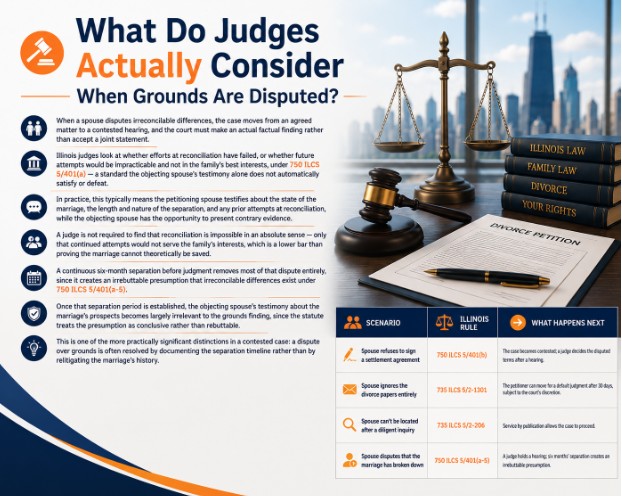
When a spouse disputes irreconcilable differences, the case moves from an agreed matter to a contested hearing, and the court must make an actual factual finding rather than accept a joint statement. 

Illinois judges look at whether efforts at reconciliation have failed, or whether future attempts would be impracticable and not in the family’s best interests, under 750 ILCS 5/401(a) — a standard the objecting spouse’s testimony alone does not automatically satisfy or defeat.

In practice, this typically means the petitioning spouse testifies about the state of the marriage, the length and nature of the separation, and any prior attempts at reconciliation, while the objecting spouse has the opportunity to present contrary evidence. 

A judge is not required to find that reconciliation is impossible in an absolute sense — only that continued attempts would not serve the family’s interests, which is a lower bar than proving the marriage cannot theoretically be saved.

A continuous six-month separation before judgment removes most of that dispute entirely, since it creates an irrebuttable presumption that irreconcilable differences exist under 750 ILCS 5/401(a-5). 

Once that separation period is established, the objecting spouse’s testimony about the marriage’s prospects becomes largely irrelevant to the grounds finding, since the statute treats the presumption as conclusive rather than rebuttable. 

This is one of the more practically significant distinctions in a contested case: a dispute over grounds is often resolved by documenting the separation timeline rather than by relitigating the marriage’s history.

ScenarioIllinois RuleWhat Happens Next
Spouse refuses to sign a settlement agreement750 ILCS 5/401(b)The case becomes contested; a judge decides the disputed terms after a hearing
Spouse ignores the divorce papers entirely735 ILCS 5/2-1301The petitioner can move for a default judgment after 30 days, subject to the court’s discretion
Spouse can’t be located after a diligent inquiry735 ILCS 5/2-206Service by publication allows the case to proceed
Spouse disputes that the marriage has broken down750 ILCS 5/401(a-5)A judge holds a hearing; six months’ separation creates an irrebuttable presumption

Does Refusing to Divorce Affect Property, Custody, or Support?

Refusing to cooperate does not change the substantive rules a court applies, but it can meaningfully affect how a case actually unfolds procedurally. 

Property still divides under the equitable division standard of 750 ILCS 5/503, and parenting matters still follow the best-interests factors under 750 ILCS 5/602.5 and 5/602.7, whether or not both spouses agree.

An uncooperative spouse can, however, increase the cost and length of a case by forcing formal discovery, contested hearings, and additional court appearances instead of a negotiated settlement, and a spouse’s participation or non-participation can affect what evidence is available and how efficiently a case resolves even where the underlying legal standard stays the same. 

Understanding how Illinois divides marital property helps a petitioning spouse anticipate what a contested case is likely to decide, even before the other spouse cooperates.

What Should Someone Do If Their Spouse Won’t Cooperate?

Documenting every attempt at service and communication protects a petitioner’s position if the case eventually requires a default judgment or a motion regarding service. 

Keeping records of certified mail, process server attempts, and any correspondence creates the evidentiary trail Illinois courts expect — though it’s the formal service and filing record, not a petitioner’s own communication log, that ultimately satisfies the legal service requirement.

A refusing spouse sometimes signals a broader pattern of conflict rather than a one-time objection, and high-conflict situations often benefit from a different litigation strategy than a straightforward uncontested case.

Contact Us Today For An Appointment

    I have read the

    Frequently Asked Questions

    Can a spouse refuse to divorce in Illinois? No, not legally. Illinois is a no-fault state, and a court can grant a divorce under 750 ILCS 5/401(a) once irreconcilable differences are shown, regardless of whether the other spouse agrees. A spouse who refuses can contest specific terms but cannot block the divorce itself.

    What happens if a spouse won’t sign divorce papers in Illinois? The case becomes contested rather than agreed, and a judge decides the disputed issues after hearing evidence from both sides. Illinois does not require both spouses’ signatures on a settlement agreement for a court to grant the divorce.

    What is a default judgment in an Illinois divorce case? A default judgment under 735 ILCS 5/2-1301 allows a court to rule when a properly served spouse fails to file an appearance or response. The petitioner must still prove the allegations supporting the relief requested before judgment is entered, even without the other spouse’s participation.

    How long does a spouse have to respond to divorce papers in Illinois? A served spouse generally has 30 days to file an appearance or response under Illinois Supreme Court Rule 101(d) before a default motion becomes available. Failing to respond within that window puts a spouse at risk of the court proceeding without their participation.

    What happens if a spouse can’t be located for service? After a diligent, documented inquiry fails to locate the spouse, service by publication under 735 ILCS 5/2-206 permits the divorce to proceed, though personal relief, such as a maintenance judgment, may require a different jurisdictional basis. Notice is published and mailed to any known last address.

    Can a default judgment be reversed after it’s entered? Sometimes. A spouse can generally file a motion to vacate a default judgment within 30 days under 735 ILCS 5/2-1301(e), and the court has discretion to grant that relief on reasonable terms. Vacating a default is not automatic or guaranteed.

    Does a spouse’s objection affect how property is divided? No, not the legal standard. Property still divides under the equitable distribution standard in 750 ILCS 5/503, regardless of whether both spouses agree to the divorce. An objection can increase the litigation involved without changing the standard a court applies.

    What is the six-month separation presumption in Illinois? Under 750 ILCS 5/401(a-5), spouses who live separate and apart continuously for at least six months before judgment create an irrebuttable presumption that irreconcilable differences exist. This resolves most disputes over the grounds themselves, regardless of an objecting spouse’s testimony.

    Does refusing to cooperate make a divorce more expensive? Often, yes. An uncooperative spouse can force formal discovery, contested hearings, and additional court appearances instead of a negotiated settlement, which typically increases both the cost and the length of the case compared to an agreed divorce, particularly when default or publication procedures become necessary.

    What should someone do if their spouse refuses to engage? Documenting every attempt at service and communication protects a petitioner’s position if the case requires a default judgment or a motion involving service. Consulting an attorney early helps determine whether default, publication, or a contested hearing is appropriate.

    Bottom Line: 

    Illinois’s no-fault system means a spouse’s refusal cannot legally prevent a divorce, though contested terms, a missed response, or an unreachable spouse each send the case down a different Illinois procedure — contested hearing, default judgment, or service by publication. 

    The six-month separation presumption under 750 ILCS 5/401(a-5) is irrebuttable, and judges weigh actual evidence of the marriage’s breakdown rather than just an objecting spouse’s disagreement.

    A spouse who refuses cannot prevent the divorce, though contested terms still shape the outcome. The firm helps choose between default, publication, or a contested hearing.

    What Are the Legal and Financial Steps Before You File for Divorce in Illinois

    This article provides general information about Illinois divorce law and is not a substitute for advice from a licensed Illinois attorney about a specific situation.

    Illinois spouses preparing to file for divorce typically work through four steps: legal grounds, financial documentation, a parenting framework, and any safety concerns. 

    Illinois law itself requires only irreconcilable differences and 90 days of residency completed before filing or before the court’s finding, under 750 ILCS 5/401. 

    Everything else is preparation that shapes how smoothly the Illinois divorce process unfolds afterward.

    Key Takeaways

    • Illinois requires irreconcilable differences and 90 days of residency under 750 ILCS 5/401, with residency completed before filing or before the court’s finding — not a fixed pre-filing wait.
    • Illinois classifies most property and debt acquired during marriage as marital property under 750 ILCS 5/503, divided equitably rather than automatically in half.
    • Illinois separates parenting decisions into significant decision-making under 750 ILCS 5/602.5 and parenting time under 750 ILCS 5/602.7.
    • Illinois allows a spouse to request an emergency order of protection under 750 ILCS 60/217 independent of any divorce filing.

    Working through these steps before filing often makes the case that follows more efficient. The firm offers confidential Illinois divorce consultations to help.

    What Legal Steps Come Before Filing for Divorce in Illinois?

    Illinois’s dissolution statute sets the substantive legal threshold to file: proof that irreconcilable differences have caused an irretrievable breakdown, and 90 days of Illinois residency completed before the case is filed or before the court’s finding, both under 750 ILCS 5/401. 

    No fault-based ground exists, so a filing spouse never has to prove infidelity, cruelty, or abandonment in court. A continuous six-month separation before judgment separately creates an irrebuttable presumption that irreconcilable differences exist, though it is not a mandatory pre-filing wait.

    Cooper Trachtenberg Law Group, LLC is a Rolling Meadows based, Illinois family law firm offering comprehensive family law services to clients from around the Chicago and surrounding suburban area, including Cook, Lake and DuPage counties. 

    Reviewing the available divorce options before filing helps clarify which legal process fits a given situation, since the chosen process shapes several of the steps that follow, including how documentation is exchanged and how parenting terms are worked out. 

    Only the legal grounds and residency requirement above are mandated by Illinois law before a court will grant a divorce; the remaining steps in this guide reflect preparation attorneys commonly recommend, not legal prerequisites to filing a petition.

    Spouses who have already worked through the personal decision about when to leave a marriage often find these legal and financial steps more straightforward to complete, since the emotional groundwork is separate from the practical checklist.

    If you’re ready to get started, call us now!

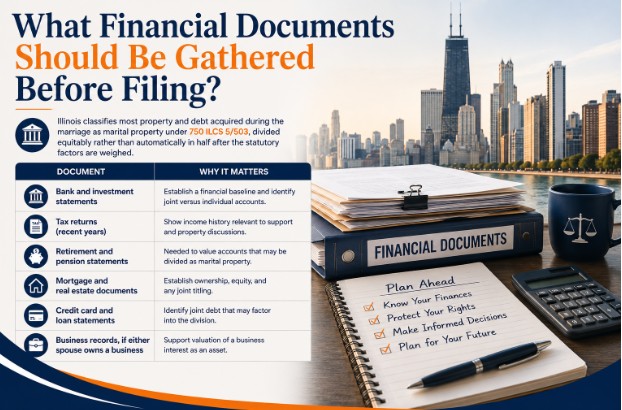
    What Financial Documents Should Be Gathered Before Filing?

    What Financial Documents Should Be Gathered Before Filing?

    Financial documentation gathered before filing is not legally required, but it affects how smoothly the property is divided afterward. 

    Illinois classifies most property and debt acquired during the marriage as marital property under 750 ILCS 5/503, divided equitably rather than automatically in half after the statutory factors are weighed.

    DocumentWhy It Matters
    Bank and investment statementsEstablish a financial baseline and identify joint versus individual accounts
    Tax returns (recent years)Show income history relevant to support and property discussions
    Retirement and pension statementsNeeded to value accounts that may be divided as marital property
    Mortgage and real estate documentsEstablish ownership, equity, and any joint titling
    Credit card and loan statementsIdentify joint debt that may factor into the division
    Business records, if either spouse owns a businessSupport valuation of a business interest as an asset

    Gathering these records early gives an attorney a fuller picture during an initial consultation and reduces delay once the case is underway. 

    A more detailed financial planning guide for Illinois spouses covers additional considerations, including budgeting for the transition and anticipating support questions.

    How Should Marital Property and Debt Be Identified Before Filing?

    Identifying what counts as marital versus non-marital property is easier before filing than after, when memories fade and records scatter. 

    Property acquired before the marriage, along with certain gifts and inheritances, generally remains non-marital, though courts require documentation to prove the distinction, and property that becomes commingled with marital assets can lose that non-marital status.

    Retirement accounts and pensions accumulated during the marriage typically count as marital property regardless of whose name is on the account, though any portion accumulated before the marriage may remain non-marital and require tracing. Understanding how retirement assets divide in an Illinois divorce before filing helps avoid surprises once the case moves toward settlement.

    Concerns about concealed income deserve early attention rather than being addressed after filing. 

    A spouse who suspects a partner is not disclosing income or hiding assets should raise that concern with an attorney before submitting a petition, since Illinois limits how far back a dissipation claim can reach: notice must be given no later than 60 days before trial or 30 days after discovery closes, whichever is later, and no claim may reach back more than 3 years after a spouse knew or should have known of it, or more than 5 years before the petition is filed, under 750 ILCS 5/503(d).

    If you’re ready to get started, call us now!

    What Parenting Steps Should Happen Before Filing?

    Illinois does not require a finished parenting plan before filing, but thinking through the framework beforehand often shortens what follows. 

    The law separates two questions: who makes significant decisions for a child under 750 ILCS 5/602.5, covering education, health, religion, and extracurricular activities, and how parenting time is scheduled under 750 ILCS 5/602.7, which applies its own related but distinct best-interest factors.

    Helena L. Trachtenberg, Partner and Fellow of the American Academy of Matrimonial Lawyers, represents Illinois parents in custody, mediation, and collaborative divorce matters at the firm. 

    Parents who can negotiate directly before filing sometimes use mediation to draft a workable parenting framework, which can reduce conflict once the case is formally underway.

    What Safety Steps Should Happen Before Filing?

    Safety takes priority over every other step on this list whenever there is immediate danger, and pursuing safety never requires waiting for a divorce filing. 

    An order of protection restricts an abusive spouse’s contact with a petitioner, and emergency relief is available under 750 ILCS 60/217, which can often be issued the same day, including outside normal court hours, without prior notice to the respondent when immediate danger is shown; emergency orders generally last up to 21 days, though exact procedure can vary by county.

    A spouse in danger can secure an emergency order first and reach the National Domestic Violence Hotline for safety planning, addressing the divorce filing on a separate timeline. 

    Illinois treats these as independent, parallel steps rather than a required sequence, so a completed safety step is never a reason to delay filing, and an incomplete one is never a reason to delay safety action.

    Which Illinois Divorce Process Should Be Chosen Before Filing?

    The process an Illinois spouse expects to use can shape how the remaining steps unfold, though process selection is not a legal prerequisite to filing, and cases can move between approaches — mediation, for example, can also take place within a litigated case rather than only as a separate track. 

    Illinois spouses generally consider mediation, collaborative divorce, and litigation, and thinking through which fits best before filing can reduce later friction, even though switching approaches partway through a case remains possible.

    Miriam E. Cooper, Founder of the firm, is a certified mediator and collaborative divorce practitioner with more than 30 years of experience in Illinois family law. 

    Mediation uses a neutral third party to help spouses negotiate directly, while collaborative divorce, under the Collaborative Process Act, 750 ILCS 90, requires both spouses’ attorneys to withdraw if the process fails, thereby encouraging both sides to stay engaged in negotiation. 

    Litigation instead leaves contested issues for a judge to decide when spouses cannot reach agreement on their own.

    What Does a Complete Pre-Filing Checklist Look Like?

    Pulling these steps into a single reference makes it easier to confirm that nothing has been missed before a petition is submitted. Not every step applies to every situation — a spouse without children skips the parenting step, for example — and only one of the steps below is legally mandatory, not merely recommended preparation.

    StepRequired or Recommended?Illinois Reference
    Confirm the legal grounds and residency requirementRequired by statute750 ILCS 5/401
    Gather financial documents and identify marital propertyRecommended preparation750 ILCS 5/503
    Address any concerns about hidden income or assetsRecommended preparation750 ILCS 5/503(d)
    Think through a parenting framework, if children are involvedRecommended, not required750 ILCS 5/602.5 and 5/602.7
    Resolve any immediate safety concernSituational, always a priority750 ILCS 60/217
    Choose a divorce process — mediation, collaborative, or litigationRecommended, not a strict prerequisite750 ILCS 90

    A detailed walk-through of what happens once a petition is actually submitted appears in the Illinois divorce timeline, which covers the sequence from filing through judgment.

    Contact Us Today For An Appointment

      I have read the

      Frequently Asked Questions

      What legal steps are required before filing for divorce in Illinois? Illinois’s dissolution statute, 750 ILCS 5/401, requires proof that irreconcilable differences have caused an irretrievable breakdown, with no need to prove fault. At least one spouse must also complete 90 days of Illinois residency before the case is filed or the court’s finding is made.

      What financial documents should be gathered before filing? Bank and retirement statements, tax returns, mortgage documents, and a list of joint debts matter most before filing. These records establish a financial baseline and support claims for equitable division under 750 ILCS 5/503. Missing documentation is a common source of delay afterward.

      How is marital property identified before an Illinois divorce? Property acquired during the marriage generally counts as marital property under 750 ILCS 5/503, while property owned before marriage or received as a gift or inheritance is generally treated as non-marital, subject to statutory exceptions such as commingling. Courts require documentation to prove the distinction.

      Is a parenting plan required before filing for divorce in Illinois? No. Illinois does not require a completed parenting plan before filing. Courts make significant decisions under 750 ILCS 5/602.5 and parenting time decisions under 750 ILCS 5/602.7 separately, and parents can develop a full plan through mediation or litigation after filing.

      What should be done about safety concerns before filing? An emergency order of protection under 750 ILCS 60/217 can often be requested the same day, separate from any divorce filing, though procedure can vary by county. Contacting local law enforcement and the National Domestic Violence Hotline provides immediate safety-planning support, as well as assistance with any subsequent filing.

      How far back can a dissipation of assets claim reach in Illinois? Under 750 ILCS 5/503(d), a dissipation claim cannot reach back more than 3 years after a spouse knew or should have known of the dissipation, and never more than 5 years before the petition is filed. Notice of the claim must also be given no later than 60 days before trial or 30 days after discovery closes, whichever is later.

      What’s the difference between mediation, collaborative divorce, and litigation? Mediation uses a neutral third party to help spouses negotiate directly, and can also be used within a litigated case rather than only as a separate path. Collaborative divorce under 750 ILCS 90 uses each spouse’s own attorney under a participation agreement, with both required to withdraw if the process fails. Litigation lets a judge decide unresolved issues.

      Do retirement accounts need to be addressed before filing for divorce? Retirement accounts accumulated during the marriage generally count as marital property under 750 ILCS 5/503, regardless of whose name is on the account, though any pre-marital portion may require tracing to remain non-marital. Identifying and valuing these accounts before filing helps avoid delays once settlement negotiations begin.

      Does every pre-filing step apply to every Illinois divorce? No. Steps involving children apply only when children are part of the marriage, and safety steps apply only when a safety concern exists. Of the remaining steps, only confirming the legal grounds and residency requirements is legally mandatory; the rest are recommended preparations that vary with the facts of each case.

      What happens after these pre-filing steps are complete? A petition is filed with the Illinois circuit court, and the other spouse is formally served with notice. A response period follows before the case moves toward temporary orders, discovery, or settlement discussions, with the exact sequence varying by county.

      Bottom Line: 

      Illinois’s substantive legal requirement to file is narrow — irreconcilable differences and 90 days of residency completed before filing or before the court’s finding, under 750 ILCS 5/401 — while the practical steps that make a case run smoothly are broader: financial documentation, marital property identification, a parenting framework where relevant, a chosen process, and any needed safety action. 

      Only the first of these is a legal prerequisite; the rest are recommended preparation. Safety steps stand apart from the other pre-filing steps, since they never wait on a filing date and a filing never needs to wait on them.

      Working through this checklist alone can feel overwhelming. The firm helps Illinois spouses complete these steps before filing for divorce in Illinois.

      How to Decide Whether to File for Divorce in Illinois

      Illinois’s dissolution statute sets two substantive requirements for a court to grant a divorce: irreconcilable differences causing an irretrievable breakdown, and Illinois residency maintained for 90 days before filing or before the court’s finding, both under 750 ILCS 5/401. 

      Meeting those requirements is different from being procedurally or personally ready to file — financial documentation, a safety assessment, and a parenting-time framework often matter just as much before submitting a petition. 

      This guide separates what Illinois law requires from what’s practically worth preparing before starting the Illinois divorce process.

      Key Takeaways

      • Illinois law requires no proof of fault; irreconcilable differences under 750 ILCS 5/401 is the substantive legal ground needed for dissolution.
      • Illinois requires at least 90 days of residency completed before filing or before the court’s finding — not a fixed pre-filing wait.
      • Gathering financial records and considering a parenting plan before filing can shorten the subsequent process.
      • Safety concerns should be addressed through an order of protection under 750 ILCS 60/217, regardless of the timing of the filing — safety action and a divorce filing are separate decisions.

      Meeting Illinois’s legal threshold is only one part of deciding when to file. The firm offers confidential Illinois divorce consultations to review readiness.

      What Legal Requirements Must Be Met to File for Divorce in Illinois?

      Illinois’s dissolution statute, 750 ILCS 5/401, establishes two substantive requirements: proof that irreconcilable differences have caused an irretrievable breakdown, and that Illinois residency has been maintained for 90 days before the case is filed or before the court’s finding. 

      No fault-based ground exists, so a filing spouse never has to prove infidelity, cruelty, or abandonment in court.

      These substantive requirements are distinct from the procedural mechanics of filing — which court to file in, what forms to submit, and how the other spouse is served are governed by separate Illinois court rules and can vary by county. 

      A prospective filer typically needs to understand both: what §401 requires to obtain a dissolution, and what the local circuit court requires to commence the case correctly.

      Cooper Trachtenberg Law Group, LLC is a Rolling Meadows, Illinois based family law a firm that offers comprehensive family law services to clients from around the Chicagoland area. 

      Meeting the statutory threshold and feeling personally ready to file are separate questions — Illinois courts examine the statute, not a spouse’s certainty — so reviewing the available divorce options before filing helps clarify which process fits the situation. 

      Attorneys generally find it useful when a prospective client brings a rough list of shared assets and debts, recent income documentation, and a summary of any custody or safety concerns to a first consultation, since those three items most often shape how quickly a case can move once filed.

      Is Enough Financial Documentation Ready to File?

      Financial documentation gathered before filing shapes how smoothly marital property gets divided afterward. Illinois classifies most property and debt acquired during the marriage as marital property under 750 ILCS 5/503, divided equitably rather than automatically in half.

      Bank statements, tax returns, retirement account summaries, and a list of jointly titled property should be collected before a petition is filed. A spouse who suspects a partner is concealing income should review the process for uncovering hidden assets before filing.

      Illinois also limits dissipation claims under 750 ILCS 5/503(d). A notice of intent to claim dissipation must be given no later than 60 days before trial, or 30 days after discovery closes, whichever is later. 

      Separately, a dissipation claim cannot reach back more than 3 years after a spouse knew or should have known of it, and never more than 5 years before the petition is filed.

      If you’re ready to get started, call us now!

      Does a Parenting Plan Need to Be Ready Before Filing?

      Illinois does not require a finished parenting plan before filing, but thinking through the framework beforehand often shortens what follows. The law separates two questions: who makes significant decisions for a child under 750 ILCS 5/602.5.

      Parenting time is scheduled separately under 750 ILCS 5/602.7, using a related but distinct set of best-interest factors.

      Helena L. Trachtenberg, Partner and Fellow of the American Academy of Matrimonial Lawyers, represents Illinois parents in custody, mediation, and collaborative divorce matters at the firm. 

      Parents who can negotiate directly sometimes use mediation to draft a parenting plan before a judge becomes involved; parents pursuing custody arrangements through litigation instead leave that framework for the court to decide after filing.

      A parenting-time framework is easier to build before filing than under time pressure. The firm’s Illinois child custody attorneys help parents map it out early.

      Should Safety Concerns Be Resolved Before or After Filing?

      Safety takes priority over filing timing whenever there is immediate danger, and pursuing safety never requires delaying a divorce filing or waiting for one. An order of protection is available under 750 ILCS 60/214, which restricts an abusive spouse’s contact with a petitioner.

      Emergency relief is available under 750 ILCS 60/217, which can often be issued the same day — including outside normal court hours — without prior notice to the respondent when immediate danger is shown; emergency orders generally last up to 21 days, though exact procedure can vary by county and circumstance.

      A spouse in danger can secure an emergency order first, reach the National Domestic Violence Hotline for safety planning, and address the divorce filing on a separate timeline. 

      Illinois treats these as independent, parallel decisions rather than as a required sequence, and the differences among protective orders are worth understanding regardless of when a divorce petition is filed.

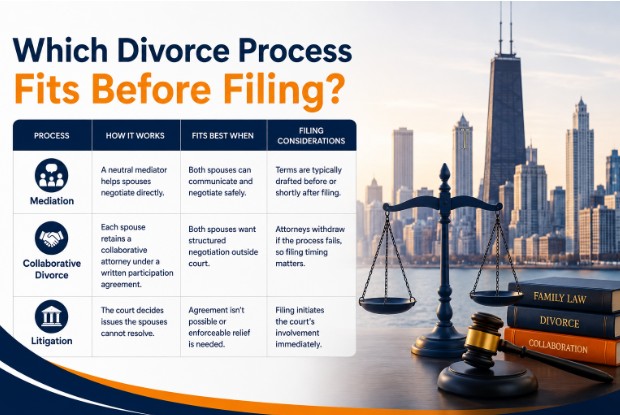
      Which Divorce Process Fits Before Filing?

      Which Divorce Process Fits Before Filing?

      The process chosen before filing shapes the entire case that follows. Illinois spouses generally choose among mediation, collaborative divorce, and litigation, and that choice is worth making before, not after, a petition is submitted.

      Miriam E. Cooper, Founder of the firm, is a certified mediator and collaborative divorce practitioner with more than 30 years of experience in Illinois family law. 

      Mediation uses a neutral third party to help spouses negotiate directly; collaborative divorce, under the Collaborative Process Act, 750 ILCS 90, requires both spouses’ attorneys to withdraw if the process fails, thereby encouraging both sides to stay at the table.

      ProcessHow It WorksFits Best WhenFiling Considerations
      MediationA neutral mediator helps spouses negotiate directlyBoth spouses can communicate and negotiate safelyTerms are typically drafted before or shortly after filing
      Collaborative DivorceEach spouse retains a collaborative attorney under a written participation agreementBoth spouses want structured negotiation outside courtAttorneys withdraw if the process fails, so filing timing matters
      LitigationThe court decides issues the spouses cannot resolveAgreement isn’t possible or enforceable relief is neededFiling initiates the court’s involvement immediately

      If you’re ready to get started, call us now!

      What Does Filing for Divorce in Illinois Actually Involve?

      Filing itself is a procedural step, not a final decision about how the case will unfold. A petition is submitted to the circuit court, the other spouse is served, and a response period follows before the case moves toward resolution; the exact sequence and timing can vary by county.

      A detailed walk-through of what happens at each stage, from petition to judgment, appears in the Illinois divorce timeline.

      Spouses preparing to file benefit from organizing documentation beforehand — a Chicago-area preparation guide can help identify what to gather before an initial consultation.

      When Should Someone Wait Before Filing?

      Waiting sometimes serves a spouse better than filing immediately, particularly when key readiness questions remain unresolved. 

      Incomplete financial records or genuine uncertainty about whether the marriage can be repaired are common reasons a brief pause can help — though an unresolved safety concern is never a reason to delay protective action, even if it delays the divorce filing itself.

      For spouses still working through whether ending the marriage is the right call at all, the broader personal and relationship considerations are covered separately in When to Leave a Marriage in Illinois.

      Reviewing financial planning steps before filing can also clarify whether more preparation time would help.

      Ready to FileBetter to Wait
      Financial documents are gathered and organizedBank and account records are still missing or incomplete
      A parenting-time framework has been discussed, if children are involvedCustody expectations haven’t been discussed with an attorney
      A divorce process (mediation, collaborative, or litigation) has been chosenNo process has been chosen yet
      Any immediate safety concern has already been addressed through emergency protective stepsUncertainty remains about whether reconciliation is possible

      Contact Us Today For An Appointment

        I have read the

        Frequently Asked Questions

        What is the legal requirement to file for divorce in Illinois? Illinois’s dissolution statute, 750 ILCS 5/401, requires proof that irreconcilable differences have caused an irretrievable breakdown of the marriage, with no need to prove fault. At least one spouse must also complete 90 days of Illinois residency before the case is filed or the court’s finding is made.

        Does Illinois require living separately before filing? No. Illinois does not require separation before filing. A continuous six-month separation creates an irrebuttable presumption of irreconcilable differences under 750 ILCS 5/401(a-5), but spouses who both agree the marriage has broken down can file without waiting through that period.

        What financial records should be gathered before filing? Bank and retirement statements, tax returns, mortgage documents, and a list of joint debts matter most before filing. These records establish a financial baseline and support claims for equitable division under 750 ILCS 5/503. Missing documentation is a common source of delay afterward.

        Is a parenting plan required to file for divorce in Illinois? No. Illinois does not require a completed parenting plan before filing for divorce. Courts make significant decisions under 750 ILCS 5/602.5 and parenting time decisions under 750 ILCS 5/602.7 separately, and parents can develop a full plan through mediation or litigation after filing.

        What should someone do if safety is a concern before filing? An emergency order of protection under 750 ILCS 60/217 can often be requested the same day, separate from any divorce filing, though procedure can vary by county. Contacting local law enforcement and the National Domestic Violence Hotline provides immediate safety-planning support, as well as assistance with any subsequent filing.

        How is marital property divided after filing in Illinois? Illinois divides marital property equitably, not automatically equally, under 750 ILCS 5/503. Courts weigh each spouse’s contribution, economic circumstances, and the length of the marriage. Property owned before marriage or received as a gift or inheritance is generally treated as non-marital, subject to statutory exceptions.

        What’s the difference between mediation, collaborative divorce, and litigation? Mediation uses a neutral third party to help spouses negotiate directly. Collaborative divorce under 750 ILCS 90 uses each spouse’s own attorney under a participation agreement, with both required to withdraw if the process fails. Litigation lets a judge decide issues spouses cannot resolve.

        What happens immediately after a divorce petition is filed in Illinois? The petition is filed with the Illinois circuit court, and the other spouse is formally served with notice. A response period follows before the case moves toward temporary orders, discovery, or settlement discussions. The full sequence and timing vary by county and case complexity.

        Is there a reason to wait before filing for divorce? Yes, in some situations. Incomplete financial documentation or genuine uncertainty about whether reconciliation remains possible are common reasons Illinois spouses choose to wait before filing. Waiting is a personal decision, not a legal requirement under Illinois law, and safety concerns are never grounds to wait.

        Does filing for divorce mean the case will go to trial? No. Filing initiates the legal process, but the chosen process — not the filing itself — determines whether a case proceeds to a contested courtroom hearing or is resolved through settlement, mediation, or collaborative divorce. Contested trials are the exception rather than the default path.

        Bottom Line: 

        Illinois’s substantive legal filing requirement is narrow: irreconcilable differences and 90 days of residency under 750 ILCS 5/401. 

        Procedural filing mechanics — venue, forms, and service — are a separate matter governed by court rules and can vary by county. 

        The practical readiness considerations covered here — financial documentation, a parenting-time framework, a chosen process, and resolved safety concerns — often matter more day-to-day than the legal threshold itself. Safety concerns are the one consideration that should never be put on hold for a filing date.

        Whether filing now, preparing further, or exploring another path is best, the firm helps confirm which option best fits an individual situation.

        How to Know When It’s Time to Leave a Marriage: An Illinois Family Law Perspective

        Deciding whether to leave a marriage is a personal decision, separate from Illinois’s legal test for divorce. 

        Under 750 ILCS 5/401, a court may dissolve a marriage once irreconcilable differences have caused an irretrievable breakdown and reconciliation efforts have failed — with no need to prove infidelity, financial misconduct, or other spousal wrongdoing. 

        This guide explains that legal standard alongside the safety, financial, and parenting questions that often shape the more personal decision, without assuming what a reader should choose about the Illinois divorce process.

        Key Takeaways

        • Illinois uses irreconcilable differences as the sole legal basis for divorce under 750 ILCS 5/401; no proof of marital fault is required.
        • A continuous six-month separation before judgment creates an irrebuttable presumption that irreconcilable differences exist under 750 ILCS 5/401(a-5) — it is not a mandatory waiting period.
        • Illinois divides marital property in “just proportions” under 750 ILCS 5/503, not through an automatic 50/50 split.
        • A safety emergency should be addressed as a safety matter first; Illinois law does not require filing for divorce before seeking an order of protection under 750 ILCS 60/217.

        Understanding these distinctions can make the decision less abstract. The firm offers confidential Illinois divorce consultations to help clarify legal options before deciding what’s next.

        What Are the Legal Grounds for Divorce in Illinois?

        Illinois divorce law focuses on the breakdown of the marriage rather than assigning fault. Under 750 ILCS 5/401, a court may enter judgment dissolving a marriage when irreconcilable differences have caused its irretrievable breakdown and the statutory requirements are satisfied — including 90 days of Illinois residency or military presence maintained before the case is filed or before the court’s finding.

        Illinois therefore does not require a spouse seeking divorce to establish adultery, cruelty, abandonment, or another form of marital wrongdoing as the legal ground for dissolution. 

        Section 401 also creates an irrebuttable presumption of irreconcilable differences once spouses have lived separate and apart continuously for at least six months immediately before judgment — a provision distinct from any mandatory pre-filing waiting period.

        Meeting these legal requirements and deciding whether ending the marriage is personally appropriate remain separate questions. 

        Cooper Trachtenberg Law Group, LLC is a Rolling Meadows, Illinois family law firm serving clients from around Chicago and the surrounding suburbs including Cook, Lake and DuPage counties. 

        A consultation can help clarify legal consequences and available divorce options without assuming that a filing must follow immediately.

        If you’re ready to get started, call us now!

        What Signs May Mean It’s Time to Consider Your Options?

        What Signs May Mean It's Time to Consider Your Options?

        No legally recognized checklist determines when someone should leave a marriage. Distinguishing relationship concerns that may call for counseling from circumstances that also raise legal, financial, parenting, or safety questions is often more useful than searching for a fixed list.

        Examples include repeated financial secrecy, an inability to obtain information about shared assets or debts, significant disagreement over parenting, threats or coercive behavior, or a prolonged inability to reach decisions about the family’s future. 

        These circumstances do not automatically mean divorce is the correct answer, though they may make professional advice worthwhile so a spouse understands the choices available.

        SituationProfessional Guidance That May Be Relevant
        Communication problems without a safety concernMarriage counselor or therapist
        Uncertainty about divorce rights or consequencesIllinois family-law attorney
        Questions about shared finances or undisclosed assetsFamily-law attorney and, where appropriate, a financial professional
        Parenting disputes connected with a possible separationFamily-law attorney, mediator, or other appropriate professional
        Threats, abuse, coercive control, or immediate dangerSafety resources, law enforcement where appropriate, and legal assistance

        The distinction is particularly important where safety is involved. Joint counseling or negotiation is not an appropriate substitute for individualized safety planning when someone fears abuse or retaliation. 

        For spouses navigating the emotional upheaval surrounding divorce, identifying the right professional support matters as much as identifying the right legal step.

        Should I Try Marriage Counseling or Legal Separation First?

        Marriage counseling and legal separation address different problems. Counseling focuses on the relationship and whether spouses want to repair it. Legal separation is a legal remedy for spouses living separate and apart who want certain legal issues addressed without dissolving the marriage.

        Under 750 ILCS 5/402, a person living separate and apart from a spouse may seek reasonable support and maintenance while remaining married. 

        Property is an important limitation: a court may approve a property settlement agreement the spouses submit for that purpose, but the statute does not allow the court to value or allocate property without one. 

        Legal separation carries different legal consequences than dissolution and may not resolve every issue a full divorce can address. Spouses considering legal separation in Illinois benefit from reviewing the option with an attorney before relying on it as a complete solution.

        Mediation is another process worth considering when spouses can negotiate safely and productively. 

        A neutral mediator helps the parties work toward agreements, but does not decide disputed issues for them; those agreements become enforceable only once documented in writing and, where applicable, entered by a court.

        What Financial Issues Should I Consider Before Leaving a Marriage?

        Before making major financial changes, it helps to understand what the marital estate may include and what records already exist. 

        Under 750 ILCS 5/503, marital property generally includes property, debts, and obligations acquired by either spouse after the marriage, subject to statutory exceptions such as gifts, inheritances, and property owned before marriage. 

        Illinois does not require an automatic equal division; Section 503 directs courts to divide marital property in “just proportions” after weighing the statutory factors.

        For someone contemplating separation, useful records typically include recent bank and investment statements, tax returns, retirement and pension information, mortgage and real estate documents, credit card and loan statements, business records in which either spouse holds a business interest, and insurance information. 

        Gathering lawfully accessible records helps a spouse understand the household’s financial position and gives an attorney a fuller picture during an initial consultation.

        Concerns about concealed money require particular care. A spouse who suspects hidden income, property, or accounts can review the process for uncovering hidden assets before deciding on next steps. 

        Illinois also limits dissipation claims under 750 ILCS 5/503(d): notice of an intent to claim dissipation generally must be given no later than 60 days before trial or 30 days after discovery closes, and no claim may reach back more than 3 years after a spouse knew or should have known of it, or more than 5 years before the petition is filed. Because those rules are technical and fact-dependent, a spouse concerned about unusual withdrawals or missing assets should seek legal advice rather than assume that every questionable transaction constitutes dissipation.

        Financial secrecy and custody uncertainty often surface together once a decision feels close. The firm’s Illinois child custody attorneys help parents protect stability early.

        If you’re ready to get started, call us now!

        How Does Divorce Affect Children in Illinois?

        A parent’s decision to end a marriage does not by itself determine how parental responsibilities will be allocated. Illinois law separates two concepts: significant decision-making responsibilities and parenting time.

        Under 750 ILCS 5/602.5, courts allocate significant decision-making responsibilities — including education, health, religion, and extracurricular activities — in the child’s best interests. 

        Parenting time is addressed separately under 750 ILCS 5/602.7, which applies its own best-interests factors. Illinois law does not automatically require a particular parenting schedule or an equal division of parenting time in every case.

        Parents who can negotiate may use mediation or another consensual process to work toward a parenting plan; when agreement isn’t possible, the court decides contested issues under these statutes. 

        Helena L. Trachtenberg, Partner at the firm, advises Illinois parents on allocation of parental responsibilities, parenting time, mediation, and collaborative law.

        When Does a Marriage Problem Become a Safety Emergency?

        When there is immediate danger or abuse, the first question is safety, not whether or when to file for divorce. The Illinois Domestic Violence Act, 750 ILCS 60, allows a court to issue an order of protection under Section 214 when the statutory requirements are met.

        Emergency orders are governed separately by 750 ILCS 60/217, which permits relief without prior notice to the respondent when good-cause requirements are satisfied, including a 21-day emergency order when the court is unavailable at the close of business. Seeking an order of protection does not require a spouse to wait until a divorce has been filed.

        A person facing immediate danger should prioritize safety first — contacting local law enforcement, seeking individualized legal assistance, and reaching the National Domestic Violence Hotline for safety-planning resources. Understanding the differences among Illinois protective orders can also clarify the legal options available.

        What Steps and Process Options Should Illinois Spouses Consider Before Filing?

        Someone considering divorce does not need to make every legal and financial decision before talking with an attorney. 

        Gathering information early can help identify actions that carry consequences later — organizing financial records, identifying major assets and debts, reviewing household expenses, and collecting relevant parenting information are useful starting points.

        Before changing ownership, moving substantial funds, altering insurance coverage or beneficiary designations, or selling property, a spouse benefits from individualized legal advice, since consequences depend on the asset, policy, existing agreements, and the specific facts of the marriage. 

        The same caution applies to leaving the marital home: moving out does not, by itself, resolve later property or parenting questions, and the practical consequences vary enough that tailored advice is worth seeking when children, a jointly owned home, or safety concerns are involved.

         A Chicago-area preparation guide can help organize what to bring to an initial consultation.

        Divorce does not automatically mean a contested trial. Illinois spouses may resolve issues through direct negotiation, mediation, collaborative divorce under the Collaborative Process Act, 750 ILCS 90, litigation, or a combination of approaches as a case develops. 

        No process has a universal timeline — how long a case takes depends on the issues in dispute, the spouses’ ability to reach agreement, discovery, asset complexity, parenting questions, and court availability.

        ProcessHow It WorksMay Be Appropriate WhenImportant Limitation
        MediationA neutral mediator helps spouses negotiate disputed issuesBoth spouses can participate meaningfully and negotiate safelyThe mediator does not decide contested issues for the parties
        Collaborative DivorceEach spouse retains a collaborative lawyer; both sign a written participation agreement under 750 ILCS 90Both spouses want a structured, negotiation-based processIllinois law requires the collaborative lawyers and firms to withdraw if the process fails
        LitigationThe court enters orders and decides issues the spouses cannot resolveAgreement isn’t possible or enforceable; judicial relief is neededThe parties give the court authority over contested issues

        Contact Us Today For An Appointment

          I have read the

          Frequently Asked Questions

          What is the legal threshold for divorce in Illinois? Under 750 ILCS 5/401, irreconcilable differences must have caused an irretrievable breakdown, and reconciliation efforts must have failed. Illinois requires no proof of marital fault. At least one spouse must meet a 90-day Illinois residency requirement, either tied to filing or to the court’s finding.

          Does Illinois require spouses to separate for six months before filing for divorce? No. The six-month provision in 750 ILCS 5/401(a-5) is not a universal pre-filing waiting period. Living separate and apart continuously for at least six months immediately before judgment instead creates an irrebuttable presumption that irreconcilable differences exist — not a mandatory delay before every Illinois filing.

          What is the difference between legal separation and divorce in Illinois? Legal separation allows spouses to remain married while obtaining support and maintenance under 750 ILCS 5/402; a court cannot divide marital property in that proceeding without the spouses’ settlement agreement. Divorce under 750 ILCS 5/401 permanently ends the marriage and lets the court address property.

          Is marital property divided 50/50 in Illinois? Not necessarily. 750 ILCS 5/503 directs courts to divide marital property in “just proportions” after weighing statutory factors, including each spouse’s contribution and the marriage’s length. Equal division may occur in some cases, but Illinois law imposes no automatic 50/50 rule.

          What financial records should I gather if I am considering divorce? Useful records include tax returns, bank and investment statements, retirement information, mortgage and real estate documents, loan and credit card statements, insurance information, and records concerning major assets and debts. The records that matter most depend on the household’s financial picture and complexity.

          How does Illinois decide child custody? Illinois separates two custody-related questions. Significant decision-making responsibilities are governed by 750 ILCS 5/602.5, while parenting time is governed separately by 750 ILCS 5/602.7. Courts apply the child’s best interests under the statutory factors for each, so no single factor controls either decision.

          What should I do if my spouse becomes threatening or abusive? Safety comes first when there is immediate danger, not when it comes to the timing of a divorce filing. Illinois’s Domestic Violence Act, 750 ILCS 60, allows same-day emergency orders of protection under Section 217. Local law enforcement, an attorney, and the National Domestic Violence Hotline can provide assistance.

          How long does an Illinois divorce take? No single reliable timeline applies to every Illinois divorce. Duration depends on agreement between the spouses, financial complexity, discovery, parenting disputes, motion practice, and court scheduling. An attorney familiar with a case’s specific facts can offer more useful expectations than a statewide average.

          Can I leave the marital home before filing for divorce? Leaving the marital home does not automatically forfeit property or custody rights in Illinois, though outcomes vary by circumstance and are best confirmed with an attorney. Documenting the reason for leaving, especially in safety-related situations, may support a spouse’s position in custody and property proceedings.

          Do I have to be certain I want a divorce before speaking with an attorney? No. A legal consultation can serve as an information-gathering step rather than a commitment. Understanding Illinois law, financial consequences, parenting considerations, and available processes can help a spouse reach a more informed personal decision. Consulting an attorney does not, by itself, require filing for divorce.

          Bottom Line: 

          No Illinois legal rule determines when a marriage has become personally impossible to continue — the law answers only whether the requirements for dissolving it have been met and how property, parenting, support, and safety can be addressed. 

          For someone still uncertain, the next step doesn’t have to be filing: gathering financial information, speaking with a counselor, learning about legal separation, or arranging a confidential consultation are all reasonable starting points. 

          Safety concerns are the one exception, since those call for immediate action regardless of where someone stands on filing.

          Staying uncertain has its own cost. The firm helps Illinois spouses understand their options before deciding on a divorce plan in Illinois.