GPS, RFID, and Digital Tracking: Legal Boundaries When Investigating a Spouse in Illinois

Several of the most common ways to track a spouse in Illinois are criminal offenses, not just missteps in an Illinois divorce case. 

Placing a GPS tracker without consent, recording a conversation without someone’s agreement, and accessing someone else’s accounts can each carry independent criminal exposure under Illinois law.

That exposure exists separate from anything the tracking might reveal about the marriage itself.  Understanding where the legal line sits matters before gathering any evidence.

Key Takeaways

  • Illinois law criminalizes several common self-tracking methods — unauthorized GPS trackers, non-consensual recording, and unauthorized account access — as offenses separate from the divorce case itself.
  • Illinois requires every party’s consent to record a private conversation, even one you’re part of, under the state’s eavesdropping law.
  • Illinois’s tracking-device law does not carve out an exception for licensed private investigators — the prohibition applies to them the same as anyone else who doesn’t fall within the statute’s owner-consent, law enforcement, or business-fleet exceptions.
  • Illegally gathered evidence can create legal exposure for the person who collected it, on top of any admissibility problems in the divorce case.

Before you install anything or press record, it’s worth understanding exactly where Illinois draws the line. Contact Cooper Trachtenberg Law Group to talk through what’s legal in your situation.

Is It Legal to Track Your Spouse’s Location in Illinois?

Tracking a spouse’s location without consent is generally illegal in Illinois when it involves an electronic tracking device placed on a vehicle. Under 720 ILCS 5/21-2.5, the key exception in a marriage is consent: the statute exempts tracking when “the car’s owner, renter, or leaseholder agrees to have the tracking device on their vehicle.” 

Marriage doesn’t substitute for that consent — the question is whether the person who actually owns, rents, or leases the vehicle agreed to the tracker, not the marital relationship itself.

The method of tracking changes the legal analysis. A shared family location app that both spouses knowingly use and can see is different from secretly installing a separate tracking device or spyware. 

The statute’s definition is broad — “any device attached to a vehicle that reveals its location or movement by the transmission of electronic signals” — which is worth keeping in mind for RFID-based tools too. 

A toll transponder or RFID key fob wasn’t designed as a covert tracker, but a device using RFID or similar signal transmission that’s secretly attached to reveal a vehicle’s location would likely fall within that same broad definition.

If you’re ready to get started, call us now!

What Does Illinois Law Say About GPS Trackers on a Spouse’s Vehicle?

SituationLegal Status
Tracker on a vehicle solely titled to your spouse, without their consentIllegal under 720 ILCS 5/21-2.5
Tracker on a jointly titled or jointly leased vehicleThe statute exempts tracking when “the owner, renter, or leaseholder” consents; it doesn’t specify whether one co-owner’s consent alone satisfies that exception on a jointly titled vehicle
Factory telematics (built-in GPS) the owner already subscribes toNot a violation — covers everyone who drives the vehicle
Tracker installed by a business on its own fleet vehicleExempted under the statute
Tracker installed by law enforcementExempted under the statute

Using an electronic tracking system to determine someone’s location or movement patterns is also explicitly addressed elsewhere in Illinois law: under 740 ILCS 21/10, as amended by Public Act 103-0760 (2024), a “course of conduct” that can support a stalking no contact order specifically includes using an electronic tracking system or acquiring tracking information to determine a person’s location or travel patterns.

Is Recording Your Spouse’s Conversations Legal in Illinois?

Recording a private conversation in Illinois requires the consent of everyone involved, under 720 ILCS 5/14-2 — even when you’re a participant in the conversation, not just an outside party listening in. A violation is a felony rather than a misdemeanor.

This surprises a lot of people: many states only require one party (meaning you, if you’re on the call) to consent. 

Recording your spouse’s phone call, a private conversation at home, or a voice message without their knowledge can expose you to criminal liability regardless of what the recording reveals about the marriage.

Is It Legal to Access a Spouse’s Phone, Computer, or Accounts?

Accessing a spouse’s phone, email, or computer without authorization is illegal in Illinois, even if the device is considered a shared family device or you obtained the password legitimately in the past. 

Illinois’s computer tampering law does not carve out an exception for spouses, and a previously shared password doesn’t create ongoing consent once that consent is withdrawn.

This can cover more than logging into an email account — installing spyware or a keylogger, reading messages on a device left unlocked, or accessing a shared “family” laptop can raise the same concerns. 

Whether a specific device or account is genuinely authorized for both spouses is a fact-specific question, not something to assume either way — one worth discussing with an attorney before it becomes an issue in a case. 

The safer approach when you suspect something is on a device is formal discovery once a case is filed, not self-directed access.

Can a Private Investigator Legally Track a Spouse in Illinois?

A licensed private investigator does not have a special exception to Illinois’s tracking-device law. 

Illinois lawmakers have introduced bills that would have created a private-investigator exception to 720 ILCS 5/21-2.5, but those bills did not pass — the current statute’s exceptions cover owner/renter/leaseholder consent, law enforcement, business-owned fleet vehicles, state-agency vehicles, and qualifying factory telematics, not private investigators. 

A private investigator you hire is bound by the same tracking-device prohibition as anyone else.

What a private investigator can legally do is different from installing a tracker: documenting what’s publicly visible — where someone goes in public, who they’re seen with, public social media activity — doesn’t involve attaching a device to someone else’s vehicle or accessing a private account, so it doesn’t run into the same statutory prohibition. 

The distinction is between public observation and non-consensual access to something private, not between hiring a professional and doing it yourself.

If you’re ready to get started, call us now!

What Happens to Illegally Obtained Tracking Evidence in a Divorce Case?

Illinois law treats different categories of improperly obtained evidence differently, so it’s worth being precise rather than assuming one rule covers everything. 

For recordings, Illinois’s eavesdropping law contains an explicit rule: evidence obtained in violation of the Eavesdropping Article is generally inadmissible in both civil and criminal proceedings, subject to statutory exceptions. 

That’s a specific, named exclusionary rule — not a general principle that automatically extends to every other kind of improperly gathered evidence.

For an unauthorized tracker or unauthorized account access, Illinois law doesn’t provide that same explicit blanket exclusion. Whether that evidence can be used still depends on the specific facts and how it was obtained, which is a case-specific legal question. 

What’s consistent across all three categories is that the underlying conduct—the tracking, the recording, or the account access—can create legal exposure for the person who did it, regardless of whether the evidence itself is admissible. 

Even when tracking data or a recording captures something relevant—evidence connected to an affair or dissipated funds—how it was gathered can still undermine its usefulness in court.

What Are the Legal Alternatives to Tracking a Spouse?
What Are the Legal Alternatives to Tracking a Spouse?

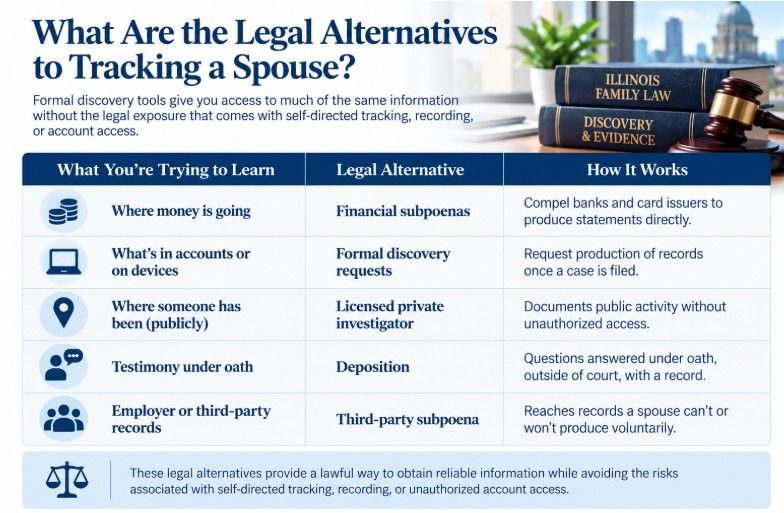
Formal discovery tools give you access to much of the same information without the legal exposure that comes with self-directed tracking, recording, or account access.

What You’re Trying to LearnLegal AlternativeHow It Works
Where money is goingFinancial subpoenasCompel banks and card issuers to produce statements directly
What’s in accounts or on devicesFormal discovery requestsRequest production of records once a case is filed
Where someone has been (publicly)Licensed private investigatorDocuments public activity without unauthorized access
Testimony under oathDepositionQuestions answered under oath, outside of court, with a record
Employer or third-party recordsThird-party subpoenaReaches records a spouse can’t or won’t produce voluntarily

A financial statement obtained this way carries more weight than the same information gathered through unauthorized access, because it comes with a documented, lawful chain of custody.

Every case is different, and the line between what’s legal and what isn’t can be less obvious than it looks. Talk to Cooper Trachtenberg Law Group before you take any step you can’t undo.

Bottom Line

  • GPS trackers, non-consensual recordings, and unauthorized account access are each separately illegal in Illinois, regardless of the marital relationship.
  • Illinois requires all-party consent to record a private conversation, even one you’re part of.
  • Licensed private investigators don’t have a special statutory exception for GPS trackers — the tracking-device law applies to them the same as anyone else.
  • Formal discovery—subpoenas, depositions, document requests— can obtain much of the same information without the legal risk of self-directed tracking.

Contact Us Today For An Appointment

    I have read the

    Frequently Asked Questions

    Is it illegal to put a GPS tracker on my spouse’s car in Illinois?
    Generally yes, if the vehicle’s owner, renter, or leaseholder hasn’t consented. Under 720 ILCS 5/21-2.5, using an electronic tracking device to follow someone’s location without that consent is a Class A misdemeanor, with narrow exceptions for law enforcement, business fleet vehicles, and factory telematics.

    Can I record a phone call with my spouse without telling them?
    No. Illinois requires the consent of everyone involved in a private conversation before it can be recorded, including conversations you’re part of. Recording without that consent violates the state’s eavesdropping law and can be charged as a felony.

    Is it illegal to look through my spouse’s phone if I know the password?
    It can be, even if you know the password. Illinois’s computer tampering law doesn’t create an automatic exception for spouses or shared devices, and accessing private data without current authorization can expose you to liability regardless of how you learned the password.

    Can I use a location-sharing app to see where my spouse is?
    If both of you knowingly use a shared app and consent to being visible to each other, that’s different from secretly installing separate tracking software. Once consent is withdrawn or the tracking becomes hidden, the same legal concerns that apply to GPS trackers can apply.

    What happens if I get caught illegally tracking my spouse?
    You could face criminal charges under Illinois’s tracking, eavesdropping, or computer tampering laws, independent of the divorce case itself. The evidence you gathered may also be harder to use in your divorce case, meaning the legal risk isn’t offset by any guaranteed benefit to your case.

    Can a private investigator do things I can’t do myself?
    To a limited extent, but not through a special tracking exception — Illinois law gives investigators no unique permission to install GPS trackers. What they can lawfully do is document publicly visible activity, which doesn’t require the consent that private tracking or account access would.

    Is it legal to hire someone to hack my spouse’s email?
    No. This falls squarely under Illinois’s computer tampering law regardless of who physically does the accessing, and involving a third party doesn’t reduce the legal exposure—it can extend liability to both people involved.

    Can text messages I already have access to be used as evidence?
    Messages you received directly or were sent to you can generally be used, since you’re a legitimate recipient. The legal problem arises when you access messages you weren’t sent, on a device or account you don’t currently have authorization to access.

    Does it matter if the car or phone is jointly owned?
    It can, though Illinois’s tracking statute doesn’t spell out exactly how for a jointly titled vehicle. A court may still expect an explanation for secretly tracking or accessing something jointly owned, particularly once a divorce is underway.

    What should I do if I already gathered evidence this way before understanding the law?
    Talk to a divorce attorney before using or disclosing it further. How the evidence was obtained affects both its usefulness in your case and your own legal exposure, and an attorney can help you understand the options before you take any additional steps.

    A single tracking app or recording can create more legal risk than it resolves. Reach out to Cooper Trachtenberg Law Group to talk through what evidence you actually need and the legal way to get it.
    Social Media Evidence in Illinois Divorce: What Courts Will and Won’t Accept

    Facebook photos, Instagram messages, and Snapchat location tags can all become evidence in an Illinois divorce, but not automatically. 

    Under the Illinois Rules of Evidence, a post must be authenticated—shown to be what it claims to be—before a judge will consider it. 

    A screenshot alone often isn’t enough to clear that bar. What matters is how the post was obtained, who can verify it, and whether it’s relevant to a specific issue in the case.

    Key Takeaways

    • Social media posts are not automatically admissible in an Illinois divorce; they must be authenticated under Illinois Rule of Evidence 901.
    • A witness’s own admission that a post came from their account is one of the more straightforward ways to satisfy authentication.
    • Illinois courts have considered a spouse’s Facebook photos and posts as evidence on a specific issue, such as cohabitation, when properly authenticated.
    • Deleting posts after a case is filed can trigger sanctions under Illinois Supreme Court Rule 219(c), regardless of what the posts originally showed.

    Wondering what your own social media activity — or your spouse’s — might mean for your case? Contact Cooper Trachtenberg Law Group to talk through the specifics.

    Is Social Media Evidence Admissible in an Illinois Divorce?

    Social media evidence is admissible in an Illinois divorce when it clears the same three hurdles as any other evidence: authentication, relevance, and the hearsay rules. 

    A judge won’t consider a post just because one spouse says it’s real — the post must be tied to its source through testimony, distinctive characteristics, or another recognized method.

    Relevance matters just as much as authenticity. A photo from a night out might be relevant to a claim about lifestyle or spending, but irrelevant to a property dispute that has nothing to do with either spouse’s social habits. 

    Courts can exclude social media content that’s authentic but doesn’t bear on the issue before the judge.

    How Do Illinois Courts Authenticate Social Media Posts?

    How Do Illinois Courts Authenticate Social Media Posts?

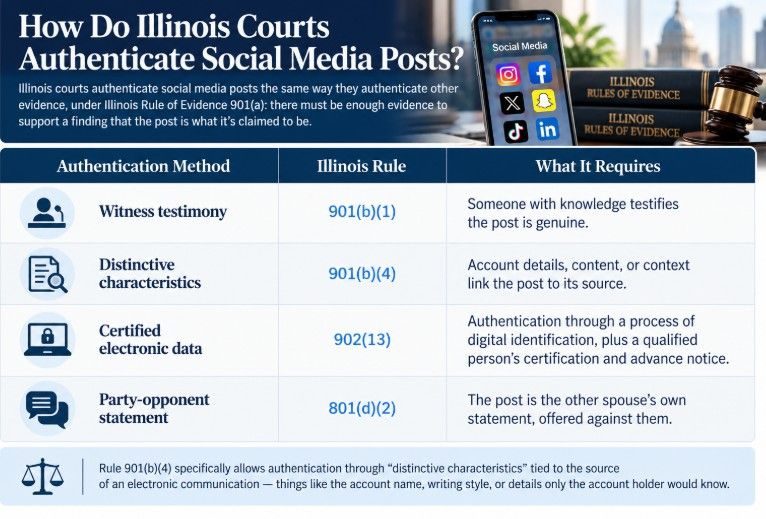
    Illinois courts authenticate social media posts the same way they authenticate other evidence, under Illinois Rule of Evidence 901(a): there must be enough evidence to support a finding that the post is what it’s claimed to be. 

    Rule 901(b)(4) specifically allows authentication through “distinctive characteristics” tied to the source of an electronic communication — things like the account name, writing style, or details only the account holder would know.

    Authentication MethodIllinois RuleWhat It Requires
    Witness testimony901(b)(1)Someone with knowledge testifies that the post is genuine
    Distinctive characteristics901(b)(4)Account details, content, or context link the post to its source
    Certified electronic data902(13)Authentication through a process of digital identification, plus a qualified person’s certification and advance notice
    Party-opponent statement801(d)(2)The post is the other spouse’s own statement, offered against them

    Rule 902(13) lets data copied from an electronic device, storage medium, or file authenticate itself without live testimony — but only when it has been authenticated through a process of digital identification and is accompanied by a qualified person’s written certification meeting Rule 902(11)’s procedural and notice requirements. 

    It applies to a narrow category of certified data, not to social media content generally.

    If you’re ready to get started, call us now!

    What Types of Social Media Evidence Do Courts Typically Accept?

    Illinois courts have accepted a spouse’s own posts and photos when they’re relevant to a specific, contested issue in the case. 

    In In re Marriage of Miller, 2015 IL App (2d) 140530, the Illinois Appellate Court upheld a trial court’s decision to consider Facebook photos and posts written by the maintenance recipient and her boyfriend when deciding whether they were cohabiting on a “resident, continuing, and conjugal basis” under 750 ILCS 5/510(c) — a basis for terminating maintenance. 

    The recipient testified that the posts came from her own Facebook profile, even though she claimed not to remember writing them—testimony the appellate court found sufficient to satisfy Rule 901(a)’s authentication requirement. Miller, ¶ 37.

    Separately, the trial court considered only posts written by the two people directly involved in the cohabitation question, not comments or posts written by other third parties. 

    The opinion doesn’t establish that a witness’s boyfriend’s posts always come in as easily as the witness’s own posts—it reflects that both people’s content was relevant to the specific issue being litigated, while unconnected third-party commentary would have needed separate authentication and could raise its own hearsay concerns.

    What Social Media Evidence Do Illinois Courts Reject?

    Illinois courts can reject social media evidence that isn’t authenticated, that amounts to hearsay with no applicable exception, or that a party never had a legitimate way to obtain. 

    A screenshot with no way to verify who posted it, when, or whether it was edited often won’t clear the authentication bar on its own.

    Evidence ProblemWhy It’s Often Rejected
    Unverified screenshotsNo testimony or distinctive characteristics tie the image to its claimed source
    Third-party comments or postsGenerally hearsay when offered to prove the truth of what a non-party said
    Content obtained by unauthorized account accessRaises separate legal and privacy issues that can affect how it’s used
    Posts stripped of metadata or contextHarder to authenticate and easier to challenge as edited or incomplete
    Irrelevant contentAuthentic posts can still be excluded if they don’t bear on an issue in the case

    Can Deleted Posts Still Be Used as Evidence?

    Deleted posts can often be recovered through screenshots someone else took, platform records obtained through discovery, or forensic recovery tools, so deletion doesn’t guarantee a post disappears from a case. Deletion can create a separate problem for the person who deleted it.

    Illinois Supreme Court Rule 219(c) gives judges broad authority to sanction a party who fails to comply with discovery obligations or a court order, including barring evidence, striking pleadings, or shifting attorney fees. 

    Illinois courts have applied Rule 219(c) in divorce cases themselves — in In re Marriage of Szczepanczyk, the Illinois Appellate Court upheld a trial court’s decision to strike a respondent’s pleadings and enter judgment against her after she repeatedly failed to comply with discovery, including a missed deposition. 

    Once a divorce is filed — and especially once specific content has been requested, or a preservation obligation is clear — deleting relevant posts can expose a spouse to this same kind of sanction. 

    The safer approach is to stop posting and preserve existing accounts rather than delete anything once a case is underway.

    How Does Social Media Evidence Affect Custody and Property Division?

    Social media evidence affects custody in Illinois only to the extent it bears on a parent’s relationship with the child, since 750 ILCS 5/602.7(c) directs courts not to consider a parent’s conduct that doesn’t affect that relationship. 

    A post showing behavior unrelated to parenting carries less weight than one showing something that actually touches the child’s safety or well-being.

    In property matters, social media evidence tends to matter most when it corroborates something already at issue — spending inconsistent with a financial disclosure, or evidence connected to an affair that ties into a dissipation claim. 

    On its own, a post rarely decides a property or custody outcome; it typically works alongside other evidence rather than replacing it.

    If you’re ready to get started, call us now!

    What Should You Avoid Posting During an Illinois Divorce?

    The safest approach during an Illinois divorce is to avoid posting anything about the case, the other spouse, finances, or new relationships until the case is resolved.

     Even posts that feel unrelated to the divorce can be authenticated and introduced if they later become relevant to an issue that comes up.

    • New purchases, trips, or lifestyle changes that could contradict a financial disclosure
    • Complaints about the other spouse, the case, or the judge
    • Photos or posts involving a new romantic partner
    • Anything about the children that could be read as putting them in the middle of the dispute
    • Deleting old posts or accounts after the case has started

    Privacy settings help less than people expect, since screenshots, shared connections, and formal discovery can all reach content a spouse assumed was private.

    Bottom Line

    • Social media posts are evidence only after they clear authentication, relevance, and hearsay rules — not simply because they exist.
    • A witness’s own admission that a post came from their account is one of the clearer ways to satisfy authentication; third-party posts and comments face a higher hearsay hurdle.
    • Deleting posts after a case starts can trigger sanctions under Illinois Supreme Court Rule 219(c), separate from whatever the posts originally showed.
    • Social media evidence typically supports a broader claim about custody, property, or credibility rather than deciding a case on its own.

    Contact Us Today For An Appointment

      I have read the

      Frequently Asked Questions

      Can my spouse use my private Instagram posts against me in an Illinois divorce?
      Yes, if the posts are authenticated and relevant. Privacy settings don’t make content inadmissible — a spouse, mutual friend, or the discovery process can still surface private posts, and once authenticated, they’re treated the same as any other evidence.

      Do I have to hand over my social media accounts during divorce discovery?
      You may have to produce specific, relevant records if properly requested. You generally don’t have to turn over full account access, but withholding clearly relevant, requested content can lead to a motion to compel or sanctions under Rule 219(c).

      Is a text message treated differently from a social media post in Illinois court?
      Not fundamentally. Both require authentication under Rule 901, and both can qualify as non-hearsay under Rule 801(d)(2) when they’re the other party’s own statement. The main practical difference is how each is typically obtained and verified.

      Can old posts from before the marriage be used as evidence?
      Yes, if they’re relevant and authenticated, though relevance becomes a bigger issue the older and more disconnected the post is from the current dispute. A judge is more likely to admit recent, directly relevant content than something posted years before the marriage began.

      What happens if I delete a post after my divorce is filed?
      Deleting a relevant post after filing can expose you to sanctions under Illinois Supreme Court Rule 219(c), which lets a judge address discovery noncompliance through remedies including barring evidence, striking pleadings, or shifting fees. Recovered copies or screenshots may still surface the content anyway.

      Can screenshots alone be used as evidence in Illinois?
      A screenshot alone is often not enough without something else connecting it to its source, such as testimony, metadata, or distinctive account details. Courts have excluded unverified screenshots specifically because nothing tied the image to the claimed source.

      Does it matter who took the screenshot?
      Yes. Testimony from the person who took the screenshot, including when and how, is a common way to authenticate it under Rule 901(b)(1). A screenshot with no known origin is much easier to challenge.

      Can my attorney use a private investigator to gather social media evidence?
      Yes, within legal limits. A private investigator can document publicly visible social media activity, but accessing a spouse’s private accounts without authorization raises separate legal and privacy risks that can affect how the resulting evidence is used.

      Will an old, unrelated post hurt my custody case?
      Generally not, unless it bears on your relationship with your child, since Illinois courts are directed not to weigh parental conduct unrelated to that relationship. An isolated post with no connection to parenting carries limited weight on its own.

      Can I still post normally if I’m not involved in a custody or property dispute?
      Even in cases without contested custody or complex property issues, posts can still become relevant to credibility, spending, or new relationships. The safest practice is to post minimally until the divorce is final, regardless of how contested the case is.

      A single post can become part of a much bigger picture in an Illinois divorce — for better or worse. Talk to Cooper Trachtenberg Law Group about what your case actually needs before you post, delete, or share anything else.

      Financial Red Flags: How Hidden Accounts and Spending Expose a Cheating Spouse

      Hidden bank accounts, secret credit cards, and unexplained spending are often the financial trail that exposes an affair before a spouse admits to one. 

      That discovery does not change the Illinois divorce process itself — Illinois has been no-fault since 2016. What financial evidence can do is support a dissipation of marital assets claim under 750 ILCS 5/503(d)(2). That claim lets a court credit a spouse for money the other partner spent on an affair. 

      Finding and organizing that evidence correctly is often what separates a provable claim from an unprovable suspicion.

      Key Takeaways

      • Hidden accounts, unexplained withdrawals, and spending mismatches are common financial signs that an affair may be involved.
      • None of these signs affect the Illinois divorce ground itself, but they can support a dissipation of marital assets claim under 750 ILCS 5/503(d)(2).
      • Financial subpoenas and formal discovery generally produce stronger, more usable evidence than personal snooping.
      • The full legal deadlines and burden-of-proof rules governing dissipation claims apply to financial evidence the same way they apply to any other kind.

      Financial secrecy during a divorce raises real questions about what’s provable and what isn’t. Contact Cooper Trachtenberg Law Group to review the financial picture and lay out the options.

      What Financial Red Flags Suggest a Spouse Is Cheating?

      A handful of financial patterns tend to show up when an affair is involved, because an affair usually requires spending that has to be hidden from a shared household budget. Expenses that don’t match a spouse’s stated income, a sudden drop in visible savings, or new debt with no clear purpose are common starting points.

      • Credit card statements arriving at a separate address or a P.O. box
      • A sudden request for privacy around banking apps or statements
      • Cash withdrawals that don’t correspond to any household expense
      • A new account the other spouse wasn’t told about
      • Bills or subscriptions for services neither spouse recognizes

      None of these prove infidelity by themselves — they’re the reason to look closer, not the conclusion. A spouse noticing several of these at once is often looking at the same financial trail an attorney would eventually need to document hidden assets.

      If you’re ready to get started, call us now!

      How Do Hidden Bank Accounts and Credit Cards Surface an Affair?

      Hidden bank accounts and credit cards typically surface through documents a spouse already has access to — tax returns, mail, and household financial statements — rather than through investigation. 

      A 1099 for interest income on an account that was never disclosed, or a credit report showing a card neither spouse remembers opening, is often the first hard evidence.

      Credit card and other financial evidence is often what first confirms a suspicion, more so than a spouse’s own confession.

      What Spending Patterns Point to an Affair Partner?

      Spending patterns tied to an affair partner tend to cluster around travel, hospitality, and gifts that don’t fit the household’s ordinary routine. The table below summarizes the categories that come up most often and what to check against.

      Spending PatternWhat to CheckWhy It Matters
      Hotel or short-term rental chargesWhether the trip corresponds to a known business trip or family eventCharges with no matching explanation are a common early flag
      Restaurant charges outside normal patternsLocation, time of day, and frequency compared to past statementsRepeated charges at odd hours or unfamiliar locations stand out
      Jewelry, flowers, or gift purchasesWhether the item was ever received by the householdGifts that never arrive at home can be relevant if a dissipation claim is later raised
      Rideshare or transportation chargesWhether the pickup/drop-off pattern matches a known routineLate-night or repeated trips to one address can corroborate other evidence
      Cash advances or ATM withdrawalsSize, frequency, and location relative to normal habitsCash is harder to trace, which is itself sometimes the point

      A single unusual charge rarely means much. A repeated pattern across several categories, especially one that escalates once the marriage starts breaking down, is what typically supports a legal claim.

      Cooper Trachtenberg Law Group has helped Chicago-area clients turn exactly this kind of financial pattern into a documented case. Schedule a consultation to review the specifics of your situation.

      How Does Financial Evidence of an Affair Become a Dissipation Claim in Illinois?

      Financial evidence of an affair becomes legally relevant in Illinois through the dissipation of marital assets doctrine under 750 ILCS 5/503(d)(2), which allows a court to credit a spouse for marital funds the other partner spent on an affair once the marriage began undergoing an irreconcilable breakdown. 

      The full deadlines and burden-of-proof rules governing these claims — including who has to account for the money and how far back a claim can reach — apply to financial red flags the same way they apply to any other dissipation evidence.

      In practice, this means a bank statement or credit card bill only becomes useful once it’s tied to a specific date, amount, and purpose. 

      A spouse who can show that a specific dollar amount went to hotel stays and gifts over a six-month period, cross-referenced to statements, is in a much stronger position than a spouse who simply points to a pattern of “suspicious spending.”

      If you’re ready to get started, call us now!

      What Financial Records Should Be Reviewed or Subpoenaed?

      What Financial Records Should Be Reviewed or Subpoenaed?

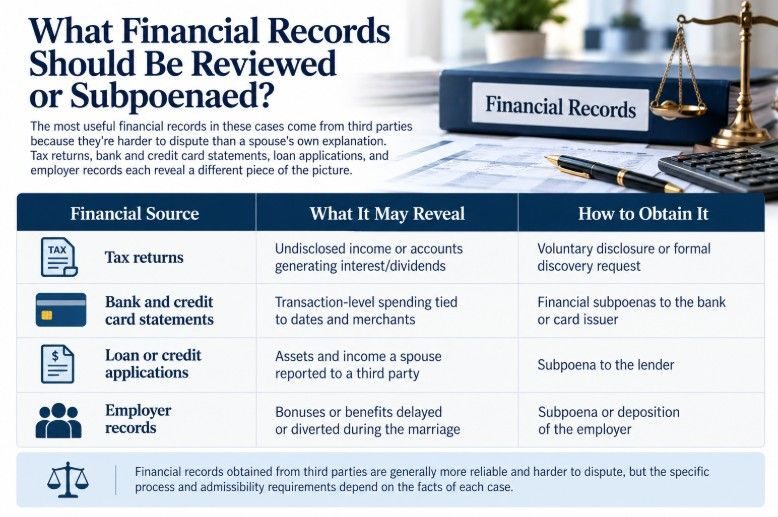
      The most useful financial records in these cases come from third parties because they’re harder to dispute than a spouse’s own explanation. Tax returns, bank and credit card statements, loan applications, and employer records each reveal a different piece of the picture.

      Financial SourceWhat It May RevealHow to Obtain It
      Tax returnsUndisclosed income or accounts generating interest/dividendsVoluntary disclosure or formal discovery request
      Bank and credit card statementsTransaction-level spending tied to dates and merchantsFinancial subpoenas to the bank or card issuer
      Loan or credit applicationsAssets and income a spouse reported to a third partySubpoena to the lender
      Employer recordsBonuses or benefits delayed or diverted during the marriageSubpoena or deposition of the employer

      Formal discovery generally produces more reliable records than personal access to a spouse’s accounts, and it avoids the legal and privacy exposure of accessing someone else’s private accounts without authorization.

      How Should Financial Evidence of an Affair Be Organized Before Filing?

      Organize financial evidence by date, source, and amount before filing a divorce petition, since Illinois courts require clear, specific proof rather than a general impression of “suspicious spending.” 

      A simple spreadsheet — transaction date, amount, merchant, and the underlying statement it came from — turns a stack of paperwork into something a court can actually evaluate.

      • Keep original statements or downloaded PDFs, not just screenshots
      • Note the date each document was obtained and from where
      • Flag transactions that fall after the date the marriage began breaking down
      • Separate confirmed affair-related spending from spending that’s merely unusual

      This kind of organization matters most in the weeks before the dissipation notice deadline, since the notice itself has to identify specific property and specific time periods.

      Bottom Line

      • Hidden accounts, unexplained withdrawals, and spending mismatches are the financial red flags that come up most often when an affair is involved.
      • These signs don’t change the Illinois divorce ground, but they can support a dissipation of marital assets claim under 750 ILCS 5/503(d)(2).
      • Third-party records — bank statements, tax returns, employer records — generally hold up better than a spouse’s personal access to another’s accounts.
      • Organizing evidence by date, source, and amount well before the notice deadline is what turns suspicion into a usable claim.

      Contact Us Today For An Appointment

        I have read the

        Frequently Asked Questions

        What is the first financial red flag most spouses notice? Unexplained credit card charges or a mismatch between claimed income and actual spending are typically the first signs spouses notice. These alone don’t prove infidelity, but they often prompt a closer look at bank statements, tax returns, or other financial records.

        Can a hidden bank account be used as evidence in an Illinois divorce? Yes. A previously undisclosed bank or investment account can support both a dissipation claim and a broader property-disclosure issue, since Illinois requires full financial disclosure during divorce. Tax documents, statements, and formal discovery are the usual ways such accounts come to light.

        Does spending on an affair partner automatically count as dissipation? Not automatically. Under Illinois law, the spending has to be shown, with clear and specific evidence, to have occurred after the marriage began undergoing an irretrievable breakdown and to have been for the sole benefit of the spending spouse, consistent with 750 ILCS 5/503(d)(2).

        How do financial subpoenas work in an Illinois divorce? A financial subpoena legally compels a bank, credit card company, or employer to produce records directly, rather than relying on a spouse’s voluntary disclosure. This is often necessary when accounts are hidden, or a spouse’s records are incomplete.

        Is it legal to access my spouse’s bank statements during a divorce? Jointly held account statements are generally accessible to both spouses, but accessing a spouse’s separate or password-protected accounts without authorization raises legal and privacy risks. An attorney should review any evidence obtained this way before it’s used in a case.

        What if the affair spending happened years before the divorce was filed? Illinois dissipation claims are limited by both a 3-year knowledge-based rule and a 5-year outside limit, so spending from years earlier may fall outside what can be claimed. The specific dates matter, so documentation should include when each transaction occurred.

        Can a forensic accountant help find hidden financial evidence? Yes, particularly in cases involving business interests, self-employment income, or complex account structures. A forensic accountant can trace transfers, reconstruct spending patterns, and identify irregularities across multiple accounts that would not always be obvious from a review of statements alone.

        Do I need proof of the affair itself, or just proof of the spending? For a dissipation claim, proof of the spending and its timing matters more than proof of the affair itself. Illinois courts focus on whether marital funds were used for a purpose unrelated to the marriage, not on establishing the affair as a fact.

        What happens if my spouse can explain the spending as a marital expense? If the spouse charged with dissipation can show, through clear and specific evidence, that the funds went to legitimate marital or household expenses, the claim may fail. Vague explanations without supporting documentation generally do not meet that burden.

        Should I confront my spouse before gathering financial evidence? Gathering and preserving financial evidence before any direct confrontation is generally advisable, since a spouse who suspects you may quickly close accounts or alter records. Confronting a spouse first can make the documentation process much harder.

        How Infidelity Is Discovered and What It Means for Your Illinois Divorce

        Text messages, shared financial accounts, and location-sharing apps are among the most common ways spouses first encounter evidence of an affair, based on the patterns Illinois divorce attorneys see in these cases. 

        Illinois divorce law does not change based on that discovery, because Illinois has been a no-fault state since 2016. 

        What the evidence can do is support a dissipation of marital assets claim under 750 ILCS 5/503(d)(2), which lets a court credit a spouse for marital funds the other partner spent on an affair.

         How that evidence is found and documented often determines whether the claim succeeds.

        Key Takeaways

        • Illinois has been a no-fault divorce state since 2016; infidelity is not a legal ground and does not by itself change how a judge divides property.
        • Digital records — texts, shared cloud accounts, credit card statements, and location data — are what attorneys most often see raised in these cases, more frequently than a spouse’s own confession.
        • Money spent on an affair partner can be recovered through a dissipation of marital assets claim under 750 ILCS 5/503(d)(2), but the spouse charged with dissipation — not the spouse raising the claim — bears the burden of accounting for the funds.
        • Dissipation claims are limited by two separate time rules and a strict notice deadline, not by general suspicion.

        Discovering a cheating spouse raises real questions about property, custody, and next steps. Contact Cooper Trachtenberg Law Group to review the evidence and lay out where it stands legally.

        How Do Most Spouses First Discover an Affair?

        Spouses most often encounter evidence of an affair through everyday digital records rather than a confession or a private investigator, based on the pattern divorce attorneys see in these cases. 

        A shared family iCloud or Google account, a credit card statement, or a phone left unlocked on the counter often surfaces the first clue.

        Common early signs include unexplained credit card charges, a second phone or hidden app, a sudden change in password habits, or unfamiliar names appearing in call logs. 

        None of these proves infidelity on their own, but they typically prompt a closer look — bank statements, hidden assets review, or a private investigator — that produces confirmable evidence. 

        A spouse who suspects hiding property alongside an affair is often looking at the same financial trail.

        It’s worth separating two different questions early on: proving that an affair happened, and proving where marital money went. Illinois divorce law has almost nothing to say about the first question — it matters legally through the second, via dissipation.

        If you’re ready to get started, call us now!

        What Digital Evidence Most Often Reveals a Cheating Spouse?

        What Digital Evidence Most Often Reveals a Cheating Spouse?

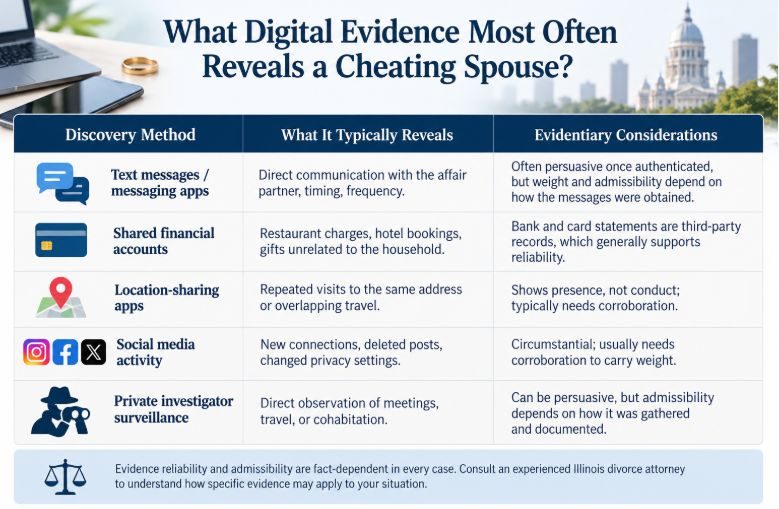
        In practice, text messages, location history, and shared financial accounts are the digital records divorce attorneys most often see surface an affair, because they are generated automatically and rarely deleted everywhere at once. 

        The table below summarises what each source typically shows, with the evidentiary caveat that reliability and admissibility are fact-dependent in every case.

        Discovery MethodWhat It Typically RevealsEvidentiary Considerations
        Text messages/messaging appsDirect communication with the affair partner, timing, frequencyOften persuasive once authenticated, but weight and admissibility depend on how the messages were obtained
        Shared financial accountsRestaurant charges, hotel bookings, gifts unrelated to the householdBank and card statements are third-party records, which generally supports reliability
        Location-sharing appsRepeated visits to the same address or overlapping travelShows presence, not conduct; typically needs corroboration
        Social media activityNew connections, deleted posts, changed privacy settingsCircumstantial; usually needs corroboration to carry weight
        Private investigator surveillanceDirect observation of meetings, travel, or cohabitationCan be persuasive, but admissibility depends on how it was gathered and documented

        Whether any of this evidence is admissible or persuasive in a specific case depends heavily on how it was obtained — an attorney should review it before it becomes central to a claim. 

        A spouse building a record from any of these sources should also preserve the original file or statement, since formal discovery tools used later in the case will typically call for the underlying document, not a screenshot.

        Does Illinois Law Treat Infidelity as Grounds for Divorce?

        Illinois does not recognize infidelity as a legal ground for divorce. Under 750 ILCS 5/401, irreconcilable differences that have caused the irretrievable breakdown of the marriage are the sole ground, and it has been since Public Act 99-90 eliminated fault-based grounds effective January 1, 2016.

        A petition for dissolution in Illinois does not name an affair, and a judge does not weigh who caused the breakdown when granting the divorce itself. 

        Adultery does remain, on paper, a Class A misdemeanor under 720 ILCS 5/11-35, but prosecutions are rare and have no bearing on a civil divorce case. Marital misconduct also plays no role in the maintenance analysis under 750 ILCS 5/504, so a spouse cannot expect a larger support award simply because the other spouse cheated.

        Can an Affair Affect Property Division Through Dissipation of Marital Assets?

        An affair can affect property division when marital funds are paid for it, through a legal claim called dissipation of assets. The Illinois Supreme Court defined dissipation in In re Marriage of O’Neill, 138 Ill. 2d 487, 497 (1990), as the use of marital property for one spouse’s sole benefit, for a purpose unrelated to the marriage, once the marriage is undergoing an irreconcilable breakdown.

        Hotel stays, travel, gifts, and meals charged to a joint account for an affair partner typically qualify. 

        So does cash withdrawn and unaccounted for once the marriage began breaking down. Once dissipation is properly raised, Illinois law places the burden on the spouse charged with dissipating the funds — not the spouse making the claim — to prove through clear and specific evidence how the money was spent; vague testimony that the funds simply covered marital expenses is not enough. 

        (In re Marriage of Schneeweis, 2016 IL App (2d) 140147, ¶ 37, citing In re Marriage of Carter, 317 Ill. App. 3d 546, 552 (2000).) 

        A court that finds dissipation does not simply split the dissipated amount — it adjusts the overall property division so the wronged spouse’s share reflects what was lost, which can matter significantly in a complex asset division case involving business interests or investment accounts.

        Cooper Trachtenberg Law Group works through exactly this kind of financial evidence with clients across Rolling Meadows, Lincolnshire, and Chicago. Schedule a consultation to see where a dissipation claim stands.

        If you’re ready to get started, call us now!

        Does Infidelity Affect Child Custody or Parenting Time in Illinois?

        Infidelity generally does not affect the allocation of parental responsibilities or parenting time in Illinois. Under 750 ILCS 5/602.7(c), a court may not consider a parent’s conduct unless that conduct affects the parent’s relationship to the child — and an affair, standing alone, typically does not meet that standard.

        The statute does name specific, narrow exceptions where a parent’s household matters directly: physical violence or its threat against the child or a household member, other abuse against the child or household member, and whether a parent is a convicted sex offender or lives with one (750 ILCS 5/602.7(b)(11), (14), (15)). 

        Where one of those factors is genuinely present — not simply suspected — it becomes part of the child custody best-interests analysis. 

        Where safety is a documented, immediate concern rather than a general worry about a new partner, an order of protection may be worth discussing with an attorney, though eligibility and relief depend on the Illinois Domestic Violence Act’s own requirements, not simply on the existence of an affair.

        How Should Evidence of an Affair Be Documented Before Filing?

        Evidence of an affair should be preserved in its original form, dated, and organized by source before a divorce petition is filed, because Illinois courts require clear and specific proof rather than general suspicion. 

        A spreadsheet listing each transaction, date, and amount — cross-referenced to the underlying bank or card statement — holds up far better than a folder of screenshots.

        Financial records are often easier to obtain through formal channels once you file the case. Financial subpoenas can compel banks, credit card companies, and employers to produce records a spouse cannot access alone, and a DuPage County discovery process (or its equivalent in Cook or Lake County) can reach further than informal evidence-gathering. 

        A spouse should stop short of accessing a partner’s private accounts without authorization — evidence gathered that way raises real legal and privacy exposure of its own, and an attorney should be consulted before it’s used in a case.

        What Are the Deadlines for Filing a Dissipation Claim in Illinois?

        A dissipation claim under 750 ILCS 5/503(d)(2) is limited by two separate time rules, plus a strict notice deadline — and missing any of them can waive a claim regardless of how strong the underlying evidence is.

        RequirementIllinois Rule
        Notice deadlineAt least 60 days before trial, or 30 days after the close of discovery, whichever is later
        Knowledge-based limitNo dissipation is deemed to have occurred more than 3 years before the claiming spouse knew or should have known of it
        Outside limitIn no event may dissipation reach more than 5 years before the divorce petition was filed
        Timing requirementSpending must have occurred after the marriage began undergoing an irretrievable breakdown
        What the notice must includeA date or period when the breakdown began, identification of the dissipated property, and a date or period during which the dissipation occurred

        The 3-year and 5-year rules work together, not as alternatives: a claim must fall within 3 years of when the spouse knew or should have known of the dissipation, and in no case may it reach back further than 5 years before the petition was filed. 

        Because the notice must pin down dates and identify the specific property involved, the documentation work described above needs to start well before the deadline arrives, not after.

        A missed deadline can waive a valid dissipation claim before it’s ever heard. Contact Cooper Trachtenberg Law Group now to confirm the timeline for your specific case.

        Bottom Line

        • Illinois divorce is granted on irreconcilable differences alone; infidelity itself changes neither the grounds nor the basic property split.
        • Evidence of an affair matters legally when it supports a dissipation of marital assets claim under 750 ILCS 5/503(d)(2) — and once raised, the spouse charged with dissipation must account for the funds.
        • Dissipation claims are bound by a 3-year knowledge-based limit, a 5-year outside limit, and a notice deadline of 60 days before trial or 30 days after discovery closes.
        • Digital records, financial subpoenas, and formal discovery typically produce stronger evidence than informal snooping.

        Contact Us Today For An Appointment

          I have read the

          Frequently Asked Questions

          Does cheating affect alimony in Illinois?
          No. Under 750 ILCS 5/504, Illinois courts award maintenance without regard to marital misconduct. Maintenance depends on 14 statutory factors, including income, needs, and marriage length — not on which spouse was unfaithful.

          Can I use text messages as evidence in my Illinois divorce?
          Yes, if they were obtained appropriately. Text messages showing an affair can support a dissipation claim or credibility issues in custody disputes, but messages taken by accessing a spouse’s phone or account without authorization raise separate legal and privacy risks an attorney should review.

          Is adultery still a crime in Illinois?
          Technically yes. Under 720 ILCS 5/11-35, adultery remains a Class A misdemeanor when the conduct is open and notorious. Prosecutions are rare, and a criminal charge has no direct bearing on how a civil divorce case is resolved.

          Who has the burden of proving how dissipated funds were spent?
          Once dissipation is properly raised, Illinois law places the burden on the spouse charged with dissipating the money, not the spouse making the claim. That spouse must show, through clear and specific evidence, how the funds were spent — vague claims of marital use are not enough.

          How far back can a dissipation claim reach in Illinois?
          A dissipation claim is limited to 3 years after the claiming spouse knew or should have known of it, and in no case may it reach more than 5 years before the petition was filed. Within that window, the spending must also have occurred after the marriage began breaking down.

          What counts as marital funds spent on an affair?
          Hotel stays, travel, restaurant charges, gifts, and unexplained cash withdrawals tied to an affair partner generally count, once the marriage was breaking down. Ordinary joint expenses that also benefited the household typically do not qualify as dissipation.

          Do I need a private investigator to prove infidelity in Illinois?
          Not necessarily. Bank statements, phone records obtained through discovery, and financial subpoenas often establish dissipation without surveillance. A private investigator can help in specific situations, such as documenting cohabitation for maintenance purposes.

          Will my spouse’s affair partner be named in the divorce case?
          Illinois divorce petitions do not name an affair partner as a party, since fault is not part of the case. An affair partner’s identity may still appear in financial records submitted as evidence of dissipation.

          Can infidelity impact parenting time if the affair partner has a criminal record?
          Only in narrow, statute-defined circumstances. Under 750 ILCS 5/602.7, a court may weigh whether a parent’s household includes a convicted sex offender or involves violence or abuse against the child — general disapproval of a new partner is not enough on its own.

          What happens if I miss the deadline to claim dissipation?
          Missing the notice deadline generally waives the dissipation claim, even with strong evidence. The notice must be filed at least 60 days before trial or 30 days after discovery closes, whichever is later—on top of the separate 3-year and 5-year time limits.

          Does living separately for 6 months prove irreconcilable differences?
          Yes. Under 750 ILCS 5/401, living separate and apart for 6 months or more creates an irrebuttable presumption that irreconcilable differences exist, which removes the need to prove the breakdown through other evidence.