
Facebook photos, Instagram messages, and Snapchat location tags can all become evidence in an Illinois divorce, but not automatically.
Under the Illinois Rules of Evidence, a post must be authenticated—shown to be what it claims to be—before a judge will consider it.
A screenshot alone often isn’t enough to clear that bar. What matters is how the post was obtained, who can verify it, and whether it’s relevant to a specific issue in the case.
Wondering what your own social media activity — or your spouse’s — might mean for your case? Contact Cooper Trachtenberg Law Group to talk through the specifics.
Social media evidence is admissible in an Illinois divorce when it clears the same three hurdles as any other evidence: authentication, relevance, and the hearsay rules.
A judge won’t consider a post just because one spouse says it’s real — the post must be tied to its source through testimony, distinctive characteristics, or another recognized method.
Relevance matters just as much as authenticity. A photo from a night out might be relevant to a claim about lifestyle or spending, but irrelevant to a property dispute that has nothing to do with either spouse’s social habits.
Courts can exclude social media content that’s authentic but doesn’t bear on the issue before the judge.
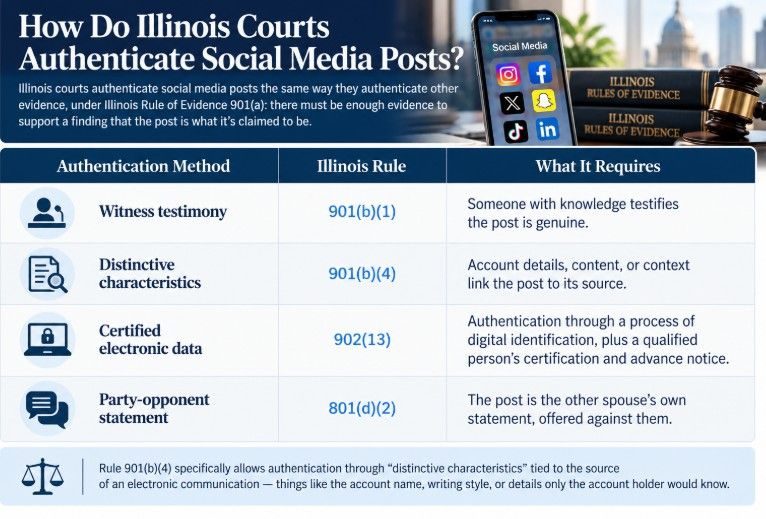
Illinois courts authenticate social media posts the same way they authenticate other evidence, under Illinois Rule of Evidence 901(a): there must be enough evidence to support a finding that the post is what it’s claimed to be.
Rule 901(b)(4) specifically allows authentication through “distinctive characteristics” tied to the source of an electronic communication — things like the account name, writing style, or details only the account holder would know.
| Authentication Method | Illinois Rule | What It Requires |
| Witness testimony | 901(b)(1) | Someone with knowledge testifies that the post is genuine |
| Distinctive characteristics | 901(b)(4) | Account details, content, or context link the post to its source |
| Certified electronic data | 902(13) | Authentication through a process of digital identification, plus a qualified person’s certification and advance notice |
| Party-opponent statement | 801(d)(2) | The post is the other spouse’s own statement, offered against them |
Rule 902(13) lets data copied from an electronic device, storage medium, or file authenticate itself without live testimony — but only when it has been authenticated through a process of digital identification and is accompanied by a qualified person’s written certification meeting Rule 902(11)’s procedural and notice requirements.
It applies to a narrow category of certified data, not to social media content generally.
If you’re ready to get started, call us now!
Illinois courts have accepted a spouse’s own posts and photos when they’re relevant to a specific, contested issue in the case.
In In re Marriage of Miller, 2015 IL App (2d) 140530, the Illinois Appellate Court upheld a trial court’s decision to consider Facebook photos and posts written by the maintenance recipient and her boyfriend when deciding whether they were cohabiting on a “resident, continuing, and conjugal basis” under 750 ILCS 5/510(c) — a basis for terminating maintenance.
The recipient testified that the posts came from her own Facebook profile, even though she claimed not to remember writing them—testimony the appellate court found sufficient to satisfy Rule 901(a)’s authentication requirement. Miller, ¶ 37.
Separately, the trial court considered only posts written by the two people directly involved in the cohabitation question, not comments or posts written by other third parties.
The opinion doesn’t establish that a witness’s boyfriend’s posts always come in as easily as the witness’s own posts—it reflects that both people’s content was relevant to the specific issue being litigated, while unconnected third-party commentary would have needed separate authentication and could raise its own hearsay concerns.
Illinois courts can reject social media evidence that isn’t authenticated, that amounts to hearsay with no applicable exception, or that a party never had a legitimate way to obtain.
A screenshot with no way to verify who posted it, when, or whether it was edited often won’t clear the authentication bar on its own.
| Evidence Problem | Why It’s Often Rejected |
| Unverified screenshots | No testimony or distinctive characteristics tie the image to its claimed source |
| Third-party comments or posts | Generally hearsay when offered to prove the truth of what a non-party said |
| Content obtained by unauthorized account access | Raises separate legal and privacy issues that can affect how it’s used |
| Posts stripped of metadata or context | Harder to authenticate and easier to challenge as edited or incomplete |
| Irrelevant content | Authentic posts can still be excluded if they don’t bear on an issue in the case |
Deleted posts can often be recovered through screenshots someone else took, platform records obtained through discovery, or forensic recovery tools, so deletion doesn’t guarantee a post disappears from a case. Deletion can create a separate problem for the person who deleted it.
Illinois Supreme Court Rule 219(c) gives judges broad authority to sanction a party who fails to comply with discovery obligations or a court order, including barring evidence, striking pleadings, or shifting attorney fees.
Illinois courts have applied Rule 219(c) in divorce cases themselves — in In re Marriage of Szczepanczyk, the Illinois Appellate Court upheld a trial court’s decision to strike a respondent’s pleadings and enter judgment against her after she repeatedly failed to comply with discovery, including a missed deposition.
Once a divorce is filed — and especially once specific content has been requested, or a preservation obligation is clear — deleting relevant posts can expose a spouse to this same kind of sanction.
The safer approach is to stop posting and preserve existing accounts rather than delete anything once a case is underway.
Social media evidence affects custody in Illinois only to the extent it bears on a parent’s relationship with the child, since 750 ILCS 5/602.7(c) directs courts not to consider a parent’s conduct that doesn’t affect that relationship.
A post showing behavior unrelated to parenting carries less weight than one showing something that actually touches the child’s safety or well-being.
In property matters, social media evidence tends to matter most when it corroborates something already at issue — spending inconsistent with a financial disclosure, or evidence connected to an affair that ties into a dissipation claim.
On its own, a post rarely decides a property or custody outcome; it typically works alongside other evidence rather than replacing it.
If you’re ready to get started, call us now!
The safest approach during an Illinois divorce is to avoid posting anything about the case, the other spouse, finances, or new relationships until the case is resolved.
Even posts that feel unrelated to the divorce can be authenticated and introduced if they later become relevant to an issue that comes up.
Privacy settings help less than people expect, since screenshots, shared connections, and formal discovery can all reach content a spouse assumed was private.
Can my spouse use my private Instagram posts against me in an Illinois divorce?
Yes, if the posts are authenticated and relevant. Privacy settings don’t make content inadmissible — a spouse, mutual friend, or the discovery process can still surface private posts, and once authenticated, they’re treated the same as any other evidence.
Do I have to hand over my social media accounts during divorce discovery?
You may have to produce specific, relevant records if properly requested. You generally don’t have to turn over full account access, but withholding clearly relevant, requested content can lead to a motion to compel or sanctions under Rule 219(c).
Is a text message treated differently from a social media post in Illinois court?
Not fundamentally. Both require authentication under Rule 901, and both can qualify as non-hearsay under Rule 801(d)(2) when they’re the other party’s own statement. The main practical difference is how each is typically obtained and verified.
Can old posts from before the marriage be used as evidence?
Yes, if they’re relevant and authenticated, though relevance becomes a bigger issue the older and more disconnected the post is from the current dispute. A judge is more likely to admit recent, directly relevant content than something posted years before the marriage began.
What happens if I delete a post after my divorce is filed?
Deleting a relevant post after filing can expose you to sanctions under Illinois Supreme Court Rule 219(c), which lets a judge address discovery noncompliance through remedies including barring evidence, striking pleadings, or shifting fees. Recovered copies or screenshots may still surface the content anyway.
Can screenshots alone be used as evidence in Illinois?
A screenshot alone is often not enough without something else connecting it to its source, such as testimony, metadata, or distinctive account details. Courts have excluded unverified screenshots specifically because nothing tied the image to the claimed source.
Does it matter who took the screenshot?
Yes. Testimony from the person who took the screenshot, including when and how, is a common way to authenticate it under Rule 901(b)(1). A screenshot with no known origin is much easier to challenge.
Can my attorney use a private investigator to gather social media evidence?
Yes, within legal limits. A private investigator can document publicly visible social media activity, but accessing a spouse’s private accounts without authorization raises separate legal and privacy risks that can affect how the resulting evidence is used.
Will an old, unrelated post hurt my custody case?
Generally not, unless it bears on your relationship with your child, since Illinois courts are directed not to weigh parental conduct unrelated to that relationship. An isolated post with no connection to parenting carries limited weight on its own.
Can I still post normally if I’m not involved in a custody or property dispute?
Even in cases without contested custody or complex property issues, posts can still become relevant to credibility, spending, or new relationships. The safest practice is to post minimally until the divorce is final, regardless of how contested the case is.
A single post can become part of a much bigger picture in an Illinois divorce — for better or worse. Talk to Cooper Trachtenberg Law Group about what your case actually needs before you post, delete, or share anything else.




About the Author
Partner · Fellow, American Academy of Matrimonial Lawyers (AAML) · Illinois Family Law Attorney · Mediator · Collaborative Divorce Practitioner
Helena L. Trachtenberg is a Partner at Cooper Trachtenberg Law Group, LLC and a Fellow of the American Academy of Matrimonial Lawyers (AAML), an invitation-only organization that recognizes the nation's leading family law attorneys.
Her practice is devoted exclusively to Illinois family law matters, including divorce, allocation of parental responsibilities, parenting time, child support, property division, prenuptial agreements, post-decree litigation, and complex family law disputes throughout the Chicago area.
Helena is a trained mediator, collaborative law practitioner, Child Representative, Guardian ad Litem, and Parenting Coordinator. She also has extensive experience handling matters involving the Illinois Department of Children and Family Services (DCFS) and the Illinois Department of Healthcare and Family Services (HFS).
Through litigation, mediation, and collaborative law, Helena helps clients navigate challenging family transitions while pursuing practical and effective resolutions that protect their long-term interests.
Practice Areas: Divorce, Collaborative Divorce, Mediation, Child Custody, Parenting Time, Child Support, Property Division, Prenuptial Agreements, Post-Decree Matters
Practice Areas
Legal Support When You Need It Most
Testimonials



Main Office
3601 Algonquin Road, Suite 610
Rolling Meadows, Illinois 60008
Lincolnshire Office
250 Parkway Drive, Suite 150
Lincolnshire, IL 60069
By Appointment Only
Phone:
847-995-8800


We represent parties across the Chicago area, including Arlington Heights, Barrington, Buffalo Grove, Carol Stream, Evanston, Glenview, Highland Park, Hinsdale, Inverness, Lincolnshire, Long Grove, Mt. Prospect, Palatine, Rolling Meadows, Schaumburg, Skokie, Streamwood, Wheeling and more. We also represent clients from Cook, Lake, DuPage, Kane and McHenry counties.
© 2026 by Cooper Trachtenberg Law Group, LLC. All Rights Reserved.
Disclaimer |
Site Map
