

Text messages, shared financial accounts, and location-sharing apps are among the most common ways spouses first encounter evidence of an affair, based on the patterns Illinois divorce attorneys see in these cases.
Illinois divorce law does not change based on that discovery, because Illinois has been a no-fault state since 2016.
What the evidence can do is support a dissipation of marital assets claim under 750 ILCS 5/503(d)(2), which lets a court credit a spouse for marital funds the other partner spent on an affair.
How that evidence is found and documented often determines whether the claim succeeds.
Discovering a cheating spouse raises real questions about property, custody, and next steps. Contact Cooper Trachtenberg Law Group to review the evidence and lay out where it stands legally.
Spouses most often encounter evidence of an affair through everyday digital records rather than a confession or a private investigator, based on the pattern divorce attorneys see in these cases.
A shared family iCloud or Google account, a credit card statement, or a phone left unlocked on the counter often surfaces the first clue.
Common early signs include unexplained credit card charges, a second phone or hidden app, a sudden change in password habits, or unfamiliar names appearing in call logs.
None of these proves infidelity on their own, but they typically prompt a closer look — bank statements, hidden assets review, or a private investigator — that produces confirmable evidence.
A spouse who suspects hiding property alongside an affair is often looking at the same financial trail.
It’s worth separating two different questions early on: proving that an affair happened, and proving where marital money went. Illinois divorce law has almost nothing to say about the first question — it matters legally through the second, via dissipation.
If you’re ready to get started, call us now!
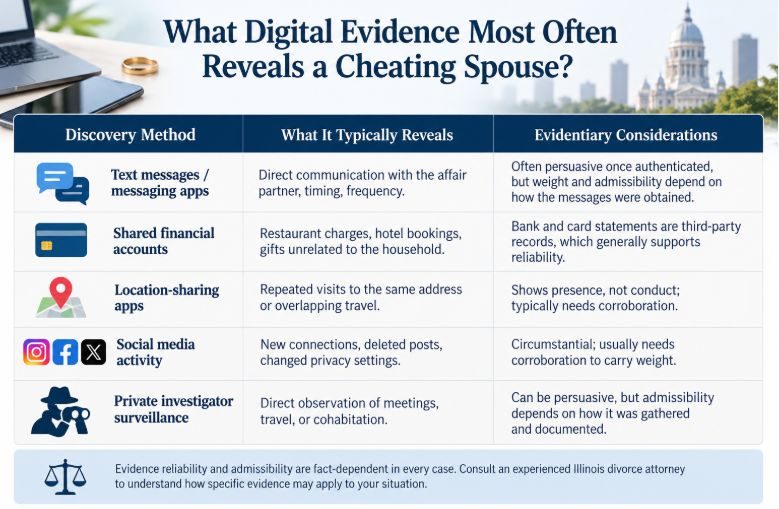
In practice, text messages, location history, and shared financial accounts are the digital records divorce attorneys most often see surface an affair, because they are generated automatically and rarely deleted everywhere at once.
The table below summarises what each source typically shows, with the evidentiary caveat that reliability and admissibility are fact-dependent in every case.
| Discovery Method | What It Typically Reveals | Evidentiary Considerations |
| Text messages/messaging apps | Direct communication with the affair partner, timing, frequency | Often persuasive once authenticated, but weight and admissibility depend on how the messages were obtained |
| Shared financial accounts | Restaurant charges, hotel bookings, gifts unrelated to the household | Bank and card statements are third-party records, which generally supports reliability |
| Location-sharing apps | Repeated visits to the same address or overlapping travel | Shows presence, not conduct; typically needs corroboration |
| Social media activity | New connections, deleted posts, changed privacy settings | Circumstantial; usually needs corroboration to carry weight |
| Private investigator surveillance | Direct observation of meetings, travel, or cohabitation | Can be persuasive, but admissibility depends on how it was gathered and documented |
Whether any of this evidence is admissible or persuasive in a specific case depends heavily on how it was obtained — an attorney should review it before it becomes central to a claim.
A spouse building a record from any of these sources should also preserve the original file or statement, since formal discovery tools used later in the case will typically call for the underlying document, not a screenshot.
Illinois does not recognize infidelity as a legal ground for divorce. Under 750 ILCS 5/401, irreconcilable differences that have caused the irretrievable breakdown of the marriage are the sole ground, and it has been since Public Act 99-90 eliminated fault-based grounds effective January 1, 2016.
A petition for dissolution in Illinois does not name an affair, and a judge does not weigh who caused the breakdown when granting the divorce itself.
Adultery does remain, on paper, a Class A misdemeanor under 720 ILCS 5/11-35, but prosecutions are rare and have no bearing on a civil divorce case. Marital misconduct also plays no role in the maintenance analysis under 750 ILCS 5/504, so a spouse cannot expect a larger support award simply because the other spouse cheated.
An affair can affect property division when marital funds are paid for it, through a legal claim called dissipation of assets. The Illinois Supreme Court defined dissipation in In re Marriage of O’Neill, 138 Ill. 2d 487, 497 (1990), as the use of marital property for one spouse’s sole benefit, for a purpose unrelated to the marriage, once the marriage is undergoing an irreconcilable breakdown.
Hotel stays, travel, gifts, and meals charged to a joint account for an affair partner typically qualify.
So does cash withdrawn and unaccounted for once the marriage began breaking down. Once dissipation is properly raised, Illinois law places the burden on the spouse charged with dissipating the funds — not the spouse making the claim — to prove through clear and specific evidence how the money was spent; vague testimony that the funds simply covered marital expenses is not enough.
(In re Marriage of Schneeweis, 2016 IL App (2d) 140147, ¶ 37, citing In re Marriage of Carter, 317 Ill. App. 3d 546, 552 (2000).)
A court that finds dissipation does not simply split the dissipated amount — it adjusts the overall property division so the wronged spouse’s share reflects what was lost, which can matter significantly in a complex asset division case involving business interests or investment accounts.
Cooper Trachtenberg Law Group works through exactly this kind of financial evidence with clients across Rolling Meadows, Lincolnshire, and Chicago. Schedule a consultation to see where a dissipation claim stands.
If you’re ready to get started, call us now!
Infidelity generally does not affect the allocation of parental responsibilities or parenting time in Illinois. Under 750 ILCS 5/602.7(c), a court may not consider a parent’s conduct unless that conduct affects the parent’s relationship to the child — and an affair, standing alone, typically does not meet that standard.
The statute does name specific, narrow exceptions where a parent’s household matters directly: physical violence or its threat against the child or a household member, other abuse against the child or household member, and whether a parent is a convicted sex offender or lives with one (750 ILCS 5/602.7(b)(11), (14), (15)).
Where one of those factors is genuinely present — not simply suspected — it becomes part of the child custody best-interests analysis.
Where safety is a documented, immediate concern rather than a general worry about a new partner, an order of protection may be worth discussing with an attorney, though eligibility and relief depend on the Illinois Domestic Violence Act’s own requirements, not simply on the existence of an affair.
Evidence of an affair should be preserved in its original form, dated, and organized by source before a divorce petition is filed, because Illinois courts require clear and specific proof rather than general suspicion.
A spreadsheet listing each transaction, date, and amount — cross-referenced to the underlying bank or card statement — holds up far better than a folder of screenshots.
Financial records are often easier to obtain through formal channels once you file the case. Financial subpoenas can compel banks, credit card companies, and employers to produce records a spouse cannot access alone, and a DuPage County discovery process (or its equivalent in Cook or Lake County) can reach further than informal evidence-gathering.
A spouse should stop short of accessing a partner’s private accounts without authorization — evidence gathered that way raises real legal and privacy exposure of its own, and an attorney should be consulted before it’s used in a case.
A dissipation claim under 750 ILCS 5/503(d)(2) is limited by two separate time rules, plus a strict notice deadline — and missing any of them can waive a claim regardless of how strong the underlying evidence is.
| Requirement | Illinois Rule |
| Notice deadline | At least 60 days before trial, or 30 days after the close of discovery, whichever is later |
| Knowledge-based limit | No dissipation is deemed to have occurred more than 3 years before the claiming spouse knew or should have known of it |
| Outside limit | In no event may dissipation reach more than 5 years before the divorce petition was filed |
| Timing requirement | Spending must have occurred after the marriage began undergoing an irretrievable breakdown |
| What the notice must include | A date or period when the breakdown began, identification of the dissipated property, and a date or period during which the dissipation occurred |
The 3-year and 5-year rules work together, not as alternatives: a claim must fall within 3 years of when the spouse knew or should have known of the dissipation, and in no case may it reach back further than 5 years before the petition was filed.
Because the notice must pin down dates and identify the specific property involved, the documentation work described above needs to start well before the deadline arrives, not after.
A missed deadline can waive a valid dissipation claim before it’s ever heard. Contact Cooper Trachtenberg Law Group now to confirm the timeline for your specific case.
Does cheating affect alimony in Illinois?
No. Under 750 ILCS 5/504, Illinois courts award maintenance without regard to marital misconduct. Maintenance depends on 14 statutory factors, including income, needs, and marriage length — not on which spouse was unfaithful.
Can I use text messages as evidence in my Illinois divorce?
Yes, if they were obtained appropriately. Text messages showing an affair can support a dissipation claim or credibility issues in custody disputes, but messages taken by accessing a spouse’s phone or account without authorization raise separate legal and privacy risks an attorney should review.
Is adultery still a crime in Illinois?
Technically yes. Under 720 ILCS 5/11-35, adultery remains a Class A misdemeanor when the conduct is open and notorious. Prosecutions are rare, and a criminal charge has no direct bearing on how a civil divorce case is resolved.
Who has the burden of proving how dissipated funds were spent?
Once dissipation is properly raised, Illinois law places the burden on the spouse charged with dissipating the money, not the spouse making the claim. That spouse must show, through clear and specific evidence, how the funds were spent — vague claims of marital use are not enough.
How far back can a dissipation claim reach in Illinois?
A dissipation claim is limited to 3 years after the claiming spouse knew or should have known of it, and in no case may it reach more than 5 years before the petition was filed. Within that window, the spending must also have occurred after the marriage began breaking down.
What counts as marital funds spent on an affair?
Hotel stays, travel, restaurant charges, gifts, and unexplained cash withdrawals tied to an affair partner generally count, once the marriage was breaking down. Ordinary joint expenses that also benefited the household typically do not qualify as dissipation.
Do I need a private investigator to prove infidelity in Illinois?
Not necessarily. Bank statements, phone records obtained through discovery, and financial subpoenas often establish dissipation without surveillance. A private investigator can help in specific situations, such as documenting cohabitation for maintenance purposes.
Will my spouse’s affair partner be named in the divorce case?
Illinois divorce petitions do not name an affair partner as a party, since fault is not part of the case. An affair partner’s identity may still appear in financial records submitted as evidence of dissipation.
Can infidelity impact parenting time if the affair partner has a criminal record?
Only in narrow, statute-defined circumstances. Under 750 ILCS 5/602.7, a court may weigh whether a parent’s household includes a convicted sex offender or involves violence or abuse against the child — general disapproval of a new partner is not enough on its own.
What happens if I miss the deadline to claim dissipation?
Missing the notice deadline generally waives the dissipation claim, even with strong evidence. The notice must be filed at least 60 days before trial or 30 days after discovery closes, whichever is later—on top of the separate 3-year and 5-year time limits.
Does living separately for 6 months prove irreconcilable differences?
Yes. Under 750 ILCS 5/401, living separate and apart for 6 months or more creates an irrebuttable presumption that irreconcilable differences exist, which removes the need to prove the breakdown through other evidence.




About the Author
Partner · Fellow, American Academy of Matrimonial Lawyers (AAML) · Illinois Family Law Attorney · Mediator · Collaborative Divorce Practitioner
Helena L. Trachtenberg is a Partner at Cooper Trachtenberg Law Group, LLC and a Fellow of the American Academy of Matrimonial Lawyers (AAML), an invitation-only organization that recognizes the nation's leading family law attorneys.
Her practice is devoted exclusively to Illinois family law matters, including divorce, allocation of parental responsibilities, parenting time, child support, property division, prenuptial agreements, post-decree litigation, and complex family law disputes throughout the Chicago area.
Helena is a trained mediator, collaborative law practitioner, Child Representative, Guardian ad Litem, and Parenting Coordinator. She also has extensive experience handling matters involving the Illinois Department of Children and Family Services (DCFS) and the Illinois Department of Healthcare and Family Services (HFS).
Through litigation, mediation, and collaborative law, Helena helps clients navigate challenging family transitions while pursuing practical and effective resolutions that protect their long-term interests.
Practice Areas: Divorce, Collaborative Divorce, Mediation, Child Custody, Parenting Time, Child Support, Property Division, Prenuptial Agreements, Post-Decree Matters
Practice Areas
Legal Support When You Need It Most
Testimonials



Main Office
3601 Algonquin Road, Suite 610
Rolling Meadows, Illinois 60008
Lincolnshire Office
250 Parkway Drive, Suite 150
Lincolnshire, IL 60069
By Appointment Only
Phone:
847-995-8800


We represent parties across the Chicago area, including Arlington Heights, Barrington, Buffalo Grove, Carol Stream, Evanston, Glenview, Highland Park, Hinsdale, Inverness, Lincolnshire, Long Grove, Mt. Prospect, Palatine, Rolling Meadows, Schaumburg, Skokie, Streamwood, Wheeling and more. We also represent clients from Cook, Lake, DuPage, Kane and McHenry counties.
© 2026 by Cooper Trachtenberg Law Group, LLC. All Rights Reserved.
Disclaimer |
Site Map
