

This article provides general information about Illinois divorce law and is not a substitute for advice from a licensed Illinois attorney about a specific situation.
Illinois is a no-fault divorce state, so a court can grant a divorce over one spouse’s objection once irreconcilable differences are shown, under 750 ILCS 5/401.
A refusing spouse can slow the case — refusing to sign, ignoring papers, or disputing the grounds — but cannot stop the Illinois divorce process from concluding.
A refusing spouse may mean refusal to sign, no response, or service issues — each follows a different Illinois procedure. The firm helps review options.
No. Illinois eliminated fault-based divorce effective January 1, 2016, and irreconcilable differences under 750 ILCS 5/401(a) is now the sole ground — a court’s finding, not the other spouse’s agreement.
A spouse who disagrees with the divorce can still contest specific issues, delay proceedings, or make the case harder, but has no legal mechanism to prevent the marriage from being dissolved once the statutory requirements are met.
Cooper Trachtenberg Law Group, LLC is a Rolling Meadows based, Illinois family law offering comprehensive family law services to clients from around Chicago and the surrounding suburbs and Cook, Lake and DuPage counties.
Spouses facing a reluctant partner often benefit from understanding unilateral divorce strategies early, since the approach that works for a cooperative case rarely works the same way once one spouse refuses to participate.
Refusing the divorce itself, refusing specific settlement terms, and failing to participate in the case at all are three different situations under Illinois law, each triggering a different procedure.
Of the three, only whether a divorce is ultimately granted cannot be prevented by objecting alone — refusing to sign or participate can still shape how long the case takes and what a court ultimately orders on disputed property, support, and parenting terms.
Illinois does not require both spouses’ signatures on a settlement agreement for a divorce to proceed. When one spouse refuses to sign or agree to proposed terms, the case becomes contested, and a judge decides the disputed issues after hearing evidence from both sides.
A refusing spouse who still shows up and participates in the case is exercising a legal right to contest specific terms, which is different from blocking the divorce itself.
The court can still find that irreconcilable differences exist under 750 ILCS 5/401(a) even when a spouse disputes it, but judgment itself is not entered until the court has also considered the allocation of parental responsibilities, support, maintenance, and property disposition under 750 ILCS 5/401(b) — which is precisely the set of terms a refusing spouse is usually disputing.
If you’re ready to get started, call us now!
A spouse who is properly served but never files a response risks a default judgment. Under 735 ILCS 5/2-1301(d), a court may enter judgment for want of an appearance or failure to plead, though the petitioner must still prove the allegations supporting the requested relief.
The 30-day deadline to appear or respond comes from Illinois Supreme Court Rule 101(d), which governs the summons itself, rather than from the default-judgment statute.
A spouse who wants to challenge a default judgment after it’s entered generally has 30 days to file a motion to vacate under 735 ILCS 5/2-1301(e), and courts have discretion to grant that relief on reasonable terms.
Understanding how to respond to divorce papers in Illinois matters for exactly this reason — silence carries real legal consequences.
Personal service is Illinois’s preferred method, but it isn’t the only one available when a spouse is evading contact or cannot be located.
After a diligent inquiry fails to find the spouse, service by publication under 735 ILCS 5/2-206 allows the case to proceed by publishing notice and mailing a copy to the spouse’s last known address, if one exists — though a court must still approve the request based on the sufficiency of the affidavit describing the inquiry made, not on the petitioner’s assertion alone.
Service by publication under Illinois law is generally available for actions affecting status — which includes the marriage itself — rather than every form of relief a divorce case might resolve.
Certain remedies, such as a personal money judgment for maintenance, may require a different basis for jurisdiction beyond publication alone, which is a distinction worth raising with an attorney rather than assuming publication resolves every issue in the case.
If you’re ready to get started, call us now!
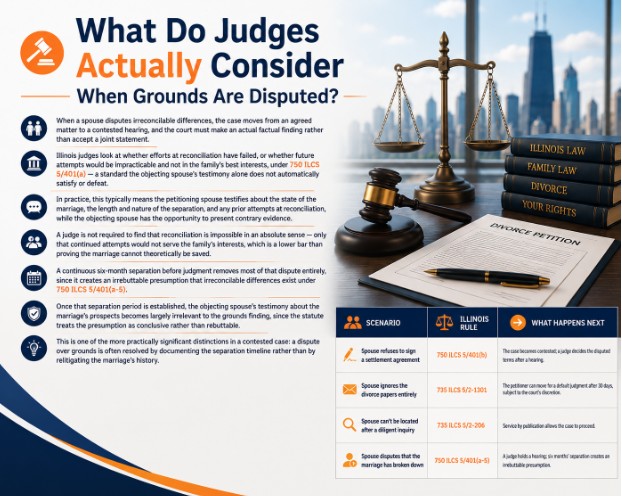
When a spouse disputes irreconcilable differences, the case moves from an agreed matter to a contested hearing, and the court must make an actual factual finding rather than accept a joint statement.
Illinois judges look at whether efforts at reconciliation have failed, or whether future attempts would be impracticable and not in the family’s best interests, under 750 ILCS 5/401(a) — a standard the objecting spouse’s testimony alone does not automatically satisfy or defeat.
In practice, this typically means the petitioning spouse testifies about the state of the marriage, the length and nature of the separation, and any prior attempts at reconciliation, while the objecting spouse has the opportunity to present contrary evidence.
A judge is not required to find that reconciliation is impossible in an absolute sense — only that continued attempts would not serve the family’s interests, which is a lower bar than proving the marriage cannot theoretically be saved.
A continuous six-month separation before judgment removes most of that dispute entirely, since it creates an irrebuttable presumption that irreconcilable differences exist under 750 ILCS 5/401(a-5).
Once that separation period is established, the objecting spouse’s testimony about the marriage’s prospects becomes largely irrelevant to the grounds finding, since the statute treats the presumption as conclusive rather than rebuttable.
This is one of the more practically significant distinctions in a contested case: a dispute over grounds is often resolved by documenting the separation timeline rather than by relitigating the marriage’s history.
| Scenario | Illinois Rule | What Happens Next |
| Spouse refuses to sign a settlement agreement | 750 ILCS 5/401(b) | The case becomes contested; a judge decides the disputed terms after a hearing |
| Spouse ignores the divorce papers entirely | 735 ILCS 5/2-1301 | The petitioner can move for a default judgment after 30 days, subject to the court’s discretion |
| Spouse can’t be located after a diligent inquiry | 735 ILCS 5/2-206 | Service by publication allows the case to proceed |
| Spouse disputes that the marriage has broken down | 750 ILCS 5/401(a-5) | A judge holds a hearing; six months’ separation creates an irrebuttable presumption |
Refusing to cooperate does not change the substantive rules a court applies, but it can meaningfully affect how a case actually unfolds procedurally.
Property still divides under the equitable division standard of 750 ILCS 5/503, and parenting matters still follow the best-interests factors under 750 ILCS 5/602.5 and 5/602.7, whether or not both spouses agree.
An uncooperative spouse can, however, increase the cost and length of a case by forcing formal discovery, contested hearings, and additional court appearances instead of a negotiated settlement, and a spouse’s participation or non-participation can affect what evidence is available and how efficiently a case resolves even where the underlying legal standard stays the same.
Understanding how Illinois divides marital property helps a petitioning spouse anticipate what a contested case is likely to decide, even before the other spouse cooperates.
Documenting every attempt at service and communication protects a petitioner’s position if the case eventually requires a default judgment or a motion regarding service.
Keeping records of certified mail, process server attempts, and any correspondence creates the evidentiary trail Illinois courts expect — though it’s the formal service and filing record, not a petitioner’s own communication log, that ultimately satisfies the legal service requirement.
A refusing spouse sometimes signals a broader pattern of conflict rather than a one-time objection, and high-conflict situations often benefit from a different litigation strategy than a straightforward uncontested case.
Can a spouse refuse to divorce in Illinois? No, not legally. Illinois is a no-fault state, and a court can grant a divorce under 750 ILCS 5/401(a) once irreconcilable differences are shown, regardless of whether the other spouse agrees. A spouse who refuses can contest specific terms but cannot block the divorce itself.
What happens if a spouse won’t sign divorce papers in Illinois? The case becomes contested rather than agreed, and a judge decides the disputed issues after hearing evidence from both sides. Illinois does not require both spouses’ signatures on a settlement agreement for a court to grant the divorce.
What is a default judgment in an Illinois divorce case? A default judgment under 735 ILCS 5/2-1301 allows a court to rule when a properly served spouse fails to file an appearance or response. The petitioner must still prove the allegations supporting the relief requested before judgment is entered, even without the other spouse’s participation.
How long does a spouse have to respond to divorce papers in Illinois? A served spouse generally has 30 days to file an appearance or response under Illinois Supreme Court Rule 101(d) before a default motion becomes available. Failing to respond within that window puts a spouse at risk of the court proceeding without their participation.
What happens if a spouse can’t be located for service? After a diligent, documented inquiry fails to locate the spouse, service by publication under 735 ILCS 5/2-206 permits the divorce to proceed, though personal relief, such as a maintenance judgment, may require a different jurisdictional basis. Notice is published and mailed to any known last address.
Can a default judgment be reversed after it’s entered? Sometimes. A spouse can generally file a motion to vacate a default judgment within 30 days under 735 ILCS 5/2-1301(e), and the court has discretion to grant that relief on reasonable terms. Vacating a default is not automatic or guaranteed.
Does a spouse’s objection affect how property is divided? No, not the legal standard. Property still divides under the equitable distribution standard in 750 ILCS 5/503, regardless of whether both spouses agree to the divorce. An objection can increase the litigation involved without changing the standard a court applies.
What is the six-month separation presumption in Illinois? Under 750 ILCS 5/401(a-5), spouses who live separate and apart continuously for at least six months before judgment create an irrebuttable presumption that irreconcilable differences exist. This resolves most disputes over the grounds themselves, regardless of an objecting spouse’s testimony.
Does refusing to cooperate make a divorce more expensive? Often, yes. An uncooperative spouse can force formal discovery, contested hearings, and additional court appearances instead of a negotiated settlement, which typically increases both the cost and the length of the case compared to an agreed divorce, particularly when default or publication procedures become necessary.
What should someone do if their spouse refuses to engage? Documenting every attempt at service and communication protects a petitioner’s position if the case requires a default judgment or a motion involving service. Consulting an attorney early helps determine whether default, publication, or a contested hearing is appropriate.
Illinois’s no-fault system means a spouse’s refusal cannot legally prevent a divorce, though contested terms, a missed response, or an unreachable spouse each send the case down a different Illinois procedure — contested hearing, default judgment, or service by publication.
The six-month separation presumption under 750 ILCS 5/401(a-5) is irrebuttable, and judges weigh actual evidence of the marriage’s breakdown rather than just an objecting spouse’s disagreement.
A spouse who refuses cannot prevent the divorce, though contested terms still shape the outcome. The firm helps choose between default, publication, or a contested hearing.



About the Author
Founder of Cooper Trachtenberg Law Group, LLC · Illinois Family Law Attorney · Certified Mediator · Collaborative Divorce Practitioner
Miriam E. Cooper is the founder of Cooper Trachtenberg Law Group, LLC and an Illinois family law attorney with more than 30 years of experience helping individuals and families navigate divorce, custody, parenting time, child support, spousal maintenance, property division, and post-decree family law matters throughout the Chicago metropolitan area.
A certified mediator and collaborative divorce practitioner, Miriam completed mediation training through Northwestern University and serves clients through mediation, collaborative law, and litigation when necessary. She is also qualified as a Child Representative and Guardian ad Litem, allowing her to provide informed guidance in complex family law disputes involving children and families.
Drawing on more than three decades of family law experience, Miriam regularly advises clients on legal issues affecting Illinois families and is committed to helping clients reach practical, durable resolutions tailored to their unique circumstances.
Practice Areas: Divorce, Mediation, Collaborative Divorce, Child Custody, Parenting Time, Child Support, Spousal Maintenance, Property Division, Post-Decree Matters
Practice Areas
Legal Support When You Need It Most
Testimonials



Main Office
3601 Algonquin Road, Suite 610
Rolling Meadows, Illinois 60008
Lincolnshire Office
250 Parkway Drive, Suite 150
Lincolnshire, IL 60069
By Appointment Only
Phone:
847-995-8800


We represent parties across the Chicago area, including Arlington Heights, Barrington, Buffalo Grove, Carol Stream, Evanston, Glenview, Highland Park, Hinsdale, Inverness, Lincolnshire, Long Grove, Mt. Prospect, Palatine, Rolling Meadows, Schaumburg, Skokie, Streamwood, Wheeling and more. We also represent clients from Cook, Lake, DuPage, Kane and McHenry counties.
© 2026 by Cooper Trachtenberg Law Group, LLC. All Rights Reserved.
Disclaimer |
Site Map
