
Adult Guardianship in Illinois: What Chicagoland Families Need to Know Before Filing

When someone you love can’t make safe choices about their health, money, or daily life, families around Chicagoland face tough decisions. 

Adult guardianship in Illinois is a court process that allows you to make decisions for an adult who can’t manage their personal or financial affairs.

Maybe you’re caring for an aging parent in Oak Park or a sibling with disabilities in Naperville. Understanding what guardianship entails can help you protect your family member and avoid costly mistakes.

Filing for guardianship isn’t just a checklist. The court wants medical proof, proper notice to everyone involved, and sometimes testimony about why less restrictive options just won’t cut it.

Many families believe they automatically have the right to make decisions for their adult relatives. Illinois law doesn’t work that way. You need a judge’s approval before you can legally act for another adult.

Key Takeaways

  • Adult guardianship starts with a court order—a judge must approve your petition and supporting medical evidence.
  • Illinois offers limited, plenary, and temporary guardianship, each depending on the level of assistance your family member needs.
  • The process usually takes months and involves court fees, medical evaluations, and annual reporting requirements.

When Adult Guardianship Is Necessary in Illinois

Families look at guardianship when a loved one can’t safely handle personal care or money decisions. You’ll want to know whether court intervention is necessary or whether a power of attorney would suffice.

To appoint a guardian, the court must find, by clear and convincing evidence, that the person meets Illinois’ definition of a person with a disability and lacks capacity to make the relevant decisions (personal care and/or financial affairs).

Signs Your Family May Need Court Authority

Adult guardianship usually becomes necessary when your family member can’t make or communicate basic life decisions. 

Maybe your loved one keeps forgetting to take medication or leaves the stove on. Sometimes, they give away money to strangers or fall for the same scam over and over.

Common warning signs include:

  • Not recognizing danger or protecting themselves from harm
  • Trouble managing bills, leading to shut-off notices or eviction threats
  • Refusing medical treatment without understanding the risks
  • Getting exploited by caregivers, family, or strangers

They might also lack the capacity to sign legal documents, such as powers of attorney. In Illinois, adult guardianship applies when someone is 18 or older and can’t make basic life decisions or manage property.

Think about whether you’ve tried less restrictive options before you jump into the guardianship process.

Quick Triage—Guardianship vs Power of Attorney vs Supported Decision-Making

Power of attorney works if your loved one still understands what they’re signing. They give you authority on their own terms. It’s cheaper and faster than going to court.

In Illinois, supported decision-making is recognized as a less restrictive alternative to guardianship for adults with intellectual and developmental disabilities who need assistance with daily living decisions, while retaining their legal rights. 

They keep their legal rights, just get more support. Illinois law actually recognizes this as a less restrictive alternative to guardianship.

Guardianship is for when someone can’t sign legal documents or make decisions on their own. The judge determines whether they lack capacity and need someone to act on their behalf.

If your loved one is still capable, try a power of attorney. If they just need help, supported decision-making might work. Only go for guardianship if nothing else will keep your family member safe.

Cooper Trachtenberg Law Group, LLC can help you evaluate whether an Illinois adult guardianship or a less restrictive option is appropriate for your loved one. Schedule an appointment.

If you’re ready to get started, call us now!

Limited vs Plenary vs Temporary Guardianship (What Each Means)

Illinois has three main types of adult guardianship, each for a different level of need. The key difference is the extent of the guardian’s decision-making authority.

Limited Guardianship—Specific Powers Only

A limited guardian only gets authority over certain parts of a person’s life. The court spells out exactly what your loved one needs help with, and leaves them in control of the rest.

Perhaps the court authorizes a limited guardian to make medical decisions but not financial decisions. Or maybe just bill paying while your family member still chooses where to live.

This option respects your loved one’s independence as much as possible. They keep control over what they can still manage. The court order outlines the guardian’s powers and the person’s retained rights.

Limited guardianship is great when someone has specific challenges but doesn’t need full oversight. It’s often the go-to choice since it’s the least restrictive.

Plenary Guardianship—Broad Authority

Plenary guardianship gives the guardian full authority over all personal and financial decisions. The person loses the legal right to make their own choices in those areas.

A plenary guardian decides where someone lives, what medical care they get, and how their money is spent. This is the strictest form of guardianship in Illinois.

Courts only grant plenary guardianship if someone truly can’t make any major life decisions safely. You’ll need to provide medical evidence and, often, expert testimony to support this.

Temporary Guardianship—Emergency, Time-Limited Relief

Temporary guardianship generally expires within 60 days of appointment (or when a permanent guardian is appointed), and extensions are limited to specific situations; in some circumstances, an extension may last no more than 120 days from the original appointment date.

This helps someone who needs immediate protection. Maybe your parent had a stroke and can’t make medical decisions in the hospital, or there’s a financial emergency that can’t wait.

You must file for permanent guardianship before or at the same time as you request temporary guardianship. The temporary order usually gets replaced by a limited or plenary guardianship after the hearing.

Type of Guardianship 

TypeBest ForProsRisksTypical Proof Needed
LimitedAdults who need help in specific areas onlyPreserves autonomy; less restrictive; targeted supportMay not cover all needs if the condition worsensMedical records showing specific deficits; evaluations documenting capable areas
PlenaryAdults are unable to make any major decisionsComplete protection; clear authority for all decisionsTotal loss of independence; potential for abuseComprehensive medical evaluations; multiple expert opinions; evidence of global incapacity
TemporaryEmergencies requiring immediate actionFast court response; protects during a crisisVery short duration (60 days max); must file permanent petitionEvidence of immediate danger or urgent need; medical crisis documentation

Guardian of the Person vs Guardian of the Estate (Or Both)

Illinois courts can appoint a guardian for personal care decisions, financial matters, or both. One person can handle both roles, or the court can assign different people to each.

Guardian of the Person—Healthcare, Placement, Daily Living Decisions

A guardian of the person makes personal and daily care decisions for someone who can’t make them on their own. This guardian makes medical choices, picks healthcare providers, and decides where your loved one lives.

The guardian of the person arranges medical appointments, consents to treatments, and handles therapy. They also decide about social activities and relationships.

This kind of guardianship focuses on healthcare and physical care, not finances. Your loved one might need help with personal stuff, but still be able to manage their own money. The guardian ensures they receive appropriate care and live safely, while respecting their preferences.

Guardian of the Estate—Assets, Bills, Income, Financial Protection

A guardian of the estate manages financial assets and property for someone who cannot manage them themselves. This guardian pays bills, manages accounts, and protects investments.

The guardian of the estate handles all financial matters, such as collecting income, paying taxes, and managing property. They must maintain accurate records and report regularly to the court.

This guardianship concerns managing finances and property—not personal care. Sometimes, a family member needs help with finances but can still make their own healthcare decisions. If it fits, the court can appoint co-guardians to share financial responsibilities.

Gathering medical reports and family notices? Work with Cooper Trachtenberg Law Group, LLC to file correctly in Cook County and the Chicagoland suburbs—Contact us today.

If you’re ready to get started, call us now!

Before You File—What Illinois Requires You to Gather

Illinois law asks for specific documents and info before you file for adult guardianship. You’ll need medical reports, detailed petitions, and proof that you’re ready to serve as a guardian.

Petition Details the Illinois Probate Act Requires

The Illinois Probate Act, found at 755 ILCS 5, outlines the requirements for your petition. You have to estimate the total value of the proposed ward’s estate and property.

This means listing bank accounts, real estate, vehicles, and personal belongings. It’s not just a formality—the court actually wants to know what’s at stake.

Your petition should also include the names and addresses of the proposed ward’s close relatives. We’re talking about parents, adult children, siblings, and a spouse, if applicable.

The court uses this information to notify family members about the guardianship case. Forgetting someone can slow things down or cause headaches later.

You’ll need to explain why guardianship is necessary. Describe the person’s disabilities or conditions that keep them from making important decisions for themselves.

If you’re starting a case for guardianship of an adult, you should gather this info before filing. The more details, the better.

The Probate Act of 1975 also asks you to specify the type of guardianship you want. You can request guardianship of the person, the estate, or both. Make sure you’re clear about which one fits the situation.

Medical/Clinical Report Requirements and Timing

Illinois wants a physician’s report that’s both recent and thorough. The required evaluations must have been performed within 3 months of the filing date (and, in certain intellectual disability cases, a psychological evaluation may be within 1 year of filing).

If the report’s older than that, the court won’t accept it. The report must include the analysis and results of evaluations of the respondent’s mental and physical condition completed within the required timeframe, along with the evaluators’ credentials and signatures.

The report should say whether the person can make decisions about healthcare, money, and daily life. The physician must list specific disabilities or diagnoses and explain how they affect the person’s independence.

The report must include the names and signatures of all evaluators whose evaluations underlie the report, and one evaluator must be a licensed physician (or, in certain intellectual disability cases, a licensed clinical psychologist).

Proposed Guardian Readiness Checklist

Before you file, make sure you know what you’re signing up for as a guardian. You’ll be responsible for the ward’s well-being and, potentially, its finances.

The court expects you to act in its best interest at all times. It’s a big responsibility.

Here’s what you need to confirm:

  • You’re over 18 and a legal resident
  • You don’t have felony convictions that would disqualify you
  • You can dedicate time to managing the ward’s affairs
  • You know you’ll have to file annual reports with the court

Think about any conflicts of interest you might have. If you stand to inherit from the ward or could benefit financially, tell the court up front.

If you’re managing the ward’s estate, you might need to post a bond. Co-guardianship is an option as well—sometimes families split the duties between two people. Worth considering if it fits your family.

Pre-Filing Checklist 

Document/ItemWho Provides ItCommon Mistakes
Petition for guardianshipYou (the petitioner)Incomplete property valuations, missing relative addresses
Physician’s reportLicensed doctor examining wardReport older than 90 days, insufficient detail on disabilities
Proposed ward’s financial recordsBank, ward, or familyOutdated statements, missing accounts
List of relativesYou (the petitioner)Forgetting ex-spouses, half-siblings, or estranged family members
Guardian background informationYou (the proposed guardian)Not disclosing criminal history or conflicts of interest

The biggest mistake? Waiting too long to get the medical report. Schedule the exam early to avoid missing the 90-day window.

People also underestimate the ward’s assets. Establishing guardianship requires accurate financial disclosure.

Missing bank accounts or property can delay your case or make the court question your credibility. Also, don’t forget to notify the proposed ward—they have the right to participate and object if they want.

How the Case Proceeds in Cook County (What to Expect)

If you’re going for adult guardianship in Cook County, the process moves through the probate court system. You’ll complete the forms, notify the appropriate parties, and then attend a hearing where a judge decides what happens.

Where to Start—Cook County Adult Guardianship Forms and Court Hub

Adult guardianship cases go to the Probate Division at the Daley Center in Chicago. You can get help with paperwork at the Pro Se Adult Guardianship Help Desk—in person or remotely.

As of the Cook County Clerk’s Probate Division Fee Schedule effective October 1, 2025, the new case filing fee is $379, and the appearance fee is $250 for Probate Division case types, including Person, Estate, and Estate and Person. Because fees can vary by case type, confirm the current schedule before filing.

Notice, Service, and Why Timing Matters

After you file your petition, the court needs time to notify everyone involved. Illinois law directs the court to set a hearing within 30 days of the petition’s filing, though actual scheduling can vary by county and courtroom.

The proposed ward must get notice and has the right to participate. That’s not optional—it protects their rights. Parents, adult children, and others also get notified during this time.

The court sometimes appoints a guardian ad litem to investigate and report back. This person interviews the proposed ward, reviews the medical records, and provides the judge with an independent recommendation.

The Hearing—Key Rights and What the Judge Decides

At the hearing, the judge looks at your petition, medical evidence, and any testimony. The proposed ward can attend, object, and even request their own attorney.

The judge decides if guardianship is needed and what kind of authority you’ll get. You may be appointed guardian of the person, the estate, or both, depending on the circumstances.

Background checks are conducted on potential guardians before the judge makes a final decision. The court checks your ability to do the job and looks for any conflicts of interest.

If the judge approves, you’ll receive Letters of Office that allow you to act on behalf of the disabled person.

Costs and Practical Planning (Chicagoland Reality Check)

Filing for guardianship in Cook County comes with upfront court fees and ongoing legal expenses. The total cost depends on the ward’s estate value and the complexity of the case.

Attorney fees and annual reporting add to the financial commitment. Families should plan for these costs.

Cook County Probate Filing Fees to Budget For

Cook County filing fees for adult guardianship depend on what you’re asking for. It’s $50 for person-only guardianship, $70 if the estate’s up to $15,000, and $105 for estates over $15,000.

The petitioner usually pays these fees upfront. Sometimes, the court lets you use the disabled person’s estate to pay. Additionally, you’ll need to budget for service of process, court reporter fees, and certified copies of court orders.

What Usually Drives Total Cost Up

The total cost varies significantly depending on whether the case is contested, whether estate administration is involved, and whether the court appoints professionals (such as a guardian ad litem or independent experts). 

Ask counsel for a case-specific estimate after reviewing the facts and the county’s requirements.

The court might require medical or psychological evaluations at your expense. If private counsel is out of reach, you could get help from the Office of State Guardian or Public Guardian services.

Annual accounting and reporting requirements entail ongoing costs as well. Your guardianship lawyer might charge $500 to $2,000 each year to prepare court reports and handle estate administration. 

Conclusion

Making decisions about adult guardianship in Illinois requires careful thought. You’ve got to know the legal responsibilities before you file a petition with the court.

Key points to remember:

  • Guardianship deprives another person of their legal rights.
  • The process typically takes several months.
  • You have to notify the proposed ward and any other involved parties.
  • The court requires medical evidence and extensive paperwork.
  • If you’re an estate guardian, you’ll need to file annual reports.

It’s smart to consider all alternatives before entering guardianship. Sometimes, less restrictive options—like powers of attorney, healthcare directives, or supported decision-making—can help your loved one without stripping away their independence.

Getting help from an attorney makes everything less overwhelming. They’ll walk you through the paperwork, help you prep for court, and make sure you’re not missing anything important.

If adult guardianship is necessary, get guidance on next steps, filings, and reporting for Chicagoland families—Schedule an appointment with Cooper Trachtenberg Law Group, LLC.

Contact Us Today For An Appointment

    I have read the

    Frequently Asked Questions 

    What is adult guardianship in Illinois?

    Adult guardianship is a court-ordered legal relationship where a judge appoints someone to make decisions for an adult (18+) who cannot manage personal care or finances due to incapacity. Illinois courts require clear evidence before granting guardianship.

    Who may need a guardian in Illinois?

    An adult who cannot make responsible life or financial decisions due to mental deterioration, physical incapacity, developmental disability, or similar limitations may need a guardian, according to Illinois guardianship law.

    What are the types of guardianship in Illinois?

    Illinois law provides limited, plenary (full), and temporary guardianship options, depending on the level of assistance required for personal care, financial matters, or both.

    How does the adult guardianship process work?

    To start, a petition and medical report must be filed with the Probate Court. The court then schedules a hearing, notifies interested parties, and may appoint a guardian if legally justified.

    Can adult guardianship be used as a protective measure in an emergency?

    Yes. Temporary guardianship may be appointed in emergencies to protect an adult until a permanent hearing can be held, typically due to urgent safety or financial concerns.

    How long does it take to become a guardian in Illinois?

    The timeline varies by court and case complexity, but most adult guardianship petitions in Illinois typically progress through planning, evaluation, and a hearing over several weeks to a few months.

    What alternatives exist to adult guardianship?

    Alternatives include powers of attorney for healthcare/property and supported decision-making agreements, which allow adults to keep legal rights while receiving assistance. These are often less restrictive than guardianship. 

    Minor Guardianship in Illinois: A Chicagoland Parent’s Guide to Choosing the Right Type

    No parent ever wants to imagine being unable to care for their child. Still, life throws curveballs—medical emergencies, military deployments, or just plain unpredictability.

    Knowing how to legally protect your child’s care matters. In Illinois, parents can designate a short-term or standby guardian in writing. Still, a court must appoint a guardian in a probate case before that person has court-ordered authority.

    But choosing between guardianship of the person, guardianship of the estate, or both? That takes some honest thinking about your family’s situation.

    The process can look totally different depending on where you live in Chicagoland. Cook County has a dedicated help desk for guardianship cases at 69 West Washington Street, and its requirements may differ from those of other Illinois counties.

    Before you file anything, you have to figure out which type of guardianship fits your needs and what paperwork the court wants.

    This guide breaks down the decision process step by step. You’ll get a sense of when guardianship makes sense, how living parents affect the case, what costs to expect, and how the process plays out in Cook County courts.

    Key Takeaways

    • Illinois offers guardianship of the person for daily care decisions and guardianship of the estate for managing a child’s money and property.
    • A living parent can block a guardianship petition unless specific legal conditions are met under Illinois law.
    • Cook County guardianship cases require specific forms and follow a court process that typically includes filing, notice to parents, and a hearing.

    What Minor Guardianship Is In Illinois (And What It Is Not)

    Minor guardianship in Illinois is a court-approved arrangement in which an adult is granted legal authority to care for a child under 18. But there are boundaries—these rules protect both the child and parental rights.

    The court prioritizes the child’s welfare. Guardianship doesn’t just erase a parent’s legal connection to their child.

    The Court’s Focus Is “Best Interest Of The Minor”

    If you petition for guardianship of a minor in Illinois, the court only cares about what’s best for the child. It’s not about what’s most convenient for you or even what a parent might want.

    The judge considers whether you can provide proper care, make sound decisions, and meet the child’s needs. You must be at least 18, reside in the U.S., and be of sound mind.

    Legal guardianship allows you to decide where the child lives, what medical care they receive, and which school they attend. As a guardian of the person, you handle the day-to-day tasks that parents typically handle.

    The court doesn’t hand these out lightly. You’ll need to demonstrate why guardianship is necessary and how it benefits the child.

    Guardianship Doesn’t Automatically Replace Parental Rights

    Getting guardianship of a child doesn’t mean parents lose everything. That’s a common mix-up.

    Parents typically retain certain legal ties to their child unless the court specifically terminates their parental rights in a separate case. Guardianship happens when parents just can’t—or won’t—handle their responsibilities at that moment.

    Perhaps the parents are ill, deployed, or facing tough times. In most cases, parents can petition the court to terminate the guardianship later if circumstances change.

    A parent (or guardian of the person) may appoint a short-term guardian in writing, without court approval, for up to 365 days, provided the appointment is signed in the presence of at least two credible adult witnesses, and the appointed short-term guardian also signs.

    If the child has another living parent whose rights are intact and who is known, willing, and able, the appointing parent generally cannot create a short-term guardianship unless the non-appointing parent signs the appointment instrument.

    Choose The Right Type (Decision Tree For Chicagoland Families)

    Illinois law gives you three main ways to appoint a guardian for your child. Each one fits different situations and levels of urgency.

    Your choice depends on how quickly you need guardianship to kick in and whether you want the court involved.

    Short-Term Guardianship (No Court Filing Required For The Designation)

    You can name a short-term guardian without going to court if you need someone to care for your child temporarily. This is perfect for parents who travel frequently for work, have a short hospital stay, or need help during a personal crisis.

    The guardianship of a minor designation lasts up to 365 days in Illinois. You complete a written document authorizing someone else to make decisions about your child’s care, education, and medical needs.

    Key features include:

    • No court filing or judge approval needed
    • The appointment is effective upon execution unless the document states it becomes effective on a later date or upon a later event.
    • You can revoke it anytime.
    • Must be in writing and signed by you

    The short-term guardian can enroll your child in school, approve medical care, and handle daily parenting. You keep your parental rights while this is in place.

    This guardianship ends automatically after a year unless you end it sooner or renew it with a new document.

    Standby Guardianship (Designate Now, Activate When A Trigger Happens)

    A standby guardian lets you pick someone now who’ll step in when a specific event happens later. This is useful for parents dealing with serious illness, military deployment, or any situation where you anticipate the need but don’t need it right away.

    You file a petition with the probate court to set up a standby guardianship. The guardianship stays inactive until a triggering event—like your incapacity, serious illness, or death—happens.

    Common triggers include:

    • Your written consent activating the guardianship
    • Standby guardianship is typically designed to take effect if a parent becomes incapacitated or dies
    • Your death

    The standby guardian can have authority over the person, the estate, or both. This gives you peace of mind while you still keep full parental rights. Once it’s activated, the guardianship can become permanent if needed.

    Court-Ordered Guardianship Of A Minor (When You Need A Judge’s Order)

    You’ll need a court-ordered guardianship if parents can’t care for a child and no temporary fix works. This court-ordered guardianship of a minor means filing a petition in probate court and getting a judge’s approval.

    Starting a guardianship case involves several steps and court fees. The court might appoint a guardian ad litem to determine what’s in the child’s best interests.

    Any U.S. resident aged 18 or older without serious criminal convictions may apply to become a guardian.

    The court may grant:

    • Guardian of the person (day-to-day care decisions)
    • Guardian of the estate (money/property)
      Guardian of both person and estate (when both are needed)
    • Guardian of the estate (financial matters only)

    This process can take weeks or even months. The court always prioritizes the child’s welfare.

    You have to notify the child’s relatives about your petition and show up at a hearing where a judge reviews what you’ve filed.

    Cooper Trachtenberg Law Group, LLC can help you choose the right minor guardianship option and prepare Chicagoland paperwork that courts accept. Schedule an appointment.

    If you’re ready to get started, call us now!

    The Rule That Stops Many Cases: When A Living Parent Can Block Guardianship

    Illinois law puts up a big barrier to guardianship if a biological or adoptive parent is alive and capable. The court can’t grant guardianship over a minor if a fit parent objects, and there are specific consent rules even when parents agree.

    When The Court Lacks Jurisdiction, If A Parent Is Willing And Able

    A guardianship petition is most often filed by a non-parent caregiver, but the court’s ability to proceed depends on whether a living parent is known, willing, and able, and whether statutory exceptions apply (relinquishment, consent, no objection after notice, or administrative separation). The court can’t appoint a guardian if a living parent is willing and able to take care of the child.

    You can’t just file for guardianship because you disagree with a parent or think you’d do a better job. The parent must be truly unavailable or unfit, or agree to the plan.

    The court will dismiss your petition if:

    • A parent objects and shows that they can care for the child
    • There’s no proof that the parent is unfit or unable to provide care
    • The parents’ rights haven’t been terminated in a separate legal case

    Parental rights come first. Even grandparents, aunts, uncles, or longtime caregivers can’t override a fit parent’s authority.

    Consent And Objection Mechanics You Must Plan For

    When you file for guardianship, you have to notify all living parents. Each parent has the right to approve or deny your petition.

    If a parent agrees, they sign court documents attesting to their understanding of their rights. A guardian of the person can represent the child in legal matters and make choices about medical care, school, and daily life.

    Parent consent requires:

    • A parent may consent by a notarized and dated written document or by appearing and consenting in open court
    • Understanding that guardianship temporarily removes some parental rights
    • Agreement that’s voluntary—not forced

    If a parent objects, the court schedules a hearing. You’ll need to show solid evidence that guardianship helps the child, even with the parent’s objection.

    The burden’s on you—not the parent—to prove your case.

    Can The Child Choose The Guardian?

    Illinois law gives older kids some say in guardianship decisions, though the court ultimately decides. A child’s preference matters, but it doesn’t guarantee the result.

    Minors Age 14+ May Nominate A Guardian (Court Must Approve)

    If your child is 14 or older, Illinois law lets them nominate a preferred guardian. They can put their choice in writing.

    The court still has to approve the nomination. Judges determine whether the choice serves the child’s best interests.

    The judge looks at the child’s wishes but also weighs other factors. They consider the proposed guardian’s ability to care for the child, their relationship, and whether they meet basic guardianship requirements, such as being at least 18 and a U.S. resident.

    Children under 14 can’t formally nominate a guardian. The court might consider their wishes as they get closer to 14, but legally, younger kids don’t have the right to choose.

    What You Need Before You File (Cook County + Chicagoland Reality)

    Timelines vary by courtroom, notice requirements, and background check completion; families should plan for scheduling variability, especially if a parent is difficult to locate or objects to the placement.

    Core Filing Package: Petition + Birth Certificate

    The Probate Division wants two main documents for any minor guardianship: a completed petition and the child’s birth certificate. You’ll need to file the original petition and two copies.

    The guardianship petition requests basic information about you, the child, and why guardianship is needed. You’ll have to explain your relationship to the child and what happened with the parents.

    Your birth certificate needs to be an official copy with a raised seal. Hospital certificates or photocopies won’t work. If you lost it, order a certified copy from the state where the child was born before you file.

    Background Checks And CANTS Requirements In Cook County

    Cook County checks the background of anyone seeking guardianship of a minor. This occurs after you file and typically takes 3 to 6 weeks.

    The court checks criminal history and runs your name through the Child Abuse and Neglect Tracking System (CANTS). You can’t skip this. Anyone with access to the child gets screened.

    If you have a criminal record or past DCFS involvement, talk to a lawyer before you file. Some issues mean you can’t serve as a guardian, while others might just need more explanation.

    Use Statewide Forms To Reduce Defects

    Illinois offers standardized forms for court documents. Using these forms reduces the likelihood that your petition will be rejected over a technicality.

    The Minor Guardianship Help Desk at the Cook County courthouse assists individuals in completing these forms. They’ll even review your paperwork before you file to spot mistakes.

    If you can’t afford a lawyer, you can get free help. The forms request specific information in specific fields, and even minor errors can cause delays.

    Step-By-Step: How A Cook County Minor Guardianship Case Typically Moves

    Step-By-Step: How A Cook County Minor Guardianship Case Typically Moves

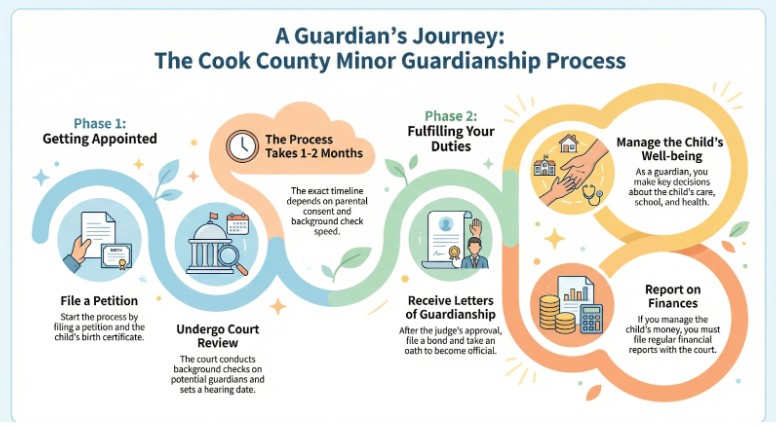
    The Circuit Court of Cook County has a process that begins with filing and culminates in the court issuing letters of guardianship. You’ll need to clear background checks, attend a hearing, and handle ongoing duties if appointed.

    Filing, Notice, And Hearing (What The Court Must Do)

    You begin by filing a petition for guardianship and the child’s birth certificate at the Circuit Court of Cook County. 

    The court conducts background checks on anyone who may become a guardian to identify any serious red flags.

    The judge reviews your petition and sets a hearing date. Sometimes, the court appoints a Guardian Ad Litem to represent the child’s interests during the case.

    If a parent objects to the entire guardianship, the court dismisses the petition. If the parent objects only to you as a guardian, the court holds a hearing to determine what’s best.

    A routine guardianship case in Cook County usually takes one to two months from start to finish. The timeline depends on whether parents agree and on how quickly you complete background checks.

    After Appointment: Letters And The Guardian’s Ongoing Duties

    When the judge signs off, you file your bond and take an oath. The court then issues letters of guardianship, which allow you to make decisions for the child.

    As a guardian, you become an officer of the court. This means you manage the child’s care, make school and medical choices, and look out for their well-being.

    If you handle the child’s money or property, you must file regular reports with the court. You have to show how you’re managing the child’s finances and that you’re spending only for their benefit.

    Guardianship keeps going until the child turns 18, the court ends it, or something major happens that changes your legal authority.

    If you’re ready to get started, call us now!

    Fees And Cost Planning 

    Effective October 1, 2025, the Illinois Supreme Court eliminated filing and appearance fees in minor guardianship cases. That removes a big barrier for families.

    You still need to plan for additional costs. Not everything is free.

    Filing Fees for Minor Guardianship May Be $0 Under Illinois Supreme Court Rule Change.

    The Illinois Supreme Court changed M.R. Order 29741 to eliminate filing fees for minor guardianship cases starting October 1, 2025. That means you won’t pay the usual court filing fee.

    What this covers:

    • Initial petition filing
    • Appearance fees in court

    What this does not cover:

    • Attorney fees if you hire a lawyer
    • Document prep costs
    • Background checks or home studies
    • Service of process fees
    • Certified copies of court orders

    This fee change applies to minor guardianship proceedings in Illinois. If you’re filing in Cook County or anywhere else in Illinois, you benefit from it—no matter your income.

    Budget For Non-Filing Costs That Still Apply

    Even with no court filing fees, the total cost of guardianship isn’t a simple, fixed number. You’ll want to budget for other expenses that depend on your situation.

    Attorney fees can be the highest cost. Rates swing a lot in Chicagoland, depending on the lawyer and the case. Some folks handle things themselves using resources like the Minor Guardianship Help Desk.

    Other possible costs:

    • Background check fees
    • Notary services for paperwork
    • Certified mail to serve notice
    • Travel to court
    • Extra certified copies of guardianship orders

    If you go the DIY route, take advantage of free help for self-represented petitioners in Illinois courts.

    Ending Or Changing Minor Guardianship (What Parents Ask Next)

    Guardianships aren’t always permanent. Illinois law outlines how guardianships can end and how parents can petition the court to regain custody.

    When Guardianship Ends Automatically

    Minor guardianship in Illinois ends automatically when the child turns 18. At that point, the child becomes a legal adult, and the guardian’s authority stops.

    Guardianship also ends if the child marries before age 18, but the court must approve the marriage. Marriage gives the minor legal emancipation.

    If the guardian dies, the guardianship ends unless the court picks a new guardian. If the ward dies, the guardianship ends—obviously a heartbreaking situation.

    The court can end guardianship if circumstances change enough that it’s no longer needed. When things improve, the court might automatically terminate it.

    How Parents Seek To Terminate/Discharge Guardianship

    Parents can file a Petition to Discharge to end a court-ordered guardianship of their minor child. This process means you’ll need to show the court that you’re now able to care for your child.

    After you file your petition, the court schedules a hearing. You have to prove that ending the guardianship really serves your child’s best interests.

    Starting a case to end guardianship means you’ll need to show that things have changed. Maybe you’ve got stable housing now, a steady job, or you finished a treatment program—whatever addressed the original reasons for guardianship.

    The guardian may push back and present their own evidence, arguing that the guardianship should remain in place. The judge listens to both sides and then decides.

    Key factors the court considers:

    • Your current living situation and stability
    • Your ability to meet the child’s physical and emotional needs
    • The child’s wishes (if old enough to express them)
    • The history of visitation and your relationship with the child
    • Any concerns about the child’s safety or welfare

    Protect your child’s care plan and avoid Cook County filing mistakes with a minor guardianship strategy. Schedule an appointment with Cooper Trachtenberg Law Group, LLC. 

    Contact Us Today For An Appointment

      I have read the

      Frequently Asked Questions 

      What is minor guardianship in Illinois?

      In Illinois, minor guardianship is a probate court appointment that grants an adult legal authority to care for a child under 18 and, if needed, to manage the child’s property. The judge decides based on the child’s best interests.

      What’s the difference between guardianship of the person and guardianship of the estate?

      Guardianship of the person covers day-to-day decisions such as housing, schooling, and medical consent. Guardianship of the estate is limited to finances—handling money, property, and accounts for the child. Courts can appoint one or both roles.

      What is short-term guardianship in Illinois, and how long does it last?

      Short-term guardianship lets a parent appoint a caregiver in writing without court approval. It must be signed by at least two adult witnesses, including the short-term guardian. It’s effective immediately unless delayed, and lasts up to 365 days.

      Can a living parent block a minor guardianship plan?

      Yes, sometimes. For short-term guardianship, a parent generally cannot appoint one if the child has another living parent with intact rights who is known, willing, and able—unless that parent signs the appointment. Standby guardianship has similar jurisdiction limits.

      What is standby guardianship in Illinois?

      Standby guardianship is a court appointment for when a parent dies or becomes unable to make day-to-day care decisions. A parent may designate someone in writing, but the person is not appointed unless the court approves a petition.

      Can a child choose their guardian in Illinois?

      If the child is 14 or older, Illinois law allows the child to nominate a guardian for their person and estate, but the judge must approve the nomination. If the nominee is not approved or no nomination is made, the court appoints.

      What do I need to file for minor guardianship in Cook County?

      In Cook County, you generally file a petition, the child’s birth certificate, and consent to a background check. Self-represented petitioners can schedule an appointment with the Guardianship Assistance Desk for Minors at 69 W. Washington, Suite 1020.

      Guardianship for Disabled Minors in Illinois: What Chicagoland Parents Should Do Before Age 18

      Once your child turns 18 in Illinois, the law sees them as an adult—even if disabilities make independent decision-making impossible. 

      You lose your automatic legal authority to make medical, financial, and personal decisions for them.

      This can create real headaches if your child still needs help managing their care or protecting their interests.

      “Families should start transition planning 6–12 months before age 18. If adult guardianship may be needed, start early so required evaluations and filings can be completed without a decision-making gap.

      The process requires court approval, medical evaluations, and specific legal steps that take time to complete.

      Families in the Chicagoland area need to know what the law requires and when to begin each step.

      Understanding the guardianship process, knowing your options, and staying on schedule can make this transition much less stressful.

      Key Takeaways

      • At 18, parental authority generally ends. Some families use Supported Decision-Making or powers of attorney when the young adult can understand and sign; adult guardianship is used when court authority is necessary.
      • Families should start the guardianship process at least one year before their child’s 18th birthday to complete all the required steps.
      • Common mistakes include waiting too long to file, choosing the wrong guardianship type, or failing to gather the necessary medical documentation.

      What Changes at Age 18 in Illinois (Why Planning Matters)

      At 18, Illinois law considers your child a legal adult with full decision-making rights. You lose automatic access to their medical records, school info, and financial accounts—even if your child can’t make safe decisions alone.

      The “Age 18 Cliff” for Medical, School, and Financial Decisions

      Once your child turns 18, your parental authority ends. You can’t see their medical records or make healthcare decisions for them unless they consent or you have a legal arrangement.

      At 18, education rights transfer to the student under IDEA/FERPA frameworks. Schools may require the adult student’s consent (or another legal authorization) to share records or involve parents in the same way as before. Banks and other financial institutions will block your access to your child’s accounts and info.

      Your child can now sign contracts, refuse medical treatment, and make financial decisions. The law grants them these rights, regardless of whether they understand the consequences or can protect themselves.

      Adult guardianship is a court process for a person who is 18 or older. You can do most preparation before 18 (planning, records, evaluation timing), but the adult guardianship case itself is for an adult. If you don’t plan ahead, you might find yourself powerless during a crisis.

      Your Core Goal: Use the Least Restrictive Option That Still Works

      Illinois courts must tailor guardianship to what is actually necessary and encourage maximum self-reliance, so limited guardianship or alternatives may be preferred when they meet the need.

      Your child may be able to make some decisions with support. Limited guardianship allows you to assist with specific areas, such as medical care or finances, while leaving other decisions to your child.

      Powers of attorney and supported decision-making agreements are even less restrictive. Courts require proof that guardianship is necessary. You’ll need to show that your child’s disability actually prevents them from making or communicating responsible decisions about their life.

      Step One—Choose the Right Legal Path (Decision Tree)

      Parents in Illinois have three main legal options to help their disabled teen move into adulthood. The best choice depends on your child’s ability to understand decisions and communicate preferences.

      Option 1 — Powers of Attorney (If Your Teen Can Understand and Sign)

      Powers of attorney allow your child to name you or someone else they trusts to help manage certain aspects of their life. Your teen must be 18 or older and able to understand what they’re signing.

      A Property Power of Attorney lets your child authorize someone to handle things like paying bills or managing a bank account. A Healthcare Power of Attorney means someone can make medical decisions if your child can’t communicate.

      This option preserves your child’s legal rights and independence. They can still make their own decisions, but get support when needed. Your child can revoke these documents at any time.

      Powers of attorney work well for teens with mild intellectual disabilities who can participate in the process. An attorney should meet with your child to ensure they understand what they’re signing.

      Option 2 — Supported Decision-Making (For Adults with ID/DD)

      Supported decision-making helps adults with intellectual or developmental disabilities make their own choices without losing legal rights. Your child picks trusted supporters who offer guidance and info.

      This approach skips the court. Your child keeps full legal authority over their decisions. Supporters might help them understand housing, medical information, or career options.

      Illinois law recognizes supported decision-making as a real alternative to guardianship. People with disabilities have the right to make their own choices with help from family or supporters.

      This route is best when your child can share their preferences, but needs help understanding complex stuff. It focuses on building skills and finding trusted people—no power gets transferred.

      Option 3 — Adult Guardianship (If Court Authority Is Necessary)

      Adult guardianship transfers some or all decision-making authority from a person to a court-appointed guardian. Illinois courts appoint a guardian only if someone can’t make or communicate responsible decisions due to a disability.

      The law assumes that every adult 18 or older can manage their own affairs. A guardian steps in only if mental deterioration, physical incapacity, mental illness, or developmental disability makes it impossible for your child to manage personal, financial, or medical matters.

      You need to file a petition with the court and show that your child really needs a guardian. The process usually takes a few months from filing to a court decision. Your child has the right to object and request their own lawyer.

      Courts usually prefer limited guardianship. A limited guardian only makes decisions in specific areas where your child needs help. Full guardianship, which covers everything, should be the last resort.

      Table 1

      Legal OptionWho DecidesCourt InvolvementYour Child’s Rights
      Powers of AttorneyYour child delegates authorityNoneKeeps all rights
      Supported Decision-MakingYour child, with help from supportersNoneKeeps all rights
      Limited GuardianshipGuardian for specific areas onlyThe court appoints and supervisesLoses some rights
      Full GuardianshipGuardian for all decisionsThe court appoints and supervisesLoses most rights

      If Adult Guardianship Is Needed: What Illinois Requires (The Non-Negotiables)

      Illinois requires specific documentation before granting guardianship, and you must match the guardianship type to your child’s needs. The clinical evidence must be current, detailed, and fit your child’s situation.

      The Required Clinical Report Timing and Contents

      The report must identify the evaluators and credentials; one evaluator must be a licensed physician, or (in an intellectual-disability case) a licensed clinical psychologist may serve in that role, consistent with the statute’s requirement.s

      The guardianship report must include evaluations performed within 3 months of filing, and for an intellectual disability, the statute allows a psychological evaluation performed within 1 year of filing (with proper licensing). The report must be based on recent evaluations that assess decision-making and functional abilities. Families should confirm that the evaluator’s process will satisfy the court’s report requirements.

      The report must explain whether your child can make and communicate responsible decisions about their person or estate. It should describe specific limitations, not just general statements.

      The evaluator needs to spell out what your child can and can’t do in daily life. The report should cover decision-making abilities for health care, living arrangements, and finances.

      If the court appoints a guardian ad litem, the guardian will review this clinical report. The guardian ad litem advocates for your child’s best interests throughout the process.

      Choosing the Scope: Limited vs Plenary vs Temporary

      Limited guardianship gives you authority only in areas where your child needs help. Maybe it’s just medical decisions or just finances. The court lists exactly what you can do.

      Plenary guardianship grants full authority over all personal and financial decisions. The court only does this if your child can’t make responsible decisions in any area. It removes most of your child’s legal rights.

      Temporary guardianship is generally short-term and expires within 60 days, but Illinois law allows limited extensions under specified conditions (up to 120 days from the original appointment).

      Illinois courts lean toward limited guardianship. You can ask for co-guardians if two people will share duties. A guardian of the person handles care and medical choices, while a guardian of the estate manages money and property.

      Need the required medical report and Cook County forms ready before your child turns 18? Cooper Trachtenberg Law Group, LLC can guide the process—Contact us.

      If you’re ready to get started, call us now!

      Chicagoland Process Reality: Where and How Families Typically Start

      Most Chicagoland families begin the guardianship process in the Circuit Court of Cook County using standard state forms. Local court procedures can still vary, even in the same county system.

      Cook County Probate—Adult Guardianship 

      The Circuit Court of Cook County hears guardianship cases through its Probate Division. When your child nears 18, you’ll file your petition in the Adult Guardianship Section—not the minor section you might expect.

      This matters because the process changes completely once your child turns 18. The court doesn’t assume you have parental authority anymore.

      You have to prove your adult child really needs a guardian because of their disability. In Cook County, adult guardianship matters are handled in the Probate Division’s Adult Guardianship Estates Section at the Richard J. Daley Center.

      Expect to attend multiple hearings. Your child has rights here—including the right to a lawyer and even a jury trial.

      Use Illinois Courts Approved Forms to Reduce Defects

      Illinois courts offer approved forms just for guardianship petitions. Using these forms helps prevent errors that could delay your case.

      You can grab these forms from the Illinois Courts website. They include the petition, notice documents, and required financial disclosures.

      Key forms you’ll need:

      • Petition for Guardianship of a Disabled Adult
      • Physician’s Report documenting disability
      • Notice of Hearing documents
      • Consent or waiver forms, if applicable

      Fill out everything as completely and honestly as possible. Missing information or incorrect formatting can cause your forms to be rejected. Court clerks can’t give legal advice, but they can check if your paperwork looks complete before you file.

      Expect County-Specific Practices Even Under State Law

      Illinois state law covers all guardianships. But Cook County has its own local procedures and timing expectations.

      The court may require additional supporting documents beyond what state law requires. Filing fees, hearing schedules, and paperwork can differ from those in nearby counties.

      Some judges may require medical reports in a specific format or request additional evaluations. Ask the court clerk about local rules when you file.

      Cook County also runs guardian ad litem programs and court-appointed attorneys who follow county-specific steps. These local quirks affect how quickly your case moves and what evidence the judge expects at your hearing.

      Your Pre-18 Timeline Checklist (What to Do and When)

      Your Pre-18 Timeline Checklist (What to Do and When)

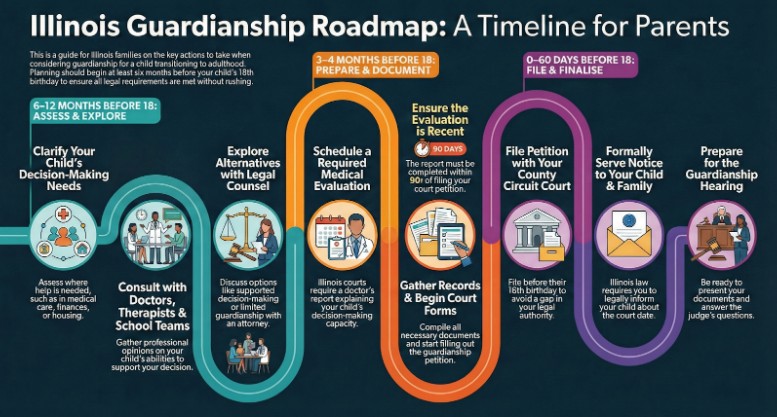
      Start planning at least six months before your child turns 18. That way, you won’t rush big decisions.

      The steps you take depend on whether your child needs full guardianship, limited guardianship, or maybe just supported decision-making.

      6–12 Months Before 18: Clarify Needs and Identify the Decision Tool

      Begin by making a list of areas where your child needs help making decisions. This could be medical care, finances, housing, or daily living choices.

      Meet with your child’s doctors, therapists, and school team to talk through their current abilities. Ask them to write down what your child can and can’t do on their own.

      This information will help you decide whether guardianship is necessary or if something less restrictive could work. Maybe your child can handle some decisions with a bit of support.

      Supported decision-making allows your child to maintain their legal rights while receiving help from trusted people. Limited guardianship removes only certain rights that your child can’t manage.

      Talk to a disability attorney or legal aid group during this time. They can walk you through the options and tell you what the court will want. Many Illinois families realize they don’t need guardianship if they put the right supports in place.

      3–4 Months Before 18: If Guardianship Is Likely, Prepare the Required Evaluation Window

      Set up a medical evaluation with a doctor who knows your child. Illinois courts ask for a professional assessment that explains why your child can’t make some decisions alone.

      The doctor fills out specific forms describing your child’s disability and decision-making skills. These forms must be current when you file, so timing matters.

      Most courts want evaluations done within 90 days of your petition. Gather medical records, school records, and anything else that shows your child’s history and needs.

      You’ll need to submit these with your guardianship petition. Start filling out the court forms for guardianship now.

      Cook County and other Illinois counties provide packets for parents who want to represent themselves, but many families hire attorneys for this step. 

      The paperwork asks detailed questions about your child’s abilities and the reasons for guardianship.

      0–60 Days Before 18: File, Serve, and Prepare for Hearing (If Needed)

      Prepare in advance so you can file as soon as the young adult is legally an adult (often right at/after the 18th birthday), using a current evaluation window and complete notice requirements.

      The court assigns a guardian ad litem to represent your child’s interests. This attorney meets with your child and reviews whether guardianship makes sense.

      Your child may object to guardianship or request a different guardian. You must formally serve notice on your child and certain family members, as Illinois law requires.

      This legal notice tells them about the petition and the court date. The guardianship hearing usually happens within a few months of filing.

      You’ll need to demonstrate why guardianship is necessary and that you’re qualified to serve as a guardian. Bring your documents and be ready for the judge’s questions.

      The process feels formal, but judges know these are tough family situations.

      TimelineKey ActionsWhy It Matters
      6–12 months before age 18Assess your child’s decision-making abilities; consult with the medical team; explore alternatives to guardianshipDetermines if guardianship is actually necessary or if less restrictive options work better
      3–4 months before age 18Schedule medical evaluation; gather records; begin court paperworkEnsures evaluation is current when you file; gives time to complete complex forms
      0–60 days before age 18File petition with court; serve legal notice; prepare for guardianship hearingPrevents a gap in legal authority; meets court deadlines; allows time for a hearing to be scheduled

      If you’re ready to get started, call us now!

      Common Mistakes Chicagoland Parents Make (and How to Avoid Them)

      Parents often underestimate how long evaluations take. Some assume full guardianship is always needed, and many don’t prepare for the ongoing court requirements that follow its grant.

      Waiting Too Long to Schedule the Required Evaluation

      The court wants a thorough evaluation before granting guardianship. A physician, psychologist, or other qualified professional needs to examine your child and write up detailed findings about their abilities and limits.

      Many parents wait until their child turns 18 to start this process. That’s risky, as it can take weeks or even months to schedule an appointment, complete the assessment, and receive a written report.

      Start the evaluation process at least six months before your child’s 18th birthday. This gives you breathing room if the first appointment is rescheduled or if the evaluator needs more information.

      If you can’t afford court filing fees, you may apply for a waiver of court fees. Separately, if independent expert fees arise, Illinois law allows the court to allocate payment responsibility depending on the ability to pay.

      Seeking Guardianship by Default When a Less Restrictive Tool Fits

      Not every disabled adult needs full guardianship. Illinois law says courts must use the least restrictive option that meets your child’s needs.

      Full guardianship takes away all decision-making rights from your adult child, which might be too much. Your child might do better with limited guardianship instead.

      This allows them to make some decisions while you handle specific areas such as medical care or finances. Some young adults only need help with finances, but can make their own daily choices.

      Other options include:

      • Power of attorney for financial decisions
      • Healthcare power of attorney for medical choices
      • Supported decision-making agreements that offer guidance without removing rights

      Consult an attorney about which option best fits your child’s abilities. The goal? Protect your child, but respect their independence where possible.

      Not Planning for Ongoing Court Supervision and Annual Reporting

      Guardianship doesn’t end just because the court signs off. You must file annual reports with the court regarding your child’s status and how you’ve managed matters.

      Every year, the court expects these reports for as long as guardianship lasts. You’ll need to share details about medical appointments, where your child lives, financial transactions, and big decisions you made for them.

      If you miss these reports, the court can penalize you or even question if you’re fit to be a guardian. It’s smart to set up a way to track all the important stuff throughout the year.

      Hang onto receipts, medical paperwork, and notes about any major events. Honestly, it’s easier to keep a dedicated folder or file and drop things in as they come up, instead of scrambling at the last minute.

      How Cooper Trachtenberg Law Group, LLC Helps Families Plan Before Age 18

      At Cooper Trachtenberg Law Group, LLC, we help Chicagoland parents plan for the legal shift that happens when a child with disabilities turns 18—so decision-making, care coordination, and financial safeguards don’t fall into a gap.

      What we do for families 

      • Clarify the right legal path for your teen: Supported Decision-Making, powers of attorney, or adult guardianship—based on the level of independence and support needed.
      • Build an “age 18” readiness plan that covers healthcare decisions, education/service coordination, and day-to-day support roles (who does what, when).
      • Prepare the guardianship case correctly when it’s truly necessary, including document checklists and court-facing materials to reduce delays and rejected filings (Cook County and collar counties).
      • Coordinate disability-related guardianship considerations when special needs intersect with court processes, including child-focused advocacy roles when required by the court.
      • Keep the plan “least restrictive” whenever possible, so your child retains as much independence as their situation allows, while your family still has workable protections.

      Protect your child’s care and safeguards with an Illinois age-18 transition plan built for Chicagoland families. Schedule an appointment with Cooper Trachtenberg Law Group, LLC.

      Contact Us Today For An Appointment

        I have read the

        Frequently Asked Questions 

        What changes when my child with disabilities turns 18 in Illinois?

        In Illinois, parents’ legal authority generally ends when a child turns 18, so providers may treat your child as the decision-maker. Under IDEA, education rights also transfer at 18 unless another legal arrangement is in place.

        Do I need guardianship when my child with disabilities turns 18?

        Not always. If your teen can understand and sign documents, powers of attorney may be appropriate; if they have ID/DD and can make decisions with support, Supported Decision-Making may be a good fit. Guardianship is typically used only when court authority is truly necessary.

        What is a Supported Decision-Making Agreement in Illinois, and who can use it?

        A Supported Decision-Making Agreement allows an adult with ID/DD to maintain legal rights while designating supporters to assist with everyday decisions, including healthcare, residence, and finances. It’s voluntary and can support IEP transition planning after your child turns 18.

        When should Chicagoland parents start planning for age 18?

        Start planning 6–12 months before the 18th birthday. If guardianship is likely, schedule evaluations early because the required clinical report must be based on evaluations completed within three months of filing, and court scheduling varies by county.

        What medical/clinical report is required for adult guardianship in Illinois?

        Illinois courts typically require a physician’s report describing the disability and its effects on decision-making, based on recent evaluations. In Cook County, the report form states that evaluations must occur within 3 months of filing the adult guardianship petition.

        Where do we file if we need adult guardianship in Cook County?

        If your child will live in Cook County at 18, adult guardianship cases are heard in the Cook County Probate Division’s Adult Guardianship Estates Section. The filing location depends on the adult’s county of residence, so confirm the correct county first.

        Can I stay involved with my child’s IEP/services after 18 without guardianship?

        Yes. In Illinois, IDEA education rights generally transfer to the student at 18. A Supported Decision-Making Agreement can let you continue helping with school and services while your adult child keeps legal rights.

        Couples Planning for a Disabled Spouse or Adult Child: Illinois Guardianship Steps for Chicagoland Households

        If your spouse or adult child has a disability, planning for their future care can feel overwhelming. Many couples in Chicagoland assume guardianship happens automatically or put off the legal work because it seems complicated.

        In Illinois, parental legal decision-making authority generally ends at age 18. After that, families often use powers of attorney, supported decision-making, or, when necessary, court-ordered adult guardianship to continue assisting an adult child with disabilities.

        The guardianship process here has steps that differ from those for planning for a minor. It’s important to know what Illinois guardianship for disabled adults requires before your child turns 18, or when your spouse’s condition changes.

        Cook County has its own approach, with timelines that determine how quickly you can obtain legal authority.

        Key Takeaways 

        • At age 18, parental legal authority generally ends in Illinois. Families may use powers of attorney or supported decision-making when appropriate, or pursue adult guardianship if court authority is necessary.
        • Illinois courts can tailor guardianship to the person’s needs. When guardianship is granted, the court may appoint a limited guardian for specific decision areas or a broader guardian only when the evidence supports it.
        • File in the correct county and plan the documentation timeline. Adult guardianship is typically filed where the disabled adult resides, and the petition should be supported by a current clinical report and complete notice materials to avoid delays.

        The Planning Problem Couples Face In Illinois (Why This Isn’t Just “Paperwork”)

        Illinois courts require specific evidence and adhere to strict legal standards before granting guardianship. The process changes depending on whether you’re planning for a spouse or for an adult child with disabilities.

        Two Common Scenarios: Disabled Spouse Vs Disabled Adult Child

        Planning for a disabled spouse isn’t the same as planning for an adult child. When your spouse has a disability, you might think you automatically have decision-making authority, but Illinois law doesn’t always agree.

        Doctors and banks often want legal proof before they let you act for your spouse. If you don’t have guardianship or power of attorney, you could hit roadblocks when you need to access accounts or make healthcare calls in an emergency.

        For parents, everything shifts when your child turns 18. You lose parental authority on their 18th birthday. Even if your child can’t make decisions alone, you need court approval to keep managing their affairs.

        Parents seeking guardianship for adult disabled children have to file a petition and provide medical evidence of incapacity. The court won’t grant guardianship just based on a diagnosis.

        The Court Standard Couples Should Understand Up Front

        Illinois courts stick to a strict legal standard for guardianship. You must show that your loved one can’t make or communicate responsible decisions about their care or finances.

        The court expects medical documentation, evaluations, and, in some cases, testimony from doctors. Just having a disability diagnosis doesn’t meet the standard for adult guardianship. The petition needs to show specific ways your loved one can’t make decisions independently.

        Judges prefer less restrictive options before granting full guardianship. You may need to explain why powers of attorney or supported decision-making won’t work. The judge will also consider if your loved one understands the choices and their consequences.

        Cooper Trachtenberg Law Group, LLC helps Chicagoland couples map the right guardianship path and paperwork before a crisis. Contact us to discuss next steps.

        If you’re ready to get started, call us now!

        Step One—Pick The Right Legal Path (Least Restrictive Decision Tree)

        Illinois law requires families to try the least restrictive option before resorting to guardianship. The best tool depends on whether your spouse or adult child can still help make decisions.

        Option A — Powers Of Attorney (When Capacity Exists To Sign)

        If your disabled spouse or adult child understands what they’re signing, a power of attorney is usually the easiest way forward. A power of attorney lets them pick you (or someone else they trust) to handle finances, healthcare, or both without needing court approval.

        This preserves their legal rights while giving you the authority to assist. They can revoke the POA at any time.

        There are two main types:

        • Financial POA — covers banking, bills, property, and contracts
        • Healthcare POA — authorizes medical decisions and HIPAA access

        It’s smart to have a lawyer draft documents that comply with Illinois law. The person signing must understand what they’re doing at the time.

        This path works well if someone has a condition that might worsen, but still has capacity now.

        Option B — Supported Decision-Making (Adults With ID/DD)

        Supported decision-making lets your adult child with intellectual or developmental disabilities make their own choices, but with your help. Your role shifts from deciding to guiding them.

        A supported decision-making agreement lists you and others as supporters in certain areas of life. Your adult child keeps the right to vote, marry, and sign contracts.

        This model respects their independence while still providing the help they need. Illinois recognizes these agreements as alternatives to guardianship.

        The agreement should specify which decisions require support and how you’ll help. Common topics include healthcare, housing, and managing benefits.

        Option C — Adult Guardianship (When Court Authority Is Required)

        Guardianship deprives a person of major rights and requires a court order. You’ll need this route if your spouse or adult child can’t make sound decisions and other options won’t suffice.

        Illinois courts can appoint limited or plenary guardians. Limited guardians only control certain areas. Plenary guardians get almost all decision-making authority.

        You must provide medical evidence to establish disability and lack of capacity. Courts prefer less restrictive options before approving guardianship.

        The process includes:

        • Filing a petition in circuit court
        • Medical evaluations showing incapacity
        • Notice to your spouse or adult child
        • A court hearing, sometimes with testimony
        Legal ToolBest ForCourt Required?Rights Removed
        Power of AttorneyAdults who can sign and understand documentsNoNone (voluntary delegation)
        Supported Decision-MakingAdults with ID/DD who can participate in choicesNoNone
        Limited GuardianshipAdults who need help with specific decisions onlyYesOnly areas specified by the court
        Plenary GuardianshipAdults who cannot make safe decisionsYesNearly all rights

        If Guardianship Is Necessary: The Illinois “Non-Negotiables”

        Illinois courts consider each guardianship petition on its own merits, but some rules always apply. 

        The court decides whether you need limited or plenary guardianship, whether clinical reports must be current, and whether temporary arrangements impose strict restrictions.

        What The Court Can Appoint And Why Scope Matters

        Illinois law recognizes two main types of adult guardianship, based on the disabled person’s capacity. Limited guardianship grants the guardian control only over specific areas. Plenary guardianship covers most or all life decisions when someone can’t manage on their own.

        The court can name a guardian of the person for healthcare and daily living. A guardian of the estate handles money and property. Sometimes you need both, sometimes just one.

        Your petition must specify which powers you want. Courts lean toward the least restrictive choice that still protects the disabled adult. You’ll need to show exactly which decisions need outside help.

        In adult guardianship cases, the court generally appoints a guardian ad litem (GAL) to investigate and report on the respondent’s best interests, unless the court finds a GAL is not necessary to protect the respondent or make an informed decision.

        The Required Clinical/Physician Report Timing

        Your petition needs a physician’s report or clinical evaluation documenting the adult’s alleged disability

        Illinois requires the petition to be accompanied by a report based on evaluations performed within three (3) months of filing (with a special rule allowing certain psychological evaluations for intellectual disability to be within one year).

        The doctor must examine your loved one and provide specific findings regarding their limitations. Vague statements won’t cut it. The report needs to discuss the person’s ability to make and communicate decisions regarding healthcare, finances, and safety.

        If you file using an old report, the court will reject your filing. You’ll lose time and money getting a new evaluation. It’s smart to schedule the medical appointment so the 90-day window doesn’t expire before your hearing.

        Temporary Guardianship For Emergencies 

        Illinois lets courts appoint a temporary guardian if a disabled adult faces immediate harm. This process is fast, but you must demonstrate a genuine emergency.

        Temporary guardianship usually lasts up to 60 days. You need to show the court that waiting would cause serious injury or financial trouble. Medical crises or cases of exploitation sometimes qualify.

        The court may still notify the respondent and appoint a guardian ad litem in emergencies. 

        Temporary orders don’t guarantee permanent guardianship later. You’ll still need to complete the full process for a long-term appointment.

        Chicagoland Steps: How The Process Typically Starts (Cook County Focus)

        Cook County handles adult guardianship at a specific downtown location. Some judges focus on these cases, and you have to use county-approved forms and follow local court rules—these are different from rules in other Illinois counties.

        Where Cook County Adult Guardianship Cases Are Handled

        In Cook County, adult guardianship cases are handled through the Probate Division at the Richard J. Daley Center, and local procedures (forms, scheduling, and help-desk support) can affect timing.

        You’ll file and process your guardianship petition at this one location. Suburban Cook County courthouses won’t accept adult guardianship petitions.

        Cook County offers pro se guardianship resources, including a help desk at the Daley Center for form/procedure guidance, and disability/elder law assistance programs located at 205 W. Randolph (Suite 1610) in Chicago. 

        You can also contact the Pro Se Adult Guardianship Help Desk for support. They offer in-person appointments at the Daley Center and remote phone support.

        Use The Correct Cook County Forms And Report Format

        Illinois Supreme Court-approved Statewide Standardized Forms must be accepted in all Illinois courts, and Cook County also provides commonly used Probate Division forms and local filing guidance. 

        Most counties provide their own forms through the probate court clerk, and every probate court prefers its own paperwork.

        Your guardianship petition needs to include several documents:

        • Petition for guardianship explaining why guardianship is needed
        • Summons to notify the disabled person
        • Notice of motion for your guardianship hearing
        • Medical reports about the disability
        • Financial disclosures if you’re seeking estate guardianship

        If you can’t afford filing costs, you might qualify for a fee waiver. Ask the clerk’s office about fee waiver applications when you hand in your paperwork.

        These forms use Cook County-specific designations and numbering. If you use the wrong forms, your case can get delayed or even rejected.

        What Couples Should Expect Procedurally

        After you file your petition, the court will set a date for a guardianship hearing. They’ll give you a hearing date, usually a few weeks after filing.

        The disabled person must receive proper notice and has the right to attend.

        The court might appoint a guardian ad litem to determine whether guardianship is appropriate. This person will speak with you, your spouse, or your adult child and review your medical records before the hearing.

        At the hearing, you’ll present evidence showing guardianship is necessary. Bring medical documentation and be ready to explain your loved one’s inability to make decisions.

        The judge will ask about your relationship and whether you’re fit to serve as a guardian.

        Guardianship cases may cover care decisions, estate and financial matters, or both. You’ll need to specify which type you want in your paperwork.

        When capacity, benefits, or finances are involved, planning becomes technical quickly. Work with Cooper Trachtenberg Law Group, LLC to reduce delays. Schedule an appointment.

        If you’re ready to get started, call us now!

        Couples-Only Planning Issues (What Changes When You’re Managing A Household)

        If you’re planning as a couple with a disabled spouse or adult child, you’ll face financial and legal challenges that single guardians don’t.

         Managing finances together can be more challenging when one person can’t participate in decisions, or when you need to protect government benefits for an adult child.

        Household Finance Protection When A Spouse Can’t Manage Money

        If your spouse can’t manage money due to disability, you’ll need legal authority to handle joint accounts and pay bills. Without planning, you might get locked out of accounts you both use every day.

        A financial power of attorney lets you manage your spouse’s finances without going to court. It’s best to create this before a crisis hits.

        Illinois recognizes durable powers of attorney that remain in effect even if someone becomes incapacitated.

        You’ll also have to decide whether to keep joint accounts or split them up for protection. Joint accounts can be at risk if creditors come after your disabled spouse, but separating everything can make paying bills a headache.

        Consider setting up:

        • Individual checking accounts for each spouse’s personal needs
        • One joint account for shared household expenses like mortgage and utilities
        • Separate savings to shield assets from potential legal claims

        Financial planning for couples means tackling these questions before your spouse loses the ability to sign legal documents.

        Benefit-Safe Planning For An Adult Child (ABLE + Trust Planning Concepts)

        If your adult child receives Medicaid or SSI benefits, you need to protect their eligibility while planning for their future. Direct gifts or inheritances can knock them off benefits they rely on for healthcare and living expenses.

        ABLE accounts generally use the federal annual gift tax exclusion as the baseline contribution cap; for 2026, that amount is $19,000 (with additional contributions available for eligible working beneficiaries under ABLE-to-Work rules).

        Effective January 1, 2026, ABLE eligibility expands to individuals whose disability began before age 46 (previously before age 26).

        Special needs trusts can hold larger amounts without affecting benefits. You can fund these with:

        • Life insurance proceeds
        • Inheritance money
        • Personal injury settlements
        • Savings you want to leave to your child

        First-party trusts use the disabled person’s own money. Third-party trusts use money from parents or other relatives. Third-party trusts offer better protection and don’t require Medicaid payback after death.

        It’s smart to coordinate both tools in your estate plan. Use ABLE accounts for immediate needs, and trusts for long-term security and bigger assets.

        Pre-Filing Checklist For Chicagoland Couples (Reduce Delays And Gaps)

        Illinois guardianship cases move faster when you gather the right medical records, figure out which decisions need court approval, and time your physician evaluations to fit the court’s three-month window. 

        If you’re missing documents or your petition isn’t clear, judges might schedule extra hearings that push your case back by weeks or months.

        Decision Map: What Decisions Must Be Covered (Person Vs Estate)

        You need to say whether you want guardianship of the person, estate, or both when you file in Illinois. A guardian of the person makes healthcare, living, and personal care decisions for your disabled spouse or adult child.

        A guardian of the estate handles money, benefits, property sales, and bills.

        Illinois courts want you to explain why your disabled family member can’t make these decisions alone. You must include concrete examples in your petition.

        For a disabled spouse, you might mention they can’t manage insulin or remember medications. An adult child with developmental delays may not understand lease agreements or manage monthly expenses.

        The court only grants authority over decisions you request and prove are necessary. If your spouse can still handle their own bank account, the judge may deny estate authority. Be specific about what needs help and what your family member can still do independently.

        Evidence Prep: Records That Support The Report And The Petition

        Your petition has to include a physician’s report describing your family member’s disability and why they can’t make decisions. Illinois law says this report can’t be more than 90 days old when you file.

        Gather medical records from neurologists, psychiatrists, primary care doctors, or any specialists who treat your spouse or adult child regularly.

        Key documents to collect:

        • Diagnosis letters or psychological evaluations
        • Hospital discharge summaries
        • Medication lists and treatment plans
        • School IEP records for adult children
        • Social Security disability determination letters

        Illinois guardianship cases include safeguards such as a required clinical report and (in many cases) a GAL investigation, designed to protect the respondent’s rights and ensure any guardianship is appropriately limited. Strong medical evidence helps them see why guardianship is in your family member’s best interest. Include records that show real functional limitations, not just a diagnosis.

        You also need proof of your relationship to the disabled person. Bring a marriage certificate for a spouse or a birth certificate for an adult child.

        If other family members object, these documents demonstrate your legal standing to file.

        Calendar Backward From The 3-Month Evaluation Window

        Schedule your family member’s physician evaluation carefully, since Illinois courts reject medical reports older than 90 days. Count backward from your planned filing date to book the doctor appointment.

        If you’re filing on February 1st, the evaluation has to be on or after November 3rd.

        Some Chicagoland doctors take weeks to finish guardianship reports after the appointment. Ask the office how long it usually takes. Build that time into your calendar so your report stays within the 90-day window.

        Court hearing dates in Cook County and the suburbs often land 30 to 60 days after you file. If you schedule the evaluation too early, your report might expire before the hearing.

        Many couples schedule the physician visit 30 to 45 days before filing to allow a buffer.

        Timeline example:

        TaskTiming
        Schedule a physician evaluation6-8 weeks before filing
        Attend evaluation appointment4-6 weeks before filing
        Receive completed report2-4 weeks before filing
        File a guardianship petitionFiling date
        Court hearing4-8 weeks after filing

        If your hearing gets continued past the original date, ask your attorney if you’ll need updated records. Some judges accept the 90-day-old report from filing, even if the hearing happens later.

        How Cooper Trachtenberg Law Group, LLC Helps Chicagoland Households

        Cooper Trachtenberg Law Group helps families across the Chicago area with legal support for guardianship matters.

        The firm has spent decades advising clients in Cook County and nearby communities.

        If you need a guardianship attorney, the firm’s legal team walks you through every step. They really get the challenges that come up when you’re planning for a disabled spouse or adult child.

        The firm offers several ways to help:

        • Mediation services
        • Negotiated settlements
        • Traditional litigation, when necessary
        • Collaborative legal strategies

        Helena L. Trachtenberg and Miriam Cooper lead the legal team. They bring a lot of experience in family law and work with you to find solutions that fit your family’s unique situation.

        You get comprehensive legal support for both urgent guardianship concerns and long-term planning. The attorneys take time to learn about your family before recommending any next steps.

        The firm handles complex family law issues with care and attention. Their Rolling Meadows office is convenient if you live in the Chicagoland area and need help with guardianship.

        If you need to set up guardianship, change an existing arrangement, or plan for future care, the firm offers free consultations. You can discuss your situation and options without worrying about cost.

        Protect decision-making and benefit eligibility with a plan built for Cook County and the Chicagoland suburbs. Schedule an appointment with Cooper Trachtenberg Law Group, LLC.

        Contact Us Today For An Appointment

          I have read the

          Frequently Asked Questions 

          Do parents automatically keep decision-making rights after a child with disabilities turns 18 in Illinois?

          No. In Illinois, parental legal authority generally ends at 18. Families often use powers of attorney, supported decision-making, or adult guardianship to keep healthcare, financial, and daily-life decisions covered when an adult child cannot manage independently.

          Do spouses automatically have legal authority to make medical or financial decisions in Illinois?

          Not always. Hospitals, banks, and agencies may require a signed healthcare power of attorney, property power of attorney, or a court order. Planning early can prevent delays when urgent decisions or access to accounts are needed.

          What is the “least restrictive” approach Illinois courts prefer for adult guardianship?

          Illinois policy is to use guardianship only when necessary and to preserve as much independence as possible. Limited guardianship, powers of attorney, or supported decision-making may be appropriate depending on the adult’s abilities and needs.

          How recent must the medical/clinical report be for an Illinois adult guardianship filing?

          The petition should include a report based on evaluations performed within three months of filing. For certain intellectual disability cases, a qualifying psychological evaluation may be acceptable within one year, depending on the situation.

          Will the court appoint an investigator in an Illinois adult guardianship case?

          Often, yes. Courts commonly appoint a guardian ad litem to investigate and report on the respondent’s best interests, unless the court finds that appointment is not necessary to protect the respondent or decide the petition.

          Where are adult guardianship cases handled in Cook County?

          Adult guardianship cases are handled through the Cook County Probate Division at the Richard J. Daley Center. Local procedures, forms, and scheduling can affect how quickly a case moves from filing to hearing and appointment.

          Do ABLE accounts protect benefits, and what changed in 2026?

          ABLE accounts can help preserve SSI/Medicaid planning when used correctly. Starting January 1, 2026, eligibility expanded to disabilities beginning before age 46, and the standard annual contribution cap aligns with the 2026 gift exclusion amount.