

Originally published: July 2023 | Updated: November 2025
Divorce mediation in Illinois is a confidential, problem-solving process in which a neutral mediator helps you resolve parenting, financial, and property issues faster and at lower cost than a trial.
Many circuit courts require mediation when parenting responsibilities or time are contested, with limited exceptions for endangerment or abuse. Showing up prepared shortens sessions and improves outcomes.
Illinois requires mediation in many contested parenting disputes, so it’s an important step for divorcing couples.
Illinois law allows a divorce to proceed when at least one spouse has been an Illinois resident (or stationed here in the military) for 90 days before the case begins (commencement).
Understanding these rules and gathering the right documents helps people achieve better results in their mediation sessions. Preparation really does matter here.
Mediation enables couples to resolve parenting, financial, and property issues with assistance from a neutral mediator in a private setting.
When people participate in mediation with the right mindset and paperwork, they usually find solutions that work better than what a judge might order.
Divorce mediation in Illinois means couples work with a neutral third party to resolve disputes outside of court. Illinois courts often require mediation in contested divorces, especially when children are involved.
Divorce mediation lets both spouses resolve disputes outside of the courtroom. Unlike litigation, where a judge makes the final call, mediation gives couples control over their future.
In mediation, a neutral mediator guides the discussion. The mediator doesn’t take sides or make decisions for the couple. Instead, they help both people communicate and search for solutions that work for everyone.
Key differences include:
Litigation brings formal court hearings and strict rules. Mediation takes place in a more relaxed setting, so people can speak openly. This often leads to better communication and less emotionality between former spouses.
In Illinois, judges often require couples in contested divorces to utilize mediation before litigation. Courts especially order mediation if couples can’t agree about parenting time or child custody.
Illinois law aims to keep children out of courtroom battles. Judges know parents understand their own children better than any court could. Mediation is often a sensible solution as a first step for parenting disputes.
Common situations where courts require mediation:
In Illinois, mediation is required in many divorce cases. Courts want to see that parents at least tried to work together before asking a judge to decide what happens with their kids.
The requirement helps reduce emotional stress on families. It also allows courts to focus on cases that really need a judge’s decision.
The first steps involve creating a clear roadmap of what matters most and organizing the key issues that need resolution. This groundwork helps divorcing spouses stay focused and make better decisions during mediation sessions.
Before mediation, divorcing spouses should determine their core priorities and where they can compromise. This mental preparation enables them handle negotiations without getting stuck.
Non-negotiables are the must-haves—things you just can’t give up. These might include:
Trade zones are where you can bend a little. Examples:
Making two simple lists clarifies your thinking. One list is for absolute priorities; the other is for things you could trade or adjust.
Many people realize they have fewer true non-negotiables than they thought. That often makes mediation more productive and opens up more room for creative solutions.
It’s smart to consider your former partner’s likely priorities, too. Understanding what matters to both sides can create real opportunities for win-win agreements.
A focused issues list keeps mediation sessions on track. This list should cover all the main topics you need to resolve.
Common divorce issues include:
| Financial | Children | Property |
| Spousal support | Custody schedule | House division |
| Child support | School decisions | Car ownership |
| Debt division | Healthcare choices | Personal items |
| Retirement accounts | Activity permissions | Business assets |
The list should be specific, not vague. Instead of writing “money stuff,” jot down “monthly spousal support amount” or “credit card debt responsibility.”
Organizing paperwork and getting prepared helps ensure nothing important gets forgotten in the heat of the moment.
Each spouse can draft their own list, then compare before mediation starts. This process often reveals issues one person hadn’t even considered.
The issues list becomes your roadmap for mediation. It keeps conversations on track and ensures you address all the important topics before you reach a final agreement.
Cooper Trachtenberg Law Group prepares you for mediation with organized finances, child-focused priorities, and a strategy that avoids stalemates. Start with a prep checklist tailored to your case. Contact us.
If you’re ready to get started, call us now!
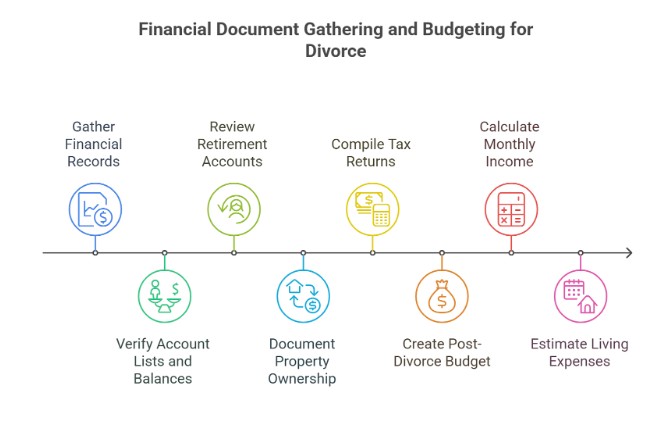
Bring recent bank, tax, payroll, retirement, loan, and insurance records, plus a monthly budget. A complete snapshot speeds negotiations, anchors fair support/property terms, and reduces session time.
Creating a realistic post-divorce budget requires knowing your current expenses and future financial needs.
Couples should bring comprehensive financial records to ensure an accurate asset division. Bank statements from the past six months show your current balances and spending patterns.
Essential account documents include:
Retirement accounts deserve special attention. 401(k) statements, IRA balances, and pension documents help decide how to split these assets between spouses.
Property ownership documents, such as deeds, prove who owns real estate and vehicles. These records help confirm what counts as marital property versus separate property.
Tax returns from the past three years give a complete picture of income and assets. They show wages, investment income, and business earnings that affect support calculations.
A post-divorce budget helps both parties understand what their future finances will look like. This planning affects decisions about spousal support amounts and duration.
Key budget categories to consider:
Individuals should figure out their monthly income after divorce. This includes wages, possible spousal support, and any investment income they’ll receive.
Child support calculations depend on both parents’ incomes and custody arrangements. Parents need solid income documentation to determine fair support amounts.
Living expenses usually increase after a divorce because now there are two households to maintain. The budget should reflect realistic costs for housing, utilities, and other essentials in this new situation.
This checklist reduces session time and prevents “missing document” stalls.
| Document | Why It Matters | Typical Source |
| Bank & credit statements (6–12 mo.) | Income/spending, debts | Online banking, statements |
| Tax returns (3 yrs) | Income, assets, businesses | IRS, CPA |
| Pay stubs (3–6 mo.) | Current earnings, insurance | Employer portal |
| Retirement/investments | Marital vs. non-marital value | Plan admin, broker |
| Loans/mortgage | Debt allocation, equity | Lender statements |
| Insurance & childcare | Add-ons for support | Insurer, receipts |
Draft a parenting plan covering schedules, holidays, transportation, communication, decision-making, travel, and dispute-resolution.
Ground proposals in your child’s routine and best-interest factors; courts reward stable, workable plans.
They should also decide how to handle major choices regarding their child’s education, health care, and activities.
When you create a parenting plan, you’ve got to think about different schedules for different parts of the year.
School months typically require more structure than those laid-back summer breaks.
School-Year Schedule Considerations:
Parents should write down their current work schedules.
It’s important to be honest about when you can actually be with your kids—no sense pretending otherwise.
Summer Schedule Planning:
Summer opens up more options for longer visits since school isn’t in the way.
Try two-week blocks or even month-long arrangements if that fits your family.
Both parents should bring calendars that show their work commitments.
It helps to list any planned vacations or family events for the year ahead.
Child custody agreements need to clearly outline who makes major decisions about the children’s lives.
Parents have to decide whether to share these choices or let one person have the final say.
Education Decisions Include:
Health Care Decisions Cover:
Activity Decisions Involve:
Before mediation, parents should talk through their values and priorities.
It’s worth thinking about how you both handled these decisions during your marriage, too.
Some families opt for joint decision-making, requiring both parents to agree.
Others assign final decision-making authority to one parent after discussion.
Bring lists of your kids’ current doctors, schools, and activities.
This info makes it easier to create a thorough parenting plan during mediation.
| Topic | Option A | Option B | Notes |
| Week schedule | 2-2-3 rotation | Week-on/week-off | Age/school fit |
| Holidays | Alternate odd/even | Split each holiday | Travel distance |
| Decision-making | Joint, tie-breaker mom | Joint, tie-breaker dad | Health/education/activity |
| Communication | Co-parenting app | Email/text | Civility logs |
When talks stall over parenting time or money, Cooper Trachtenberg Law Group reframes proposals and keeps momentum without resorting to the courtroom whenever possible. Schedule an appointment.
If you’re ready to get started, call us now!
The right mindset makes or breaks mediation. People who focus on what they truly need—rather than focusing on demands—and who can keep emotions separate from practical decisions usually see better results.
A position is what someone says they want, but an interest is the reason behind it.
Getting this difference helps folks find solutions that actually work for everyone.
Position-based thinking tends to create conflict.
If one spouse says, “I want the house,” and the other says, “No, I want the house,” you’ve got a standoff.
Interest-based thinking opens up more options.
The spouse asking for the house might really want:
When both spouses see these real interests, they can get creative.
One may keep the house, refinance to give the other spouse their share, or sell and use the proceeds to move forward.
Parenting time is another classic example.
One parent might demand “every weekend,” but what they actually want is more quality time for sports or just bonding.
Knowing this, you can try alternating weekends and a weeknight dinner, or something else that works for you.
Divorce stirs up big emotions—anger, sadness, fear, you name it.
But when those feelings take over, people often make choices that just don’t work out well for anyone.
Financial decisions need a cooler head.
Someone might want to keep the family business just to spite their ex, but if they can’t afford the buyout or don’t have the skills to run it, that’s a recipe for disaster.
It’s smarter to examine the actual numbers: retirement savings, monthly expenses, and what life will really look like after divorce.
Parenting decisions can also go sideways when emotions overwhelm the negotiations.
Sometimes a parent pushes for more custody just to lower child support or get back at their ex, not to help the kids.
Kids do better when parents base custody on:
Successful mediation really depends on the mindset—commitment and flexibility matter more than winning a fight.
Parents who focus on their kids’ well-being, not old hurts, usually build co-parenting relationships that last.
If emotions get too high, it’s okay to take a break and come back to the table with a clearer head.
Many people wonder whether they need legal help during divorce mediation.
It depends on your situation and how comfortable you feel with legal stuff.
When a lawyer might help:
Divorce mediation is most effective when both people are open to compromise.
Legal help becomes increasingly important if things become complicated or tense.
Options for legal support:
| Option | Best For |
| Full representation | Complex cases with major conflicts |
| Consulting attorney | Reviewing agreements before signing |
| No attorney | Simple cases with cooperative spouses |
Some people meet with a divorce lawyer before mediation just to get a handle on their rights and goals.
That can make it easier to prepare for tough discussions.
Others wait and have an attorney review the final agreement, which offers peace of mind without the full cost.
They’re there to guide the conversation, not tell you what to do legally. Think about how confident you feel with legal documents and processes.
If you’re comfortable, you might not need a lawyer—but if not, legal backup can be a lifesaver.
The best choice depends on your assets, kids, and how comfortable you are with the process.
Mediation sessions usually have a structure, but they can feel pretty personal as you work through divorce issues.
You’ll move from identifying problems to brainstorming solutions and, hopefully, building agreements that fit your lives.
The mediator begins by outlining the issues you need to tackle.
These often include child custody schedules, property division, spousal support, and debt allocation.
Once you’ve got the list, you’ll start exploring options for each problem.
Take the family home, for example—maybe you sell, maybe one buys out the other, or perhaps you keep it for a while together.
The mediator helps you understand how these choices connect.
Deciding to keep the house affects your budget, which, in turn, impacts child support and all the other issue areas.
Eventually, you’ll create “packages” that bundle related decisions together.
This helps ensure everything works as a whole rather than a bunch of disconnected choices.
Topics discussed during divorce mediation cover every issue you’ll need to finalize things.
If you hit a wall, mediators often use private caucuses to get things moving again.
Each spouse meets privately with the mediator, which can feel like a relief if you need to vent or say something you’re not ready to share with your ex.
In a caucus, people can talk about worries or ideas without immediate pushback.
Sessions might use private caucuses when you need space to figure out your actual priorities.
The mediator keeps what you say confidential unless you permit them to share it. This space allows you to be honest about fears, finances, or parenting worries.
Then, the mediator brings you both back together with some new approaches to the issue.
| Issue | Your Opening | Acceptable Range | Linked Trade | Notes |
| Parenting time | 6/8 overnights per 14 | 5–9 | Holiday givebacks | Work schedule |
| House | Buyout 60 days | 60–120 days | Offset vehicle | Refi timing |
| Support | Guideline ±10% | ±15% | Insurance add-on | Income volatility |
Terms are reduced to writing, reviewed by counsel, and submitted for court entry. Track deadlines for title transfers, account updates, insurance, and beneficiaries to avoid post-decree headaches.
The mediator or your attorneys will draft a formal settlement agreement based on what you decided.
This document covers all aspects: property division, child custody, support payments, and more.
Key components of the settlement agreement:
The deal must meet Illinois legal requirements. Both spouses review and sign before the attorneys file it with the court.
After filing, a judge reviews the settlement to ensure it complies with state law.
The court reviews child support and custody to confirm they serve the kids’ best interests.
Most judges approve mediated settlements quickly since both sides have already agreed.
What happens after mediation settlements usually involves a short court appearance or just paperwork.
Illinois divorce cases set out clear deadlines after you settle. Couples must complete several tasks before their divorce becomes official.
Important deadlines to track:
Both spouses should gather documents, such as updated financial statements or parenting class certificates. Some counties want these before they’ll approve the divorce.
The final divorce decree becomes official once the judge signs it. That usually takes approximately 30 to 90 days after you file the settlement agreement.
Post-decree tasks include:
If you miss these deadlines, you may encounter delays or legal headaches down the road. Nobody wants that.
Ready to finalize an agreement and court-ready filings? Cooper Trachtenberg Law Group reviews terms, closes loopholes, and protects deadlines, with the goal that your settlement holds . Move forward. Contact us now.
What is divorce mediation in Illinois?
Divorce mediation is a confidential process during which a neutral mediator helps spouses negotiate parenting, support, and property issues without a trial. It’s typically faster, less expensive, and more flexible than litigation, producing practical agreements that families can follow. Most counties strongly favor mediation for parenting disputes before court hearings.
How should I prepare financially for mediation?
Assemble recent bank statements, tax returns, pay stubs, mortgage and loan balances, retirement and investment statements, insurance costs, childcare expenses, and a monthly budget. Creating a complete, current financial snapshot reduces surprises, shortens sessions, and helps you evaluate trade-offs—such as support amounts, equity buyouts, or selling versus keeping the home.
What should a parenting plan include for mediation?
A strong plan addresses weekly schedules, holidays, transportation, communication methods, decision-making (education, health, activities), travel permissions, and dispute-resolution steps. Propose options that match your child’s routine and developmental needs. Courts look for stability, cooperation, and the ability to foster the child’s relationship with both parents when reviewing mediated terms.
Do I need a lawyer if we’re mediating?
The mediator is neutral and cannot give individualized legal advice. Consulting your own lawyer before and between sessions helps you reality-check proposals, understand Illinois law, and draft enforceable language.
How many mediation sessions does a divorce usually take?
Simple matters may resolve in a single extended session, but parenting and finances often require multiple shorter sessions with document exchange between meetings. Timelines depend on the organization, responsiveness, and the level of conflict.
What happens if talks stall during mediation?
Ask the mediator to caucus privately, reframe proposals around interests (needs) instead of positions (demands), and table one issue while settling others. Brief legal consults between sessions often unstick roadblocks. If an impasse persists, you can narrow disputes through partial agreements and reserve remaining issues for the court.
Are mediated agreements enforceable in Illinois?
Yes. Once reduced to writing, reviewed by each party, and incorporated into a court order or judgment, mediated agreements are enforceable like any other order. Keep copies, calendars, and deadlines.



Practice Areas
Legal Support When You Need It Most
Testimonials



Main Office
3601 Algonquin Road, Suite 610
Rolling Meadows, Illinois 60008
Lincolnshire Office
250 Parkway Drive, Suite 150
Lincolnshire, IL 60069
By Appointment Only
Phone:
847-995-8800


We represent parties across the Chicago area, including Arlington Heights, Barrington, Buffalo Grove, Carol Stream, Evanston, Glenview, Highland Park, Hinsdale, Inverness, Lincolnshire, Long Grove, Mt. Prospect, Palatine, Rolling Meadows, Schaumburg, Skokie, Streamwood, Wheeling and more. We also represent clients from Cook, Lake, DuPage, Kane and McHenry counties.
© 2026 by Cooper Trachtenberg Law Group, LLC. All Rights Reserved.
Disclaimer |
Site Map
