

This article provides general information about Illinois divorce law and is not a substitute for advice from a licensed Illinois attorney about a specific situation.
Illinois spouses preparing to file for divorce typically work through four steps: legal grounds, financial documentation, a parenting framework, and any safety concerns.
Illinois law itself requires only irreconcilable differences and 90 days of residency completed before filing or before the court’s finding, under 750 ILCS 5/401.
Everything else is preparation that shapes how smoothly the Illinois divorce process unfolds afterward.
Working through these steps before filing often makes the case that follows more efficient. The firm offers confidential Illinois divorce consultations to help.
Illinois’s dissolution statute sets the substantive legal threshold to file: proof that irreconcilable differences have caused an irretrievable breakdown, and 90 days of Illinois residency completed before the case is filed or before the court’s finding, both under 750 ILCS 5/401.
No fault-based ground exists, so a filing spouse never has to prove infidelity, cruelty, or abandonment in court. A continuous six-month separation before judgment separately creates an irrebuttable presumption that irreconcilable differences exist, though it is not a mandatory pre-filing wait.
Cooper Trachtenberg Law Group, LLC is a Rolling Meadows based, Illinois family law firm offering comprehensive family law services to clients from around the Chicago and surrounding suburban area, including Cook, Lake and DuPage counties.
Reviewing the available divorce options before filing helps clarify which legal process fits a given situation, since the chosen process shapes several of the steps that follow, including how documentation is exchanged and how parenting terms are worked out.
Only the legal grounds and residency requirement above are mandated by Illinois law before a court will grant a divorce; the remaining steps in this guide reflect preparation attorneys commonly recommend, not legal prerequisites to filing a petition.
Spouses who have already worked through the personal decision about when to leave a marriage often find these legal and financial steps more straightforward to complete, since the emotional groundwork is separate from the practical checklist.
If you’re ready to get started, call us now!
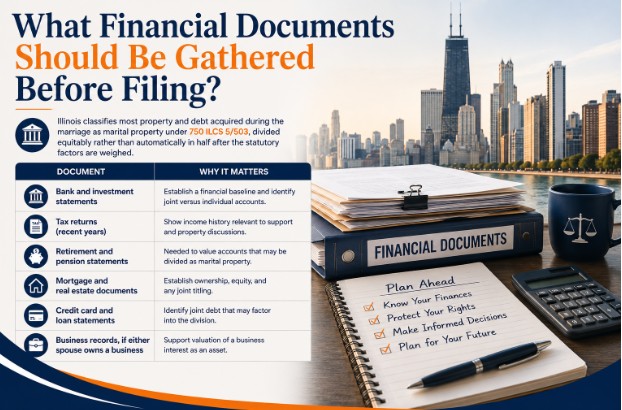
Financial documentation gathered before filing is not legally required, but it affects how smoothly the property is divided afterward.
Illinois classifies most property and debt acquired during the marriage as marital property under 750 ILCS 5/503, divided equitably rather than automatically in half after the statutory factors are weighed.
| Document | Why It Matters |
| Bank and investment statements | Establish a financial baseline and identify joint versus individual accounts |
| Tax returns (recent years) | Show income history relevant to support and property discussions |
| Retirement and pension statements | Needed to value accounts that may be divided as marital property |
| Mortgage and real estate documents | Establish ownership, equity, and any joint titling |
| Credit card and loan statements | Identify joint debt that may factor into the division |
| Business records, if either spouse owns a business | Support valuation of a business interest as an asset |
Gathering these records early gives an attorney a fuller picture during an initial consultation and reduces delay once the case is underway.
A more detailed financial planning guide for Illinois spouses covers additional considerations, including budgeting for the transition and anticipating support questions.
Identifying what counts as marital versus non-marital property is easier before filing than after, when memories fade and records scatter.
Property acquired before the marriage, along with certain gifts and inheritances, generally remains non-marital, though courts require documentation to prove the distinction, and property that becomes commingled with marital assets can lose that non-marital status.
Retirement accounts and pensions accumulated during the marriage typically count as marital property regardless of whose name is on the account, though any portion accumulated before the marriage may remain non-marital and require tracing. Understanding how retirement assets divide in an Illinois divorce before filing helps avoid surprises once the case moves toward settlement.
Concerns about concealed income deserve early attention rather than being addressed after filing.
A spouse who suspects a partner is not disclosing income or hiding assets should raise that concern with an attorney before submitting a petition, since Illinois limits how far back a dissipation claim can reach: notice must be given no later than 60 days before trial or 30 days after discovery closes, whichever is later, and no claim may reach back more than 3 years after a spouse knew or should have known of it, or more than 5 years before the petition is filed, under 750 ILCS 5/503(d).
If you’re ready to get started, call us now!
Illinois does not require a finished parenting plan before filing, but thinking through the framework beforehand often shortens what follows.
The law separates two questions: who makes significant decisions for a child under 750 ILCS 5/602.5, covering education, health, religion, and extracurricular activities, and how parenting time is scheduled under 750 ILCS 5/602.7, which applies its own related but distinct best-interest factors.
Helena L. Trachtenberg, Partner and Fellow of the American Academy of Matrimonial Lawyers, represents Illinois parents in custody, mediation, and collaborative divorce matters at the firm.
Parents who can negotiate directly before filing sometimes use mediation to draft a workable parenting framework, which can reduce conflict once the case is formally underway.
Safety takes priority over every other step on this list whenever there is immediate danger, and pursuing safety never requires waiting for a divorce filing.
An order of protection restricts an abusive spouse’s contact with a petitioner, and emergency relief is available under 750 ILCS 60/217, which can often be issued the same day, including outside normal court hours, without prior notice to the respondent when immediate danger is shown; emergency orders generally last up to 21 days, though exact procedure can vary by county.
A spouse in danger can secure an emergency order first and reach the National Domestic Violence Hotline for safety planning, addressing the divorce filing on a separate timeline.
Illinois treats these as independent, parallel steps rather than a required sequence, so a completed safety step is never a reason to delay filing, and an incomplete one is never a reason to delay safety action.
The process an Illinois spouse expects to use can shape how the remaining steps unfold, though process selection is not a legal prerequisite to filing, and cases can move between approaches — mediation, for example, can also take place within a litigated case rather than only as a separate track.
Illinois spouses generally consider mediation, collaborative divorce, and litigation, and thinking through which fits best before filing can reduce later friction, even though switching approaches partway through a case remains possible.
Miriam E. Cooper, Founder of the firm, is a certified mediator and collaborative divorce practitioner with more than 30 years of experience in Illinois family law.
Mediation uses a neutral third party to help spouses negotiate directly, while collaborative divorce, under the Collaborative Process Act, 750 ILCS 90, requires both spouses’ attorneys to withdraw if the process fails, thereby encouraging both sides to stay engaged in negotiation.
Litigation instead leaves contested issues for a judge to decide when spouses cannot reach agreement on their own.
Pulling these steps into a single reference makes it easier to confirm that nothing has been missed before a petition is submitted. Not every step applies to every situation — a spouse without children skips the parenting step, for example — and only one of the steps below is legally mandatory, not merely recommended preparation.
| Step | Required or Recommended? | Illinois Reference |
| Confirm the legal grounds and residency requirement | Required by statute | 750 ILCS 5/401 |
| Gather financial documents and identify marital property | Recommended preparation | 750 ILCS 5/503 |
| Address any concerns about hidden income or assets | Recommended preparation | 750 ILCS 5/503(d) |
| Think through a parenting framework, if children are involved | Recommended, not required | 750 ILCS 5/602.5 and 5/602.7 |
| Resolve any immediate safety concern | Situational, always a priority | 750 ILCS 60/217 |
| Choose a divorce process — mediation, collaborative, or litigation | Recommended, not a strict prerequisite | 750 ILCS 90 |
A detailed walk-through of what happens once a petition is actually submitted appears in the Illinois divorce timeline, which covers the sequence from filing through judgment.
What legal steps are required before filing for divorce in Illinois? Illinois’s dissolution statute, 750 ILCS 5/401, requires proof that irreconcilable differences have caused an irretrievable breakdown, with no need to prove fault. At least one spouse must also complete 90 days of Illinois residency before the case is filed or the court’s finding is made.
What financial documents should be gathered before filing? Bank and retirement statements, tax returns, mortgage documents, and a list of joint debts matter most before filing. These records establish a financial baseline and support claims for equitable division under 750 ILCS 5/503. Missing documentation is a common source of delay afterward.
How is marital property identified before an Illinois divorce? Property acquired during the marriage generally counts as marital property under 750 ILCS 5/503, while property owned before marriage or received as a gift or inheritance is generally treated as non-marital, subject to statutory exceptions such as commingling. Courts require documentation to prove the distinction.
Is a parenting plan required before filing for divorce in Illinois? No. Illinois does not require a completed parenting plan before filing. Courts make significant decisions under 750 ILCS 5/602.5 and parenting time decisions under 750 ILCS 5/602.7 separately, and parents can develop a full plan through mediation or litigation after filing.
What should be done about safety concerns before filing? An emergency order of protection under 750 ILCS 60/217 can often be requested the same day, separate from any divorce filing, though procedure can vary by county. Contacting local law enforcement and the National Domestic Violence Hotline provides immediate safety-planning support, as well as assistance with any subsequent filing.
How far back can a dissipation of assets claim reach in Illinois? Under 750 ILCS 5/503(d), a dissipation claim cannot reach back more than 3 years after a spouse knew or should have known of the dissipation, and never more than 5 years before the petition is filed. Notice of the claim must also be given no later than 60 days before trial or 30 days after discovery closes, whichever is later.
What’s the difference between mediation, collaborative divorce, and litigation? Mediation uses a neutral third party to help spouses negotiate directly, and can also be used within a litigated case rather than only as a separate path. Collaborative divorce under 750 ILCS 90 uses each spouse’s own attorney under a participation agreement, with both required to withdraw if the process fails. Litigation lets a judge decide unresolved issues.
Do retirement accounts need to be addressed before filing for divorce? Retirement accounts accumulated during the marriage generally count as marital property under 750 ILCS 5/503, regardless of whose name is on the account, though any pre-marital portion may require tracing to remain non-marital. Identifying and valuing these accounts before filing helps avoid delays once settlement negotiations begin.
Does every pre-filing step apply to every Illinois divorce? No. Steps involving children apply only when children are part of the marriage, and safety steps apply only when a safety concern exists. Of the remaining steps, only confirming the legal grounds and residency requirements is legally mandatory; the rest are recommended preparations that vary with the facts of each case.
What happens after these pre-filing steps are complete? A petition is filed with the Illinois circuit court, and the other spouse is formally served with notice. A response period follows before the case moves toward temporary orders, discovery, or settlement discussions, with the exact sequence varying by county.
Illinois’s substantive legal requirement to file is narrow — irreconcilable differences and 90 days of residency completed before filing or before the court’s finding, under 750 ILCS 5/401 — while the practical steps that make a case run smoothly are broader: financial documentation, marital property identification, a parenting framework where relevant, a chosen process, and any needed safety action.
Only the first of these is a legal prerequisite; the rest are recommended preparation. Safety steps stand apart from the other pre-filing steps, since they never wait on a filing date and a filing never needs to wait on them.
Working through this checklist alone can feel overwhelming. The firm helps Illinois spouses complete these steps before filing for divorce in Illinois.




About the Author
Partner · Fellow, American Academy of Matrimonial Lawyers (AAML) · Illinois Family Law Attorney · Mediator · Collaborative Divorce Practitioner
Helena L. Trachtenberg is a Partner at Cooper Trachtenberg Law Group, LLC and a Fellow of the American Academy of Matrimonial Lawyers (AAML), an invitation-only organization that recognizes the nation's leading family law attorneys.
Her practice is devoted exclusively to Illinois family law matters, including divorce, allocation of parental responsibilities, parenting time, child support, property division, prenuptial agreements, post-decree litigation, and complex family law disputes throughout the Chicago area.
Helena is a trained mediator, collaborative law practitioner, Child Representative, Guardian ad Litem, and Parenting Coordinator. She also has extensive experience handling matters involving the Illinois Department of Children and Family Services (DCFS) and the Illinois Department of Healthcare and Family Services (HFS).
Through litigation, mediation, and collaborative law, Helena helps clients navigate challenging family transitions while pursuing practical and effective resolutions that protect their long-term interests.
Practice Areas: Divorce, Collaborative Divorce, Mediation, Child Custody, Parenting Time, Child Support, Property Division, Prenuptial Agreements, Post-Decree Matters
Practice Areas
Legal Support When You Need It Most
Testimonials



Main Office
3601 Algonquin Road, Suite 610
Rolling Meadows, Illinois 60008
Lincolnshire Office
250 Parkway Drive, Suite 150
Lincolnshire, IL 60069
By Appointment Only
Phone:
847-995-8800


We represent parties across the Chicago area, including Arlington Heights, Barrington, Buffalo Grove, Carol Stream, Evanston, Glenview, Highland Park, Hinsdale, Inverness, Lincolnshire, Long Grove, Mt. Prospect, Palatine, Rolling Meadows, Schaumburg, Skokie, Streamwood, Wheeling and more. We also represent clients from Cook, Lake, DuPage, Kane and McHenry counties.
© 2026 by Cooper Trachtenberg Law Group, LLC. All Rights Reserved.
Disclaimer |
Site Map
