

Originally published: January 2026
Once your child turns 18 in Illinois, the law sees them as an adult—even if disabilities make independent decision-making impossible.
You lose your automatic legal authority to make medical, financial, and personal decisions for them.
This can create real headaches if your child still needs help managing their care or protecting their interests.
“Families should start transition planning 6–12 months before age 18. If adult guardianship may be needed, start early so required evaluations and filings can be completed without a decision-making gap.
The process requires court approval, medical evaluations, and specific legal steps that take time to complete.
Families in the Chicagoland area need to know what the law requires and when to begin each step.
Understanding the guardianship process, knowing your options, and staying on schedule can make this transition much less stressful.
At 18, Illinois law considers your child a legal adult with full decision-making rights. You lose automatic access to their medical records, school info, and financial accounts—even if your child can’t make safe decisions alone.
Once your child turns 18, your parental authority ends. You can’t see their medical records or make healthcare decisions for them unless they consent or you have a legal arrangement.
At 18, education rights transfer to the student under IDEA/FERPA frameworks. Schools may require the adult student’s consent (or another legal authorization) to share records or involve parents in the same way as before. Banks and other financial institutions will block your access to your child’s accounts and info.
Your child can now sign contracts, refuse medical treatment, and make financial decisions. The law grants them these rights, regardless of whether they understand the consequences or can protect themselves.
Adult guardianship is a court process for a person who is 18 or older. You can do most preparation before 18 (planning, records, evaluation timing), but the adult guardianship case itself is for an adult. If you don’t plan ahead, you might find yourself powerless during a crisis.
Illinois courts must tailor guardianship to what is actually necessary and encourage maximum self-reliance, so limited guardianship or alternatives may be preferred when they meet the need.
Your child may be able to make some decisions with support. Limited guardianship allows you to assist with specific areas, such as medical care or finances, while leaving other decisions to your child.
Powers of attorney and supported decision-making agreements are even less restrictive. Courts require proof that guardianship is necessary. You’ll need to show that your child’s disability actually prevents them from making or communicating responsible decisions about their life.
Parents in Illinois have three main legal options to help their disabled teen move into adulthood. The best choice depends on your child’s ability to understand decisions and communicate preferences.
Powers of attorney allow your child to name you or someone else they trusts to help manage certain aspects of their life. Your teen must be 18 or older and able to understand what they’re signing.
A Property Power of Attorney lets your child authorize someone to handle things like paying bills or managing a bank account. A Healthcare Power of Attorney means someone can make medical decisions if your child can’t communicate.
This option preserves your child’s legal rights and independence. They can still make their own decisions, but get support when needed. Your child can revoke these documents at any time.
Powers of attorney work well for teens with mild intellectual disabilities who can participate in the process. An attorney should meet with your child to ensure they understand what they’re signing.
Supported decision-making helps adults with intellectual or developmental disabilities make their own choices without losing legal rights. Your child picks trusted supporters who offer guidance and info.
This approach skips the court. Your child keeps full legal authority over their decisions. Supporters might help them understand housing, medical information, or career options.
Illinois law recognizes supported decision-making as a real alternative to guardianship. People with disabilities have the right to make their own choices with help from family or supporters.
This route is best when your child can share their preferences, but needs help understanding complex stuff. It focuses on building skills and finding trusted people—no power gets transferred.
Adult guardianship transfers some or all decision-making authority from a person to a court-appointed guardian. Illinois courts appoint a guardian only if someone can’t make or communicate responsible decisions due to a disability.
The law assumes that every adult 18 or older can manage their own affairs. A guardian steps in only if mental deterioration, physical incapacity, mental illness, or developmental disability makes it impossible for your child to manage personal, financial, or medical matters.
You need to file a petition with the court and show that your child really needs a guardian. The process usually takes a few months from filing to a court decision. Your child has the right to object and request their own lawyer.
Courts usually prefer limited guardianship. A limited guardian only makes decisions in specific areas where your child needs help. Full guardianship, which covers everything, should be the last resort.
| Legal Option | Who Decides | Court Involvement | Your Child’s Rights |
| Powers of Attorney | Your child delegates authority | None | Keeps all rights |
| Supported Decision-Making | Your child, with help from supporters | None | Keeps all rights |
| Limited Guardianship | Guardian for specific areas only | The court appoints and supervises | Loses some rights |
| Full Guardianship | Guardian for all decisions | The court appoints and supervises | Loses most rights |
Illinois requires specific documentation before granting guardianship, and you must match the guardianship type to your child’s needs. The clinical evidence must be current, detailed, and fit your child’s situation.
The report must identify the evaluators and credentials; one evaluator must be a licensed physician, or (in an intellectual-disability case) a licensed clinical psychologist may serve in that role, consistent with the statute’s requirement.s
The guardianship report must include evaluations performed within 3 months of filing, and for an intellectual disability, the statute allows a psychological evaluation performed within 1 year of filing (with proper licensing). The report must be based on recent evaluations that assess decision-making and functional abilities. Families should confirm that the evaluator’s process will satisfy the court’s report requirements.
The report must explain whether your child can make and communicate responsible decisions about their person or estate. It should describe specific limitations, not just general statements.
The evaluator needs to spell out what your child can and can’t do in daily life. The report should cover decision-making abilities for health care, living arrangements, and finances.
If the court appoints a guardian ad litem, the guardian will review this clinical report. The guardian ad litem advocates for your child’s best interests throughout the process.
Limited guardianship gives you authority only in areas where your child needs help. Maybe it’s just medical decisions or just finances. The court lists exactly what you can do.
Plenary guardianship grants full authority over all personal and financial decisions. The court only does this if your child can’t make responsible decisions in any area. It removes most of your child’s legal rights.
Temporary guardianship is generally short-term and expires within 60 days, but Illinois law allows limited extensions under specified conditions (up to 120 days from the original appointment).
Illinois courts lean toward limited guardianship. You can ask for co-guardians if two people will share duties. A guardian of the person handles care and medical choices, while a guardian of the estate manages money and property.
Need the required medical report and Cook County forms ready before your child turns 18? Cooper Trachtenberg Law Group, LLC can guide the process—Contact us.
If you’re ready to get started, call us now!
Most Chicagoland families begin the guardianship process in the Circuit Court of Cook County using standard state forms. Local court procedures can still vary, even in the same county system.
The Circuit Court of Cook County hears guardianship cases through its Probate Division. When your child nears 18, you’ll file your petition in the Adult Guardianship Section—not the minor section you might expect.
This matters because the process changes completely once your child turns 18. The court doesn’t assume you have parental authority anymore.
You have to prove your adult child really needs a guardian because of their disability. In Cook County, adult guardianship matters are handled in the Probate Division’s Adult Guardianship Estates Section at the Richard J. Daley Center.
Expect to attend multiple hearings. Your child has rights here—including the right to a lawyer and even a jury trial.
Illinois courts offer approved forms just for guardianship petitions. Using these forms helps prevent errors that could delay your case.
You can grab these forms from the Illinois Courts website. They include the petition, notice documents, and required financial disclosures.
Key forms you’ll need:
Fill out everything as completely and honestly as possible. Missing information or incorrect formatting can cause your forms to be rejected. Court clerks can’t give legal advice, but they can check if your paperwork looks complete before you file.
Illinois state law covers all guardianships. But Cook County has its own local procedures and timing expectations.
The court may require additional supporting documents beyond what state law requires. Filing fees, hearing schedules, and paperwork can differ from those in nearby counties.
Some judges may require medical reports in a specific format or request additional evaluations. Ask the court clerk about local rules when you file.
Cook County also runs guardian ad litem programs and court-appointed attorneys who follow county-specific steps. These local quirks affect how quickly your case moves and what evidence the judge expects at your hearing.
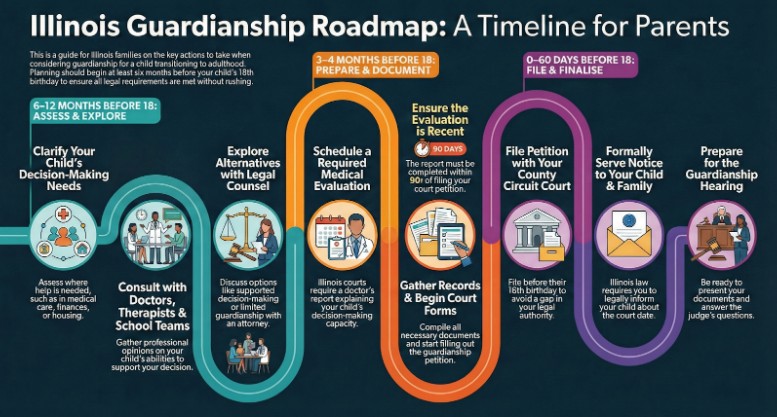
Start planning at least six months before your child turns 18. That way, you won’t rush big decisions.
The steps you take depend on whether your child needs full guardianship, limited guardianship, or maybe just supported decision-making.
Begin by making a list of areas where your child needs help making decisions. This could be medical care, finances, housing, or daily living choices.
Meet with your child’s doctors, therapists, and school team to talk through their current abilities. Ask them to write down what your child can and can’t do on their own.
This information will help you decide whether guardianship is necessary or if something less restrictive could work. Maybe your child can handle some decisions with a bit of support.
Supported decision-making allows your child to maintain their legal rights while receiving help from trusted people. Limited guardianship removes only certain rights that your child can’t manage.
Talk to a disability attorney or legal aid group during this time. They can walk you through the options and tell you what the court will want. Many Illinois families realize they don’t need guardianship if they put the right supports in place.
Set up a medical evaluation with a doctor who knows your child. Illinois courts ask for a professional assessment that explains why your child can’t make some decisions alone.
The doctor fills out specific forms describing your child’s disability and decision-making skills. These forms must be current when you file, so timing matters.
Most courts want evaluations done within 90 days of your petition. Gather medical records, school records, and anything else that shows your child’s history and needs.
You’ll need to submit these with your guardianship petition. Start filling out the court forms for guardianship now.
Cook County and other Illinois counties provide packets for parents who want to represent themselves, but many families hire attorneys for this step.
The paperwork asks detailed questions about your child’s abilities and the reasons for guardianship.
Prepare in advance so you can file as soon as the young adult is legally an adult (often right at/after the 18th birthday), using a current evaluation window and complete notice requirements.
The court assigns a guardian ad litem to represent your child’s interests. This attorney meets with your child and reviews whether guardianship makes sense.
Your child may object to guardianship or request a different guardian. You must formally serve notice on your child and certain family members, as Illinois law requires.
This legal notice tells them about the petition and the court date. The guardianship hearing usually happens within a few months of filing.
You’ll need to demonstrate why guardianship is necessary and that you’re qualified to serve as a guardian. Bring your documents and be ready for the judge’s questions.
The process feels formal, but judges know these are tough family situations.
| Timeline | Key Actions | Why It Matters |
| 6–12 months before age 18 | Assess your child’s decision-making abilities; consult with the medical team; explore alternatives to guardianship | Determines if guardianship is actually necessary or if less restrictive options work better |
| 3–4 months before age 18 | Schedule medical evaluation; gather records; begin court paperwork | Ensures evaluation is current when you file; gives time to complete complex forms |
| 0–60 days before age 18 | File petition with court; serve legal notice; prepare for guardianship hearing | Prevents a gap in legal authority; meets court deadlines; allows time for a hearing to be scheduled |
If you’re ready to get started, call us now!
Parents often underestimate how long evaluations take. Some assume full guardianship is always needed, and many don’t prepare for the ongoing court requirements that follow its grant.
The court wants a thorough evaluation before granting guardianship. A physician, psychologist, or other qualified professional needs to examine your child and write up detailed findings about their abilities and limits.
Many parents wait until their child turns 18 to start this process. That’s risky, as it can take weeks or even months to schedule an appointment, complete the assessment, and receive a written report.
Start the evaluation process at least six months before your child’s 18th birthday. This gives you breathing room if the first appointment is rescheduled or if the evaluator needs more information.
If you can’t afford court filing fees, you may apply for a waiver of court fees. Separately, if independent expert fees arise, Illinois law allows the court to allocate payment responsibility depending on the ability to pay.
Not every disabled adult needs full guardianship. Illinois law says courts must use the least restrictive option that meets your child’s needs.
Full guardianship takes away all decision-making rights from your adult child, which might be too much. Your child might do better with limited guardianship instead.
This allows them to make some decisions while you handle specific areas such as medical care or finances. Some young adults only need help with finances, but can make their own daily choices.
Other options include:
Consult an attorney about which option best fits your child’s abilities. The goal? Protect your child, but respect their independence where possible.
Guardianship doesn’t end just because the court signs off. You must file annual reports with the court regarding your child’s status and how you’ve managed matters.
Every year, the court expects these reports for as long as guardianship lasts. You’ll need to share details about medical appointments, where your child lives, financial transactions, and big decisions you made for them.
If you miss these reports, the court can penalize you or even question if you’re fit to be a guardian. It’s smart to set up a way to track all the important stuff throughout the year.
Hang onto receipts, medical paperwork, and notes about any major events. Honestly, it’s easier to keep a dedicated folder or file and drop things in as they come up, instead of scrambling at the last minute.
At Cooper Trachtenberg Law Group, LLC, we help Chicagoland parents plan for the legal shift that happens when a child with disabilities turns 18—so decision-making, care coordination, and financial safeguards don’t fall into a gap.
Protect your child’s care and safeguards with an Illinois age-18 transition plan built for Chicagoland families. Schedule an appointment with Cooper Trachtenberg Law Group, LLC.
What changes when my child with disabilities turns 18 in Illinois?
In Illinois, parents’ legal authority generally ends when a child turns 18, so providers may treat your child as the decision-maker. Under IDEA, education rights also transfer at 18 unless another legal arrangement is in place.
Do I need guardianship when my child with disabilities turns 18?
Not always. If your teen can understand and sign documents, powers of attorney may be appropriate; if they have ID/DD and can make decisions with support, Supported Decision-Making may be a good fit. Guardianship is typically used only when court authority is truly necessary.
What is a Supported Decision-Making Agreement in Illinois, and who can use it?
A Supported Decision-Making Agreement allows an adult with ID/DD to maintain legal rights while designating supporters to assist with everyday decisions, including healthcare, residence, and finances. It’s voluntary and can support IEP transition planning after your child turns 18.
When should Chicagoland parents start planning for age 18?
Start planning 6–12 months before the 18th birthday. If guardianship is likely, schedule evaluations early because the required clinical report must be based on evaluations completed within three months of filing, and court scheduling varies by county.
What medical/clinical report is required for adult guardianship in Illinois?
Illinois courts typically require a physician’s report describing the disability and its effects on decision-making, based on recent evaluations. In Cook County, the report form states that evaluations must occur within 3 months of filing the adult guardianship petition.
Where do we file if we need adult guardianship in Cook County?
If your child will live in Cook County at 18, adult guardianship cases are heard in the Cook County Probate Division’s Adult Guardianship Estates Section. The filing location depends on the adult’s county of residence, so confirm the correct county first.
Can I stay involved with my child’s IEP/services after 18 without guardianship?
Yes. In Illinois, IDEA education rights generally transfer to the student at 18. A Supported Decision-Making Agreement can let you continue helping with school and services while your adult child keeps legal rights.



Practice Areas
Legal Support When You Need It Most
Testimonials



Main Office
3601 Algonquin Road, Suite 610
Rolling Meadows, Illinois 60008
Lincolnshire Office
250 Parkway Drive, Suite 150
Lincolnshire, IL 60069
By Appointment Only
Phone:
847-995-8800


We represent parties across the Chicago area, including Arlington Heights, Barrington, Buffalo Grove, Carol Stream, Evanston, Glenview, Highland Park, Hinsdale, Inverness, Lincolnshire, Long Grove, Mt. Prospect, Palatine, Rolling Meadows, Schaumburg, Skokie, Streamwood, Wheeling and more. We also represent clients from Cook, Lake, DuPage, Kane and McHenry counties.
© 2026 by Cooper Trachtenberg Law Group, LLC. All Rights Reserved.
Disclaimer |
Site Map
