

Bringing up a prenuptial agreement with a partner works best when framed as a shared financial planning conversation rather than a statement of distrust.
Couples who introduce the topic early, explain their reasoning honestly, and allow time for both partners to consult independent attorneys report significantly less relationship strain than couples who raise the subject close to the wedding date.
Raising a prenuptial agreement early in the engagement protects both the relationship and the agreement’s enforceability under the Illinois Uniform Premarital Agreement Act, 750 ILCS 10/1 et seq.
Illinois courts examine the circumstances of signing when evaluating enforceability challenges — an agreement presented weeks before the wedding carries a higher risk of duress than one negotiated months in advance.
The complete Illinois prenuptial agreement guide explains in detail how voluntariness and timing interact with enforceability.
Couples who begin the prenuptial conversation at least 90 days before the wedding give both partners time to process the request, consult independent attorneys, review financial disclosures, and negotiate terms without social or logistical pressure.
That timeline also signals to a reviewing court that neither party was coerced by the imminence of the wedding.
Waiting until the final weeks before the ceremony creates two compounding problems. The emotional stakes of the wedding itself make rational financial negotiation harder, and the compressed timeline gives courts reason to question whether both parties had a genuine opportunity for independent review.
Illinois family law practitioners consistently advise clients to treat the prenuptial conversation as a pre-engagement or early-engagement priority rather than a last-minute checklist item.
The most effective prenuptial conversations begin with the reason behind the request, not the document itself. A partner who hears “I want us to talk about financial planning before we get married” responds differently than a partner who hears “I want you to sign a prenup.”
Leading with the underlying goal — protecting both parties, clarifying financial expectations, preserving family assets — shifts the conversation from adversarial to collaborative.
Couples entering marriage with significantly different financial profiles, business interests, children from prior relationships, or family inheritance expectations have concrete, explainable reasons for wanting a prenuptial agreement.
Naming those reasons directly — “I own a business that my family helped build, and I want to protect their investment” or “I have significant student debt, and I don’t want that to affect you if things change” — makes the request specific rather than abstract.
Collaborative law attorneys trained in interest-based negotiation can help couples structure the prenuptial conversation around shared goals rather than competing interests. The collaborative process is built on mutual disclosure and joint problem-solving, which makes it particularly well-suited to prenuptial negotiations, where both parties seek a fair outcome and a strong relationship.
Specific language matters in the prenuptial conversation. Vague framing — “I just think it’s a good idea” — gives a partner little to engage with and can come across as dismissive. Concrete, personal framing gives both partners something substantive to discuss.
Effective opening framing includes statements that connect the prenuptial agreement to shared values rather than anticipated failure.
Examples of constructive openings include: “I want us to talk openly about our finances before we get married so we both go in with clear expectations.” Or: “I’ve been thinking about how to protect both of us financially, and I’d like to explore whether a prenuptial agreement makes sense for our situation.”
Or: “My family has assets that go back generations, and I have an obligation to address that before we marry — I want to do it in a way that feels fair to both of us.”
What to avoid is equally important. Framing the prenuptial agreement as protection against the partner specifically — “in case you leave” or “if you decide this isn’t working” — personalizes the request in a way that creates defensiveness. The agreement plans for a legal contingency, not a predicted outcome.
If you’re ready to get started, call us now!
A negative initial reaction to a request for a prenuptial agreement is common and does not necessarily mean the conversation has failed.
Partners who feel surprised, hurt, or defensive when first hearing the request often reach a different position once they have time to understand the purpose of the agreement and consult independent legal counsel.
A partner who needs space to react should receive that space without immediate pressure toward agreement.
Acknowledging the emotional weight of the request — “I understand this feels uncomfortable, and I want to talk through it at whatever pace works for you” — keeps the conversation open without abandoning the prenuptial planning goal.
Partners who remain opposed after initial discussion often benefit from speaking with their own attorney before the next conversation.
An independent attorney can explain what a prenuptial agreement can and cannot do under 750 ILCS 10/4, address misconceptions about the document’s implications, and help the resistant partner identify their own interests within the negotiation.
Couples who each retain independent counsel before negotiating terms are significantly more likely to reach an agreement both parties feel is fair.
If a partner’s objection is that the prenuptial agreement signals distrust, explaining what the agreement cannot cover often helps.
A prenuptial agreement cannot govern child custody, cannot require a specific outcome at divorce, and cannot override Illinois courts’ equitable distribution authority for assets acquired jointly during the marriage.
A partner who understands those limits is better positioned to evaluate the agreement on its actual terms rather than on assumptions about its scope.
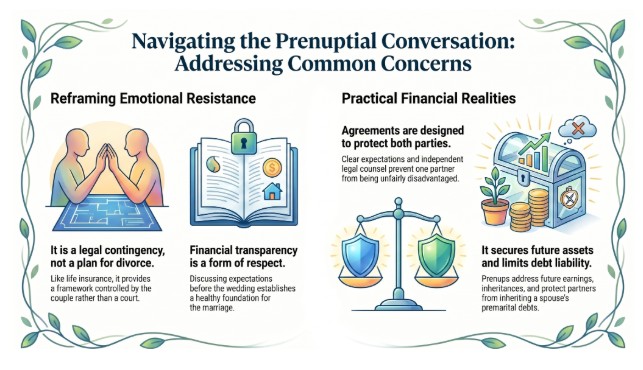
Partners who resist prenuptial agreements typically raise a small number of recurring concerns. Addressing each concern directly and factually moves the conversation forward more effectively than general reassurance.
“A prenup means you’re planning to divorce me.” A prenuptial agreement plans for a legal contingency, the same way life insurance plans for death or a will plans for incapacity. The agreement provides a framework that both parties control together, rather than leaving financial outcomes to a court that does not know the couple.
“A prenup protects you but not me.” A well-drafted prenuptial agreement protects both parties by establishing clear financial expectations before conflict arises. A partner who waives spousal maintenance rights without understanding the implications, for example, may be disadvantaged, which is exactly why independent legal counsel for both parties is essential. The agreement can be structured to protect both spouses, not just the one initiating the request.
“I don’t have assets, so this doesn’t apply to me.” A prenuptial agreement applies to future assets as well as current ones. A partner who earns significant income during the marriage, receives an inheritance, or builds a business after the wedding has financial interests worth protecting in a prenuptial agreement. The agreement also addresses debt allocation, which protects a lower-asset partner from inheriting the other spouse’s premarital liabilities.
“This feels unromantic.” Financial transparency before marriage is a form of respect, not a failure of romance. Couples who discuss property division, debt, and financial expectations before the wedding establish a foundation of financial transparency that benefits the marriage regardless of whether the prenuptial agreement is ever invoked.
If you’re ready to get started, call us now!
Parents entering a second or subsequent marriage have a concrete, sympathetic reason for requesting a prenuptial agreement that most partners understand.
Protecting assets intended to pass to children from a prior relationship is a straightforward estate planning goal that does not imply distrust of the new partner.
Framing the prenuptial request around the children’s interests — “I want to make sure my kids’ inheritance is protected regardless of what happens between us” — gives a new partner a reason to support the agreement that has nothing to do with anticipated conflict.
Most partners respond constructively to a request framed around parental responsibility rather than marital suspicion.
A prenuptial agreement in this context can designate inherited assets, premarital property, and any assets for which the children are named beneficiaries as separate property not subject to equitable distribution at divorce.
A prenuptial agreement coordinated with estate planning documents — wills, trusts, beneficiary designations — ensures the children’s interests are protected at every level. Clients navigating a previous divorce and entering a new marriage often bring these concerns to prenuptial negotiations precisely.
The collaborative divorce process offers an unusually effective framework for prenuptial negotiations because it is designed for exactly the situation couples face: two parties who care about their relationship and want a fair financial outcome without adversarial positioning.
In a collaborative prenuptial negotiation, both partners retain their own collaboratively trained attorneys, share financial information transparently, and work toward terms both parties understand and accept.
The process avoids the dynamic where one party’s attorney drafts an agreement and presents it to the other party as a take-it-or-leave-it document — a dynamic that creates resentment and enforceability risk in equal measure.
Collaborative prenuptial negotiations also produce agreements that Illinois courts are more likely to enforce.
When both parties participated in structured, transparent negotiations with independent counsel, the voluntariness and disclosure requirements of 750 ILCS 10/7 are clearly satisfied, and enforceability challenges based on duress or lack of understanding have little factual basis to stand on.
Once both partners have agreed in principle to explore a prenuptial agreement, the practical steps are straightforward. Each partner should retain independent legal counsel before the next substantive discussion.
Both parties should prepare a complete inventory of assets, debts, income sources, and financial obligations to support the disclosure requirements under Illinois law.
The negotiation should proceed at a pace both parties find comfortable, with neither partner pressuring the other toward a signing deadline driven by the wedding calendar.
Signing the final agreement at least 30 days before the wedding date — and ideally 60 to 90 days before — gives courts no procedural basis for a duress challenge.
Couples who complete the prenuptial process collaboratively and on a comfortable timeline often report that the financial conversations required by the process strengthened their relationship rather than straining it.
Clients who want to understand what the agreement will govern at divorce should review what a prenuptial agreement can and cannot include under Illinois law before finalizing terms.
How early in an engagement should you bring up a prenuptial agreement?
Raising a prenuptial agreement at least 90 days before the wedding gives both partners time to retain independent attorneys, review financial disclosures, and negotiate terms without pressure. Illinois courts examine the timeline of prenuptial negotiations when evaluating enforceability challenges, and agreements signed close to the wedding face a higher duress challenge.
What if your partner refuses to discuss a prenuptial agreement?
A partner who refuses cannot be compelled to sign a prenuptial agreement under Illinois law. Explaining the specific reasons behind the request and offering to have both partners speak with independent attorneys before the next conversation addresses most initial refusals. Persistent refusal after full information and independent counsel is a legitimate signal about the partner’s approach to financial transparency.
Can bringing up a prenup actually strengthen a relationship?
Prenuptial conversations that result in open financial disclosure, shared goal-setting, and mutual agreement on financial expectations often strengthen the relationship by establishing a foundation of financial transparency. Couples who complete the collaborative prenuptial process report that the structured financial discussions improved their understanding of each other’s financial history and priorities before the wedding.
Should both partners have separate attorneys for the prenup conversation?
Both partners retaining separate attorneys before prenuptial negotiations begin is the single most effective step for protecting the relationship and the agreement’s enforceability. Independent counsel ensures neither party feels pressured, both parties understand every term, and Illinois courts have clear evidence of voluntariness under 750 ILCS 10/7.
What if one partner earns significantly more than the other?
Income disparity between partners makes prenuptial planning more important, not less. The higher-earning spouse has financial interests to protect, and the lower-earning spouse has spousal maintenance rights that deserve careful attention in the negotiation. A well-structured prenuptial agreement addresses both parties’ interests explicitly, which reduces resentment and produces a more durable agreement.
Is it normal to feel uncomfortable bringing up a prenuptial agreement?
Discomfort is a normal response to raising a prenuptial agreement, particularly when the request comes from the partner with more assets. Framing the conversation around shared financial planning rather than anticipated divorce, giving the partner time to react and consult counsel, and approaching the negotiation through a collaborative process all reduce the discomfort for both parties over time.
Can a prenuptial agreement be signed after the wedding if the couple did not get around to it before?
A prenuptial agreement cannot be signed after the wedding — by definition, a prenuptial agreement is executed before marriage. Couples who did not complete a prenuptial agreement before their wedding can pursue a postnuptial agreement. Illinois courts apply heightened scrutiny to postnuptial agreements, making the involvement of independent legal counsel for both parties even more important.
What is the biggest mistake couples make when discussing a prenuptial agreement?
The biggest mistake couples make when discussing a prenuptial agreement is waiting too long to raise the topic. An agreement introduced weeks before the wedding creates time pressure, emotional stress, and a risk of non-enforceability simultaneously. Raising the prenuptial conversation early gives both partners time to approach the negotiation as the financial-planning exercise it is, rather than as a last-minute legal demand.




About the Author
Partner · Fellow, American Academy of Matrimonial Lawyers (AAML) · Illinois Family Law Attorney · Mediator · Collaborative Divorce Practitioner
Helena L. Trachtenberg is a Partner at Cooper Trachtenberg Law Group, LLC and a Fellow of the American Academy of Matrimonial Lawyers (AAML), an invitation-only organization that recognizes the nation's leading family law attorneys.
Her practice is devoted exclusively to Illinois family law matters, including divorce, allocation of parental responsibilities, parenting time, child support, property division, prenuptial agreements, post-decree litigation, and complex family law disputes throughout the Chicago area.
Helena is a trained mediator, collaborative law practitioner, Child Representative, Guardian ad Litem, and Parenting Coordinator. She also has extensive experience handling matters involving the Illinois Department of Children and Family Services (DCFS) and the Illinois Department of Healthcare and Family Services (HFS).
Through litigation, mediation, and collaborative law, Helena helps clients navigate challenging family transitions while pursuing practical and effective resolutions that protect their long-term interests.
Practice Areas: Divorce, Collaborative Divorce, Mediation, Child Custody, Parenting Time, Child Support, Property Division, Prenuptial Agreements, Post-Decree Matters
Practice Areas
Legal Support When You Need It Most
Testimonials



Main Office
3601 Algonquin Road, Suite 610
Rolling Meadows, Illinois 60008
Lincolnshire Office
250 Parkway Drive, Suite 150
Lincolnshire, IL 60069
By Appointment Only
Phone:
847-995-8800


We represent parties across the Chicago area, including Arlington Heights, Barrington, Buffalo Grove, Carol Stream, Evanston, Glenview, Highland Park, Hinsdale, Inverness, Lincolnshire, Long Grove, Mt. Prospect, Palatine, Rolling Meadows, Schaumburg, Skokie, Streamwood, Wheeling and more. We also represent clients from Cook, Lake, DuPage, Kane and McHenry counties.
© 2026 by Cooper Trachtenberg Law Group, LLC. All Rights Reserved.
Disclaimer |
Site Map
