

Data last verified: March 2026
Illinois divorce mediation is a negotiated settlement process led by a neutral mediator, so spouses retain control over decisions and often reduce costs and scheduling delays.
Illinois collaborative divorce is a team-based settlement process under the Illinois Collaborative Process Act, so spouses negotiate with collaborative attorneys and, when needed, neutral specialists.
Mediation uses one neutral mediator to facilitate settlement discussions. Collaborative divorce uses collaboratively trained attorneys for both spouses and a written participation agreement under the Illinois Collaborative Process Act.

Illinois divorce mediation is a facilitated negotiation led by a neutral mediator. A divorce mediator does not represent either spouse and does not impose a decision.
A divorce mediator manages the agenda, communication, and option-building so spouses can reach a voluntary settlement.
Illinois collaborative divorce is a structured settlement process that requires each spouse to retain a collaborative process lawyer.
The Illinois Collaborative Process Act defines a collaborative process participation agreement as a written agreement in which the spouses agree to discharge collaborative counsel if the collaborative process fails.
Mediation and collaborative divorce both still require court filing to finalize the divorce. A court filing converts settlement terms into enforceable orders, even when negotiations occur outside the courtroom.
A spouse seeking a broader range of process options can compare divorce options in Illinois before choosing a settlement path.
Cooper Trachtenberg Law Group helps Illinois couples choose mediation or collaborative divorce based on cost, privacy, and control. Schedule an appointment.
If you’re ready to get started, call us now!
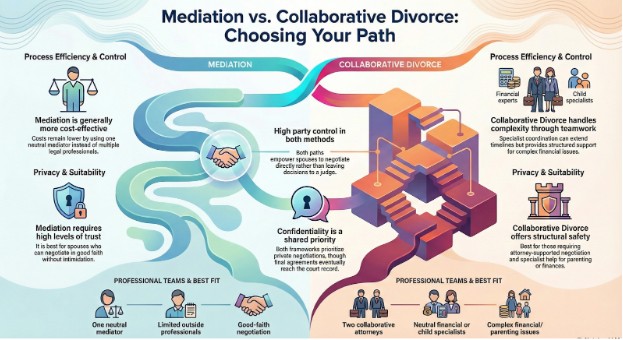
| Factor | Mediation | Collaborative Divorce |
| Cost | Often lower because one neutral mediator leads sessions, and spouses can limit outside professionals | Often higher because each spouse retains a collaborative attorney, and the process may include neutral financial or child specialists |
| Speed | Often faster when spouses exchange documents early and schedule sessions consistently | It can be efficient for complex cases, but team scheduling and specialist coordination can extend the timeline |
| Control | High party control because spouses negotiate directly with the mediator facilitation | High party control with structured attorney support and team input during negotiations |
| Privacy | Negotiations are generally confidential, and mediation communications receive statutory protections under the Illinois Uniform Mediation Act | Negotiations are generally private within the collaborative framework, but final agreements still reach the court record |
| Suitability | Best fit for spouses who can negotiate in good faith without intimidation and who can exchange financial documents voluntarily | Best fit for spouses who want attorney-supported negotiation, added structure, and specialist help for complex parenting or financial issues |
Cooper Trachtenberg Law Group can match case goals to a mediation or collaborative structure, so spouses reduce avoidable delay and conflict. Schedule an appointment.
Mediation costs depend on the mediator’s hours, the number of sessions, and the level of professional review each spouse wants before signing.
Mediation costs rise when spouses arrive unprepared, postpone document exchange, or add issues late in the process.
Collaborative divorce cost depends on attorney time, meeting cadence, and the number of neutral specialists involved.
Collaborative divorce costs rise when a case requires a business valuation, complex compensation analysis, or a detailed parenting plan supported by child-focused professionals.
A spouse who wants a preparation framework that reduces paid meeting time can use a mediation planning checklist, such as mediation preparation.
A collaborative breakdown creates a specific cost risk because the participation agreement may require the withdrawal of collaborative counsel if the process fails. The Illinois Collaborative Process Act defines the withdrawal trigger within the participation agreement definition
Mediation speed improves when spouses exchange financial documents early and batch issues into agenda blocks. Mediation speed slows when spouses treat mediation sessions as discovery rather than decision-making sessions.
Collaborative divorce speed improves when the team uses structured meeting agendas, defined homework assignments, and a single shared financial dataset.
Collaborative divorce speed slows when multiple calendars create long gaps between meetings or when specialists wait on valuations and appraisals.
Court scheduling does not control the pace of mediation, so mediation can move as fast as spouses’ readiness allows.
Court scheduling still affects the filing and approval timeline after settlement, regardless of the negotiation method.
A spouse seeking an Illinois baseline for duration expectations can refer to an Illinois divorce timeline overview.
If you’re ready to get started, call us now!
Mediation confidentiality and privilege protections come from the Illinois Uniform Mediation Act, which defines mediation communications and sets confidentiality and privilege rules with exceptions.
Collaborative divorce emphasizes private negotiation within a defined legal framework, but court filings still exist because court filings finalize divorce terms. Collaborative divorce also concentrates sensitive discussion inside a smaller settlement team rather than open court hearings.
Mediation gives spouses direct control over negotiation because the mediator facilitates without advocating for either spouse.
Collaborative divorce gives spouses the support of negotiated control because each spouse receives attorney guidance during negotiation sessions.
A spouse who wants an attorney-supported settlement structure without trial escalation can explore the firm’s collaborative process approach through collaborative law.
Mediation requires safe, voluntary negotiation because mediation relies on good-faith disclosure and balanced participation.
Mediation can produce unfair outcomes when one spouse controls information, controls access to funds, or uses intimidation.
A spouse should avoid mediation when domestic violence, coercive control, or credible safety concerns prevent free negotiation.
A spouse should also avoid mediation when chronic nondisclosure prevents a reliable financial agreement, because mediation does not grant subpoena power within the mediation room.
A spouse facing financial concealment often needs formal tools that compel disclosure, including the discovery approach described in divorce discovery.
Cooper Trachtenberg Law Group can guide settlement strategy, disclosure, and parenting planning for mediation or collaborative divorce in Illinois. Contact us today.
Illinois divorce mediation uses a neutral mediator to facilitate negotiation, while Illinois collaborative divorce uses collaborative attorneys and a participation agreement under the Illinois Collaborative Process Act.
Mediation often costs less because the process typically involves one mediator and fewer professionals. Collaborative divorce often costs more because each spouse retains a collaborative attorney and may use neutral specialists.
Mediation often moves faster when spouses exchange financial documents early and schedule sessions consistently. Collaborative divorce can be efficient for complex issues, but coordinating attorneys and specialists can extend timelines.
Illinois mediation communications receive confidentiality and privilege protections under the Illinois Uniform Mediation Act, subject to statutory exceptions.
Illinois collaborative divorce typically uses a participation agreement that can require collaborative attorneys to withdraw if the process ends without settlement, which can increase restart costs.
Mediation is a poor fit when domestic violence, coercion, or chronic nondisclosure prevents safe, good-faith negotiation. A spouse facing concealed finances may need formal discovery tools instead.



About the Author
Founder of Cooper Trachtenberg Law Group, LLC · Illinois Family Law Attorney · Certified Mediator · Collaborative Divorce Practitioner
Miriam E. Cooper is the founder of Cooper Trachtenberg Law Group, LLC and an Illinois family law attorney with more than 30 years of experience helping individuals and families navigate divorce, custody, parenting time, child support, spousal maintenance, property division, and post-decree family law matters throughout the Chicago metropolitan area.
A certified mediator and collaborative divorce practitioner, Miriam completed mediation training through Northwestern University and serves clients through mediation, collaborative law, and litigation when necessary. She is also qualified as a Child Representative and Guardian ad Litem, allowing her to provide informed guidance in complex family law disputes involving children and families.
Drawing on more than three decades of family law experience, Miriam regularly advises clients on legal issues affecting Illinois families and is committed to helping clients reach practical, durable resolutions tailored to their unique circumstances.
Practice Areas: Divorce, Mediation, Collaborative Divorce, Child Custody, Parenting Time, Child Support, Spousal Maintenance, Property Division, Post-Decree Matters
Practice Areas
Legal Support When You Need It Most
Testimonials



Main Office
3601 Algonquin Road, Suite 610
Rolling Meadows, Illinois 60008
Lincolnshire Office
250 Parkway Drive, Suite 150
Lincolnshire, IL 60069
By Appointment Only
Phone:
847-995-8800


We represent parties across the Chicago area, including Arlington Heights, Barrington, Buffalo Grove, Carol Stream, Evanston, Glenview, Highland Park, Hinsdale, Inverness, Lincolnshire, Long Grove, Mt. Prospect, Palatine, Rolling Meadows, Schaumburg, Skokie, Streamwood, Wheeling and more. We also represent clients from Cook, Lake, DuPage, Kane and McHenry counties.
© 2026 by Cooper Trachtenberg Law Group, LLC. All Rights Reserved.
Disclaimer |
Site Map
