

Getting divorced is tough enough, but ignoring court orders during an Illinois divorce can make things spiral out of control.
Some people think they can skirt the rules or put things off when emotions flare, but Illinois courts don’t see it that way.
When someone violates a court order in an Illinois divorce, they risk immediate consequences, including fines, wage garnishment, asset seizure, or even jail.
The courts have a lot of ways to enforce orders, and they’re not shy about using them.
It doesn’t matter if the order is about child support, parenting time, or splitting up property—violating it can seriously hurt your credibility and your case down the line.
People who know what can happen when they ignore court orders usually make better choices.
The fallout can be massive, from legal trouble and money woes to losing credibility or future custody rights.
Not every court document in a divorce packs the same punch. A court order becomes enforceable only if it complies with certain rules regarding timing, proper service, and clear instructions for both parties.
Illinois courts hand down three main types of enforceable orders during a divorce. Each serves a different purpose and comes with its own timing.
Temporary orders keep things running while the divorce is ongoing. These typically cover child support, spousal maintenance, and custody arrangements for the children. They stick around until the judge finalizes the divorce.
Final orders show up with the divorce decree. The judgment for dissolution of marriage outlines who gets what, who pays support, and how custody arrangements will be implemented.
Post-judgment orders tweak or clarify the original divorce decree. Courts use these if something changes or if someone needs help enforcing what’s already there.
Once the court properly enters any of these orders, they all carry the same weight in terms of enforcement.
The court can’t enforce an order until the right person is actually aware of it. Illinois law outlines the steps for giving notice before anything else happens.
Service requirements depend on the order. Temporary orders usually require personal delivery by a sheriff or process server, while others may be sent by certified mail or published if necessary.
Notice that timing is critical. You can’t violate an order you never saw. Judges need proof that you got the paperwork before they’ll slap you with contempt.
The entry date refers to when the judge signs the order, making it official. Orders become enforceable then, not when you get them—though you can’t get in trouble until you’ve been notified.
Many Illinois counties now use electronic filing, so parties receive automatic notice quickly.
Badly written court orders just slow everything down. If the wording’s unclear, both sides can end up confused about what they’re supposed to do.
Vague language makes enforcing orders a headache. It’s way easier to enforce “every other weekend from Friday at 6 PM to Sunday at 6 PM” than “reasonable visitation.”
Missing details—such as how to pay, where to meet, or deadlines—spark arguments. Orders should specify who is responsible for what, when, where, and for what amount.
Conflicting provisions inside the same order just create chaos. Everything in a divorce decree needs to work together, not against itself.
Courts often want parties to document violations with solid evidence. Clear orders make it that much easier.
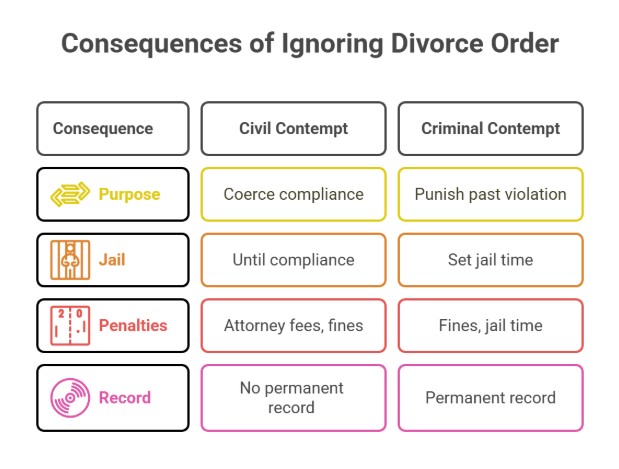
If you ignore a divorce court order in Illinois, serious consequences can ensue. These include contempt-of-court charges, financial penalties, and possibly even jail. Judges don’t mess around when it comes to protecting people’s rights.
Illinois courts use two types of contempt when someone fails to comply with a divorce order. Civil contempt is used to get the person to follow the order.
Civil Contempt Actions:
Criminal Contempt Actions:
Most divorce cases see civil contempt. Judges want people to start following the rules, not just punish them for slipping up.
Legal penalties can be severe for either type. Criminal contempt can leave you with a permanent record, which is very problematic.
If you willfully ignore divorce orders, courts often make you pay your ex’s attorney fees. That’s on top of any other penalties.
Common Financial Sanctions Include:
Judges look at whether you broke the rules on purpose. If you did, expect the fines to sting a lot more than if it were an honest mistake.
These costs pile up fast. Just going to court for contempt can run from a few hundred to several thousand dollars in attorney fees.
Some judges tack on daily fines until you get in line. That kind of pressure can get expensive real quick.
Illinois courts typically respond to violations of a divorce order within a few days or weeks of someone filing a motion for contempt. They take these matters seriously and move enforcement to the highest priority.
Typical Timeline for Court Action:
Emergencies—such as hiding kids or refusing to pay support—get lightning-fast attention. The court might issue temporary orders in just a few hours.
Nonemergencies move quickly. Most contempt hearings occur within a month of the motion’s filing.
Once the judge finds contempt, enforcement begins immediately. Deputies can even arrest people in the courtroom if jail time’s ordered.
This table clarifies the differences between civil and criminal contempt, helping readers understand potential outcomes and how to purge contempt.
| Aspect | Civil Contempt (Coercive) | Criminal Contempt (Punitive) |
| Primary Goal | Force compliance with a current order | Punish past willful defiance |
| Trigger | Ongoing, remediable violation | Completed, intentional violation |
| Burden/Proof | Clear and convincing evidence of noncompliance | Beyond a reasonable doubt (due process safeguards) |
| Sanctions | Fines, conditional jail with purge | Fixed fines or fixed jail term |
| Purge Condition | Yes (e.g., pay amount, turnover documents) | No purge; sentence served |
| Typical Use Cases | Support arrears, turnover orders, and parenting time | Repeated, egregious defiance; courtroom misconduct |
| Appeal/Review | Ongoing court control while noncompliance persists | Appeals like a criminal sentence |
Cooper Trachtenberg Law Group can step in fast when missed payments, denied parenting time, or contempt threats put you at risk. Protect yourself before consequences escalate. Contact us now.
Illinois courts have a whole toolbox for dealing with parents or spouses who ignore divorce orders. They can garnish wages, seize assets, or even send repeat offenders to jail.
Illinois courts take child support enforcement seriously when parents skip payments. The state doesn’t hesitate to use every trick in the book to collect unpaid support.
Income-Based Collection Methods:
If someone consistently avoids payments, the court can suspend their professional licenses. This isn’t just driver’s licenses—it can include business licenses and professional certificates.
Contempt of court charges can include fines and jail for willful non-payment. A parent could face up to six months in jail for each violation.
Credit reporting agencies get notified about missed payments, which tanks your credit score and makes loans or housing tough to get.
The state can slap liens on your house or other property. You can’t sell or transfer those assets until you pay off the support you owe.
Courts handle parenting time violations differently than they do financial obligations. Parenting time and child support are separate issues with their own enforcement methods.
If a parent denies court-ordered visitation, the other parent can file a contempt petition. The court might order make-up time to cover missed visits.
Common Enforcement Remedies:
The court rarely changes custody just because of a parenting time violation. Still, if a parent keeps interfering with visitation, it can sway future custody decisions.
Parents who repeatedly break parenting orders may lose some decision-making authority. Judges can limit their involvement in major decisions about the child’s school, healthcare, or activities.
When it comes to property division, courts focus on ensuring compliance with asset transfer orders. Judges use turnover orders to compel spouses to hand over specific assets or accounts.
If someone hides assets or refuses to transfer property, judges can issue body attachments. That means law enforcement can arrest the non-compliant spouse and bring them into court.
Asset Recovery Tools:
The court can appoint receivers to manage disputed assets. These court officers step in when spouses are unable to cooperate.
If a spouse willfully disobeys property orders, they can face contempt charges. Penalties may include daily fines until they comply, or even jail time if the refusal continues.
Judges sometimes award attorney fees to the spouse who followed the rules. That way, the violator covers the legal costs.
The matrix maps common violations to the enforcement tools Illinois courts and agencies use to compel compliance.
| Order Type | Common Violation | Core Enforcement Tool | Secondary Tool | Possible Outcome |
| Child Support | Missed/late payments | Income withholding | Tax refund intercept | Arrears reduced; interest/fees added |
| Maintenance | Nonpayment | Wage withholding | Bank levy | Lump-sum catch-up or payment plan |
| Parenting Time | Denied exchanges | Make-up time order | Supervised exchanges | Restoration of time; compliance plan |
| Decision-Making | Unilateral decisions | Clarified allocation order | Mediation directive | Enforced decision roles |
| Property Division | Refusal to transfer assets | Turnover order | Special commissioner | Asset transfer completed |
| Fees/Costs | Ignoring the fee award | Contempt sanctions | Lien on assets | Payment or asset encumbrance |
| Repeated Violations | Patterned interference | Sanctions; reallocation request | Attorney’s fees | Allocation changes; penalties |
Yes, you can actually face jail time for ignoring court orders in Illinois divorce cases. Courts don’t take these violations lightly.
If someone disobeys a court order, a judge can hold them in contempt of court. That opens the door to some harsh penalties.
Possible consequences include:
Ignoring court orders can result in serious consequences such as fines, wage garnishment, or even jail time. Courts have considerable power to make sure their orders are enforced.
Jail time is most common for:
Illinois courts take custody violations seriously and may penalize parents who fail to follow court orders. In extreme cases, jail time happens.
The length of jail time really depends on the violation. First-time offenders might get shorter sentences than repeat offenders.
Judges often try other penalties first, like fines or classes, before sending someone to jail.
Some violations lead to immediate jail time. If someone kidnaps a child or flat-out refuses to pay support, police can arrest them pretty quickly.
The consequences of contempt can be severe for people who ignore divorce court orders. It’s much better to get legal help than to just ignore an order you don’t like.
If you truly can’t meet a court order’s requirements, Illinois law gives you a way to ask for help. The key is proving there’s been a substantial change in circumstances and deciding if you need a permanent modification or a temporary pause on enforcement.
Illinois courts require a substantial change in circumstances before they’ll modify divorce orders. The change must be significant compared to the order when the judge first made it.
The change also needs to be permanent, not just a blip. Losing a job for a couple of weeks won’t cut it, but a serious illness that knocks you out of work for months might.
Courts look for changes that weren’t expected when the order was made. If you knew a job loss was coming, it would be harder to get a modification.
Common substantial changes include:
If you want a change, you have to prove it with solid evidence. What happens if you can’t fulfill a court order really depends on whether you can show this substantial change.
A Motion to Modify asks the court to permanently change the order. That’s the move for long-term changes, and the new order replaces the old one.
A Motion to Stay Enforcement is for temporary problems. It puts enforcement on hold while you sort things out.
| Motion Type | When to Use | Result |
| Modify | Permanent changes | New permanent order |
| Stay | Temporary issues | Pause enforcement temporarily |
If you’re facing immediate enforcement orders like wage garnishment, consider filing a stay motion first. That buys you time to get your modification request together.
To get a stay, you have to show that enforcement will cause immediate harm. Courts don’t grant these often because it affects the other party’s rights.
Strong evidence is what wins modification cases. You need more than just stories about financial hardship—the court wants proof.
Income documentation should include:
Your medical evidence needs to show how health problems keep you from working or paying. A simple doctor’s note isn’t enough. The records should explain your limitations and how long they’ll last.
Employment documentation proves your job loss wasn’t your fault. Collect termination letters, company closure notices, or job search records.
Communication evidence includes:
Courts want to see that you tried to work things out before you filed motions. Good records show you acted responsibly when things got tough.
If your ex ignores court orders, filing a Petition for Contempt might be your best shot. Success depends on having clear evidence, understanding what you have to prove, and following the right court procedures in time.
A Rule to Show Cause forces the violating party to show up in court and explain why they shouldn’t be held in contempt. The person filing needs to prove three main things.
The original order has to be clear and leave no wiggle room. Vague language can really sink your case.
The other party must have known about the order. You can usually prove this by:
You have to show the violation was intentional, not due to circumstances beyond their control. Just being broke isn’t always enough to make a support order violation willful.
Documentation Requirements
How you organize your evidence can really make a difference in contempt cases. Family lawyers can help enforce court orders through contempt actions by laying out evidence in a way that’s easy for the judge to follow.
| Exhibit | Content | Purpose |
| A | Original court order | Establishes a legal obligation |
| B | Service documentation | Proves knowledge |
| C | Violation evidence | Shows specific breaches |
| D | Communication records | Demonstrates willful defiance |
Keep records in order, with dates and times. Screenshots should show full conversations with timestamps. If you have third-party witnesses, that’s even better.
Illinois courts follow a set process for contempt cases. Knowing what to expect makes the whole thing less overwhelming.
After you file the petition, the court issues a summons. The other party must be served personally, which usually takes about a week or two, depending on how easy they are to find.
Illinois law gives at least 21 days’ notice before the hearing. Most hearings get set about 3-4 weeks out because court schedules are packed.
For urgent stuff—like child abduction or immediate safety issues—emergency hearings can happen within a day or two.
Factors Affecting Timeline
Most contempt cases wrap up within 60-90 days from the first filing to the final order.
If you’re overwhelmed by violations, penalties, or unclear court demands, Cooper Trachtenberg Law Group can break down your options and help you. Schedule an appointment.
Violating a court order can shake up parenting arrangements and custody decisions in Illinois. Illinois courts focus on the child’s best interests and often closely examine each parent’s track record of complying with court orders.
If a parent repeatedly violates court orders, the judge might cut their parenting time or limit their decision-making authority. Illinois family courts consider how well parents follow the rules when deciding custody.
Key factors courts consider include:
Judges check if a parent’s violations indicate they’re putting themselves ahead of the child. If parents continue to ignore orders, they might lose overnight visits or miss out on holidays.
Courts can change parenting arrangements if violations show that the current arrangement isn’t in the child’s best interests. Even small violations, if they keep happening, can add up and become significant.
When one parent consistently violates parenting time, Illinois courts have several ways to intervene. Denying or interfering with parenting time violates custody orders and can lead to swift legal consequences.
Common violations include:
Courts can order makeup parenting time, counseling, or mediation, and sometimes hold the violating parent in contempt. If violations keep happening, the parent might lose parenting time or have to undergo supervised visits.
The parent breaking the order might also have to pay fines or cover the other parent’s legal fees. In the worst cases, the judge could even switch primary custody to the parent who follows the rules.
Technology and structure help reduce conflict and ensure everyone follows court orders. Many Illinois families use parenting apps to track exchanges and communication.
Helpful tools include:
These tools give courts a clear paper trail if someone breaks the rules. Parenting time schedules are enforceable, and good documentation makes it much easier to prove non-compliance.
Neutral exchanges—like meeting at school or a public place—take the edge off and keep things calmer for the kids. Parents have fewer chances to argue or break court orders this way.
Clear schedules help avoid mix-ups about pickup times and locations. Written records keep both parents on track with what the court expects.
Ignoring court orders in Illinois divorce cases can increase your expenses. The state uses license suspensions, credit reporting, and wage garnishment to encourage people to pay support or other court-ordered payments.
If you fall behind on child support or spousal support, Illinois will suspend your driver’s license automatically. You don’t get a hearing first—they just do it.
Driver’s License Suspension Process:
Professional licenses are at risk, too. Doctors, lawyers, real estate agents—anyone with a permit can lose their ability to work if they ignore divorce court orders.
The Illinois Department of Professional Regulation teams up with family courts to find people who aren’t complying. Losing your license for ignoring court orders can make it even harder to catch up on payments.
Some folks only find out their license is suspended when they get pulled over or try to renew. By then, late fees and penalties have piled up.
When you don’t pay support, the state slaps liens on your property—houses, cars, whatever. These liens show up on your credit report and block you from selling or refinancing property.
Common Enforcement Methods:
Credit bureaus get regular updates about unpaid support. These marks stick around for seven years after you finally pay off the debt.
It’s not just the support showing up—late payments, collections, and public records all hit your credit too.
Once you fall behind, wage garnishment starts without another court hearing. Employers must follow these orders, or they get in trouble, too.
Unpaid support accrues interest at 9% per year in Illinois and compounds monthly. The court won’t forgive this interest.
Cost Breakdown:
Courts can order retroactive support back to when you first filed. That can mean a huge lump sum —and yes, it earns interest, too.
If you end up in contempt proceedings, you’ll pay your attorney and the other side’s legal fees. Collection agencies might become involved with really old debts and tack on their own fees.
Most of the time, you can’t wipe out this debt in bankruptcy. Ignoring court orders comes with long-term financial fallout that can stick with you for decades.
| Violation | Court/Agency Tool | Collateral Consequence | Notes |
| Persistent support arrears | Income withholding, contempt | Credit reporting, interest accrual | Interest may compound; fees awarded |
| Willful nonpayment | License suspension | Loss of driver/professional license | Reinstatement often requires a payment plan |
| Ignoring the turnover order | Contempt; body attachment | Brief incarceration risk | Purge by complying with turnover |
| Tax refund season arrears | Intercept program | Loss of refund | Applied to arrears first |
| Repeated parenting denial | Make-up time; reallocation motion | Reduced discretion; supervised exchanges | Patterns matter more than one-offs |
| Nonpayment + evasion | Bank levy; liens | Frozen accounts; asset encumbrance | The court may award attorney’s fees |
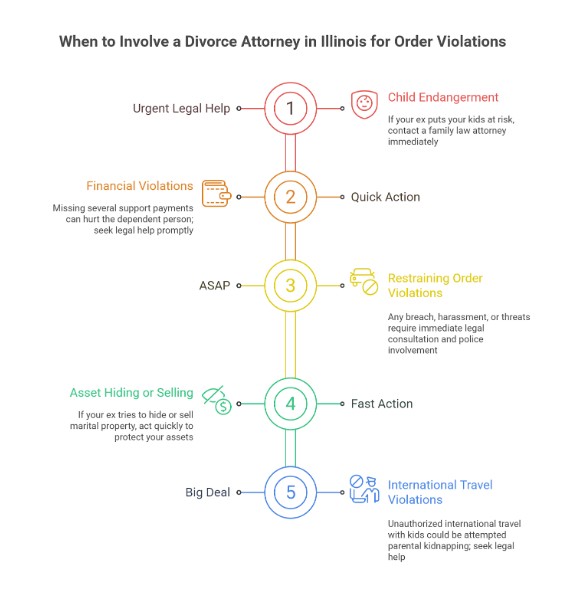
Sometimes, you need a lawyer right away. Other times, it’s better to think things through and plan.
A family law attorney is crucial if you’re facing complex enforcement issues, contempt charges, or need to change a court order.
Child endangerment calls for urgent legal help. If your ex puts your kids at risk—dangerous situations, drugs, bad supervision—call a family law attorney right away.
Financial violations that put basic needs at risk also require quick action. Missing several child or spousal support payments can really hurt the person who depends on that money.
Restraining order violations are serious. Any breach, harassment, or threats mean you should talk to a lawyer ASAP—and maybe call the police.
Asset hiding or selling during property division? Don’t wait. If your ex tries to hide or sell marital property against court orders, acting fast can keep you from losing out for good.
International travel violations with kids are a big deal. If a parent takes children out of state or country without permission, it could be attempted parental kidnapping.
Here are situations where you really need same-day legal advice:
A family law attorney can help you figure out the best move for each violation. Sometimes, settlement talks resolve minor issues without dragging everyone into court, saving money and keeping things civil.
Enforcement actions are taken when someone keeps breaking the rules intentionally. Attorneys can file contempt petitions that may result in fines, wage garnishment, or even jail for the violator.
Order modifications are for when life changes—maybe someone lost their job, moved, or got sick. Sometimes, it’s better to update support or custody orders than go after punishment.
When recommending a strategy, attorneys look at:
Cost-benefit analysis matters too. Sometimes it costs more to fight a minor violation than it’s worth, but big violations need strong action to keep things from getting worse.
When you have professional legal representation, you obtain proper documentation and procedural compliance. Family law attorneys draft petitions for a rule to show cause that clearly outline violations and requested remedies.
Attorneys handle evidence gathering with the kind of legal expertise courts expect. They know which documents, witness statements, and financial records will actually support contempt motions.
For hearing preparation, attorneys coach clients on testimony and courtroom behavior. Judges want clear, factual presentations—no emotional outbursts or personal attacks on the ex-spouse.
Attorneys take care of critical procedural requirements:
With courtroom advocacy, you get a real advantage over going it alone. Experienced attorneys understand judges’ preferences and can present compelling arguments for enforcement or sanctions.
After the hearing, there’s often more legal work. Attorneys ensure the court enters proper orders and assist with collection efforts if the court awards monetary judgments.
Repeated court-order problems can threaten parenting time, finances, and your future. Cooper Trachtenberg Law Group can help you regain control and stop ongoing damage today. Contact us.
What happens if I ignore a divorce court order in Illinois?
Ignoring a valid divorce order can trigger civil or criminal contempt, fines, fee awards, wage withholding, license suspensions, and even short jail terms. Judges may also change parenting time or decision-making if violations harm a child or show ongoing refusal to follow court directives.
Can I go to jail for noncompliance with child support or property orders?
Yes, if the court finds willful noncompliance and lesser sanctions fail. Civil contempt jail typically includes a purge condition—release upon payment or action. Criminal contempt punishes past defiance and may include fixed jail terms after due process, especially for repeated, intentional violations.
How quickly will the court act after a violation?
Timelines vary by county and docket, but urgent issues—missed parenting exchanges, support nonpayment, or property turnover—can move quickly once you file a Petition for Rule to Show Cause with supporting evidence. Courts prioritize child-impact cases and clear, ongoing violations demonstrating willful disobedience.
What if I genuinely can’t comply with the order?
Act immediately. Document the obstacle, stay partially compliant where possible, and file to modify or stay enforcement based on a substantial change in circumstances. Judges look for prompt filings, candor, and evidence. Delay, evasive behavior, or silence increases contempt risk and attorney’s fee exposure.
How do I enforce an order when my ex refuses to comply?
File a Petition for Rule to Show Cause showing a valid order, notice, a clear violation, and probable willfulness. Attach exhibits—messages, receipts, exchange logs, payment records. Remedies often include compliance deadlines, make-up parenting time, fee shifting, and sanctions. Repeat violations may justify allocation changes.
Will violations affect parenting time and decision-making?
Yes. Repeated interference, late exchanges, or refusal to co-parent undermines credibility and the child’s best interests. Courts may order make-up time, supervised exchanges, detailed schedules, or change decision-making. A parent who consistently fosters the child’s relationship—and follows orders—generally fares better in future allocations.
Can my driver’s or professional license be suspended for nonpayment?
Yes. Persistent, willful nonpayment can trigger driver’s and professional license suspensions, liens, credit reporting, and tax refund intercepts. Courts can also order bank levies, property liens, and interest on arrears, along with attorney’s fees for the party forced to pursue enforcement.
What evidence should I keep for an enforcement or defense?
Maintain a contemporaneous log of deadlines, exchanges, and payments; archive messages and emails; save receipts, payroll records, and bank statements; confirm key points in writing through a co-parenting app. Organized, timestamped evidence strengthens enforcement petitions and helps rebut claims of willful noncompliance.



About the Author
Founder of Cooper Trachtenberg Law Group, LLC · Illinois Family Law Attorney · Certified Mediator · Collaborative Divorce Practitioner
Miriam E. Cooper is the founder of Cooper Trachtenberg Law Group, LLC and an Illinois family law attorney with more than 30 years of experience helping individuals and families navigate divorce, custody, parenting time, child support, spousal maintenance, property division, and post-decree family law matters throughout the Chicago metropolitan area.
A certified mediator and collaborative divorce practitioner, Miriam completed mediation training through Northwestern University and serves clients through mediation, collaborative law, and litigation when necessary. She is also qualified as a Child Representative and Guardian ad Litem, allowing her to provide informed guidance in complex family law disputes involving children and families.
Drawing on more than three decades of family law experience, Miriam regularly advises clients on legal issues affecting Illinois families and is committed to helping clients reach practical, durable resolutions tailored to their unique circumstances.
Practice Areas: Divorce, Mediation, Collaborative Divorce, Child Custody, Parenting Time, Child Support, Spousal Maintenance, Property Division, Post-Decree Matters
Practice Areas
Legal Support When You Need It Most
Testimonials



Main Office
3601 Algonquin Road, Suite 610
Rolling Meadows, Illinois 60008
Lincolnshire Office
250 Parkway Drive, Suite 150
Lincolnshire, IL 60069
By Appointment Only
Phone:
847-995-8800


We represent parties across the Chicago area, including Arlington Heights, Barrington, Buffalo Grove, Carol Stream, Evanston, Glenview, Highland Park, Hinsdale, Inverness, Lincolnshire, Long Grove, Mt. Prospect, Palatine, Rolling Meadows, Schaumburg, Skokie, Streamwood, Wheeling and more. We also represent clients from Cook, Lake, DuPage, Kane and McHenry counties.
© 2026 by Cooper Trachtenberg Law Group, LLC. All Rights Reserved.
Disclaimer |
Site Map
